Cement plants endure some of the harshest operational conditions in heavy industry—extreme temperatures exceeding 1450°C in the kiln zone, constant vibration from rotating equipment, corrosive dust exposure, and chemical attack from process byproducts. Studies reveal that many industrial cement facilities across the globe are now over 40 years old, with structures approaching the mid-to-late stages of their service life where deterioration accelerates exponentially. A recent conditioning tower inspection at a major cement plant uncovered approximately 28% steel plate thickness loss throughout the structure, highlighting how quickly structural degradation can compromise safety when left unmonitored. Traditional inspection methods that rely solely on manual walkthroughs miss 60% of subsurface defects until visible damage manifests—by then, repair costs have typically multiplied by 8x compared to early intervention. Modern cement operations now integrate digital CMMS platforms to systematically schedule structural inspections, track deterioration trends across assets, and trigger maintenance workflows before failures occur. Sign up for Oxmaint to establish a structured inspection program that transforms reactive structural repairs into predictive maintenance intelligence.
Cement Plant Structural Integrity Assessment and Maintenance
Protect critical infrastructure through systematic evaluation, condition monitoring, and proactive repair strategies that prevent catastrophic failures and extend asset life by decades.
Critical Structural Elements in Cement Plant Operations
Every cement plant contains dozens of interconnected structural systems, each exposed to unique environmental stresses and failure mechanisms. Understanding which elements demand priority attention allows maintenance teams to allocate inspection resources efficiently and prevent cascading failures that halt production. Schedule a consultation to learn how digital inspection programs identify structural risks before they escalate.
Kiln Support Structures
Reinforced concrete piers and steel frames supporting rotary kilns experience continuous thermal cycling from 200°C to 350°C surface temperatures. Thermal stress induces micro-cracking that accelerates carbonation penetration and rebar corrosion, demanding inspection every 12 months.
High PriorityPreheater Towers
Multi-story steel frame structures reaching 80-120 meters in height are subject to wind loading, thermal expansion differentials, and cyclone dust buildup. Connection points between stages require ultrasonic thickness testing annually to detect hidden corrosion beneath insulation.
Critical HeightClinker Silos
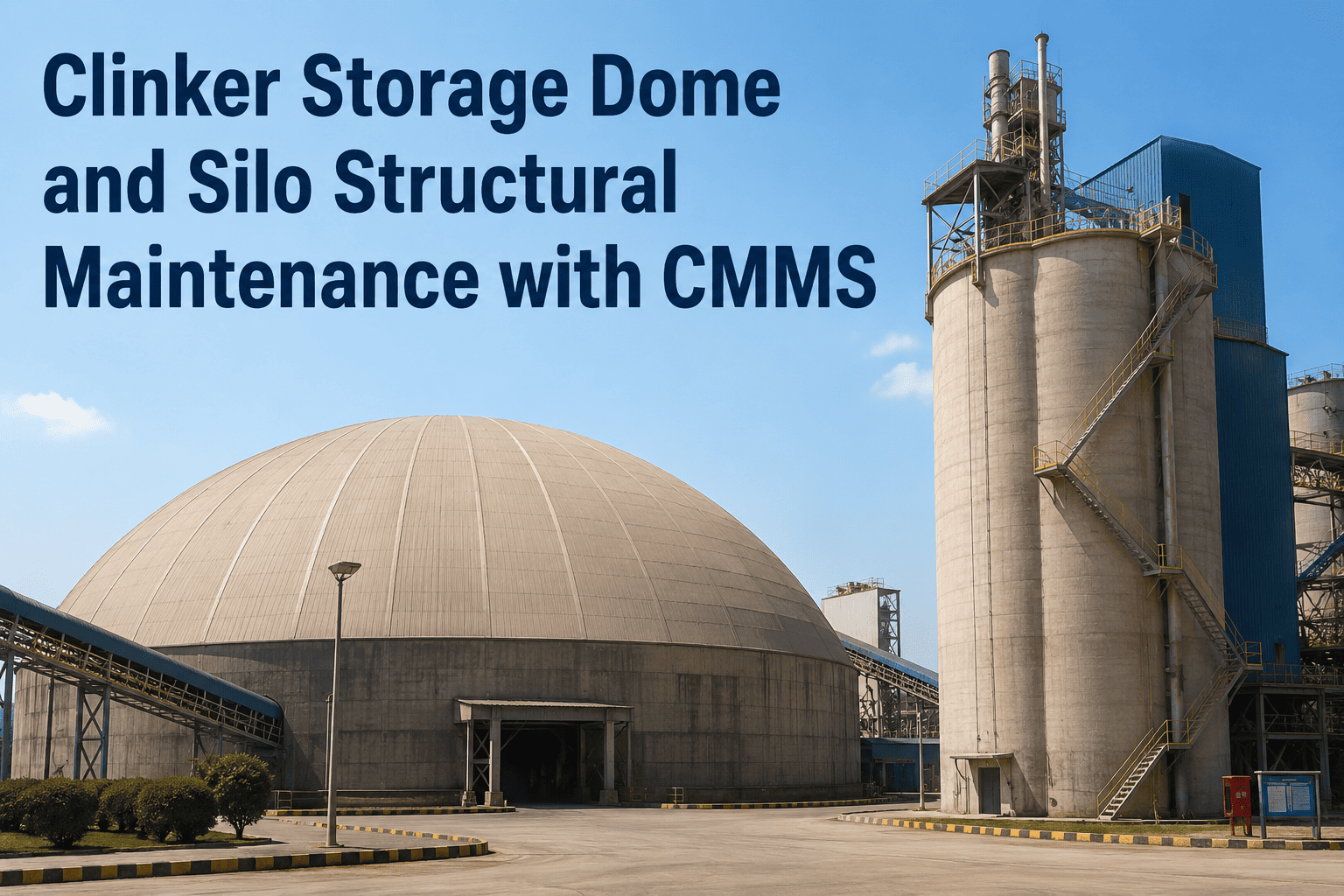
Concrete storage silos face abrasion from clinker discharge, thermal shock from hot material intake, and chemical attack from alkali-silica reactions. Delamination and vertical cracking indicate structural distress that can lead to catastrophic wall failure if not addressed.
Storage CriticalRaw Mill Foundations
Vertical roller mills and ball mills generate significant dynamic loads that transfer through foundations. Settlement, cracking, and anchor bolt loosening compromise equipment alignment and accelerate bearing wear, requiring annual settlement monitoring and vibration analysis.
Dynamic LoadConveyor Galleries
Elevated conveyor support structures spanning hundreds of meters experience cyclic loading from belt operation and environmental exposure. Steel corrosion beneath accumulated dust and concrete spalling at connection points create hidden failure pathways.
Extended SpanCooling Towers
Evaporative cooling structures endure constant moisture exposure, chemical treatment residues, and thermal gradients that accelerate concrete deterioration and steel corrosion. Annual inspections must assess fill media support integrity and basin floor conditions.
Moisture ZoneDeterioration Mechanisms Affecting Cement Plant Structures
Structural degradation in cement environments follows predictable patterns driven by specific chemical, thermal, and mechanical stressors. Identifying the dominant deterioration mechanism for each structure enables targeted inspection protocols and appropriate repair materials. Leading cement operations integrate asset lifecycle tracking to monitor how degradation progresses over time—explore how cement plant asset lifecycle management with CMMS creates longitudinal condition records that inform capital planning decisions.
Carbonation-Induced Corrosion
Atmospheric CO₂ penetrates concrete cover and reacts with calcium hydroxide in cement paste, reducing pH from ~13 to ~9. When the carbonation front reaches reinforcement depth, protective passivation breaks down, initiating steel corrosion that generates expansive rust products causing cracking and spalling.
Chloride Attack
Chloride ions from coastal environments, process chemicals, or contaminated aggregates penetrate concrete and accumulate at reinforcement level. Once chloride concentration exceeds threshold (typically 0.4% by cement weight), localized pitting corrosion initiates regardless of concrete pH.
Sulfate Degradation
External sulfates from groundwater, soil, or industrial effluent react with cement paste components to form expansive ettringite and gypsum crystals. This expansion generates internal stresses exceeding concrete tensile strength, causing characteristic map cracking and surface disintegration.
Thermal Cycling Damage
Repeated heating and cooling cycles induce differential expansion between concrete and steel reinforcement, aggregate and paste matrix, and outer and inner surfaces. Accumulated micro-cracking from thermal stress creates penetration pathways for moisture and aggressive chemicals.
Abrasion and Erosion
High-velocity material flow, clinker impact, and dust-laden air streams physically remove concrete surface material over time. Silos, chutes, cyclones, and ductwork experience progressive section loss that eventually compromises structural capacity and containment integrity.
Alkali-Silica Reaction
Alkali hydroxides in cement paste react with reactive silica in certain aggregates, forming expansive gel that absorbs moisture and generates destructive internal pressure. ASR produces characteristic pattern cracking with gel exudate visible at crack intersections.
Digitize Your Structural Inspection Program
Transform paper-based inspection checklists into digital workflows that capture photo evidence, track deterioration trends, and automatically generate maintenance work orders when thresholds are exceeded.
Non-Destructive Testing Methods for Structural Assessment
Modern structural evaluation combines multiple NDT techniques to build comprehensive condition profiles without damaging the asset. Each method reveals different aspects of structural health—surface defects, internal voids, reinforcement condition, and material strength—enabling engineers to prioritize interventions based on severity and safety implications. Book a demo to see how Oxmaint tracks NDT results over time and triggers alerts when measurements indicate accelerating deterioration.
Visual Inspection
Systematic examination of exposed surfaces for cracks, spalling, staining, efflorescence, and deformation. The most fundamental technique that costs least and reveals most, providing pattern recognition that guides targeted testing. Requires experienced inspectors familiar with cement plant environments.
Ultrasonic Thickness Testing
High-frequency sound waves measure remaining wall thickness in steel structures and detect internal voids in concrete. Essential for assessing conditioning towers, ductwork, and steel frames where corrosion occurs beneath insulation or coatings invisible to visual inspection.
Ground Penetrating Radar
Electromagnetic pulses detect reinforcement location, concrete cover depth, voids, and delamination without surface contact. Provides rapid scanning of large areas to identify zones requiring detailed investigation, particularly effective for floor slabs and elevated decks.
Infrared Thermography
Thermal imaging cameras detect temperature variations indicating moisture intrusion, delamination, and heat loss pathways. Non-contact technique ideal for inspecting elevated structures, detecting insulation failures, and identifying active water ingress locations.
Half-Cell Potential Mapping
Electrochemical technique measures corrosion probability of embedded reinforcement by detecting potential differences on concrete surface. Maps corrosion activity across large areas to prioritize repair zones before visible damage manifests externally.
Core Extraction and Testing
Physical removal of concrete cylinders for laboratory analysis of compressive strength, chloride content, carbonation depth, and petrographic examination. Provides definitive material property data for structural capacity calculations and repair material selection.
Structured Inspection Program Framework
Effective structural maintenance requires systematic inspection protocols scaled to asset criticality, environmental severity, and operational constraints. Industry standards recommend routine visual inspections every 2 years and detailed engineering assessments every 5-6 years for structures in aggressive environments—frequencies that should increase when deterioration is detected or when structures approach design life. Request a demo to see how Oxmaint automates inspection scheduling based on asset criticality and condition history.
Asset Inventory and Classification
Document all structural assets with construction date, design specifications, exposure conditions, and historical repair records. Classify assets by criticality level based on failure consequences—production impact, safety exposure, and environmental risk.
- Create digital asset register with location mapping
- Assign criticality ratings (A/B/C classification)
- Establish baseline inspection frequencies
Routine Visual Inspection
Conduct systematic walkthroughs of all structural assets at defined intervals. Inspectors follow standardized checklists capturing crack patterns, spalling, staining, deflection, and settlement with photo documentation linked to specific locations.
- Annual inspections for critical assets
- Biennial inspections for standard assets
- Digital capture with GPS location tagging
Detailed Engineering Assessment
Deploy NDT specialists to evaluate structures flagged during routine inspections or approaching assessment intervals. Testing scope includes ultrasonic measurement, cover depth surveys, half-cell mapping, and core extraction as required.
- 5-6 year intervals for stable structures
- Triggered assessments when defects detected
- Structural capacity verification calculations
Remediation Planning and Execution
Engineering analysis determines appropriate repair strategies—patch repairs, cathodic protection, structural strengthening, or replacement. Work orders integrate with maintenance schedules to minimize production impact while addressing safety priorities.
- Prioritized repair sequencing by risk
- Contractor qualification verification
- Quality assurance during execution
Continuous Monitoring and Trend Analysis
Integrate inspection findings into centralized database tracking deterioration progression over time. Trend analysis identifies accelerating degradation requiring intervention and validates repair effectiveness through post-repair monitoring.
- Longitudinal condition trend visualization
- Alert thresholds for critical parameters
- Capital planning integration for replacements
Digital Transformation of Structural Maintenance
Paper-based inspection records create information silos that prevent trend analysis, delay decision-making, and lose institutional knowledge when personnel change. Modern CMMS platforms digitize the entire structural maintenance workflow—from inspection scheduling through work order completion—creating searchable databases that reveal patterns invisible in paper archives. Safety management integration ensures structural findings connect to broader HSE programs—learn how digital HSE platforms for cement plants create unified risk visibility across structural, operational, and process safety domains.
Inspection Efficiency
Mobile inspection apps with offline capability for remote plant areas
Photo documentation linked to asset records with GPS coordinates
Standardized checklists ensuring consistent evaluation across inspectors
Voice-to-text notes eliminating manual transcription delays
Data Intelligence
Longitudinal trend tracking showing deterioration rate over years
Alert thresholds triggering work orders when parameters exceed limits
Portfolio-wide risk dashboards identifying highest-priority structures
AI-powered prediction models forecasting remaining service life
Workflow Automation
Automatic work order generation from inspection findings
Contractor assignment with qualification verification
Budget tracking and variance reporting for capital projects
Compliance documentation for regulatory audit requirements
Transform Structural Maintenance into Competitive Advantage
Plants using digital structural integrity programs reduce emergency repair costs by 45% and extend asset service life by an average of 15 years through proactive intervention. Book a demo to see how Oxmaint creates actionable intelligence from inspection data.
Frequently Asked Questions
How often should cement plant structures undergo structural integrity assessments?
Industry standards recommend routine visual inspections every 1-2 years for critical structures like kiln supports and preheater towers, with comprehensive engineering assessments every 5-6 years. Structures in aggressive environments (high temperature zones, chemical exposure areas) or showing active deterioration should be inspected more frequently. Structures approaching their original design life warrant annual detailed assessments until replacement or major rehabilitation is completed.
What are the primary warning signs that indicate structural integrity concerns in cement plants?
Key indicators include visible cracking (especially pattern cracking or cracks wider than 0.3mm), concrete spalling exposing reinforcement, rust staining on concrete surfaces, efflorescence deposits, settlement or tilting of vertical structures, unusual vibration or movement during operation, and water penetration through joints or cracks. Steel structures may show coating failure, surface pitting, section loss, and connection loosening. Any of these findings warrant immediate engineering evaluation.
What non-destructive testing methods are most effective for cement plant structural assessment?
Visual inspection remains foundational but should be supplemented with ultrasonic thickness measurement for steel structures, ground-penetrating radar for reinforcement mapping and void detection, half-cell potential mapping for corrosion activity assessment, infrared thermography for moisture and delamination detection, and rebound hammer testing for concrete surface hardness. Core extraction provides definitive material properties but is limited to strategic sampling locations. The optimal testing combination depends on structure type and suspected deterioration mechanism.
How does thermal cycling affect structural integrity in cement kiln support areas?
Repeated heating and cooling cycles induce differential thermal expansion between concrete and embedded steel reinforcement, between aggregate particles and cement paste, and between outer and inner concrete surfaces. This generates micro-cracking that accumulates over thousands of cycles, creating pathways for moisture and chemical penetration that accelerate carbonation and chloride ingress. Thermal stress also degrades the concrete-steel bond and can cause delamination at construction joints. Kiln support structures require specialized high-temperature concrete and should include thermal barriers to limit temperature gradients.
What repair methods are appropriate for corroded reinforcement in cement plant structures?
Repair approach depends on corrosion extent and cause. Localized corrosion with less than 20% section loss typically allows patch repair with removal of contaminated concrete, cleaning of reinforcement, application of bonding agents, and restoration with polymer-modified repair mortars. Significant section loss requires supplemental reinforcement. Where chloride contamination extends throughout the concrete, cathodic protection systems may be more cost-effective than full removal. Severe corrosion affecting structural capacity necessitates external strengthening with steel plates or fiber-reinforced polymers, or complete replacement.
How can CMMS software improve structural maintenance program effectiveness?
CMMS platforms centralize inspection scheduling, execution tracking, and findings documentation in searchable databases that enable trend analysis across time and assets. Mobile inspection apps capture photo evidence linked to specific locations, eliminating paper transcription delays. Automated work order generation from inspection findings ensures defects trigger maintenance action without manual intervention. Dashboard reporting visualizes portfolio-wide risk distribution for resource allocation. Integration with capital planning systems connects current condition data to replacement decisions, optimizing total lifecycle costs.
What regulatory standards govern structural integrity assessment in cement manufacturing facilities?
Cement plants must comply with local building codes and occupational safety regulations including OSHA requirements in the United States. Structural assessment practices typically follow ACI 228.2R for non-destructive testing methods, ACI 364.1R for evaluation of concrete structures prior to rehabilitation, and ASCE 11 for structural condition assessment guidelines. European operations reference EN 13791 for in-situ compressive strength assessment and EN 1504 series for concrete repair. Industry-specific standards from cement associations provide additional guidance on equipment foundation requirements and process structure specifications.