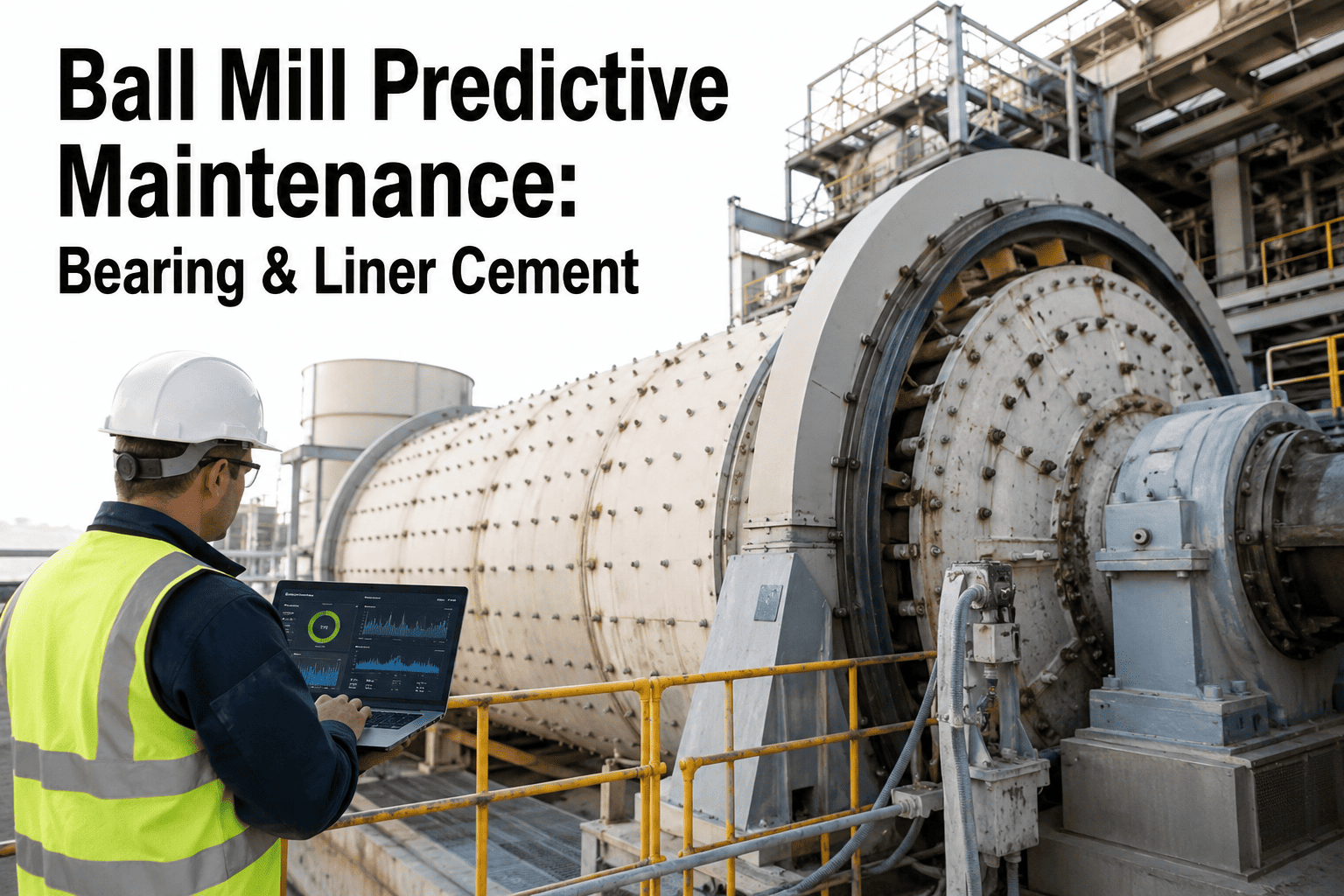
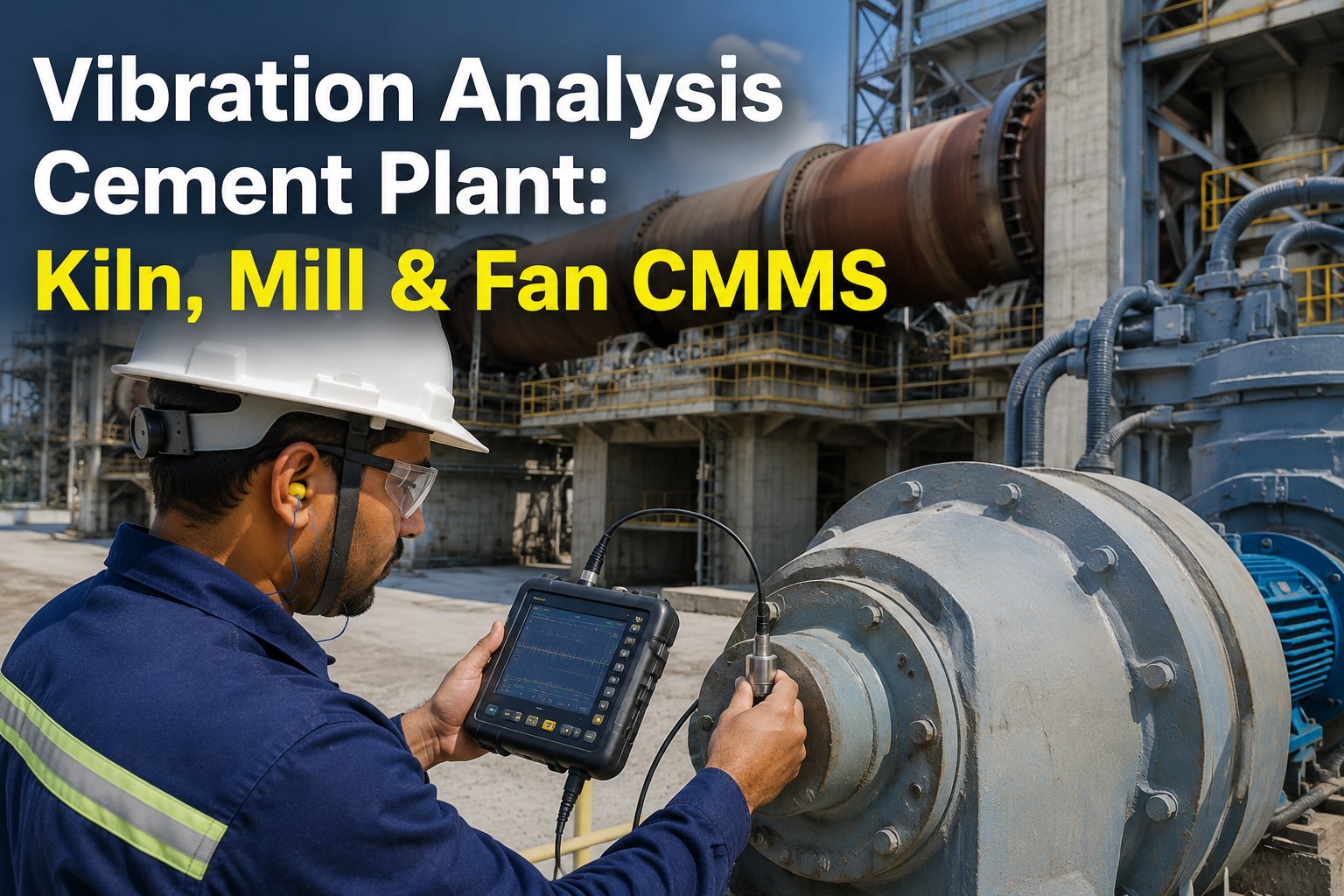
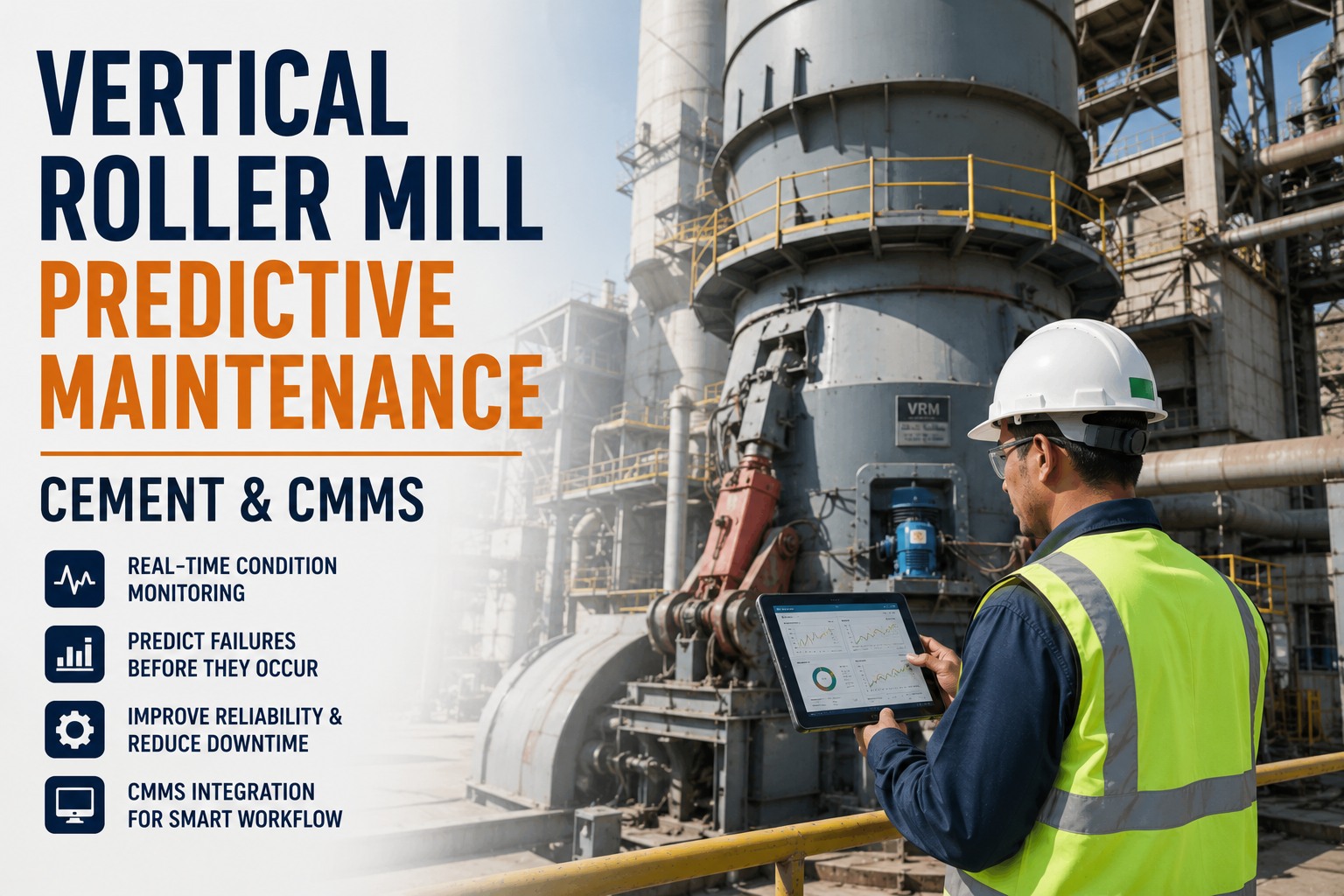
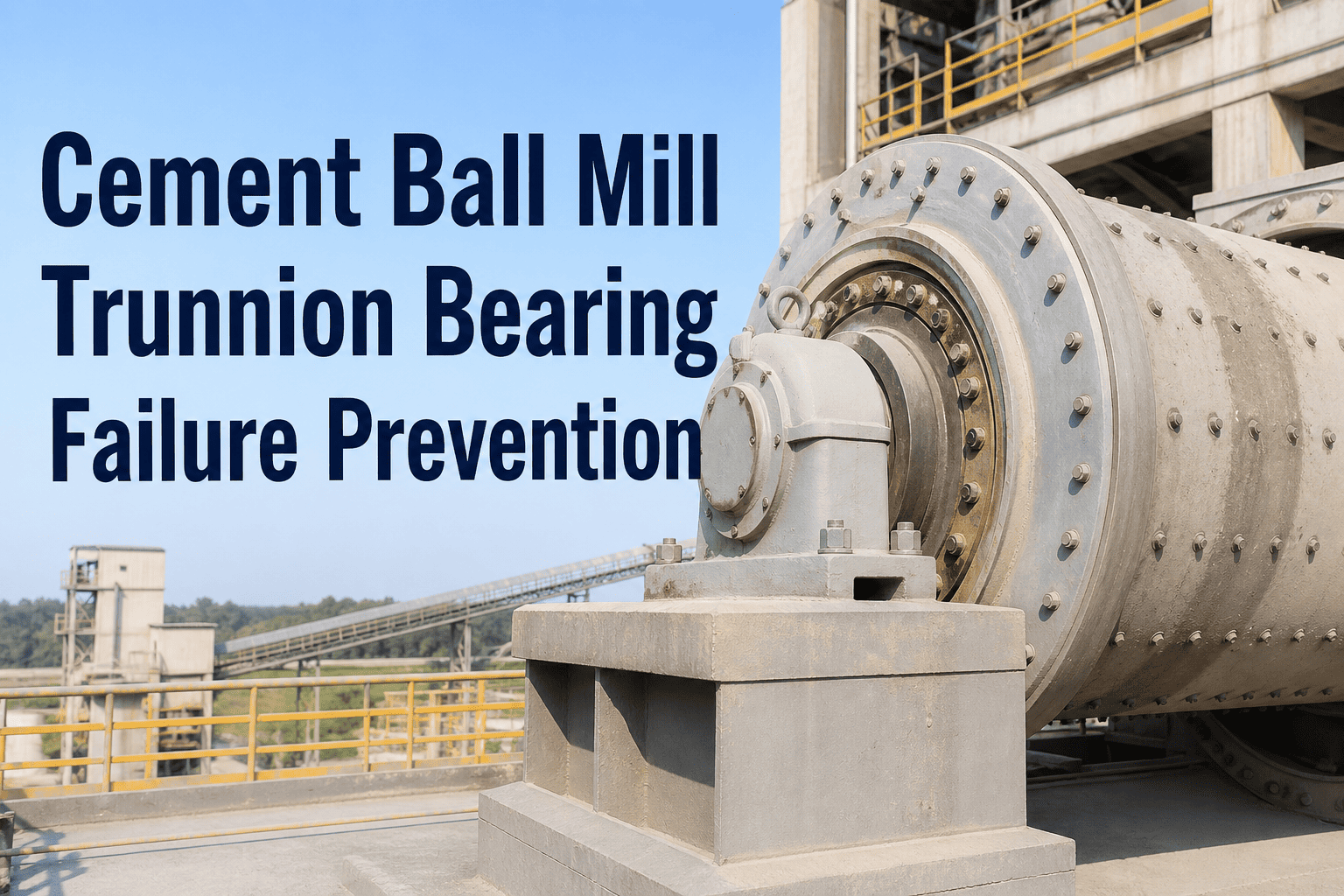
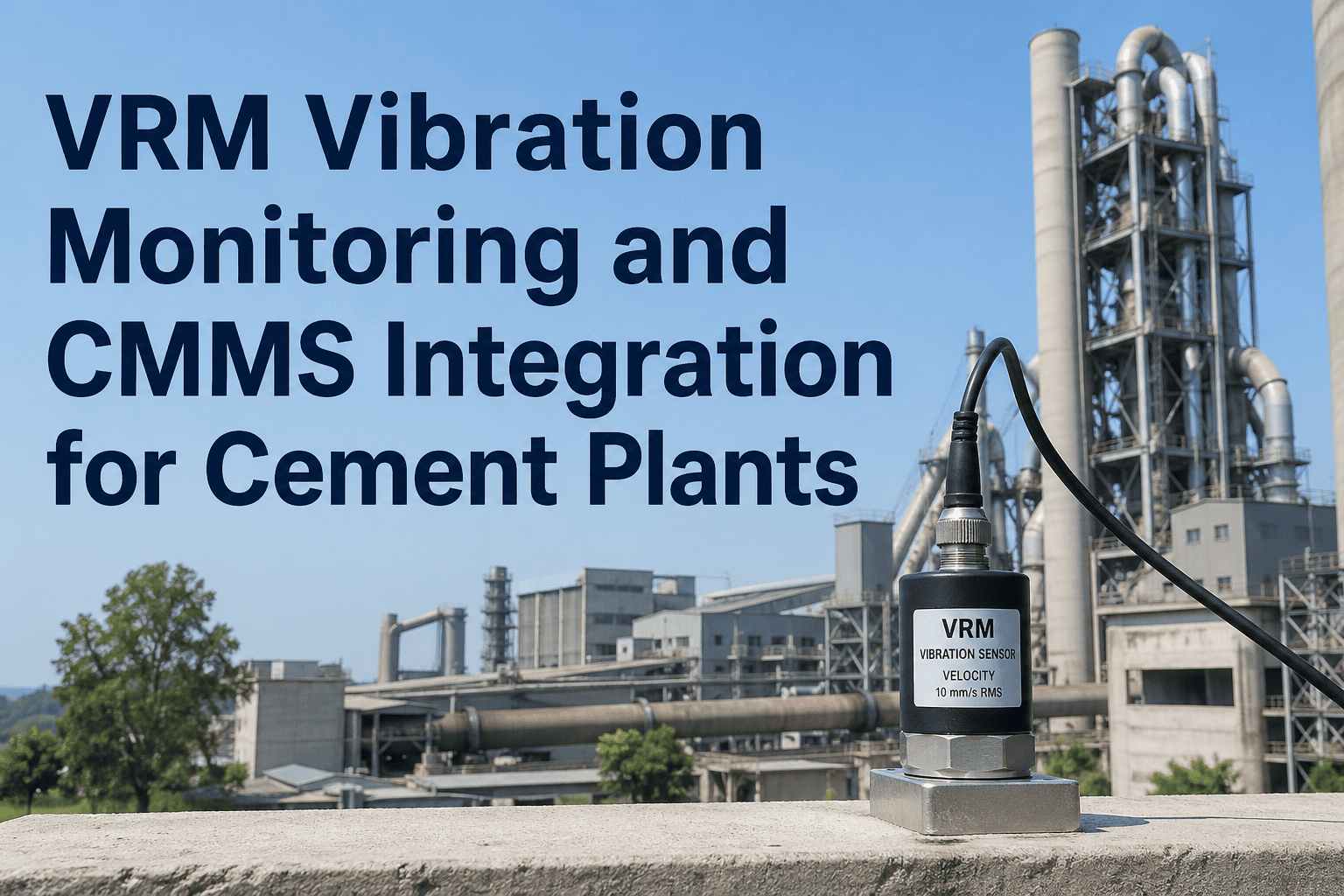
Raw vibration waveforms from cement plant rotating equipment hide fault signatures that calendar-based maintenance schedules simply cannot detect. AI-powered spectral analysis decodes FFT frequency patterns — unbalance at 1X running speed, misalignment at 2X, looseness harmonics, and bearing defect frequencies (BPFI, BPFO, BSF) — and classifies fault type and severity automatically, without a specialist analyst reviewing every sensor channel. Plants using machine learning vibration diagnostics reduce unplanned failures by 40–60% and cut diagnostic time from days to minutes.
Why Standard Vibration Monitoring Falls Short in Cement Plants
Cement plants run dozens of high-speed rotating assets — kilns, mills, crushers, fans, conveyors — under extreme dust, heat, and variable load. Traditional threshold-based alarms flag vibration only after amplitude crosses a fixed limit. By then, damage has already begun.
Masked Early Faults
Bearing defects produce sub-millimetre amplitude changes weeks before overall RMS rises. Threshold alarms miss them entirely.
Multi-Fault Confusion
Unbalance and misalignment produce overlapping frequency peaks. Manual analysts frequently misclassify one as the other, leading to wrong corrective action.
Analyst Scarcity
Certified vibration analysts are expensive and scarce. A 3,000 TPD plant may have 60+ sensor channels but only one analyst reviewing data weekly — if at all.
Cement-Specific Noise
Clinker grinding, raw mill impacts, and fan surge create broadband noise floors that confuse generic industrial vibration tools not trained on cement data.
The Four Fault Signatures AI Classifies Automatically
Every fault type leaves a distinct fingerprint in the frequency spectrum. AI models trained on cement plant failure libraries recognise these patterns in real time.
Mass Unbalance
Dominant peak at 1× running speed. Common on kiln tire assemblies, fan impellers coated with clinker buildup, and cement mill separator rotors. AI detects phase relationships and amplitude ratios that confirm unbalance vs. other 1X contributors.
Shaft Misalignment
Strong 2× component alongside 1×, with axial vibration elevation. Prevalent at gearbox-to-kiln couplings and drive-end motor shaft connections. Misclassifying this as unbalance wastes balance corrections while the real damage continues.
Structural Looseness
Forest of harmonics at 0.5×, 1×, 1.5×, 2× and beyond. Appears on foundation bolt wear, bearing housing fits, and impeller fasteners. Looseness is dangerous because it accelerates every other fault mechanism — AI flags it as a force-multiplier risk.
Rolling Element Bearing Defects
Subsurface defects generate impulses at ball pass frequencies (inner race BPFI, outer race BPFO, ball spin BSF) — often buried under the noise floor. AI uses envelope analysis and kurtosis models to extract these signatures 6–12 weeks before failure.
See AI Fault Classification on Your Plant Data
Upload 30 days of vibration records and receive a fault classification report in 48 hours — showing fault type, severity, and recommended action for every flagged asset.
How AI Spectral Analysis Works: From Raw Waveform to Work Order
Waveform Acquisition
Continuous time-domain vibration data streams from accelerometers on motor drive-ends, non-drive-ends, gearboxes, and fan bearing housings via IIoT gateways or existing SCADA.
FFT & Envelope Processing
AI pre-processor applies Fast Fourier Transform, high-pass filtering, and Hilbert envelope demodulation — extracting the frequency-domain spectrum and bearing impulse envelope in real time.
Feature Extraction
Model extracts 40+ spectral features: harmonic ratios, sideband energy, kurtosis, crest factor, narrowband RMS at fault frequencies — calibrated to cement plant operating speeds and load conditions.
Multi-Class Fault Classification
Ensemble classifier (gradient-boosted trees + CNN) assigns fault type, confidence score, and severity stage (incipient, developing, critical) using cement-specific training datasets covering 12,000+ documented failures.
CMMS Work Order Auto-Generation
Classification triggers a pre-written work order in SAP PM, Maximo, or Fiix with fault type, location, urgency, and recommended parts — no analyst touchpoint required for routine cases.
Classification Performance on Cement Plant Equipment
Models are validated on held-out cement plant datasets — not general industrial benchmarks. These numbers reflect real-world performance in dusty, high-temperature environments.
| Fault Type | Equipment | Detection Lead Time | Classification Accuracy | False Alarm Rate |
|---|---|---|---|---|
| Mass Unbalance | Kiln fans, separators | 4–8 weeks | 96% | 3% |
| Shaft Misalignment | Motor-gearbox couplings | 3–6 weeks | 93% | 5% |
| Structural Looseness | Fan housings, mill drives | 2–4 weeks | 91% | 6% |
| Bearing Defects (BPFO) | All rotating equipment | 6–12 weeks | 94% | 4% |
| Bearing Defects (BPFI) | High-speed shafts | 4–10 weeks | 92% | 5% |
Manual Analysis vs. AI Spectral Classification
Manual / Threshold-Based
- 1 analyst reviewing 60+ channels weekly
- Alarms trigger only after amplitude threshold breach
- Bearing faults detected 1–2 weeks before failure
- Misalignment misclassified as unbalance 30–40% of cases
- Work order written manually from analyst notes
- No severity tracking between inspections
- Cost: $80K–$150K/year in analyst time
AI Spectral Classification
- Continuous 24/7 monitoring of every sensor channel
- Detects sub-threshold spectral anomalies in incipient stage
- Bearing faults detected 6–12 weeks before failure
- Multi-class model distinguishes fault types at 91–96% accuracy
- Work order auto-generated with fault details in CMMS
- Severity trend tracked and reported daily
- Cost: 60–75% lower total diagnostic cost
Critical Assets Monitored in a Typical Cement Plant
Rotary Kiln Drive
Main gear, pinion bearing, tyre, and supporting roller assemblies. Kiln drive failure costs $400K–$800K per event. AI monitors all axes simultaneously.
Raw Mill & Cement Mill
Trunnion bearings, separator drives, and grinding roller bearings. Mill downtime costs 2,000–5,000 USD per hour in lost throughput.
ID & Preheater Fans
Clinker buildup causes progressive imbalance. Blade fatigue and housing looseness compound — AI differentiates the three fault modes simultaneously.
Crusher & Hammer Mill
Hammer wear, rotor imbalance, and bearing fatigue. High-impact loads accelerate fault progression — early detection windows are short without AI.
Compressors & Blowers
Unbalance and misalignment at high RPM produce rapid progression. AI flag-to-failure windows extend from 3 days (threshold alarm) to 3+ weeks.
Conveyor Drive Heads
Belt tension variation and bearing overload generate looseness harmonics. AI models account for variable-load speed profiles common on clinker conveyors.
Frequently Asked Questions
No replacement needed. The AI layer connects to your existing accelerometers via standard IIoT gateways or SCADA data exports. OxMaint integrates with Emerson, SKF, Rockwell, and generic 4–20mA / Modbus sensors already installed on your equipment.
Pre-trained cement-specific models start classifying fault types from day one. Plant-specific fine-tuning improves accuracy further within 4–8 weeks as the model learns your equipment's normal operating baseline. Book a scoping call to discuss your sensor configuration.
Auto work order generation supports SAP PM, IBM Maximo, Fiix, Infor EAM, and custom systems via REST API. Start a free trial to test the integration with your existing CMMS without changing any workflows.
Yes. The signal processing pipeline includes dust-induced noise filtering and temperature-compensated baseline correction trained specifically on cement plant environments. False alarm rates stay below 4–7% even in high-dust pre-heater and raw mill areas.
Most plants recover implementation cost within the first prevented failure event — a single avoided kiln drive failure saves $400K–$800K. Schedule a consultation to build a plant-specific ROI model using your historical failure cost data.
Stop Reacting to Failures. Start Classifying Faults Weeks Ahead.
OxMaint's AI spectral analysis engine processes your vibration data continuously, classifies fault types automatically, and delivers actionable work orders to your CMMS — so your reliability team acts on evidence, not guesswork.