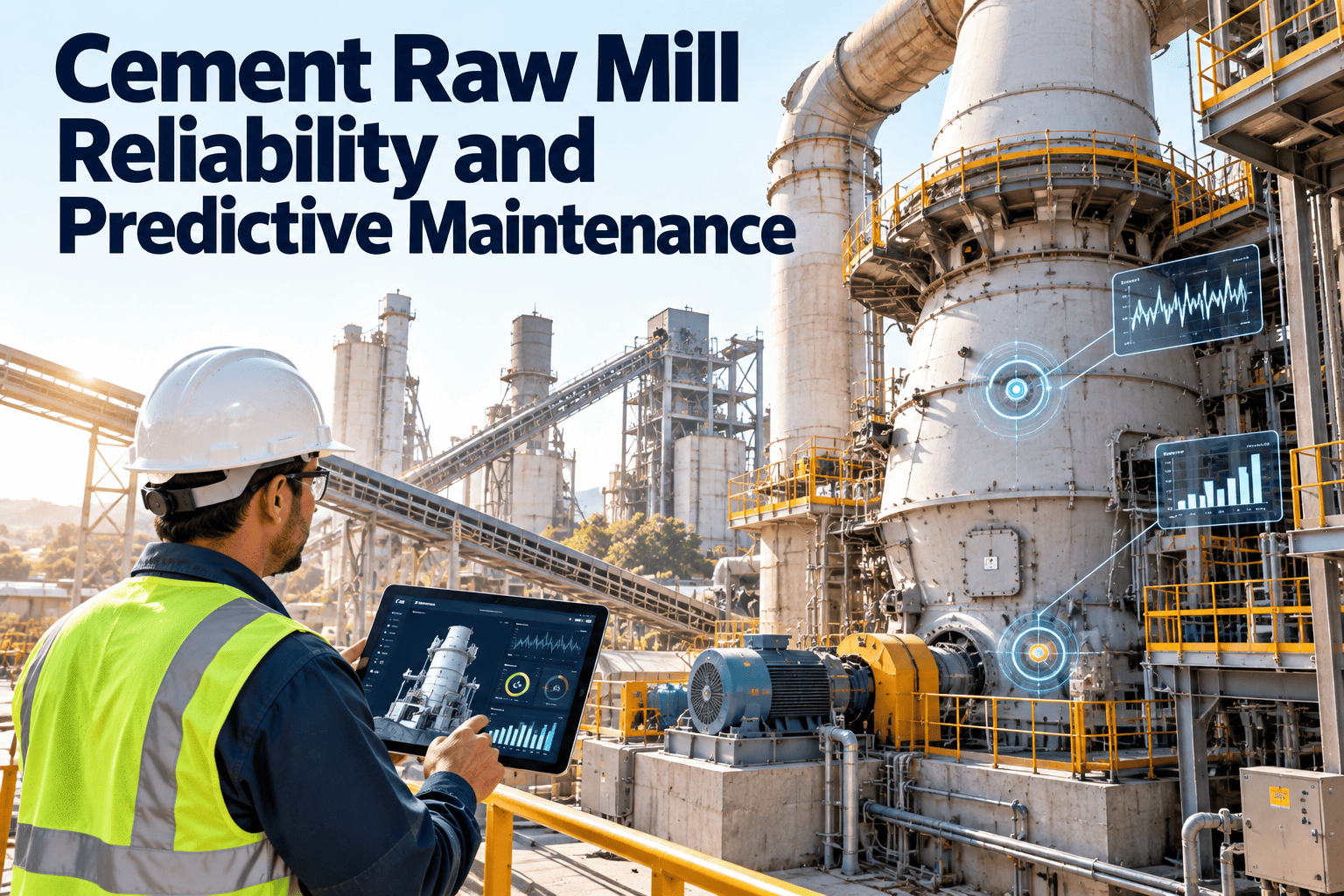
The raw mill decides how steadily a cement plant feeds its kiln. When grinding stalls, a gearbox overheats, or grinding rollers wear out early, the kiln loses stable raw meal and the whole line pays for it. Reliability depends on reading vibration, pressure, temperature, and wear trends before they turn into stoppages. This guide covers raw mill failure modes, condition signals, and a practical workflow, and shows how Oxmaint maintenance management software connects them.
Cement Raw Mill Reliability and Predictive Maintenance
Keep vertical roller mills and ball mills grinding steadily by turning condition data into planned work, not emergency shutdowns.
Why raw mill reliability matters to the whole plant
A raw mill is a high-load, abrasive, thermally active machine sitting upstream of the most expensive asset on site: the kiln.
- Unstable mill output changes raw meal fineness and chemistry, which forces kiln operators to compensate.
- Unplanned mill stops drain the raw meal silo, and once it runs low the kiln has to slow down or stop.
- Abrasive wear is continuous, so small delays in liner or roller inspections compound over weeks.
- Grinding is one of the largest electrical loads in the plant, so mechanical drift shows up in specific energy use.
Vertical roller mills and ball mills fail differently
Most modern plants use vertical roller mills (VRMs), while many older lines still run ball mills. The maintenance plan should reflect the machine in front of you.
Vertical roller mill
- Roller and table liner wear
- Hydraulic accumulator and cylinder faults
- Gearbox and thrust bearing condition
- Vibration from material bed instability
Ball mill
- Liner and diaphragm wear
- Trunnion and slide shoe bearing temperature
- Girth gear and pinion alignment
- Ball charge and grinding media top-up
Raw mill failure modes and the signals that warn you
Each failure mode leaves a trace. The table pairs common problems with the data that usually shows them first.
| Component | Typical problem | Early signal | Planned response |
|---|---|---|---|
| Mill gearbox | Bearing or gear tooth damage | Rising vibration, oil temperature, particle count | Oil analysis, inspection, planned bearing change |
| Main motor | Winding or bearing degradation | Current imbalance, bearing temperature | Electrical test, lubrication, scheduled repair |
| Grinding rollers and table | Uneven or excessive wear | Vibration, falling throughput, higher power draw | Profile measurement, hardfacing or replacement |
| Hydraulic system | Accumulator pressure loss, seal leaks | Pressure drift, oil top-up frequency | Precharge check, seal replacement |
| Separator | Bearing failure, blade wear | Speed variation, vibration, fineness swings | Bearing inspection, blade replacement |
| Mill fan | Imbalance from dust build-up or wear | Vibration trend, differential pressure | Cleaning, balancing, impeller repair |
Reactive versus predictive raw mill maintenance
The difference is not only technology. It is when the maintenance team finds out about a problem, and what choices remain at that point.
Reactive routine
- Wear parts replaced after performance drops
- Vibration readings kept in separate files
- Stops discovered by the control room first
- Spares ordered after the failure
- Repairs rushed under kiln pressure
Condition-based routine
- Wear parts planned against measured profiles
- Trends reviewed against alarm thresholds
- Alerts create work orders before failure
- Spares reserved ahead of shutdown windows
- Repairs scheduled with silo levels in mind
See your raw mill maintenance in one workflow
Bring inspections, work orders, and asset history together so raw mill problems are planned, not discovered.
Condition monitoring parameters worth tracking
Predictive maintenance for a raw mill does not need every sensor on day one. Start with parameters that reflect the highest-consequence failures.
Vibration
Gearbox, motor, fan, and separator bearings. Watch trend direction, not just single alarms.
Temperature
Bearing, oil, and mill outlet readings. Sustained drift often points to lubrication or load issues.
Differential pressure
Across the mill and filters. Changes can signal airflow restriction or material bed problems.
Motor current and power
Rising specific energy at the same output often indicates wear or mechanical resistance.
Hydraulic pressure
Roller pressure and accumulator behaviour, tied to grinding stability.
Oil condition
Viscosity, contamination, and wear particles from sampled gearbox oil.
From signal to work order: the predictive workflow
A trend on a screen protects nothing until someone acts on it. The value sits in the handoff between detection and execution.
- 1
Detect
Condition data crosses a threshold, or an inspector records an abnormal finding on a mobile checklist.
- 2
Verify
A reliability engineer confirms the trend against history and recent operating conditions.
- 3
Plan
A corrective work order is created with tasks, parts, skills, and the preferred shutdown window.
- 4
Execute
Technicians complete the job, record findings, measurements, and parts used.
- 5
Learn
Findings update asset history, adjust thresholds, and refine the preventive maintenance plan.
Managing wear parts before they manage you
Rollers, table liners, ball mill liners, and separator blades wear by design. The risk lies in not knowing how much life remains.
Practical wear management habits
- Record roller and table profile measurements at a fixed interval, with the same method each time.
- Link each measurement to the asset so wear rate can be compared across campaigns.
- Forecast replacement dates from wear rate and align them with planned kiln stops.
- Track hardfacing and repair history so decisions consider past intervention results.
- Keep critical spares visible, including lead times for long-delivery parts.
Why spares planning belongs in the same system
A predicted failure with no part on the shelf is still an unplanned stop. Inventory levels, reorder points, and work order parts lists should sit alongside asset condition.
Raw mill KPIs that show whether reliability is improving
Choose a small set of measures that operations and maintenance both accept, and review them on a regular rhythm.
Mill availability
Share of scheduled time the mill can run. Separate planned from unplanned downtime.
MTBF and MTTR
Mean time between failures and mean time to repair for gearbox, fan, and hydraulics.
Specific power consumption
Energy per tonne of raw meal. Drift can reveal mechanical or process degradation.
Planned versus reactive work
A rising planned share suggests problems are being found early.
PM compliance
Preventive tasks finished on time, with overdue critical tasks flagged.
Alert-to-action time
Time between a confirmed condition alert and a scheduled work order.
Shift and weekly inspection checklist for raw mills
Inspections catch what sensors do not, such as leaks, noise, loose guards, and housekeeping problems. Digital checklists keep the findings consistent.
Every shift
- Listen for abnormal noise at gearbox and fan
- Check oil levels and visible leaks
- Review vibration and temperature trends
- Confirm hydraulic pressure is stable
- Note dust leaks around seals and ducts
Every week
- Inspect lubrication points and filters
- Check separator drive and guarding
- Review open corrective work orders
- Compare power use against output
- Confirm critical spares are available
Every shutdown
- Measure roller and table wear
- Inspect internal liners and ducts
- Test hydraulic accumulators
- Check bolt torque on critical joints
- Record findings against each asset
How Oxmaint supports raw mill maintenance
Oxmaint gives maintenance, operations, and reliability teams one place to manage the workflow around the raw mill.
| Maintenance need | Oxmaint capability |
|---|---|
| Track each mill component and its history | Asset management with a full maintenance record |
| Prevent routine failures | Preventive maintenance schedules by time or usage |
| Act on abnormal findings | Corrective work orders with tasks, parts, and priority |
| Capture field findings | Mobile inspections and checklists |
| Prepare for shutdowns | Scheduling and planning of maintenance windows |
| Avoid missing parts | Inventory tracking for critical spares |
| Review performance | Reports and dashboards for downtime, backlog, and compliance |
Getting started without a large project
Begin with the raw mill and its top failure modes. Load the critical assets, set up inspection routes, and connect existing condition data as it becomes available.
Raw mill reliability questions
What is the most common cause of raw mill downtime?
It varies by plant, but gearbox faults, wear part failures, hydraulic issues, and fan problems are frequent contributors.
Which sensors matter most for predictive maintenance?
Vibration, temperature, pressure, and motor current on the gearbox, motor, fan, and hydraulics give the best starting coverage.
Can a CMMS help without sensors?
Yes. Preventive schedules, inspections, and work order history improve reliability, and sensor data can be added later. Get started with a simple setup.
How do we plan wear part replacement?
Measure wear at fixed intervals, calculate wear rate, and schedule replacement into planned shutdown windows.
Does this suit both vertical and ball mills?
Yes, asset structures and checklists can reflect either design. Book a demo to see an example.
Make raw mill reliability part of daily maintenance
Connect condition signals, inspections, spares, and work orders so your raw mill stays ahead of failure.