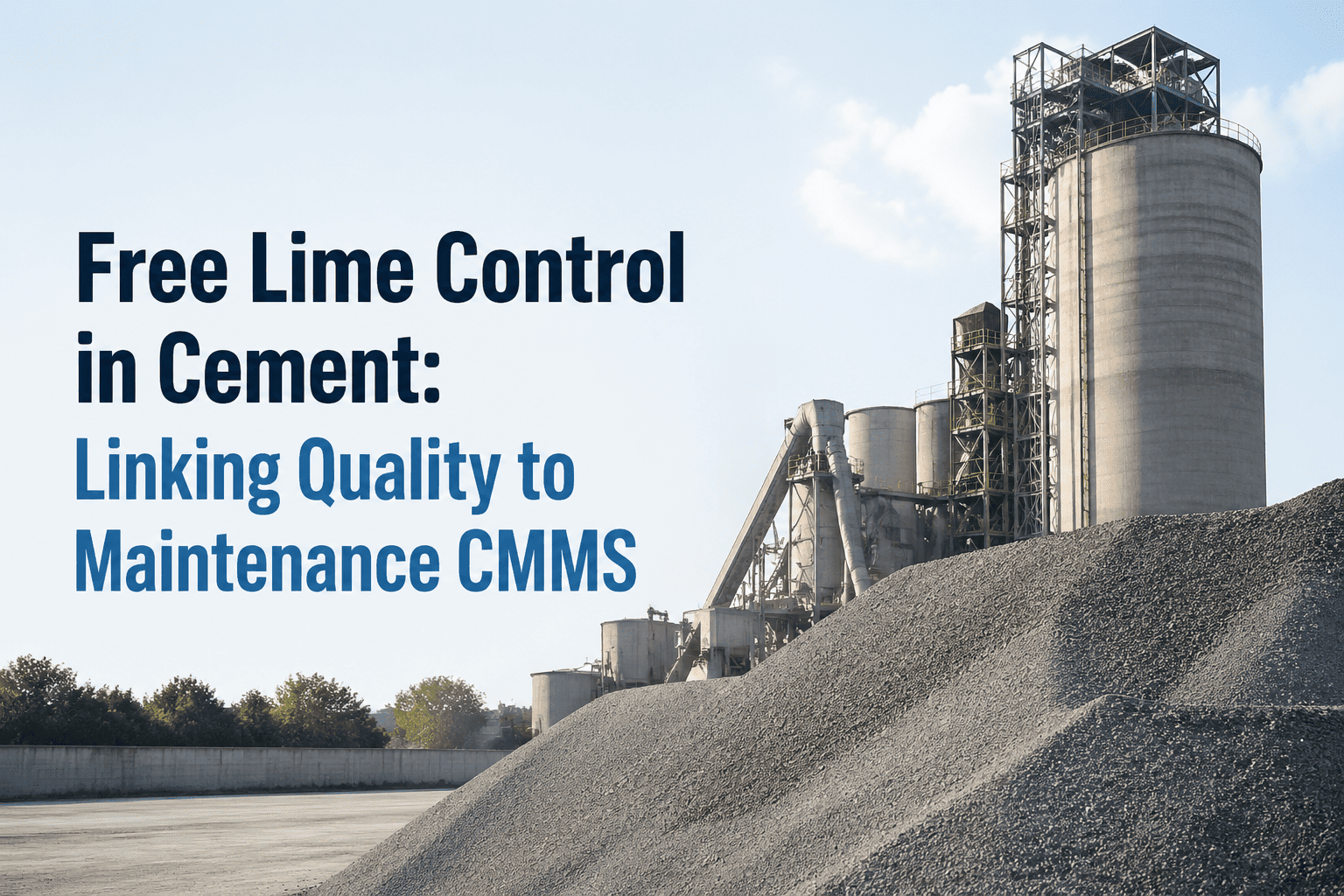
Free lime in clinker is the final report card for everything that happens upstream of the kiln. When raw mix chemistry swings, the kiln operator compensates with fuel, feed rate and speed, and the result is unstable coating, higher heat consumption and clinker that is either undercooked or overburnt. Many chemistry problems are traced back to worn feeders, drifting analyzers and blending equipment that no longer homogenizes. Treating these assets as part of quality control, with records in a maintenance management platform, helps process and maintenance teams work from the same facts.
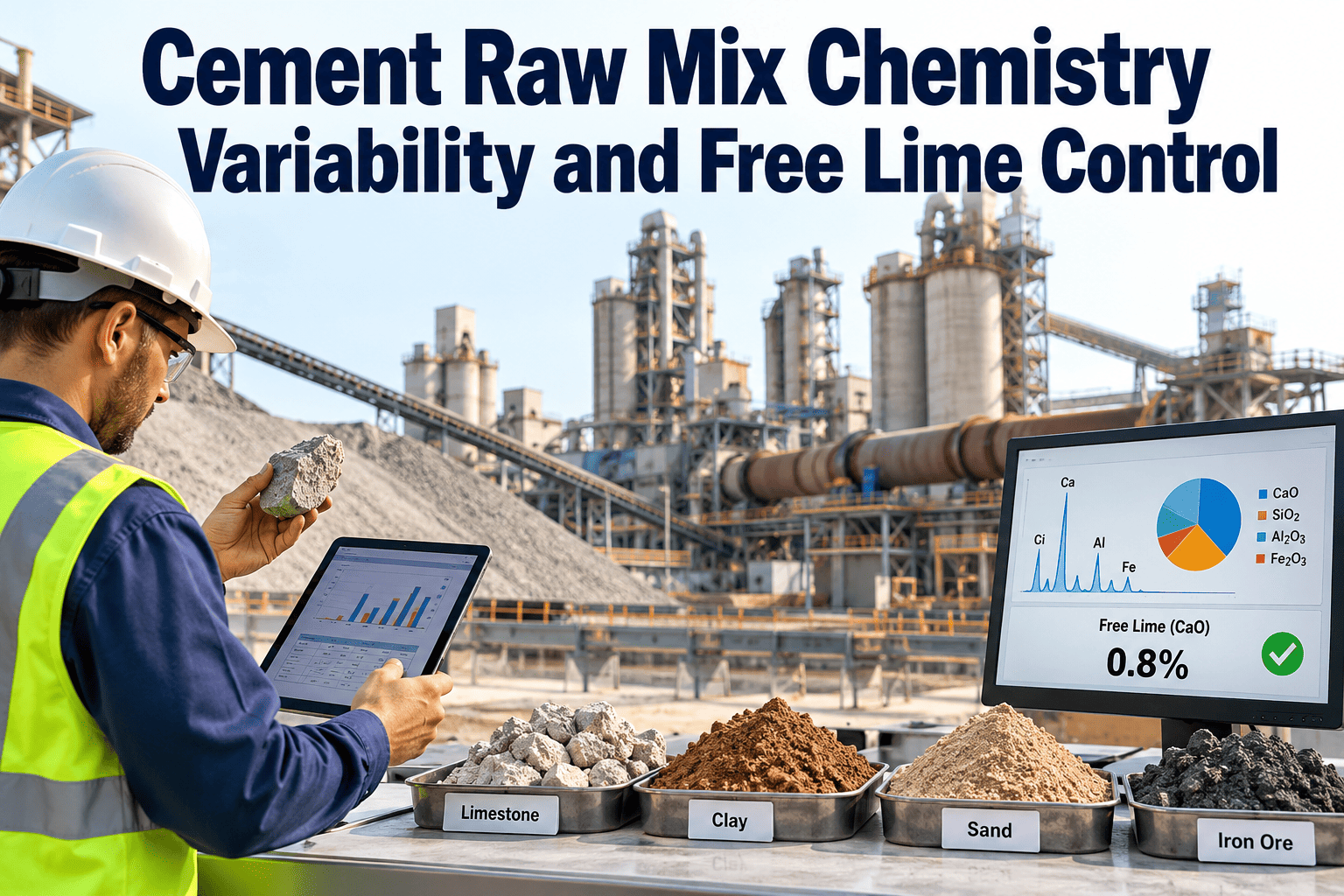
Cement Raw Mix Chemistry Variability and Free Lime Control
Stabilize the path from quarry to kiln feed so lime saturation, modulus targets and free lime stay inside the band your process team sets.
Quarry and stockpile
Raw feeders
Raw mill and analyzer
Blending silo
Kiln feed to free lime
What variability does to the kiln
Chemistry terms in practice
- Lime saturation factor shows how much lime the mix carries relative to its silica, alumina and iron.
- Silica and alumina moduli influence liquid phase, burnability and coating behavior.
- Free lime is unreacted calcium oxide left in clinker, so it signals burning or mix problems.
- Target values depend on raw materials and cement type, so each plant sets its own limits.
Typical process response
1
Feed chemistry shifts from set point
2
Burning zone behavior changes
3
Operator adjusts fuel and feed
4
Free lime and heat use drift
Equipment sources of chemistry variability
| Asset | How it creates variability | Maintenance control |
|---|---|---|
| Raw material feeders | Calibration drift, buildup, worn belts or gates | Scheduled calibration, belt and chute inspection |
| Online analyzer | Source aging, sample presentation problems, drift | Verification against lab results, cleaning and service |
| Sampling system | Blocked lines, biased or missed samples | Sampler rounds, line cleaning, timing checks |
| Raw mill and separator | Fineness change, unstable residence time | Wear checks, separator inspection, fan trends |
| Blending silo | Poor aeration, dead zones, reduced homogenization | Aeration pad and blower inspection |
| Kiln feed system | Pulsing flow, metering error | Flow meter checks, valve and airslide inspection |
Control bands and the response they should trigger
Outside action limit
Process review, check analyzer against lab, raise corrective work if equipment is suspected.
Inside warning band
Check feeder rates, sampler status and mill fineness before the next sample cycle.
On target
Continue routine rounds and record trend data for later analysis.
Inside warning band
Same checks, with attention to blending silo aeration and recirculation.
Outside action limit
Escalate, record deviation and link it to the asset concerned.
Link quality deviations to the equipment behind them
Give process and maintenance teams one record of feeders, analyzers and silos.
A weekly verification checklist
Process and quality
- Compare analyzer and lab results
- Review standard deviation of key moduli
- Review free lime trend against feed changes
Mechanical
- Check feeder calibration records
- Inspect sampler lines and cutters
- Check blending silo blower and aeration pressure
Follow-up
- Open work orders for confirmed faults
- Record cause and fix
- Review repeat deviations monthly
Where chemistry variability starts before the raw mill
| Stage | Typical variability source | What maintenance can influence |
|---|---|---|
| Quarry and crushing | Natural variation in limestone, clay and corrective materials | Crusher availability so blending plans can be followed |
| Stacking and reclaiming | Uneven stacking, segregation, poor reclaim sequence | Stacker and reclaimer condition, boom and conveyor reliability |
| Proportioning | Feeder inaccuracy, sticky or wet materials | Calibration, chute cleaning, belt and gate inspection |
| Raw grinding | Fineness swings, separator wear, unstable mill feed | Liner, roller and separator inspection, fan monitoring |
| Homogenization | Dead zones, weak aeration, uneven extraction | Aeration pads, blowers, extraction valves |
Reading the moduli and what pushes them off target
Common control parameters
- Lime saturation factor: too high raises the risk of free lime and harder burning, while too low reduces alite formation.
- Silica modulus: influences the balance between solid and liquid phases in the burning zone.
- Alumina modulus: affects liquid phase viscosity and the character of the clinker.
- Fineness of residue on selected sieves: a coarse fraction of quartz or limestone can leave unreacted lime.
Equipment signs to watch
- Steady drift in one direction often points to a feeder calibration or material change.
- Rapid oscillation can point to pulsing feed, sampler timing or silo extraction problems.
- A sudden step change may follow a repair, a changed set point or a blocked chute.
Free lime: separating mix problems from burning problems
Likely mix and preparation causes
- High lime saturation or poor homogenization in kiln feed
- Coarse raw meal, especially coarse quartz or calcite particles
- Unstable kiln feed rate that disturbs the burning zone
- Analyzer or sampler bias hiding a real chemistry shift
Likely burning and kiln causes
- Burner flame shape or fuel quality changes
- Cooler problems that alter secondary air temperature
- Unstable coating or ring formation in the kiln
- Kiln speed, feed and fuel set points chasing each other
Sampling and analysis reliability
Sampling points
- Confirm samples are representative of the stream, not only of the edge
- Check cutter wear, line blockages and sample timing
- Record every cleaning and adjustment
Online analyzers
- Follow supplier checks for source, detector and sample presentation
- Compare against laboratory results on a defined schedule
- Log drift and recalibration events against the asset
Laboratory side
- Maintain sample preparation equipment such as crushers and mills
- Keep balances and analytical instruments verified
- Share instrument status with the process team
Maintenance routines that support steady chemistry
Daily
Walk feeders and chutes for buildup, check sampler operation, review feed rate trends and note abnormal noise or vibration.
Weekly
Compare analyzer and laboratory results, inspect belts and gates, check aeration pressure and review open quality-related work orders.
Monthly
Run feeder calibration checks, inspect separator and mill internals where access allows, and review repeat deviations by asset.
Planned stop
Repair liners, replace worn separator parts, clean silo extraction zones and service analyzer sources or detectors as specified.
KPIs that connect equipment health to kiln feed quality
Quality indicators
- Standard deviation of lime saturation in kiln feed
- Share of samples inside the target band
- Free lime average and spread in clinker
Equipment indicators
- Feeder calibration compliance
- Analyzer availability and verification results
- Unplanned stops in the raw circuit
Response indicators
- Time from deviation to inspection
- Repeat deviations per asset
- Backlog of quality-related work orders
A 60-day plan to reduce raw mix variability
Days 1 to 30
- Register the raw circuit assets: feeders, mill, separator, analyzer, sampler, silo and kiln feed system.
- Ask process and quality teams which deviations occur most often.
- Create calibration, cleaning and inspection tasks with owners and due dates.
Days 31 to 60
- Record every chemistry deviation against its likely asset.
- Review repeat causes weekly and adjust task intervals.
- Compare standard deviation and free lime trends before and after the changes.
Raw mill fineness and separator performance
| Observation | Possible equipment cause | First check |
|---|---|---|
| Coarse residue rising | Separator vane wear, seal leakage, reduced air flow | Separator internals, mill fan current and damper position |
| Fineness swinging shift to shift | Unstable mill feed or erratic separator speed | Feeder trends, drive and speed control records |
| Falling mill output at same power | Liner or roller wear, grinding media condition | Wear measurements and last inspection date |
| High mill vibration | Feed bed instability, bearing or gearbox issues | Vibration trend, oil analysis, hydraulic settings |
- Coarse quartz and calcite particles react slowly in the kiln, so fineness problems can appear later as free lime.
- Record separator and mill inspections by asset so wear can be compared with the quality results that followed.
Blending silo and homogenization health
Signs of poor homogenization
- Kiln feed chemistry varies more than raw mill output
- Extraction from some silo zones runs poorly
- Blower pressure drifts or air consumption rises
- Material hang-ups appear after humid periods
Maintenance responses
- Inspect aeration pads and replace damaged sections at planned stops
- Service blowers, filters and non-return valves on schedule
- Check extraction valves and airslides for wear and leakage
- Compare silo inlet and outlet chemistry to measure real blending
When alternative materials change the chemistry
Alternative raw materials
- Industrial by-products may vary more than natural stone
- Moisture and particle size can affect feeder behavior
- Handling equipment may need extra cleaning
Alternative fuels
- Fuel ash adds to kiln feed chemistry
- Changing fuel mixes can shift burning conditions
- Dosing equipment accuracy becomes more important
Maintenance implication
- Inspect dosing and conveying equipment more often during trials
- Record material changes on the same asset history
- Review quality drift after each change
Responding to a chemistry deviation in six steps
1
Confirm the result by checking the sample and the instrument.
2
Check recent feeder, mill and silo events in the asset history.
3
Inspect the most likely asset and record what is found.
4
Raise a work order for confirmed faults with an owner and due time.
5
Re-sample after the fix and compare against the limit.
6
Review repeat causes monthly and adjust inspection intervals.
Mistakes that keep chemistry unstable
- Adjusting set points repeatedly while a worn feeder or blocked sampler is the real cause.
- Trusting the analyzer without regular comparison against laboratory results.
- Treating each deviation as a one-off instead of looking for repeat causes by asset.
- Skipping aeration and extraction checks in blending silos because they are out of sight.
- Keeping calibration records separate from quality records so patterns are never seen together.
Data worth recording for each raw circuit asset
Equipment records
- Last calibration date, method, result and technician for every feeder and scale
- Sampler cutter condition, cleaning dates and observed blockages
- Analyzer verification results against laboratory samples
- Wear measurements for liners, rollers and separator parts
- Aeration pressure and blower hours for blending silos
Linked quality records
- Deviation date, parameter, value and limit
- Equipment events in the shift before the deviation
- Cause found and corrective action taken
- Follow-up sample result after the repair
Oxmaint workflows for quality-linked maintenance
Scheduled work
- Preventive maintenance for calibration, cleaning and wear checks
- Mobile inspection checklists for feeders, samplers and silos
- Reminders for overdue verification tasks
Responsive work
- Corrective work orders raised from quality deviations
- Spare parts tracking for feeder belts, cutters and aeration pads
- Reports on repeat failures, backlog and completion by team
Questions to ask when free lime starts rising
- Did kiln feed chemistry or fineness change in the hours before the rise, and which assets handle that stream?
- Was any feeder, sampler or analyzer repaired, adjusted or out of service recently?
- Did kiln feed rate, fuel or cooler conditions change at the same time?
- Has the same pattern appeared before, and what cause was recorded then?
- Is the next planned stop early enough to inspect the suspected equipment?
What to bring to the monthly quality and maintenance review
- Trend of kiln feed variability and free lime, with equipment events marked on the same timeline.
- List of calibration and verification tasks completed, overdue or deferred in the raw circuit.
- Repeat deviations grouped by asset, with the cause recorded for each.
- Actions agreed, owners and due dates, carried forward to the next review.
How Oxmaint fits the quality control loop
Without shared records
- Lab sees a deviation, maintenance learns later
- Calibration dates sit in separate files
- Repeat causes are hard to prove
With a CMMS
- Asset history for feeders, analyzers, mills and silos
- Calibration and inspection schedules with completion records
- Work orders linked to the asset and deviation
- Reports to review repeat quality-related failures
Frequently asked questions
What causes high free lime in clinker?
Causes include burning conditions, coarse or poorly mixed raw meal, and unstable chemistry. Investigate process and equipment together.
Can feeder wear affect raw mix quality?
Yes. Calibration drift or buildup changes component proportions, so feeders need scheduled checks.
How often should analyzers be verified?
Follow supplier guidance and your quality plan, and record every verification result.
Does maintenance software help quality teams?
It records equipment history behind deviations. You can book a demo to see the workflow.
Where do we start?
Register feeders, samplers and the analyzer first, then get started with calibration schedules.
Steadier raw mix starts with reliable equipment
Connect quality control to maintenance records and reduce chemistry swings at the source.