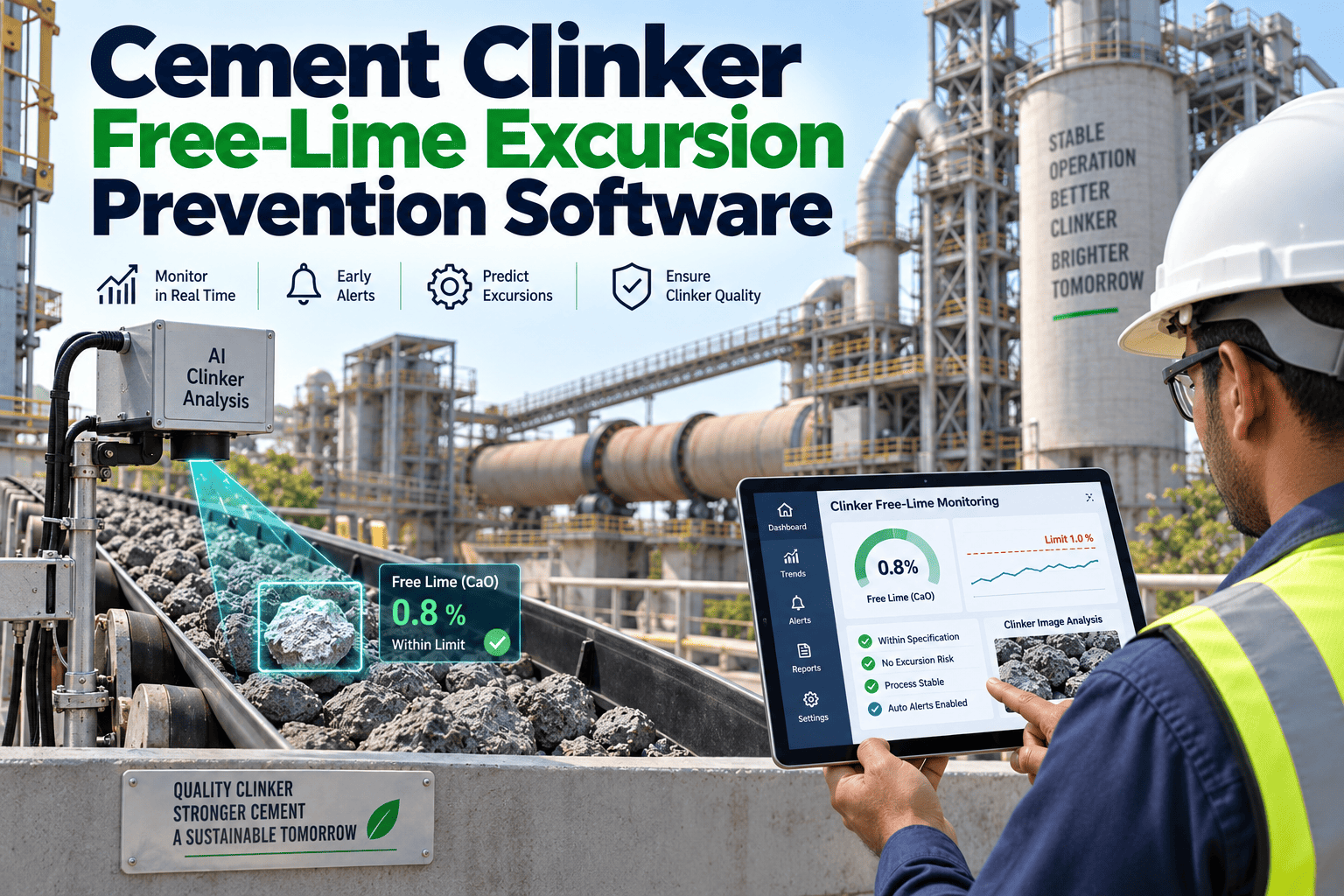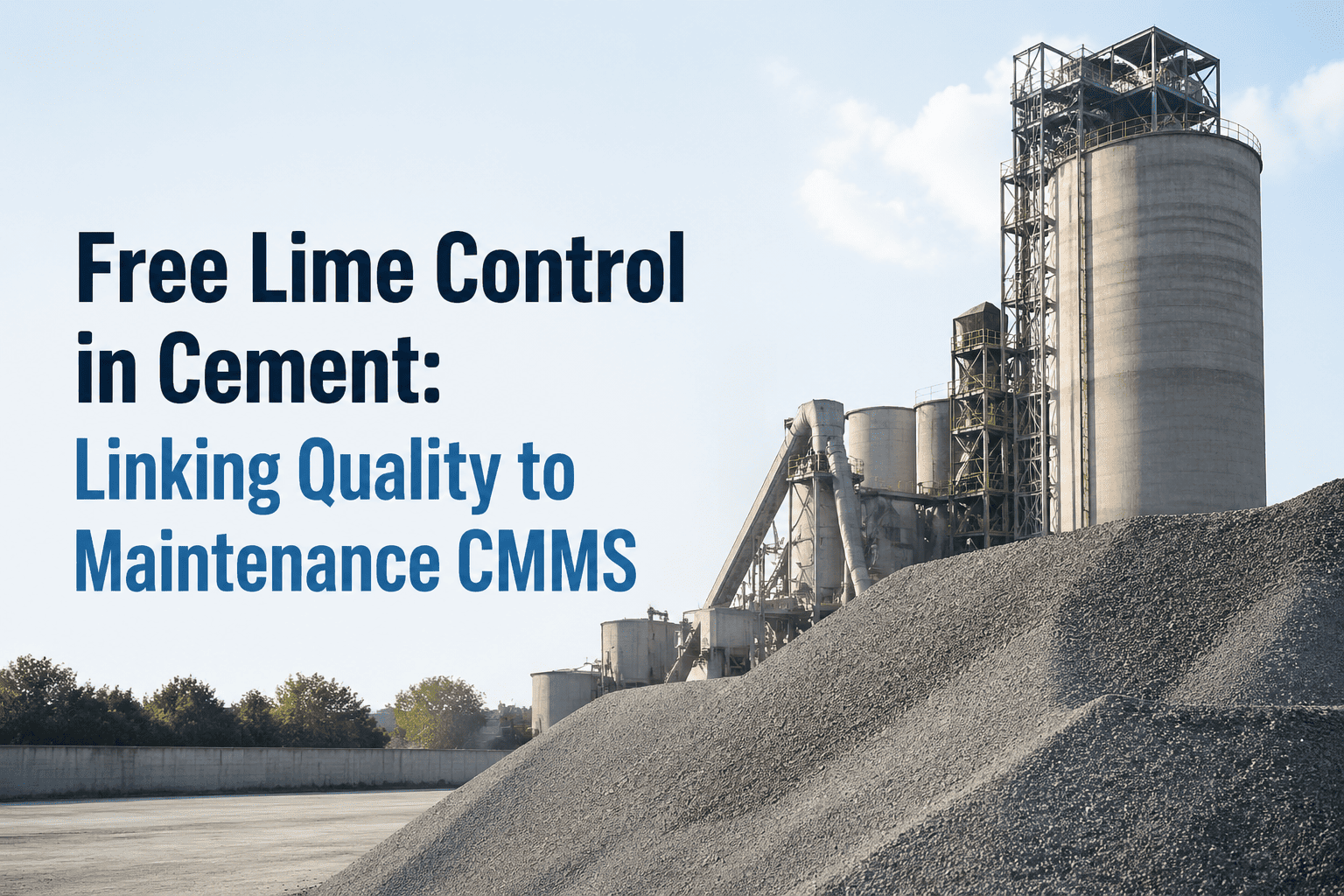
Free lime is the unreacted calcium oxide left in clinker, and it is one of the quickest signals of how well the kiln is burning and how stable the raw meal is. A drifting result can point to the burning zone, raw mix, fuel feed or cooler long before it becomes a quality complaint. Reliable monitoring depends on both laboratory discipline and healthy process equipment, which is where a cement maintenance software workflow supports quality.
Quality and Laboratory · Clinker Free Lime · Predictive Quality
Clinker Free Lime Monitoring and Predictive Quality Guide
Connect free lime results, kiln equipment condition and maintenance actions so quality drift is caught and corrected earlier.
Sample
then
Analyse
then
Trend
then
Check equipment
then
Act
What free lime tells you
Trending high
Often linked to underburning, coarse or poorly homogenised raw meal, a high lime saturation target, unstable fuel feed or a cooler problem.
Stable within the plant target band
Suggests the burning zone, feed and fuel are consistent. Targets depend on the plant's process and product requirements.
Trending very low
May indicate overburning, which can raise fuel use, stress refractory and affect clinker grindability.
Why variability matters as much as the average
- A good daily average can hide swings that cause cement quality variation.
- Rapid changes often follow equipment events such as feed interruptions or fan trips.
- Tracking the spread and the time of each swing helps link quality to plant events.
Equipment behind a stable free lime result
| Equipment or system | How it can affect free lime | Maintenance check |
|---|---|---|
| Kiln feed system and weigh feeders | Feed rate swings disturb kiln stability | Calibration, wear and blockage inspections |
| Raw mill and blending silo | Poor homogenisation changes raw mix chemistry | Separator, fan and extraction condition |
| Fuel dosing and burner | Unstable flame or fuel flow affects burning zone | Feeder, line and burner inspections |
| Kiln drive and shell support | Speed fluctuation affects residence time | Drive, girth gear and roller inspections |
| ID fan and preheater fans | Draft changes alter combustion and heat transfer | Vibration, bearing and damper checks |
| Clinker cooler | Cooling issues affect clinker quality and heat recovery | Grate, fan and drive inspections |
| Sampling and lab equipment | Poor samples or drift mislead decisions | Sampler, XRF and XRD calibration schedules |
A predictive quality loop
1
Capture lab and process data
Bring free lime results, kiln variables and equipment alarms onto a common timeline so cause and effect can be reviewed.
2
Define response limits
Set warning and action bands with the process and quality teams, and agree who responds at each level.
3
Check equipment condition
When free lime drifts, run a short inspection route for feeders, fans, drives and coolers that commonly contribute.
4
Raise work orders
Turn findings into assigned corrective tasks with priority, parts and a due time, rather than verbal handovers.
5
Review and refine
Compare repeated drift events with their causes, then adjust preventive plans and limits.
Link kiln quality drift to equipment action
Use Oxmaint to turn quality alerts and inspection findings into tracked maintenance work.
Response ladder when free lime drifts
WatchSmall upward trend. Confirm sample quality and repeat analysis, then check recent feed and fuel logs.
InvestigateSustained drift. Process and maintenance review feeders, fans, kiln drive and cooler condition.
ActResult outside the action band. Correct the process, raise urgent work orders and record the cause.
Making the laboratory side dependable
- Schedule calibration and verification for analysers, balances, furnaces and automatic samplers.
- Keep sample preparation equipment such as crushers and grinders on a preventive plan, since contamination and wear affect results.
- Log reference standard checks and instrument downtime so gaps in data are explained.
- Link lab equipment records to the same asset system used for plant equipment.
Why this belongs in maintenance
- An unreliable sampler or analyser can look like a process problem and trigger the wrong response.
- Planned lab maintenance keeps quality decisions based on trustworthy numbers.
Reactive versus predictive quality control
Reactive
Predictive and connected
Free lime reviewed after the shift ends
Trends reviewed against live equipment events
Quality and maintenance meet only after problems
Shared view of drift and asset condition
Equipment causes found by chance
Inspection routes triggered by quality alerts
Repeat events forgotten between shifts
Cause history stored against assets
Using condition monitoring and AI sensibly
- Vibration and temperature data on kiln drives, fans and cooler equipment can show developing faults that later disturb the burn.
- Analytics can compare periods of high free lime with preceding equipment alarms to suggest patterns for engineers to test.
- Models should be validated against plant knowledge, since kiln behaviour depends heavily on raw materials and fuel mix.
- Every alert should have an owner and a recorded outcome, otherwise it adds noise.
Oxmaint capabilities for quality-linked maintenance
Asset managementKiln, fans, feeders, cooler and lab instruments in one hierarchy.
Preventive maintenanceCalibration, inspection and lubrication schedules.
Work ordersCorrective tasks from drift events, with cause and closure notes.
Mobile inspectionsChecklists for kiln area routes and sampling points.
InventoryCritical spares for feeders, fans and sampling equipment.
ReportingRepeat causes, overdue tasks and downtime by area.
Monitoring checklist for the quality and maintenance team
- Confirm sampling frequency and sampler health for the current shift.
- Review the latest free lime trend, not only the last single result.
- Check weigh feeder and fuel dosing calibration status.
- Look at recent fan, kiln drive and cooler alarms.
- Record any process change next to the related inspection or work order.
- Close the loop by noting the cause and what was changed.
Frequently asked questions
What is free lime in clinker?
It is calcium oxide that did not combine during burning, used as an indicator of kiln burning and raw mix performance.
Can maintenance affect free lime?
Yes. Unstable feeders, fans, drives or coolers can disturb the burn, so equipment health supports quality.
How does a CMMS support quality control?
It links drift events to inspections and work orders. Try Oxmaint to build that workflow.
Do lab instruments belong in the CMMS?
Yes. Calibration and repair records keep results trustworthy and show why data gaps occurred.
Where can I see this workflow?
You can book a demo for a cement quality and maintenance walkthrough.
Sampling and analysis practices that protect the result
- Take clinker samples at consistent points and intervals, and keep a record of any sample taken after an upset, since representativeness changes during unstable operation.
- Prepare samples the same way every time. Grinding time, particle size and contamination from worn preparation equipment can shift results.
- Confirm the analysis method used on site, such as chemical titration or X-ray based methods, and keep calibration and verification records for each instrument.
- Repeat suspicious results before acting on them, and record whether a high value was confirmed or traced to a sampling or analysis error.
- Keep sample logs, analysis times and instrument status in one place so quality and maintenance teams review the same record.
Process causes of high free lime and the related maintenance signals
| Possible process cause | Equipment signal to review | Typical maintenance task |
|---|---|---|
| Raw meal too coarse or variable | Raw mill separator and fan condition, sampling consistency | Separator inspection, fan balance and wear checks |
| Unstable kiln feed | Feeder load cell drift, rotary valve wear, blocked chutes | Feeder calibration, cleaning and wear part replacement |
| Poor flame or fuel feed | Fuel dosing fluctuation, burner damage, conveying issues | Burner inspection, dosing system service |
| Insufficient draft or airflow | ID fan vibration, damper position, buildup in ducts | Fan bearing checks, damper and duct inspection |
| Kiln speed instability | Drive current variation, support roller or gear issues | Kiln drive and roller inspections |
| Cooler problems | Grate drive faults, fan failures, uneven clinker bed | Cooler drive, fan and grate inspections |
Maintenance tasks around the kiln that influence stability
- Weigh feeders and dosing systems need regular calibration checks and wear inspection, because small errors repeat constantly over a day.
- Kiln shell, tyre and support roller inspections reveal alignment and wear conditions that can affect rotation and refractory life.
- Refractory condition checks and shell temperature scans help plan relining and avoid emergency stops that disturb quality for days after restart.
- Preheater cyclone blockage is a common source of instability, so inspection routes and cleaning tasks should be scheduled and recorded.
- Cooler inspections should cover grate plate wear, air distribution and drive condition, since cooler behaviour feeds back into kiln operation.
Handling startups, trips and shutdown recovery
Before a stop
Complete the planned scope, record asset condition and note which findings may influence the restart, such as feeder repairs or refractory work.
During restart
Use a checklist for feeders, fans, drives and cooler so equipment faults are cleared before quality becomes unstable.
After restart
Review free lime and kiln trends alongside work orders, and note whether any repair is linked to a drift event.
Information worth logging with each drift event
- Date, time and duration of the free lime excursion, with the highest and lowest values recorded.
- Kiln feed, fuel, speed and draft conditions at the time, noted by the process team.
- Equipment alarms, trips or manual interventions in the preceding hours.
- Inspection findings and work orders raised, with owners and closure dates.
- Confirmed root cause or, if unclear, the hypotheses still being tested.
Mistakes that weaken free lime monitoring
Treating lab data as finalSampler or analyser faults can look like process drift.
Ignoring small trendsSlow drift often precedes larger excursions.
Separate recordsQuality logs, DCS alarms and maintenance history never meet.
No cause closureEvents are corrected but the cause is never recorded.
Overreliance on modelsPredictions are trusted without plant validation.
Late inspectionsEquipment is checked days after the drift has passed.
Rolling out connected quality and maintenance tracking
- Start with the equipment most often linked to quality drift: kiln feed, fuel dosing, kiln drive, ID fan and cooler.
- Create inspection checklists for those assets and run them on mobile.
- Define how a free lime alert triggers an inspection route and who owns the response.
- Review drift events monthly with quality, process and maintenance together, and update preventive plans from what you learn.
- Add condition monitoring and analytics only where the team can act on the alerts.
Who does what: quality, process and maintenance roles
Quality and laboratory
Own sampling, analysis, instrument calibration and trend reporting. Flag drift early and confirm whether results are reliable.
Process and kiln control
Adjust operating parameters, interpret trends and decide when drift needs a process response or an equipment check.
Maintenance and reliability
Inspect and repair the equipment that influences burning stability, and keep the history of findings and fixes.
Reports that connect quality and reliability
- A drift event log that lists date, duration, probable cause and linked work orders for each free lime excursion.
- Equipment influence report that counts kiln feed, fuel, fan, drive and cooler faults in the hours before each drift event.
- Repeat cause report highlighting assets that appear in many drift investigations.
- Calibration compliance report for analysers, balances and automatic samplers.
- Shutdown and restart review linking planned work to quality stability after restart.
Using free lime data in shutdown and refractory planning
- Frequent excursions linked to burning zone instability can support inspection of refractory condition, burner position and feed system health.
- Quality history helps prioritise which kiln-area repairs to include in the next planned stop.
- After a major repair, track free lime stability for several days and note whether any residual equipment issue appears.
- Keep outcomes in the asset record, so later reviews can see which repairs improved stability.
Practical limits of predictive quality
- Free lime depends on raw materials, fuel properties and kiln operation as well as equipment health, so no single signal explains every drift.
- Lab results arrive with a delay, so predictions based on process and equipment data should be treated as early warnings for engineers to confirm.
- Models trained on one period may not hold after a change in raw mix, fuel or kiln configuration. Review them after any significant change.
- The most reliable gains usually come from consistent sampling, calibrated instruments, healthy feeders, fans and coolers, and disciplined records.
Questions to ask when free lime keeps drifting
- Is the drift real or a sampling or analysis issue? Check sampler condition, sample preparation and instrument verification first.
- Did anything change upstream, such as raw mix, fuel type or feed rate setpoints, around the time the trend started?
- Were there equipment alarms, trips or manual interventions on feeders, fans, drives or the cooler in the preceding hours?
- Does the drift repeat at certain times, shifts or after specific events like cleaning or restart?
- Have inspection findings been closed with a recorded cause, or are similar issues still open?
- Would planned work on refractory, burner or feed equipment remove a recurring contributor?
Training operators and technicians on the quality link
- Show maintenance crews how feeder accuracy, fan stability and cooler condition appear in clinker quality, so inspections carry purpose.
- Show kiln operators how to request inspections and record observations through the same work order system.
- Review a recent drift event together and trace it from lab result to equipment finding to corrective action.
Protect clinker quality with connected maintenance
Bring free lime trends, kiln equipment condition and corrective actions into one cement plant workflow.