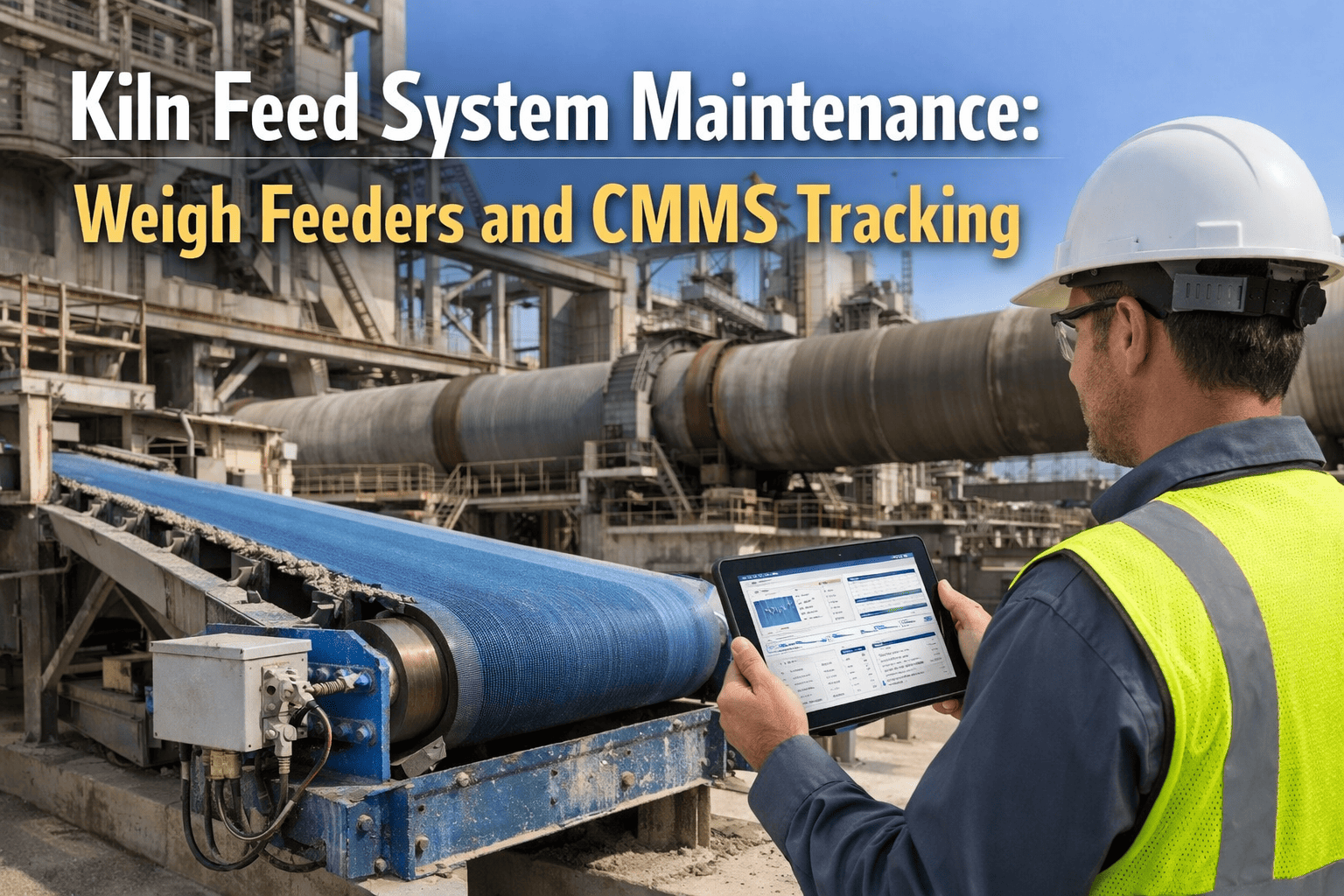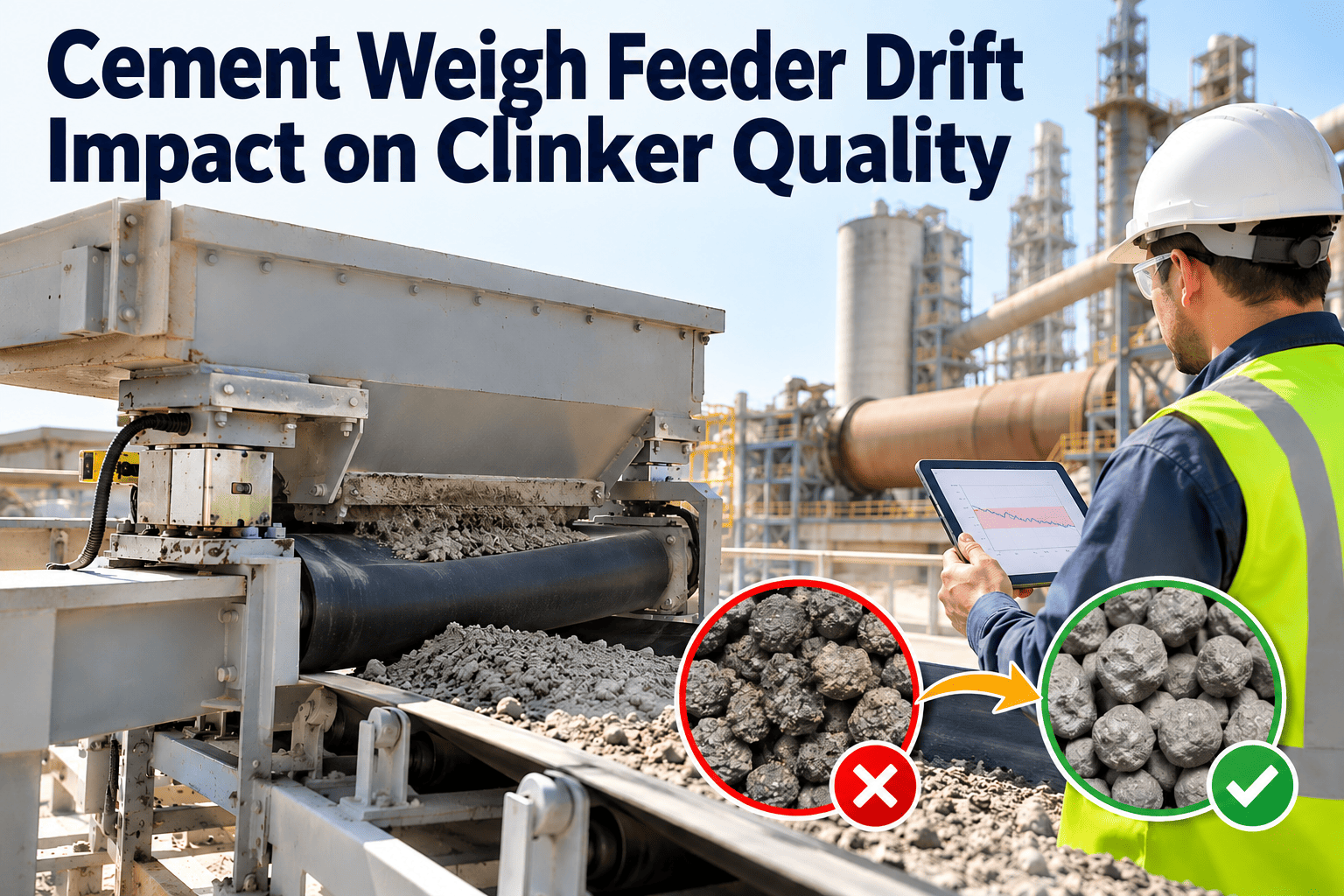
A kiln can only be as steady as the feed it receives, and that feed is weighed by a belt that few people look at after commissioning. When a raw meal or kiln feed weigh feeder drifts by a small percentage, the control room still sees a normal setpoint while the actual mass entering the system moves away from it. The effect appears later as lime saturation swings, free lime excursions, and extra fuel burned to protect the product. This guide traces the path from feeder drift to clinker quality and shows how Oxmaint maintenance software keeps calibration, mechanical condition, and verification under control.
Cement Weigh Feeder Drift Impact on Clinker Quality
Small feeder errors do not stay small. They travel through the raw mill, the blending silo, the preheater, and the kiln, and arrive as clinker that is harder to burn and harder to keep in specification.
Why feeder drift is hard to see
A failed feeder stops and raises an alarm. A drifting feeder keeps running, keeps reporting a plausible number, and quietly shifts the recipe. That is why drift is more costly than most visible failures.
A feeder that fails
- Stops or trips and raises an alarm
- Gets attention within minutes
- Produces a clear work order
- Shows up in downtime reports
A feeder that drifts
- Keeps running with a believable reading
- Is noticed only through lab results or kiln behaviour
- Gets blamed on raw material or operators first
- Rarely appears as a maintenance event until late
What actually causes weigh feeder drift
Most drift comes from a small number of mechanical and electrical causes. Each one has a recognisable footprint, which makes a structured check possible.
| Cause | How it distorts the reading | Typical clue | Maintenance check |
|---|---|---|---|
| Material build-up on idlers and belt | Extra mass is weighed as if it were product | Reading creeps up at constant feed | Clean weigh section, inspect return rollers and scrapers |
| Belt tension or tracking change | Belt loading on the weigh section varies | Zero shifts after belt work or wear | Check tension, tracking, and splice condition |
| Load cell drift or damage | Signal no longer matches the applied load | Zero and span checks fail | Test with weights, inspect mounting and cabling |
| Speed sensor error | Belt speed used in the calculation is wrong | Totalised mass disagrees with a check weigh | Verify tacho or encoder against measured speed |
| Skirt and seal leakage | Material escapes or drags on the weigh section | Spillage and unstable readings | Inspect skirts, seals, and chute alignment |
| Feed flow instability | Hopper bridging or surging changes loading | Oscillating reading around setpoint | Check hopper liners, aeration, and discharge devices |
| Control or calibration constants | Wrong span factor or tare stored | Error appears after a restart or reload | Compare stored constants with the last verified record |
A worked example of drift reaching the clinker
The numbers below are illustrative and rounded to show the logic. Use your own oxide analyses, feeder arrangement, and kiln feed rate to calculate the real sensitivity for your plant.
- AThe limestone feeder under-delivers by 2 percent while the corrective material feeders stay accurate.
- BBecause limestone carries most of the CaO, the CaO in the raw meal falls while silica, alumina, and iron stay almost unchanged.
- CLSF moves down by an amount that often reaches around one unit, depending on the chemistry of the materials in use.
- DThe raw mill control loop may later see the lab result and correct the mix, but the blending silo has already stored the off-target meal.
- EOperators see the kiln responding to a different meal and raise burning zone temperature as a safety margin, spending extra fuel.
Put feeder calibration on a schedule you can prove
Track drop tests, zero and span checks, belt condition, and as-found errors for every raw mill and kiln feed weigh feeder in one place.
How a drift event develops over weeks
Drift is slow, which is exactly why it is missed. This illustrative timeline shows how a small uncorrected error becomes a quality event.
- Week 0Calibrated baselineThe feeder is verified against a test. Records show the as-left error and the date.
- Week 3Build-up beginsFine material collects on idlers. The reading shifts slightly and stays inside normal operator tolerance.
- Week 6Lab trend wandersLSF standard deviation increases. The team suspects raw material variation and adjusts the mix.
- Week 8Fuel climbsKiln operators burn harder to protect against free lime. Specific fuel consumption rises.
- Week 10Check finds the errorA drop test shows the feeder is outside tolerance. Cleaning and recalibration bring the kiln back to its normal state.
Cross-checks that catch drift between calibrations
Scheduled calibration finds drift after the fact. Cross-checks find it earlier by comparing what the feeder says with what the rest of the process shows.
Which feeders deserve the tightest control
Not every feeder has the same influence on clinker. Rank them by the sensitivity of the kiln chemistry to their error, then set calibration frequency to match.
From lab symptom to feeder check
Quality teams usually meet drift as a symptom in the lab or the kiln. A shared lookup helps maintenance start with the most likely feeder instead of searching the whole line.
| Symptom seen | Possible feeder link | First maintenance action |
|---|---|---|
| LSF trending low over several samples | Limestone feeder reading high or corrective feeder over-delivering | Run a check weigh on the limestone feeder and clean the weigh section |
| Silica or alumina modulus moving without a raw material change | Corrective feeder blockage or inaccurate low-rate measurement | Inspect hopper outlet, belt loading, and verify accuracy at the actual feed rate |
| Free lime rising while burning zone temperature is steady | Kiln feed rate higher than displayed | Compare totalised feed with mass balance and verify belt speed |
| Frequent manual corrections by the raw mill operator | Unstable feed flow or surging at the feeder | Check hopper aeration, liners, and discharge for bridging |
| Repeated drift after each belt or load cell job | Calibration constants not reloaded or verified | Compare stored constants with the last verified record |
Calibration habits that quietly weaken accuracy
Many plants calibrate regularly and still see drift because of how the work is done and recorded. Check your own practice against this list.
- Recording only the as-left valueWithout the as-found error, nobody can tell whether drift is slow, sudden, or growing. Always record both.
- Calibrating at one load pointA feeder can be accurate at full rate and poor at low rate, which matters for corrective materials. Test across the working range.
- Calibrating a dirty weigh sectionCleaning first and calibrating second avoids locking build-up into the span factor.
- Using one fixed interval for every feederFeeders on sticky or dusty materials drift faster. Tighten intervals where history shows larger errors.
- Leaving changes undocumentedAny change to span, tare, or filters should record who made it, when, and why.
What to write down at every feeder check
A short, consistent record makes trends visible. The same fields on every check turn calibration from a chore into a source of reliability data.
Raw mill feeders and kiln feed feeders fail in different ways
Both weigh material, but the consequence of an error is different. Plan checks around what each feeder can damage.
Raw mill proportioning feeders
- Errors change the chemistry of the meal, which affects burnability and strength.
- Blending silos soften short swings but cannot fix a persistent bias.
- Low-rate corrective feeders are the easiest to get wrong and the hardest to verify.
- Material moisture and stickiness drive most of the mechanical problems.
Kiln feed weigh feeder
- Errors change the mass entering the preheater, which disturbs the thermal balance.
- Effects appear within hours as temperature, pressure, and torque changes.
- Control depends on a stable feed measurement for the whole pyro system.
- Dust, aeration, and elevator behaviour often disturb the reading.
A calibration and inspection routine for feed weighing
Use the cadence below as a starting point and set final intervals from the supplier manual, your metrology procedure, and the drift history of each feeder.
Every shift
- Look for spillage, build-up, and skirt damage
- Check for alarms and unusual loading trends
- Confirm feeder is in the intended control mode
Weekly
- Empty belt zero check and log the value
- Clean weigh section and return rollers
- Compare feeder totals with a mass balance
Monthly
- Span or material test with recorded as-found error
- Inspect belt tension, tracking, and splice
- Verify speed sensor against a measured value
Planned stop
- Load cell inspection and cable check
- Belt replacement planning and hopper liner review
- Reload and verify stored constants
Indicators that link feeder reliability to clinker results
Measure both sides so improvement in one can be tied to improvement in the other. Review them together with the process and quality teams.
How Oxmaint supports feed weighing reliability
Oxmaint is maintenance management software. It does not control the feeders or calculate the mix, but it keeps the calibration, inspection, and repair record that proves they are healthy.
Weigh feeder drift FAQs
How accurate should a kiln or raw mill feeder be?
Targets depend on design and duty, and a tolerance near one percent is often cited for kiln feed. Set limits from your supplier data and quality needs.
How can I tell feeder drift from raw material variation?
Compare feeder totals with a mass balance and run a check weigh. If the feeder disagrees with an independent measure, inspect it first.
How often should feeders be calibrated?
It depends on duty, dust, and drift history. Frequent zero checks with periodic material tests suit many plants, and Oxmaint schedules both.
Can a CMMS reduce free lime problems?
It cannot change the chemistry, but it can stop equipment faults from feeding the problem. Reliable feeders remove one common cause of off-target mix.
Where should a plant begin?
Start with the limestone and kiln feed feeders and record as-found errors for a few months. Book a demo to plan the schedule.
Stop feeder drift before it reaches the kiln
Give maintenance, quality, and process teams one shared record of feeder condition, calibration results, and corrective work.