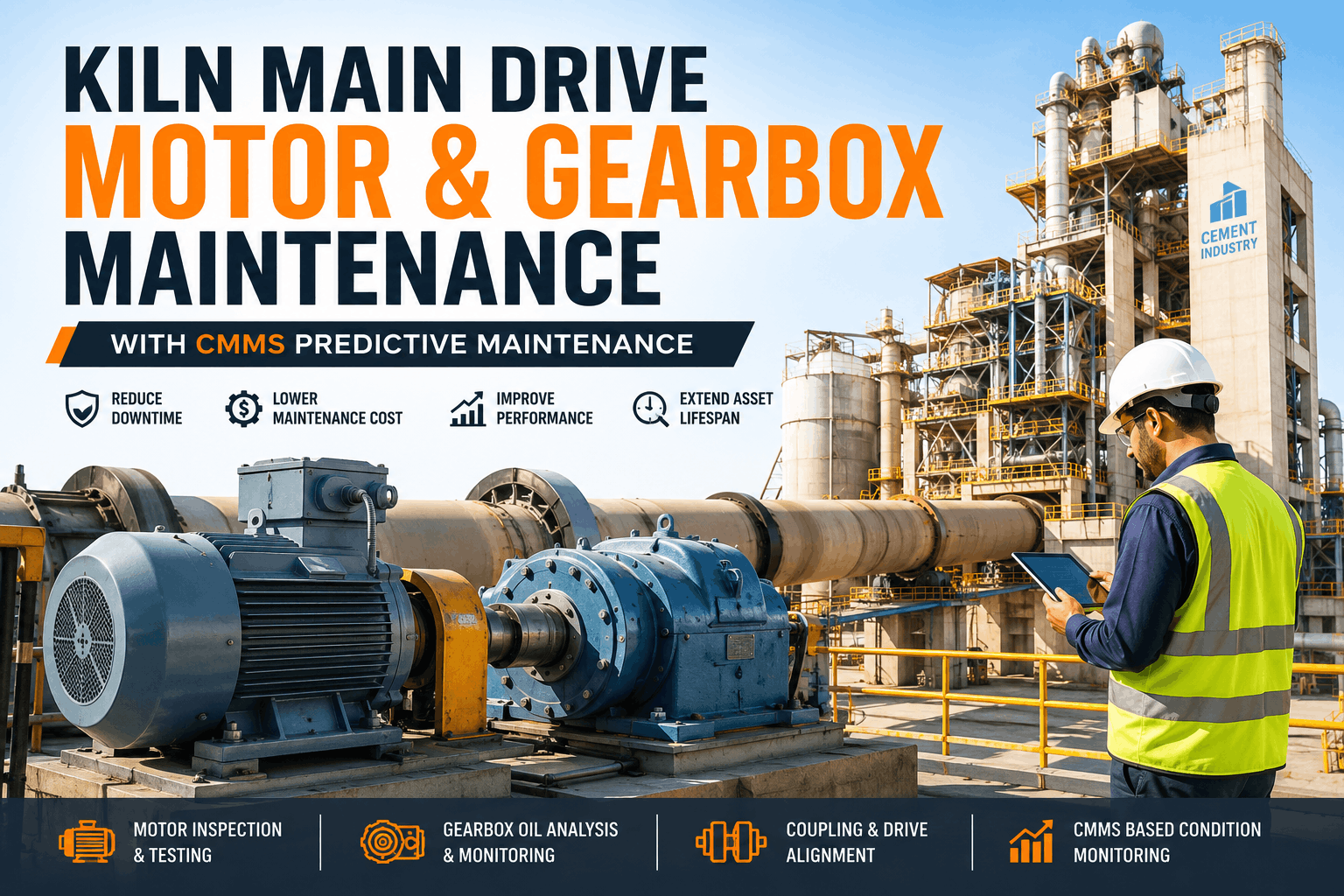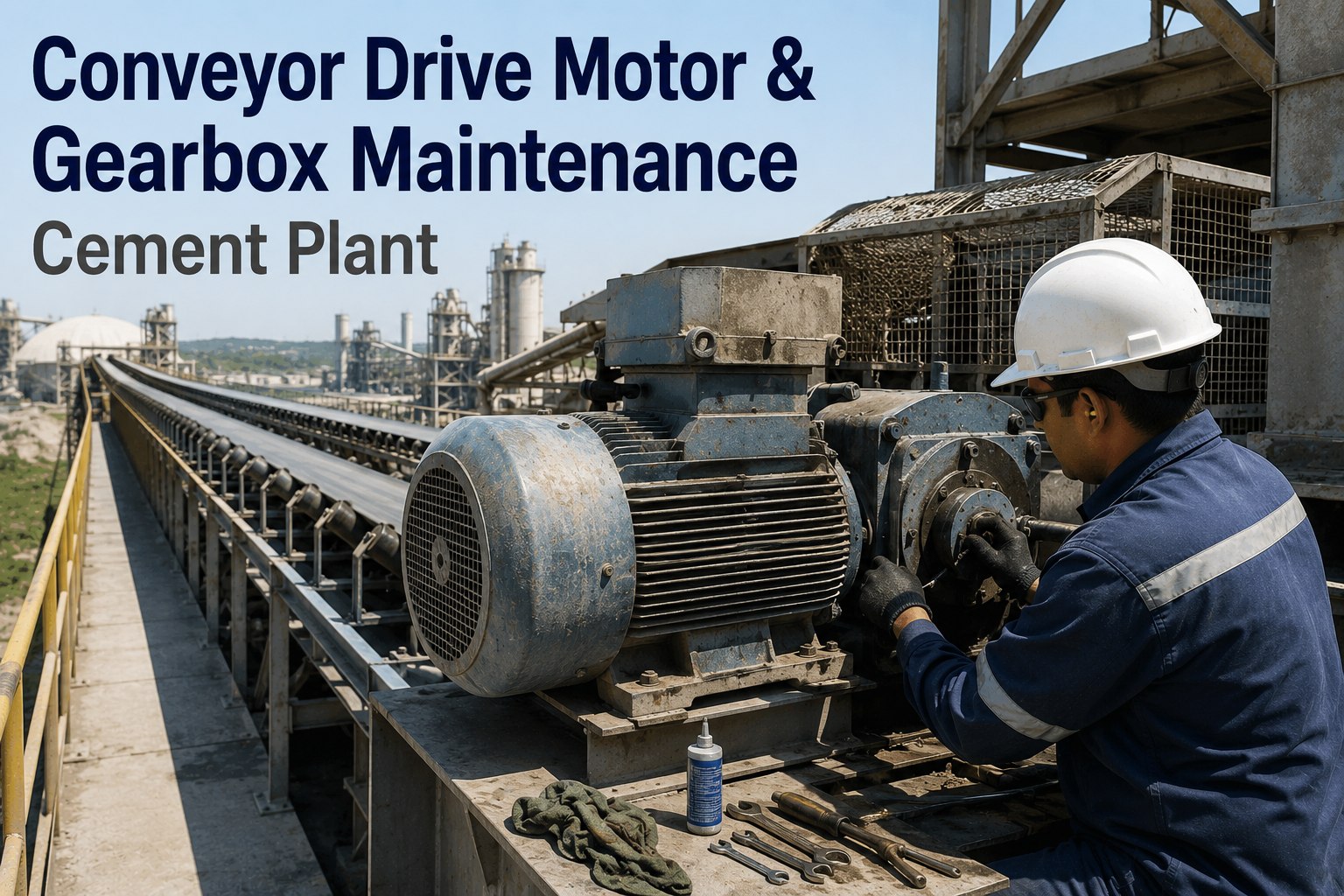
A single conveyor drive failure can halt an entire kiln feed line within minutes — and at a 5,000-tpd cement plant, every hour of stoppage translates to roughly $40,000–$70,000 in lost production. Because drive motors and gearboxes sit at the head of every critical belt, their maintenance is the single highest-leverage reliability work a cement maintenance team performs. This guide walks through the inspection cadences, oil analysis thresholds, coupling checks, and VFD care practices that keep conveyor drive trains above 98 percent availability, plus the CMMS workflows that make them repeatable. Ready to industrialize your drive-train program? Start Free Trial with oxmaint and build it in days, not quarters.
CMMS Reliability Guide · Cement Plants
What does one seized gearbox cost your kiln feed line per hour of downtime?
At a 5,000-tonne-per-day plant, a single conveyor drive failure stops the entire material flow and typically costs $40,000–$70,000 per hour in lost production, overtime, and restart fuel. The drive motor and gearbox are the highest-consequence rotating assets in your conveyor system — and the ones a CMMS-driven PM program protects best.
Why Conveyor Drives Are Mission-Critical
The drive train is where availability is won or lost
Conveyor drive motors and gearboxes account for less than 8 percent of conveyor asset count but generate over 60 percent of unplanned belt stoppages in cement plants tracked across the industry.
Worked Example
A 180-conveyor plant spending $42,000/year on reactive gearbox repairs and emergency spares implemented a CMMS-driven PM and oil-analysis program. Within 14 months, unplanned drive failures dropped 41 percent, oil-sampling caught two bearing failures before secondary damage, and total drive-train spend fell to $24,500/year — a payback period under 5 months on the CMMS subscription alone.
Motor PM Checklist
Tiered motor inspection tasks by frequency
Structure motor PM in three tiers — shift, monthly, and annual — so the highest-consequence checks happen most often. Every task below should auto-trigger as a CMMS work order with a assigned technician, spare parts list, and completion sign-off.
- Visual check for oil leaks at seals and breathers
- Infrared temperature scan at bearing housings (flag >80°C)
- Listen for abnormal whine, knock, or harmonic shift
- Confirm VFD display shows no active fault codes
- Vibration survey at drive and non-drive end (ISO 10816)
- Megger / insulation resistance test at 500V DC
- Grease bearings per lube chart — never over-lubricate
- Verify mounting bolts torqued to spec, no loose base
- Full vibration spectrum analysis with phase data
- Winding resistance and inductance balance test
- Remove, clean, and recalibrate temperature sensors
- Re-align coupling to within 0.05 mm indicator rim
Oil Analysis Program
Catch gearbox failures 3–6 months before they cascade
Oil analysis is the single highest-ROI predictive tool for conveyor gearboxes. A quarterly sample costs $35–$60 and routinely detects wear-metal trends, water ingress, and viscosity drift weeks before vibration amplitude crosses alarm thresholds.
Wear-metal severity index
SI = (Fe + Cu + Cr + Pb + Sn) × (PQ index ÷ 10)
SI > 250 → escalate to monthly sampling. SI > 600 → open gearbox for inspection within 30 days.
ISO 4406 cleanliness target
Cement conveyor gearbox: 20/18/14 or cleaner
Each ISO code reduction roughly doubles gear life. A breather-desiccant upgrade alone can drop one code in dusty kiln-floor environments.
| Test Parameter | Normal Range | Alarm Threshold | CMMS Action |
|---|---|---|---|
| Iron (Fe), ppm | 0–80 | >150 ppm or 2× trend | Halve sample interval, log work order |
| Copper (Cu), ppm | 0–30 | >60 ppm | Inspect bushings / bronze components |
| Water content | <200 ppm | >500 ppm | Drain, flush, replace breather desiccant |
| Viscosity at 40°C | ±10% of ISO VG | >15% drift | Change oil, check for fuel/shear breakdown |
| Particle Quantifier (PQ) | 0–20 | >50 or rising 3 samples | Open inspection port, magnetic plug check |
| Acid number (TAN) | 0.5–1.5 mg KOH/g | >2.5 or +1.0 trend | Schedule oil change, verify additive package |
Coupling & VFD Care
The two overlooked drive-train failure modes
Misaligned couplings and neglected VFD cooling systems together cause roughly one-third of conveyor drive failures. Both are cheap to maintain — and expensive to ignore.
Coupling misalignment
0.05 mm max indicator rim runout
Laser-align every conveyor coupling quarterly. Angular misalignment beyond 0.05 mm accelerates bearing wear 4–6× and transmits destructive axial loads into motor and gearbox shafts. Replace elastomer inserts (Lovejoy, Falk) every 8,000 hours or when hardness exceeds 90 Shore A.
VFD thermal neglect
Inspect heat sinks every 90 days
Cement dust clogs VFD heat sinks within weeks on kiln-floor and clinker-belt installations. Clean filters and fin stacks quarterly, verify fan operation, and confirm derating settings match ambient temperature. 70 percent of VFD IGBT failures trace to chronic thermal stress, not electrical faults.
CMMS-Driven Reliability
A 4-month rollout timeline that sticks
A CMMS converts these inspection tasks from memory-dependent routines into enforced, auditable work orders. Here is the typical oxmaint deployment path for a cement plant standing up a conveyor drive-train program.
Asset register & criticality
Import every conveyor drive motor and gearbox into the CMMS hierarchy with nameplate data, criticality ranking (A/B/C), bill of materials, and spare-parts min/max. Tag plant-critical (A) drives for the strictest PM cadence.
PM templates live
Build tiered PM templates — shift, monthly, annual — with checklists, safety permits, LOTO procedures, and required spare kits. Auto-generate work orders on calendar or runtime triggers; no technician action without an assigned WO.
Condition data flowing
Integrate oil-analysis lab results, vibration survey readings, and VFD fault logs into the asset record. Set alarm thresholds that auto-create corrective work orders — closing the loop between detection and action within hours, not weeks.
KPIs & optimization
Report MTBF, MTTR, PM compliance percentage, and availability by asset class. Re-baseline criticality, tune PM intervals using failure-mode data, and justify spare-parts investment with real cost-avoidance numbers from the system.
Stand up your conveyor drive program in weeks, not quarters
oxmaint gives cement maintenance teams asset hierarchies, auto-generated PM work orders, oil-analysis integration, and reliability KPIs in one platform — built for dusty, high-throughput plant floors.
FAQ
Conveyor drive maintenance, answered
How often should I sample conveyor gearbox oil in a cement plant?
Sample plant-critical (A-class) conveyor gearboxes every 90 days and non-critical units every 180 days. In dusty kiln-floor environments, a quarterly cadence catches water ingress, wear-metal trends, and viscosity drift 3–6 months before vibration alarms trigger. If a sample crosses the alarm threshold, halve the interval to monthly until two consecutive clean samples return.
What vibration severity limits should I use for conveyor drive motors?
Use ISO 10816-3 for medium machines on flexible mounts: 3.5 mm/s RMS is the caution limit, 7.1 mm/s RMS is the danger limit for machines 15–300 kW. For cement conveyors running in harsh dust, set your CMMS caution alert at 2.8 mm/s to give maintenance a 2–4 week lead time before the standard caution boundary.
Can a CMMS actually reduce my conveyor drive downtime?
Yes — by enforcing PM compliance, auto-generating work orders from condition-monitoring data, and closing the loop between detection and repair. Plants using oxmaint CMMS typically report 30–45 percent fewer unplanned drive failures within the first year because tasks no longer depend on memory or clipboard routines.
What is the biggest VFD maintenance mistake on cement conveyors?
Ignoring heat-sink and filter cleaning. Cement dust loads onto VFD cooling fins within weeks, and chronically elevated junction temperatures degrade IGBT modules long before an electrical fault appears. A 90-day cleaning cycle — scheduled automatically in the CMMS — eliminates the majority of premature VFD replacements on kiln-floor and clinker-belt installations.
Should I keep a spare gearbox for every plant-critical conveyor?
For A-class drives feeding the kiln, cooler, or finish mill — yes, a fully rebuilt spare should be on the shelf. With a 14-hour average MTTR for a gearbox swap and $40K+/hour downtime cost, the spare pays for itself in a single avoided failure. For B/C-class drives, a shared strategic spare pool across identical units is usually sufficient. Book a demo to map your criticality and spares strategy with our team.
Protect every drive motor, every gearbox, every shift
Build a CMMS-driven conveyor drive maintenance program that keeps your cement plant above 98 percent availability — with PM enforcement, oil-analysis integration, and reliability KPIs built for plant floors.
Free 14-day trial · No credit card