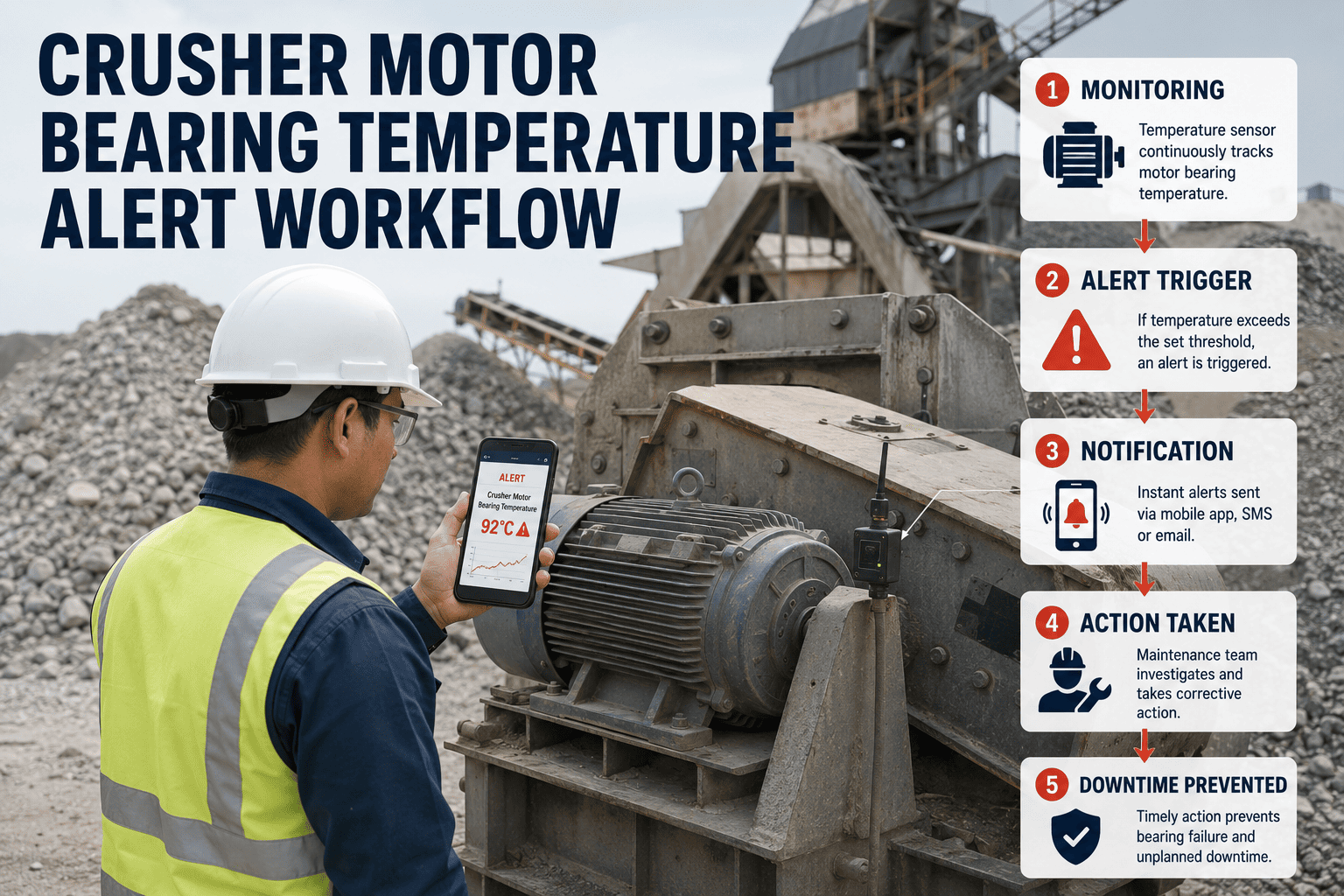
A crusher bearing does not fail without warning. It heats gradually, a few degrees at a time, as grease breaks down, dust works its way past the seal, or feed load climbs past what the race was built to carry. Most plants only catch this drift when a hand-held IR gun happens to pass by on a weekly round, or worse, when the bearing seizes mid-shift and the whole crushing circuit stops feeding the kiln. OxMaint turns bearing temperature into a live signal that raises an alert, opens a work order, and reaches the right technician before the seizure happens. Sign in to OxMaint to configure bearing temperature alerts across your crusher fleet.
The Heat Curve
How A Crusher Bearing Climbs From Normal To Failure
1
Ambient to 45°C
Normal Operating Range
The bearing runs within its designed thermal band. Grease film is intact and load distribution across the race is even. This is the baseline OxMaint records for every crusher bearing individually, not against a generic industry number.
2
45°C to 60°C
Early Friction Rise
Grease begins to lose its film strength or contamination starts increasing surface friction. The rise is slow enough that a weekly manual round can miss it entirely between visits.
3
60°C to 90°C
Active Degradation
Lubrication failure, seal wear, or overload has progressed to the point where heat generation compounds on itself. This stage typically gives a plant a one to three week window to intervene before damage becomes severe.
4
90°C and rising
Imminent Seizure
The race is close to structural damage. Without intervention, the bearing seizes, the drive motor trips, and the crusher stops feeding raw material to the plant without any planning window at all.
The Alert Workflow
From Bearing Sensor To Assigned Work Order
01
Temperature Streams In Continuously
A contact or IR sensor on the main, eccentric, or countershaft bearing feeds readings into OxMaint every few seconds, not once a week.
02
Baseline Set Per Bearing
OxMaint learns the normal operating band for that specific bearing, feed material, and load pattern, so alerts fire against the right normal.
03
Threshold Crossing Triggers An Alert
When temperature trends past the configured tier, an alert is raised automatically with the current reading, the trend line, and the affected asset.
04
Work Order Created And Assigned
A prioritised work order is generated and routed to the technician on shift, with the sensor history attached so they arrive already knowing what to check.
Stop Finding Out About Bearing Damage After The Seizure
OxMaint watches every crusher bearing continuously and turns a slow temperature climb into an early work order, so your team plans the repair instead of reacting to a stopped crusher.
Threshold Tiers
How OxMaint Escalates Bearing Temperature Alerts
| Tier | Temperature Trend | System Response | Typical Response Window |
|---|---|---|---|
| Watch | Trending above baseline | Logged, no alert raised | Reviewed at next inspection round |
| Alert | Sustained rise past 60°C | Work order created, standard priority | 1 to 3 weeks |
| Critical | Sustained rise past 90°C | Work order created, urgent priority, shift lead notified | Within current shift |
| Emergency | Rapid spike or sensor loss | Immediate notification to maintenance and control room | Immediate |
Why This Matters
The Cost Of Catching Bearing Heat Too Late
56%
of premature bearing failures across industrial crushers are lubrication-related and preventable with earlier detection
1-3
weeks is the typical warning window a bearing temperature trend gives before failure, once it is being monitored continuously
4,000+
tonnes of raw material throughput a plant can lose during a single unplanned twelve hour crusher repair
6-12
extra hours of kiln recovery time and fuel waste when a crusher stoppage empties the kiln feed buffer
Maintenance Team Experience
What Changed After Bearing Temperature Was Monitored Continuously
We used to find out a crusher bearing was failing when someone smelled hot grease on the shop floor. Now the trend shows up in OxMaint days before it would ever have been noticeable to a person walking past. We schedule the bearing change during a planned stop instead of an emergency call at two in the morning, and the difference in repair cost alone has paid for the sensors many times over.
Reliability Engineer
Integrated Cement Manufacturing Plant, Crushing And Raw Material Circuit
Root Causes
What Actually Drives A Crusher Bearing Toward Overheating
01
Lubrication Breakdown
Grease loses its film strength under sustained heat and load cycling, leaving metal surfaces in direct contact and generating friction heat.
02
Contamination Ingress
Dust and fine rock particles work past worn seals into the bearing housing, accelerating wear and raising internal friction.
03
Feed Overload
A harder rock batch or tramp metal impact pushes the bearing beyond its rated load, spiking both current draw and temperature together.
04
Shaft Misalignment
A bearing that is not seated true to the shaft carries uneven load across the race, creating a hot spot that worsens with every rotation.
Cost Comparison
Reactive Bearing Replacement vs Predictive Alerting
| Cost Factor | Reactive Replacement | Predictive Alerting |
|---|---|---|
| Bearing And Seal Parts | Standard cost, often expedited freight | Standard cost, ordered ahead of need |
| Labour | Emergency crew, overtime rates | Scheduled crew, standard shift rates |
| Production Loss | Full crusher stoppage until repaired | Repair scheduled during planned stop |
| Collateral Damage | Shaft, housing, or gear damage possible | Bearing swapped before secondary damage occurs |
Getting Started
Rollout Timeline For Bearing Temperature Alerts
1
Week 1
Sensor Installation
Contact or IR sensors are mounted on the main, eccentric, and countershaft bearings for each crusher in scope, with wiring routed to the nearest gateway.
2
Week 2
Baseline Calibration
OxMaint records normal operating temperature for each bearing under actual feed and load conditions, establishing the profile alerts will be measured against.
3
Week 3 Onward
Live Alerts And Refinement
Threshold tiers go live, work orders begin generating automatically, and alert sensitivity is fine-tuned as your team reviews the first cycle of real alerts.
Common Questions
What Cement Plant Teams Ask About Bearing Temperature Alerts
What kind of sensor is needed to feed bearing temperature into OxMaint?
Most plants use a contact RTD or thermocouple mounted directly on the bearing housing, or a fixed infrared sensor pointed at the housing surface for locations that are hard to wire. Both feed a continuous reading into OxMaint rather than the single point-in-time reading a hand-held IR gun captures on a weekly round. Book a demo to review sensor options for your crusher.
Can OxMaint tell the difference between a load-related temperature spike and a bearing problem?
Yes. OxMaint correlates temperature trend against motor current draw and feed rate, so a short spike caused by a harder feed batch is filtered out from a sustained rise that indicates lubrication failure or race damage. This keeps alert volume manageable and keeps technicians trusting the alerts they do receive. Sign in to see correlation settings for your assets.
Does a temperature alert automatically shut the crusher down?
No. OxMaint raises an alert and creates a work order, but the decision to intervene, slow the crusher, or continue running until a planned stop stays with your maintenance and operations team. The system is built to give you the earliest possible warning, not to make the shutdown decision on its own. Sign in to configure alert routing and escalation rules.
How long does it take to get bearing temperature alerts running on an existing crusher?
If sensors are already installed and feeding a PLC or SCADA system, OxMaint typically connects within hours using OPC-UA, MQTT, or REST integration. If new sensors need to be mounted, most plants have their first crusher live within one to two weeks including baseline calibration. Book a demo to scope your specific crusher setup.
Can this workflow cover multiple crushers and bearing points across the plant at once?
Yes. Each bearing point on every crusher gets its own baseline and its own alert history, and OxMaint rolls all of them up into a single reliability view so a planner can see which crusher and which bearing position is trending toward trouble first. Sign in to view fleet-wide bearing health.
Give Every Crusher Bearing A Continuous Health Check
A bearing that heats up slowly gives you weeks of warning if something is watching. OxMaint watches, alerts, and opens the work order automatically, so the next bearing failure is a planned repair instead of a stopped crusher.