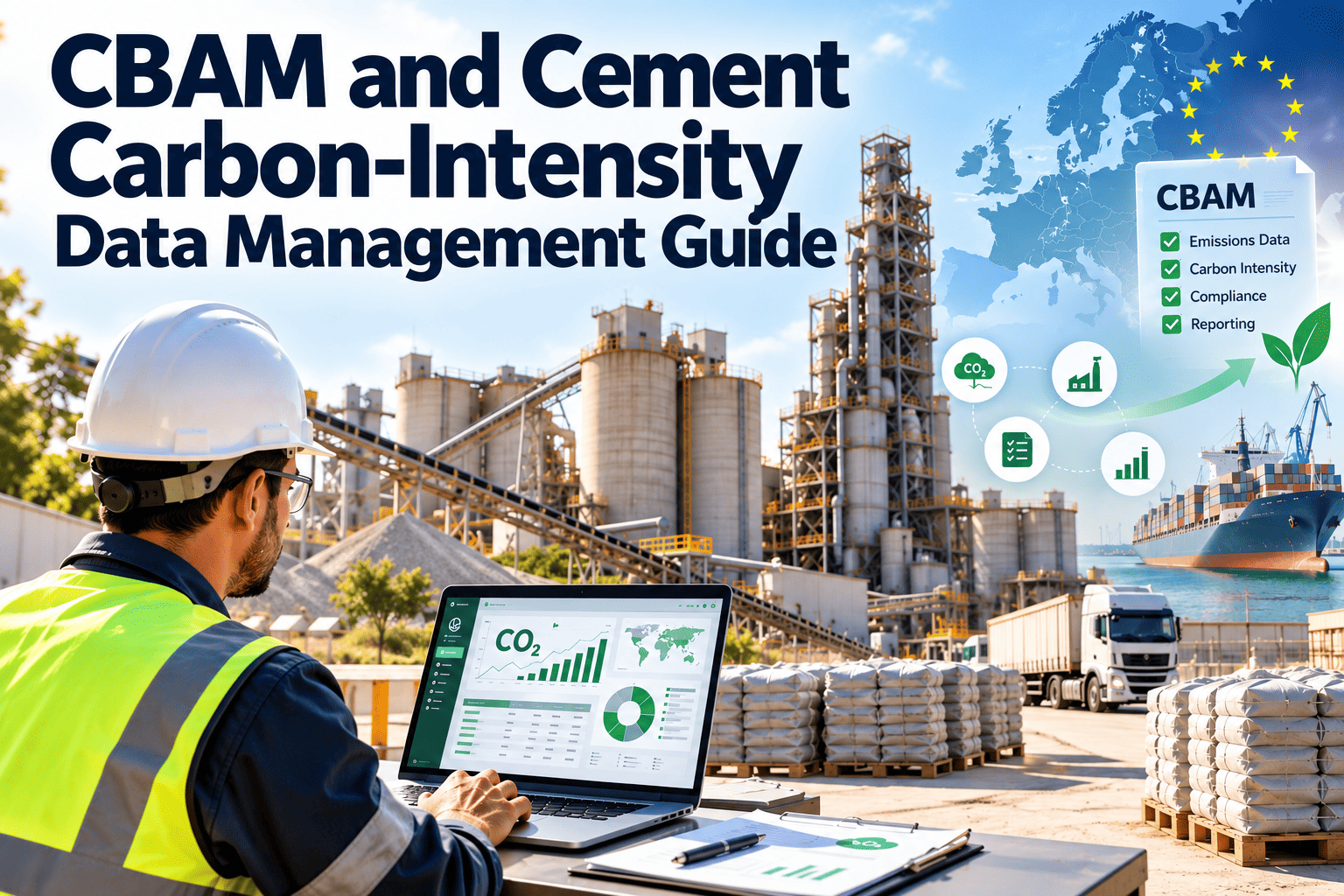
European cement producers — Heidelberg Materials, Holcim, Cemex Europe, and Buzzi — operate under the world's most aggressive decarbonization mandate: EU ETS carbon prices above $80 per tonne, CBAM import levies active from 2026, and CSRD sustainability reporting obligations requiring asset-level emissions documentation. With free allocation allowances phasing out through 2034, every unplanned kiln stop carries a dual cost — lost production and unaccounted carbon compliance exposure. Book a demo to see how Oxmaint tracks EU ETS compliance at the asset level.
$80+
EU ETS carbon price per tonne — transforming maintenance ROI calculations
2034
Free allocation fully phases out — full carbon cost exposure for all EU plants
55%
EU Fit for 55 minimum emission reduction target vs 1990 baseline
170M
tonnes of cement produced annually across Europe — second largest industrial CO₂ source
40%
of European cement plants without CMMS-tracked maintenance linked to carbon reporting
The EU ETS Decarbonization Pressure Timeline
Each regulatory phase compresses the window for European cement producers to establish structured maintenance systems with audit-ready carbon documentation — or face compounding financial exposure at every milestone.
2021–2023 · Completed
ETS Phase 4 Launch — Carbon Price Surge
EU ETS carbon price rose from $25 to above $80 per tonne with free allowances declining 2.2% annually. European cement majors began accelerating CCUS feasibility studies and alternative fuel transitions.
$80+/tonne carbon cost established
2024–2025 · Active Now
CBAM Transitional Period & CSRD Reporting Obligations
CBAM requires quarterly reporting of embedded carbon in cement products. CSRD double materiality assessments now mandate Scope 1–3 emissions linked to specific manufacturing assets and maintenance records.
CSRD asset-level reporting now mandatory
2026 · Upcoming
CBAM Full Implementation — Carbon Levy on Imports Begins
CBAM certificates become mandatory for all cement imports into the EU. Producers demonstrating certified low-carbon production gain a competitive edge — maintenance documentation is part of carbon intensity verification.
Cement import carbon levy activated
2027–2030 · Phase 4 Intensification
Free Allowance Reduction Accelerates — Fuel Switch Deadline
Free ETS allowances decline 4.3% annually from 2027. Plants without completed alternative fuel transitions or clinker substitution face full market carbon costs with no buffer.
4.3% annual allowance reduction rate
2034 · Zero Free Allocation
Full Carbon Cost Exposure — Plants Without CCUS Unviable
All free ETS allowances eliminated. Plants must purchase 100% of allowances on the market or operate CCUS commercially. Maintenance-driven emission spikes carry full carbon cost with no buffer.
100% carbon cost exposure — no free allocation
Three Decarbonization Technologies Driving Maintenance Complexity
Each decarbonization pathway introduces new asset classes and compliance documentation requirements that paper-based maintenance systems cannot reliably track.
Amine scrubbers, oxyfuel kiln retrofits, and CO₂ compression trains introduce new asset classes requiring specialised PM intervals and CCS Directive inspection schedules not covered by standard CMMS templates.
Amine scrubbers
Compression trains
CCS Directive
90%
CO₂ capture target at Norcem Brevik — requires near-total asset uptime
SRF, RDF, biomass, and hydrogen co-firing above 80% substitution rates require modified burner maintenance, expanded fuel preparation PM, and safety documentation for non-standard fuel handling systems.
SRF/RDF handling
Burner maintenance
H₂ co-firing
83%
thermal substitution rate at Holcim's leading European plants
LC3, GGBS, and fly ash substitution reduces kiln throughput but increases grinding demands. VRM and ball mill PM intervals must be recalibrated for abrasive alternative materials at higher throughput rates.
LC3 calcination
VRM recalibration
GGBS grinding
0.65
clinker-to-cement ratio target for EU net-zero pathway vs 0.76 average today
Major European Cement Producers: Decarbonization Commitments & Maintenance Challenges
Europe's largest cement groups have committed to net-zero pathways that require maintenance system transformations standard CMMS deployments do not address without EU ETS compliance configuration.
Heidelberg Materials
Germany
Largest cement producer in Europe · 160+ plants globally
Net-Zero Target
Net-zero concrete by 2050 · CCUS at Brevik operational
The Norcem Brevik CCUS project (400,000 t CO₂/year) introduces amine scrubber and compression train assets requiring new PM schedules across 16 European plants.
CCUS LeaderCSRD Reporting
Holcim Europe
Switzerland
Second largest · 83% thermal substitution rate achieved
Carbon Target
–46% net CO₂/t cement by 2030 vs 2018 baseline
ECOPact and ECOPlanet product lines require VRM PM recalibration across 70+ sites. Lägerdorf CCUS adds compression infrastructure PM to 12 German plant portfolios.
Alt-Fuels LeaderLC3 Pioneer
Cemex Europe
Spain / Mexico
30+ integrated plants across EU member states
Climate Target
Net-zero CO₂ by 2050 · Vertua Zero product range active
Operating across Germany, Spain, France, and Poland means multi-jurisdiction compliance — BetrSichV, ICCAT, and EU ETS all requiring unified maintenance documentation output.
Multi-jurisdictionCSRD Scope 1–3
Italian leader · Central European integrated operations
Sustainability Target
–30% specific CO₂ emissions by 2030 vs 2018
Italian operations face ISPRA requirements, EU ETS obligations, and the highest alternative fuel regulatory complexity in Europe — three frameworks, one maintenance system needed.
ISPRA ComplianceAlt-Fuel Leader
French cement leader · operations in 12 countries
Decarbonization Commitment
Carbon neutral cement by 2050 · Lhoist partnership active
French ICPE classification mandates 10-year retention of kiln emission records. EU ETS MRV integration requires real-time asset condition linkage to emissions reporting.
ICPE ComplianceMRV Integration
CRH / Oldcastle
Ireland / USA
Irish-domiciled global major · extensive EU presence
Climate Target
–30% CO₂ intensity by 2030 · SBTi validated
Post-divestment European operations require CMMS asset history continuity and EU ETS account reconciliation across 8+ member states — a common gap during plant ownership transitions.
SBTi ValidatedMulti-EU
CBAM and Carbon Documentation: What Maintenance Must Now Produce
CBAM creates a direct link between maintenance records and trade compliance. CEMS calibration gaps, fuel measurement lapses, and emission monitoring downtime all create CBAM reporting vulnerabilities that carry significant financial penalties.
What CBAM Requires from Maintenance Systems
Continuous CEMS uptime records with no gap periods — downtime during reporting windows triggers default emission factors that inflate reported carbon intensity.
Alternative fuel measurement records — calorific value analyser calibration and biomass moisture sensor PM logs linked to fuel composition reporting.
Calcination monitoring equipment PM — kiln gas analyser calibration and bypass filter records required for process emission calculation verification.
Audit-ready export of emission-relevant PM activities for third-party EU Accreditation Body verification — required every quarter.
$50–150
per tonne CBAM penalty if CEMS maintenance gaps exist during reporting period
How Oxmaint Closes the CBAM Documentation Gap
CEMS equipment PM templates with automated escalation alerts when monitoring equipment PM is overdue — preventing reporting gaps that trigger default emission factors.
Alternative fuel metering and analyser calibration work orders linked to the fuel composition database — every activity generates a timestamped CBAM-ready record.
One-click CBAM evidence export — all emission-relevant PM records for the period compiled into a structured verifier-ready report with no manual search.
Multi-plant carbon monitoring dashboard — aggregate CEMS uptime and fuel measurement PM compliance across all EU sites on a single screen.
100%
CEMS uptime documentation target when PM scheduling is linked to CBAM reporting calendar
Oxmaint Generates CBAM-Ready Maintenance Evidence Automatically
Every calibration and PM on emission-monitoring equipment creates a verified, timestamped record ready for CBAM quarterly submission — no manual compilation, no verifier risk. Book a demo to see the CBAM compliance documentation module.
EU vs Global CMMS Compliance Coverage
European plants operate under the most complex multi-framework compliance environment globally — combining EU ETS, national machinery safety regulation, environmental permits, and CSRD. Oxmaint's European configuration addresses all layers in a single platform.
← Scroll to view full table
How Oxmaint Solves European Cement Plant Compliance & Maintenance Gaps
Platform Overview
Four structural gaps drive compliance risk in European cement: carbon documentation disconnected from maintenance systems, CCUS and alternative fuel assets without PM templates, manual multi-jurisdiction renewal tracking, and no portfolio view across large plant estates. Oxmaint addresses each through pre-built EU compliance templates, carbon-linked work orders, multi-jurisdiction tracking, and a group-scale portfolio dashboard.
EU ETS Carbon Tracking
CBAM Evidence Auto-Generation
CCUS Asset PM Templates
CSRD Sustainability Reports
EU ETS Carbon-Linked Maintenance Records
CSRD-ready · automated quarterly export
Every PM on emission-relevant equipment generates a carbon-tagged record. Oxmaint maps each asset's maintenance history to its Scope 1 contribution — producing the asset-level documentation required for CSRD and CBAM verifier submissions. Book a demo to see EU ETS carbon tracking for your plant fleet.
CCUS & Alternative Fuel Asset PM Templates
Pre-built templates · live in 14 days
Oxmaint ships with PM libraries for new decarbonization assets: amine scrubber intervals, CO₂ compression train schedules, SRF/RDF handling, biomass analyser calibration, and H₂ burner checks — aligned to BetrSichV and PSSR requirements.
Multi-Jurisdiction Regulatory Renewal Tracking
8+ EU member states · per-country permit calendar
Oxmaint tracks each country's environmental permit renewal cycle, TÜV inspection interval, and regulatory submission deadline across all plants — with automated escalation alerts at 60, 30, and 7 days before each deadline. Book a demo for your European plant estate.
Portfolio Carbon Dashboard for European Cement Groups
70+ site coverage · single-screen EU ETS view
Central sustainability teams see CEMS uptime, alternative fuel PM compliance, and emission monitoring asset status across the entire plant estate in real time — enabling CBAM reporting risk identification before quarterly submission deadlines.
European Cement Plant KPI Benchmarks: EU ETS & Maintenance Performance
CEMS Uptime Rate — Oxmaint EU Config Target
CBAM Audit Preparation Time Reduction
Alternative Fuel Asset PM Compliance Rate
Reduction in Unplanned CCUS Asset Stops
TÜV / Statutory Inspection Overdue Rate Reduction
Multi-Plant Permit Renewal Miss Elimination
EU ETS Compliance Workflow: From Maintenance Event to Carbon Report
1
CEMS & Emission Equipment PM Triggered
Oxmaint auto-generates CEMS calibration and stack sensor PM work orders aligned to EU ETS MRV Plan reporting intervals — preventing monitoring gaps.
→
2
Carbon-Tagged Work Order Completed
Technician completes work order on mobile with photo evidence. System timestamps completion and links the activity to the asset's EU ETS monitoring plan classification automatically.
→
3
CSRD & CBAM Evidence Accumulated
Carbon-relevant maintenance activities accumulate in a structured compliance record — CEMS uptime log, fuel measurement calibration history, and alternative fuel PM — throughout the reporting quarter.
→
4
One-Click Verifier Report Export
At CBAM submission or CSRD reporting, Oxmaint exports a structured evidence package meeting verifier requirements — no manual search, no missing records.
Frequently Asked Questions: CMMS for European Cement & EU ETS Compliance
QDoes Oxmaint support EU ETS carbon monitoring documentation for European cement plants?
Yes. Oxmaint includes pre-built PM templates for all EU ETS emission-relevant equipment — CEMS analyzers, stack sensors, fuel metering systems — and automatically generates carbon-tagged maintenance records usable as MRV Plan compliance evidence and for CBAM quarterly reporting.
Book a demo to see the EU ETS compliance module.
QHow does Oxmaint handle CSRD asset-level sustainability reporting requirements?
Oxmaint maps each maintenance asset to its Scope 1 emission category and links completed PM activities to emission performance records — producing the asset-level carbon documentation chain required for CSRD double materiality assessments, exportable for third-party assurance.
Book a demo to review CSRD configuration for your operation.
QCan Oxmaint manage CCUS and alternative fuel asset maintenance alongside standard kiln PM?
Yes. Oxmaint ships with PM libraries for CCUS assets (amine scrubbers, CO₂ compression trains) and alternative fuel systems (SRF/RDF handling, biomass analysers, H₂ co-firing burners) alongside standard cement plant assets — all managed in a single unified platform.
QHow does Oxmaint handle multi-country compliance for groups across EU member states?
Oxmaint's compliance calendar supports per-country configurations — BetrSichV (Germany), PSSR (UK), ICPE (France), ISPRA (Italy) — with separate permit renewal deadlines and TÜV inspection intervals tracked per plant, all visible in a unified portfolio dashboard for central engineering teams.
QWhat is the ROI case for EU cement plant CMMS investment given EU ETS carbon pricing?
At $80+/tonne, a CEMS monitoring gap triggering default emission factors on a 3,000 TPD kiln can add $500,000–$1.2M in unnecessary carbon cost per quarter. Oxmaint's CEMS PM scheduling eliminates this risk while reducing unplanned kiln stops by 64% — delivering payback well within 6 months.
Book a demo to model the ROI case for your plant fleet.
QDoes Oxmaint integrate with existing CEMS hardware already installed at European plants?
Yes. Oxmaint integrates with existing CEMS platforms via OPC-UA and REST API, accepts CEMS reading imports and calibration logs via mobile work orders, and connects to standard EU emission monitoring stacks — no CEMS hardware replacement required.
Book a demo to confirm compatibility with your setup.
Continue Reading