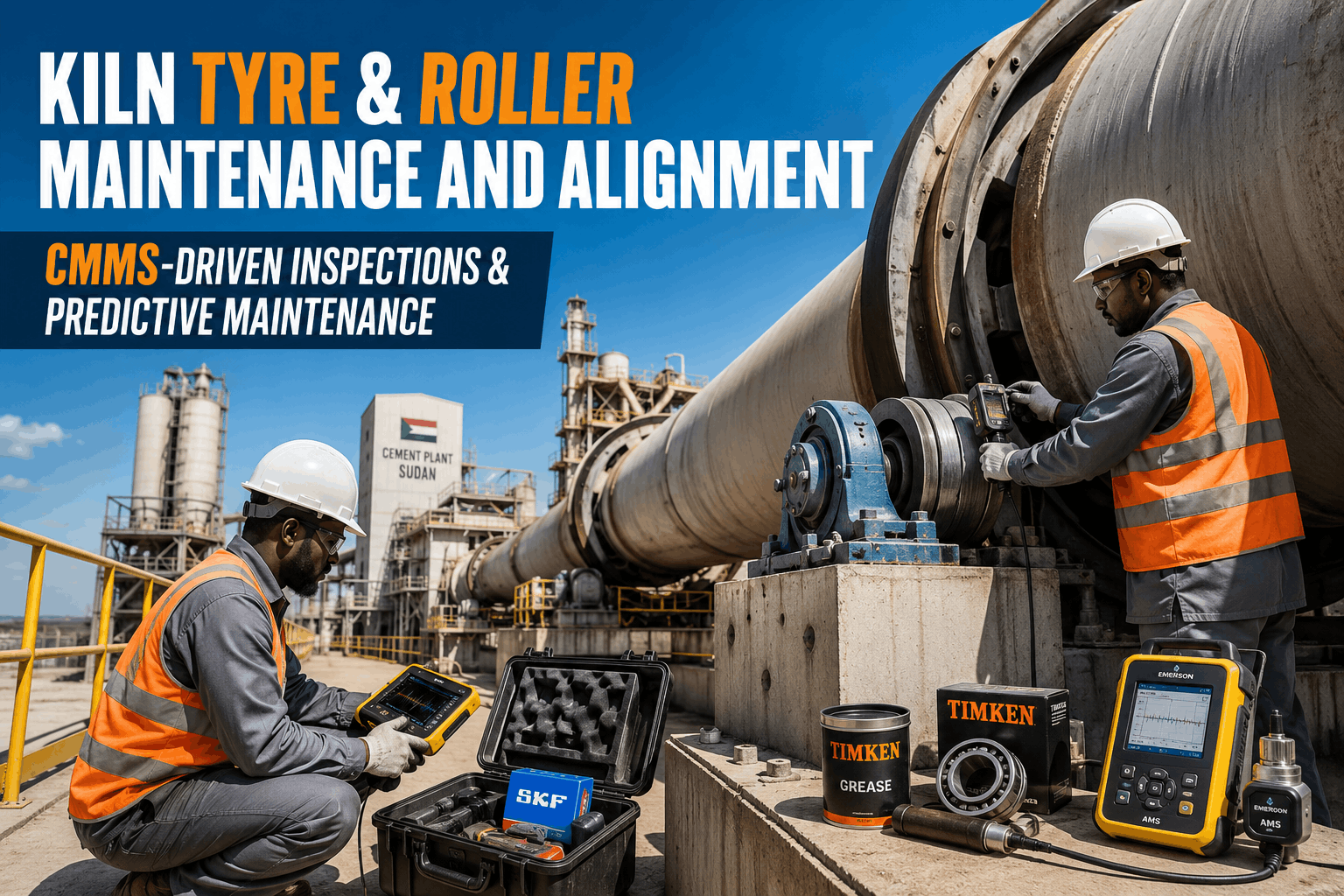
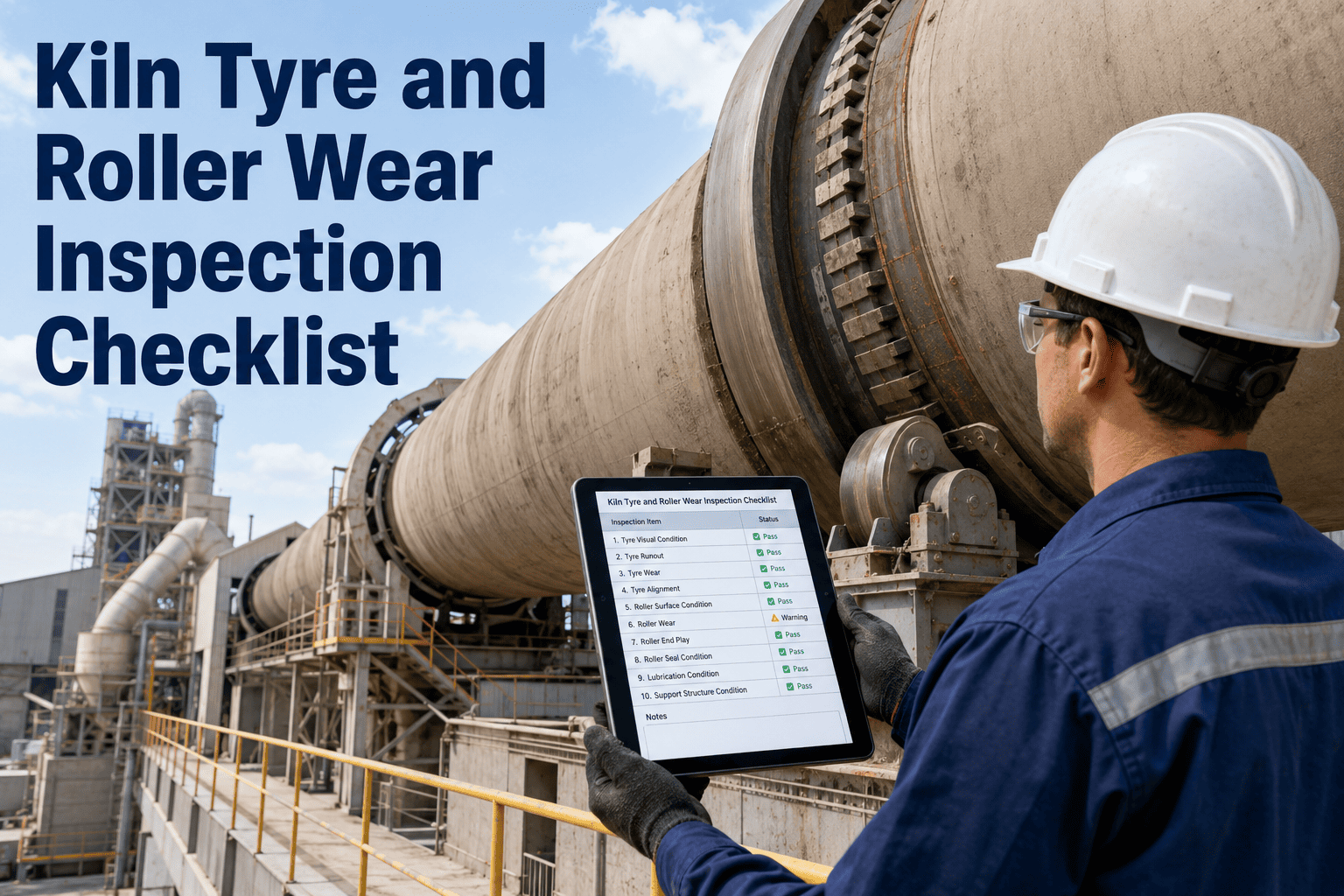
Rotary kilns are the backbone of cement, lime, and mineral processing plants — rotating continuously under extreme thermal and mechanical stress. When kiln alignment drifts undetected, the consequences cascade: accelerated tyre and riding ring wear, distorted shell sections, bearing overloads, and ultimately catastrophic failures that shut down production for weeks. This guide covers the field-proven alignment practices that reliability engineers use to keep rotary kilns running at peak availability — and how OxMaint's preventive maintenance platform keeps every measurement tracked, trended, and acted upon.
Rotary Kiln Alignment & Hot Kiln Measurement: A Reliability Engineer's Field Guide
NKM hot kiln measurement, axis verification, tyre migration, support roller skew — the complete alignment playbook with CMMS-tracked records for cement and mineral processing plants.
Why Rotary Kiln Alignment Fails
Kiln misalignment rarely appears overnight. It develops gradually through thermal cycling, foundation settlement, and wear — and stays invisible until product quality drops or a major component fails. The five root causes below account for over 85% of alignment-driven failures in cement and lime kilns.
Failure Mode Cost Reference
| Failure Mode | Primary Driver | Warning Sign | Avg. Downtime Cost |
|---|---|---|---|
| Shell ovality / cracking | Sustained axis misalignment | Brick drop, hot spot | $180,000–$400,000 |
| Tyre / riding ring wear | Tyre migration, roller skew | Surface spalling, migration rate increase | $90,000–$250,000 |
| Support roller bearing failure | Overload from misalignment | Temperature rise, vibration change | $60,000–$150,000 |
| Girth gear misalignment | Shell flex, pier movement | Backlash increase, noise | $70,000–$180,000 |
| Thrust roller overload | Excessive axial migration | Bearing temperature spike | $50,000–$130,000 |
NKM Hot Kiln Measurement — The Gold Standard
The Neck-Kiln Method (NKM) — also called hot kiln alignment — measures kiln geometry while the kiln is running at operating temperature. This is the only method that captures true load distribution, shell deflection, and pier elevation in the actual thermal state. Cold alignment surveys are useful for baseline data but cannot substitute for NKM in a reliability program.
Optical or laser targets placed at each pier position capture shell center coordinates while the kiln rotates. Readings taken at minimum 6 angular positions per pier. Acceptable shell deflection at each support is typically within 1.5–3 mm depending on kiln diameter and OEM specification.
Precise leveling instruments establish absolute pier elevation relative to the theoretical kiln axis. Differential settlement between adjacent piers exceeding 2 mm requires immediate engineering review. Results logged as before/after pairs in the CMMS asset record.
From shell deflection data, load on each support station is calculated. Ideal load distribution for a three-pier kiln is approximately 33/33/33%. Deviations beyond 15% from equal distribution indicate axis offset requiring roller position correction.
Full NKM hot kiln survey every 12–18 months or immediately following any refractory replacement, major shutdown, unusual vibration event, or observable change in tyre migration rate. Findings must be documented with correction actions and re-verification dates in the CMMS.
Schedule and Track Every Kiln Alignment Survey Automatically
OxMaint auto-generates NKM survey work orders on your defined schedule, captures before/after readings with technician signoff, and trends results over time to flag developing alignment drift before it becomes a failure.
Axis Verification Methods Compared
Kiln axis verification can be performed by several methods, each with distinct accuracy profiles, cost implications, and suitability for hot versus cold conditions. Selecting the right method for each application is a reliability decision, not simply a cost decision.
Tyre Migration — Key Thresholds
Tyre migration (axial creep of the tyre relative to the kiln shell) is the most frequently monitored kiln alignment indicator. Daily migration readings take under 5 minutes but provide the earliest possible warning of a developing mechanical problem.
Support Roller Skew — Setting and Verification
Roller skew controls the axial position of the kiln by inducing a controlled migration force. Incorrect skew — either too aggressive or in the wrong direction — is a primary driver of thrust bearing overload, tyre wear, and pier damage. Skew must be set as a precision engineering task, not adjusted by feel.
| Parameter | Typical Specification | Measurement Tool | Check Frequency |
|---|---|---|---|
| Roller axial skew angle | 0.5–2.0 mm per meter of roller width | Dial gauge on roller face | Every NKM survey + after any roller adjustment |
| Roller crown contact | Full face contact, no edge loading | Contact pattern check (blue) | Each shutdown opportunity |
| Roller bearing temperature | Alert: > 70°C / Action: > 85°C | Infrared thermometer | Daily during operation |
| Roller shaft parallelism | Within OEM tolerance (typ. ±0.15 mm/m) | Laser or optical level | Each NKM survey |
Kiln Alignment Inspection Checklist
Use this checklist as the minimum touchpoint framework for a rotary kiln alignment program. Every reading must be recorded in your CMMS with technician name, timestamp, and deviation flag. OxMaint converts this into mobile work orders with auto-escalation.
Frequently Asked Questions
Your Kiln Alignment Program Belongs in a CMMS — Not a Spreadsheet
OxMaint gives your reliability team auto-scheduled NKM surveys, mobile-accessible checklists, trending dashboards for tyre migration and roller temperatures, and a full audit trail — all without a large IT project. Most kiln maintenance teams are live within one week.