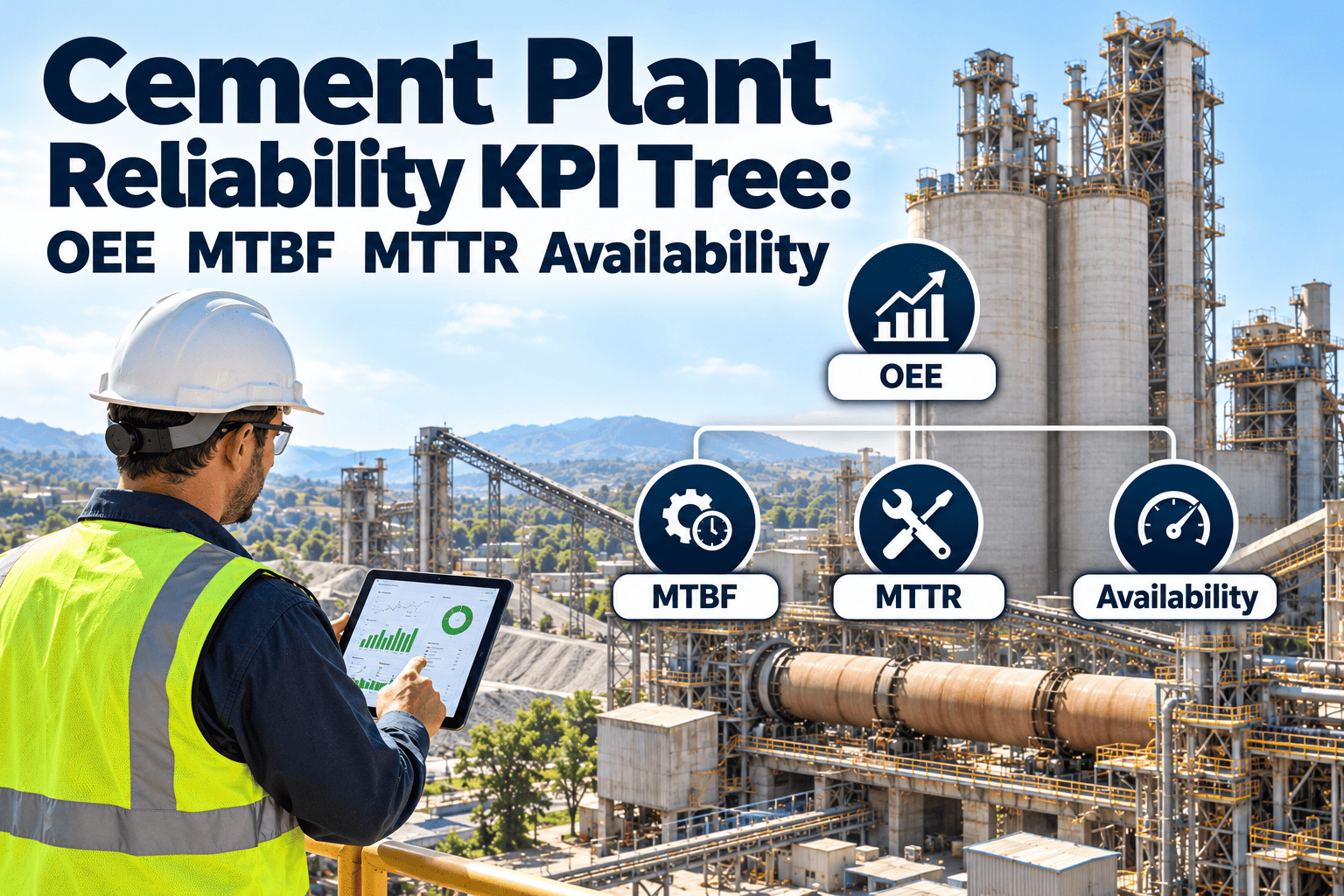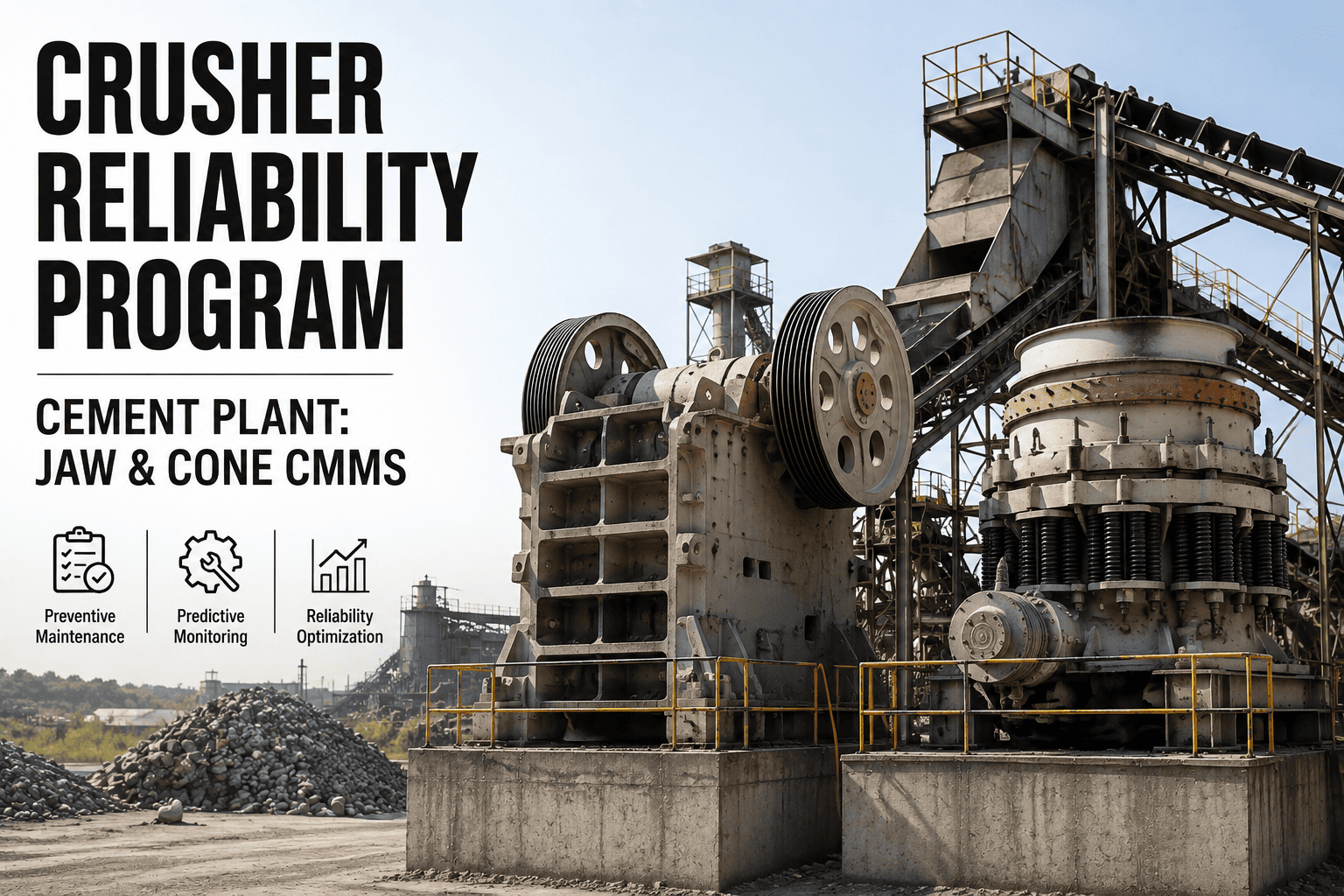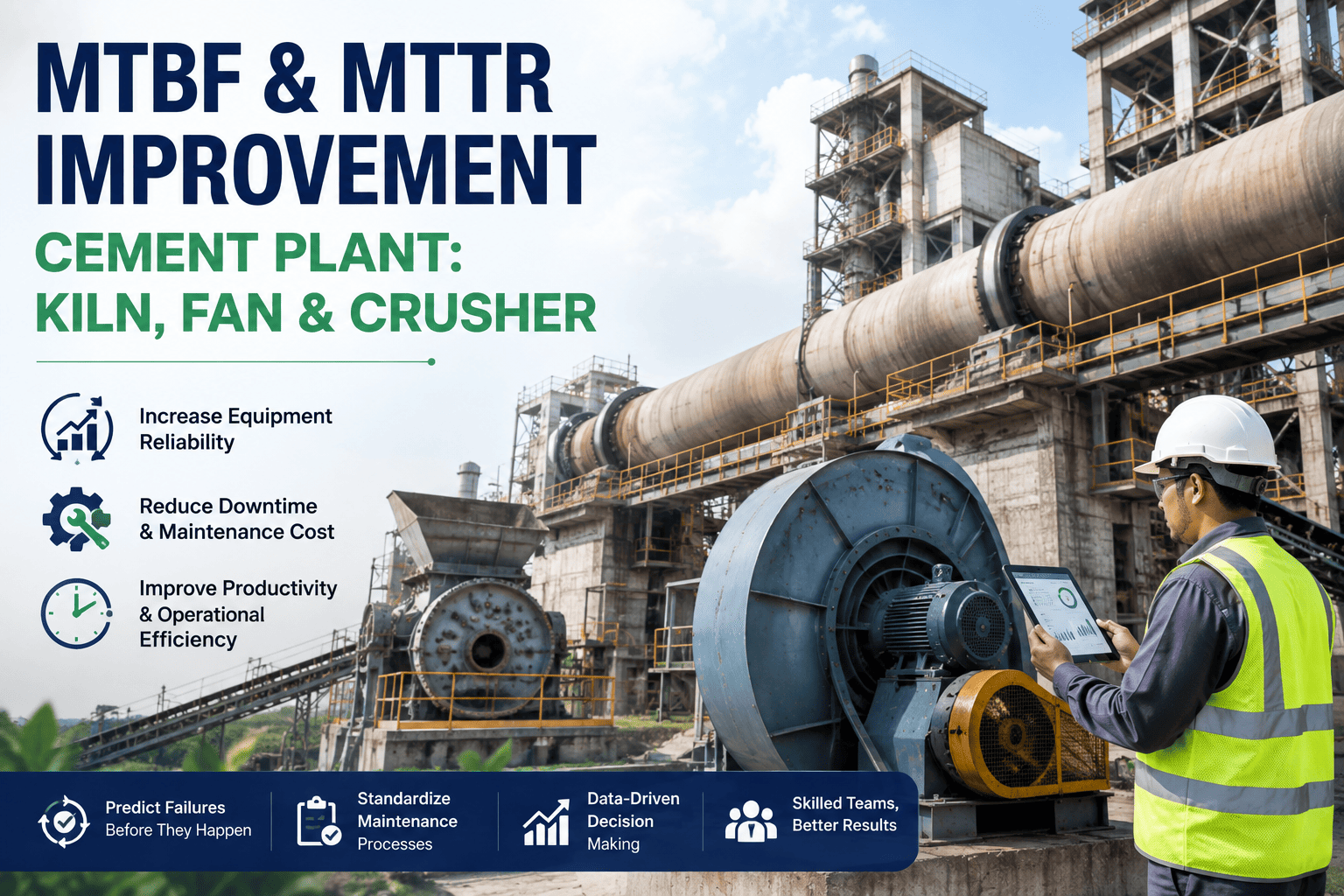
MTBF and MTTR are the two operational metrics that separate reliability-driven cement plants from reactive ones, where a single kiln outage can burn through $50,000–$120,000 per day in lost clinker production. The kiln, induced-draft fan, and crusher sit at the intersection of thermal, rotational, and impact stress—making them the highest-leverage targets for reliability programs. A well-instrumented CMMS turns anecdotal breakdowns into trended failure modes, root-cause patterns, and managed KPIs. Start your Start Free Trial to see where your plant's MTBF and MTTR actually stand today.
Is your kiln running 8 months between failures — or 8 weeks?
In a typical 5,000 TPD cement plant, extending kiln MTBF from 90 to 180 days and cutting fan MTTR by 40% recovers over $1.8M in annual production. The gap between world-class and average is measurable, manageable, and CMMS-driven.
The two metrics that define cement reliability
MTBF (Mean Time Between Failures) and MTTR (Mean Time To Repair) are the bookends of asset reliability. Together they determine whether a cement plant runs a predictable campaign or lurches from one breakdown to the next.
Measures how long an asset runs before failing. A kiln with 2,160 operating hours and 4 failures has an MTBF of 540 hours (~22 days). World-class kiln campaigns push this above 4,000 hours.
Measures how fast you recover. If a crusher's 5 repair events consumed 38 hours combined, MTTR is 7.6 hours. Top-quartile plants hold crusher MTTR under 4 hours through staged spares and digital SOPs.
Where world-class plants actually run
Reliability benchmarks vary by equipment class, but the ranges below reflect documented performance across ISO 55000-aligned cement operations. Use them as calibration, not aspiration.
| Asset | Average MTBF | World-class MTBF | Average MTTR | World-class MTTR | Annual Downtime Impact |
|---|---|---|---|---|---|
| Rotary Kiln | 90–120 days | 180–240 days | 18–36 hrs | 8–14 hrs | $1.5M – $4.2M |
| Induced-Draft Fan | 120–180 days | 300–365 days | 12–24 hrs | 4–8 hrs | $400K – $900K |
| Limestone Crusher | 60–90 days | 180–270 days | 8–16 hrs | 3–6 hrs | $250K – $600K |
| Cement Mill | 100–150 days | 240–300 days | 14–28 hrs | 6–12 hrs | $600K – $1.4M |
| Preheater Fan | 150–200 days | 300–365 days | 10–20 hrs | 4–8 hrs | $350K – $750K |
Kiln MTBF: extending campaign windows
A cement kiln is a 60-meter rotating pressure vessel operating at 1,450°C. Extending its MTBF from 90 to 180 days can recover $2M+ annually — but only if you track the right failure modes.
Tire & roller wear
Uneven contact surfaces generate axial thrust that destroys support bearings. Laser alignment every 60 days, tracked in CMMS, extends tire life by 30–40% and prevents the 36-hour bearing changeout.
Shell hot spots & coating collapse
Infrared thermography scans — logged weekly in the CMMS — catch refractory thinning before a 2-meter shell section deforms. Early detection converts a 5-day refractory repair into a planned 18-hour patch.
Drive girth-gear misalignment
Pinion-to-gear backlash drifts 0.2–0.4 mm per quarter. Vibration analysis at 30-day intervals, with thresholds automated in the CMMS, catches the drift before tooth pitting forces a 72-hour gear reversal.
Seal gas leakage
Kiln inlet and discharge seals degrade under thermal cycling. Pressure-differential monitoring flags seal failure 7–14 days before false-air ingress destabilizes the burning zone and forces an unplanned stop.
A 3,800 TPD plant in Rajasthan tracked kiln shell temperature, tire migration, and pinion vibration in a CMMS over 14 months. By shifting from calendar-based to condition-based refractory inspections, kiln MTBF rose from 104 to 196 days. MTTR fell from 28 to 11 hours because spare bricks and casting were pre-staged against flagged hot spots. Net recovery: $2.3M in regained clinker output — against a $38K CMMS subscription.
Cutting MTTR on fans and crushers
Fans and crushers fail less often than kilns, but when they do, repair time is the killer. A 5,000 TPD line losing its ID fan for 22 hours loses roughly $110K in clinker. Staged spares and digital SOPs compress that window hard.
ID fan — balance & bearing swap
Pre-stage a balanced rotor assembly. Swap-in MTTR drops from 22 hrs to 6 hrs. Vibration trend in CMMS triggers the work order 14 days early.
Preheater fan — erosion tracking
Dust-laden gas erodes impeller tips. Borescope inspections every 45 days, logged in CMMS, predict 80% of erosion failures before vibration spikes.
Crusher — mantle & concave change
Pre-kit liners, bolts, and shims. Digital SOP with torque sequences cuts change-out from 14 to 5 hrs. Spare mantle lives in CMMS with bin location.
Crusher — screen & frame cracks
Magnetic-particle inspection on welds every 90 days catches frame cracks early. CMMS history links crack growth rate to feed-tonnage spikes.
A six-month MTBF/MTTR improvement timeline
Reliability gains compound when you sequence them correctly. This timeline reflects the cadence used by cement plants that moved from reactive to predictive in under a year.
Baseline & data cleanup
Import 18 months of work-order history into the CMMS. Tag every failure on kiln, fan, and crusher by failure mode (bearing, refractory, seal, gear, liner). Calculate current MTBF and MTTR per asset.
Root-cause & criticality
Run FMEA on the top 10 failure events by downtime cost. Assign criticality (A/B/C) to every asset. Identify the 3 failure modes causing 70% of unplanned hours — these become the first targets.
Spare-parts staging
Pre-stage rotors, bearings, liners, and refractory kits for A-critical assets. CMMS min/max reorder points ensure stock. Target: zero "waiting for parts" hours on kiln, ID fan, and crusher repairs.
Digital SOPs & checklists
Convert tribal knowledge into CMMS-attached SOPs with torque values, sequences, and photo references. Mechanics follow tablets, not memory. Standardized repair steps cut MTTR variance by 40%.
Condition-based triggers
Wire vibration, thermography, and oil-analysis thresholds into automated work orders. A bearing hitting 7.1 mm/s RMS generates a replacement job — not a post-mortem. Kiln hot spots above 380°C trigger inspection.
Measure & recalibrate
Re-calculate MTBF and MTTR. Most plants see kiln MTBF climb 40–60% and fan MTTR drop 30–50%. Feed results back into the FMEA. Re-rank failure modes and start the next cycle on the new top 3.
Ready to turn MTBF and MTTR into managed KPIs?
See how oxmaint centralizes failure history, condition triggers, and spare-parts staging for kiln, fan, and crusher assets — in one CMMS built for cement.
Questions plant managers ask before deploying a CMMS
What is a realistic kiln MTBF target for a mid-size cement plant?
A mid-size plant (2,000–4,000 TPD) running a well-maintained kiln should target 150–180 days between failures, with world-class operations exceeding 200 days. If your current kiln MTBF sits below 90 days, the first priority is failure-mode tagging in a CMMS — 70% of premature kiln stops trace back to three causes: refractory failure, tire and roller wear, and girth-gear misalignment. You can explore the tagging workflow with a Start Free Trial.
How do we reduce MTTR on induced-draft fans without keeping expensive spare rotors idle?
Pre-stage one balanced rotor assembly per critical fan and track its storage location in the CMMS. The swap-in typically takes 5–7 hours versus 18–24 hours for an in-situ repair. When vibration trends cross 7.1 mm/s RMS, the CMMS auto-generates a swap work order 10–14 days before catastrophic failure — giving you time to mobilize the crew and crane without expediting fees.
Which CMMS analytics actually move MTBF and MTTR in a cement plant?
The four that matter most are: failure-mode trending by asset (catches repeat offenders), MTBF/MTTR dashboards by equipment class (spots drift before it becomes a stop), condition-based work-order triggers (vibration, temperature, oil analysis), and spare-parts readiness reporting (ensures parts are staged before the job starts). Together they shift a plant from reactive to predictive within 6 months. Book a Book a Demo to see the dashboards configured for cement assets.
How quickly can a cement plant see MTBF and MTTR improvements after CMMS deployment?
Most plants see measurable MTTR reduction within 60–90 days — primarily from digital SOPs and pre-staged spares. MTBF gains typically appear in months 4–6, once condition-based triggers and failure-mode analytics have accumulated enough history to shift inspections from calendar-based to condition-based. Full ROI, including recovered clinker output, usually lands between 5 and 9 months.
What is the single biggest mistake cement plants make when tracking MTBF and MTTR?
Treating them as plant-wide averages instead of calculating them per asset and per failure mode. A plant-wide MTBF of 120 days can hide a kiln running at 210 days and a crusher at 45 days. Without asset-level granularity, reliability dollars get spread evenly instead of targeting the 20% of assets causing 80% of downtime. A CMMS that forces failure-mode tagging at work-order closeout fixes this from day one.
Start managing MTBF and MTTR like the top quartile
Join cement plants using oxmaint to extend kiln campaigns, cut fan repair windows, and stage spares with precision. Your reliability data becomes your reliability strategy.
Free 14-day trial · No credit card