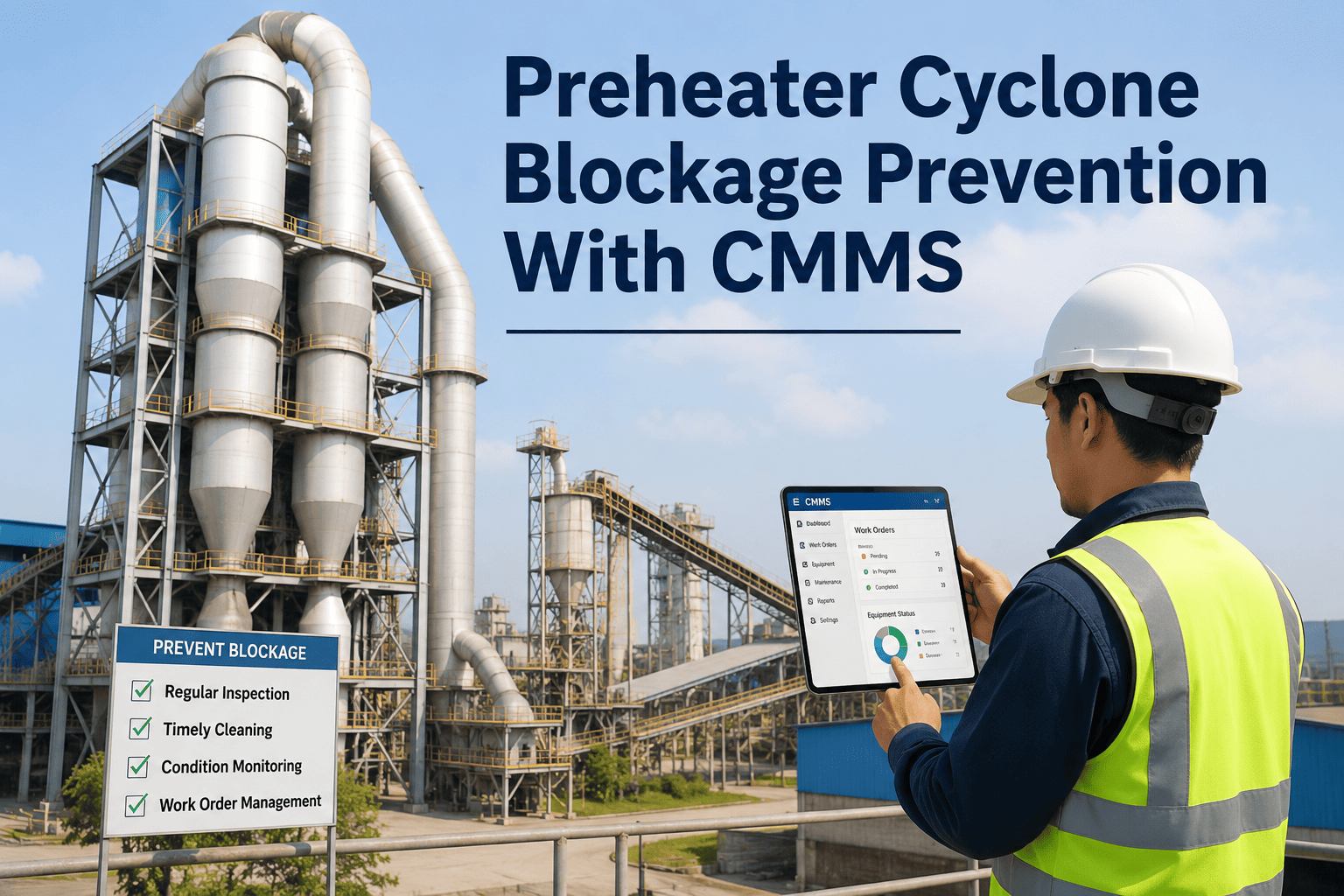
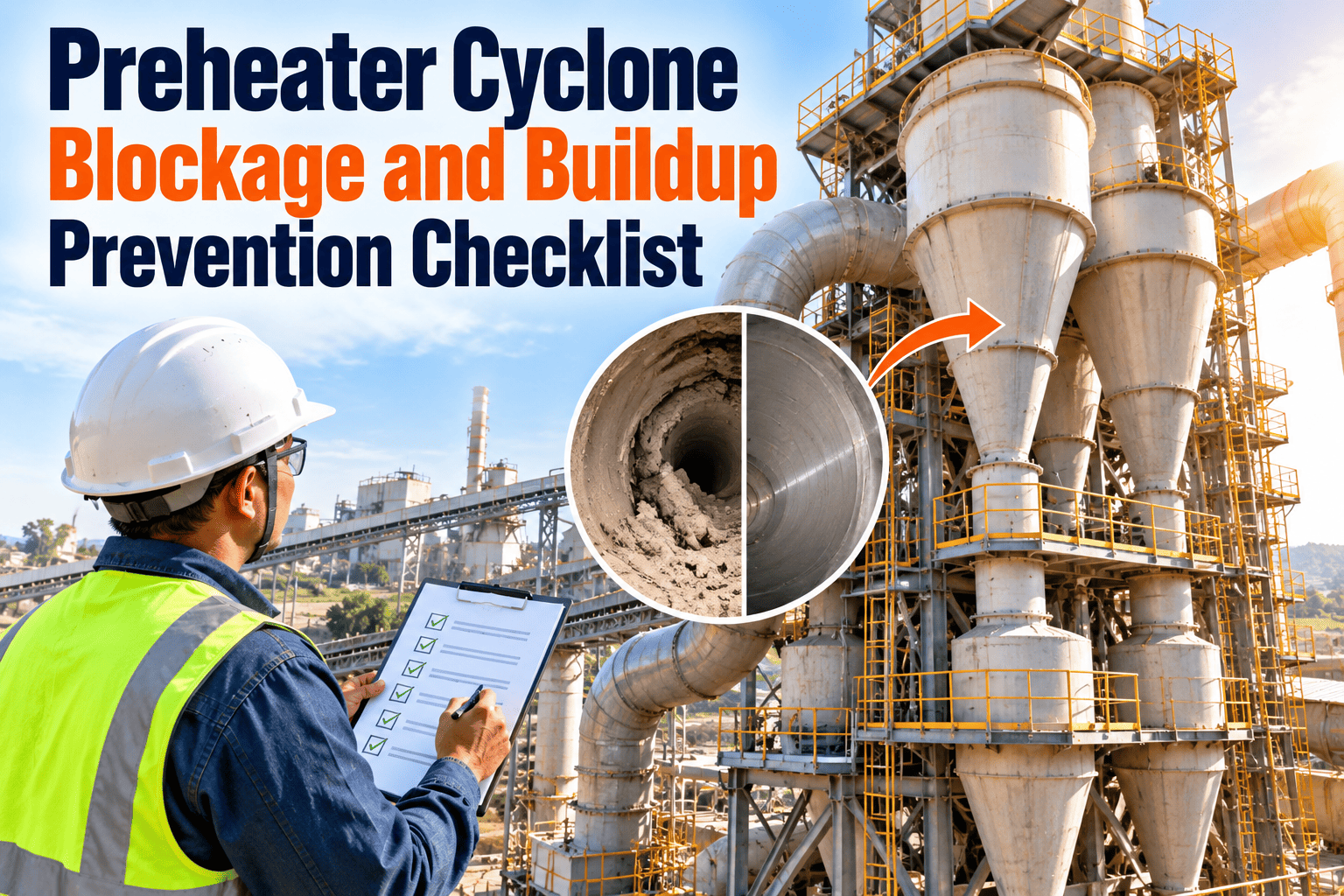
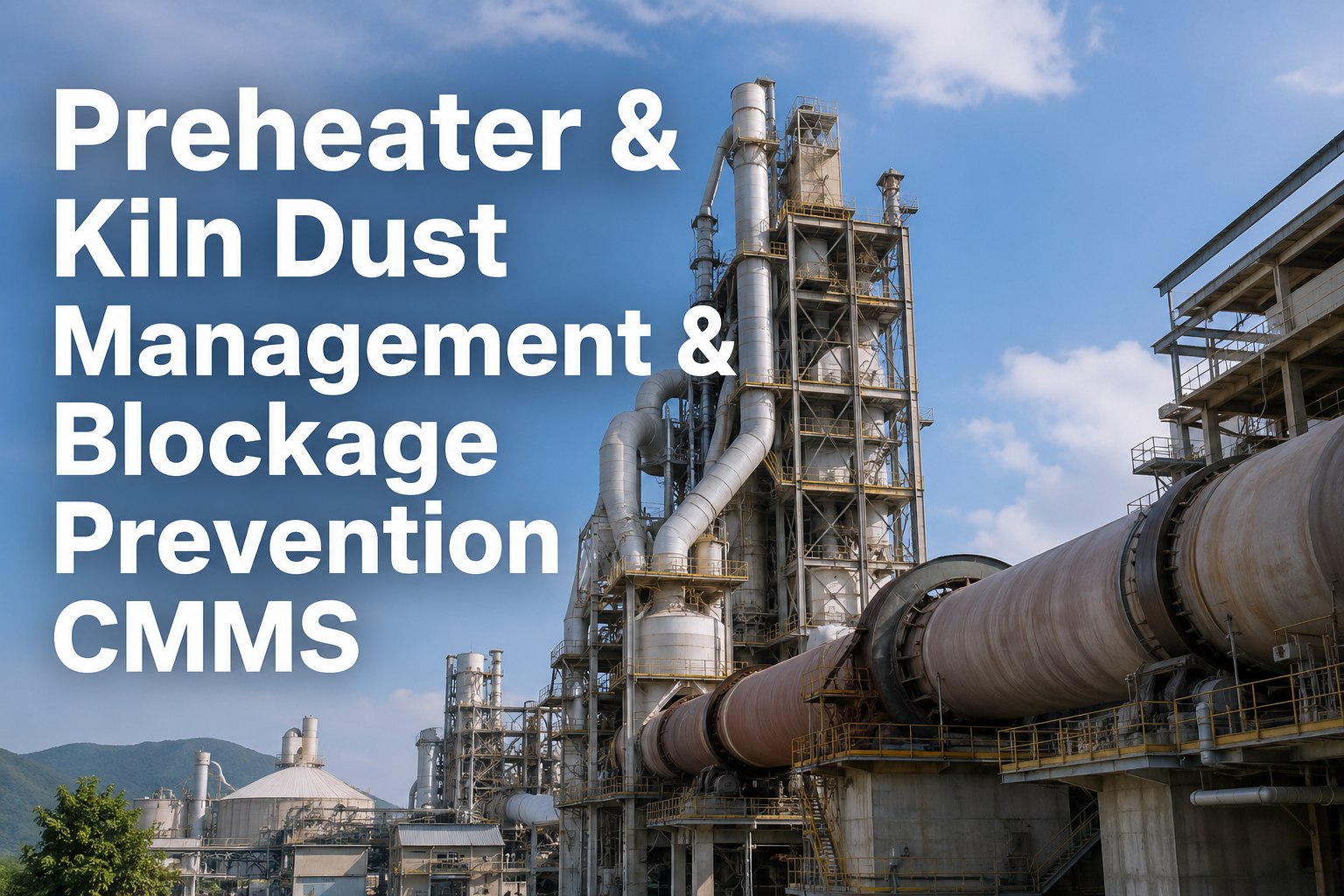
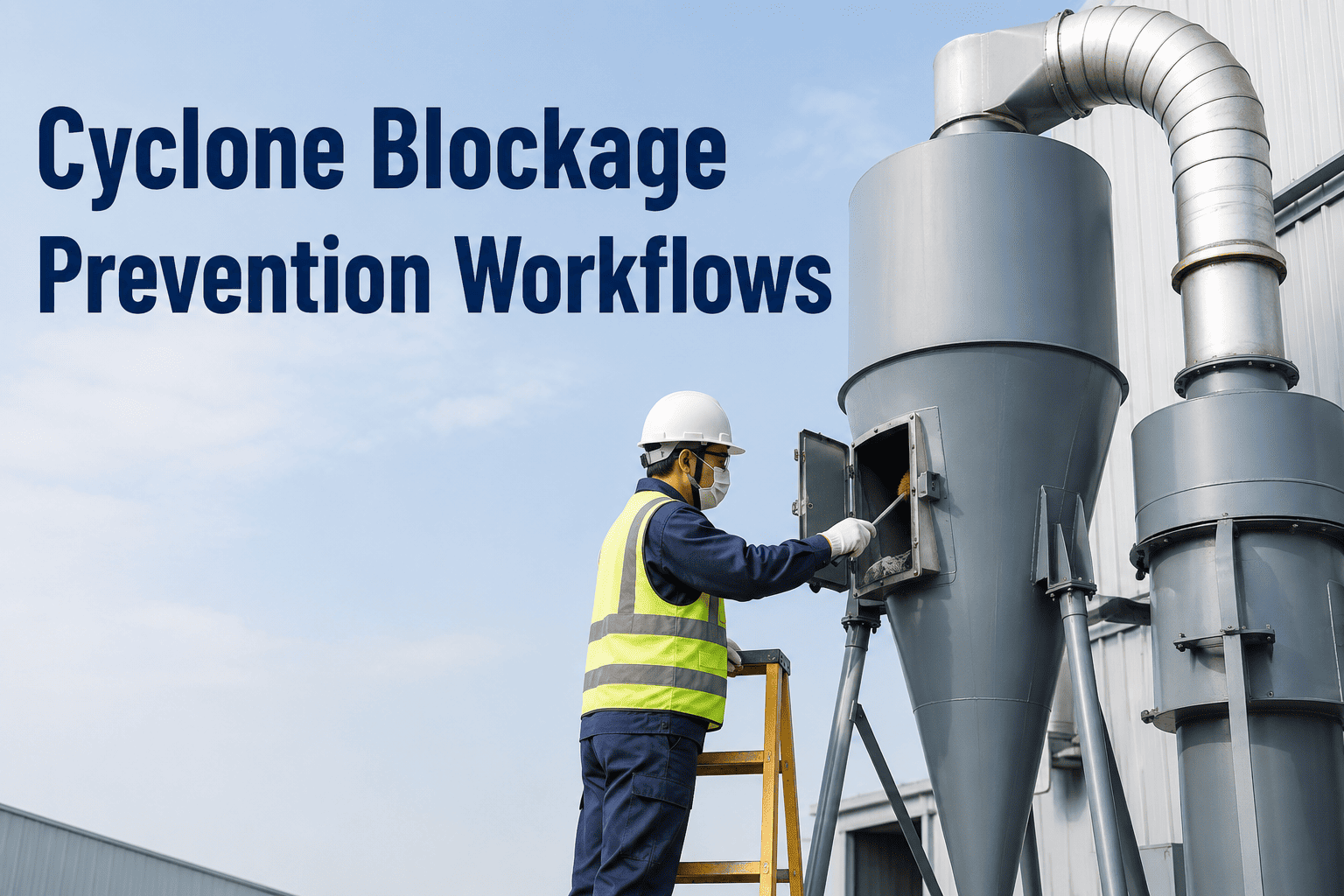
A preheater cyclone blockage does not announce itself with a warning — it announces itself with a kiln trip, a scrambled maintenance crew, and 8 to 24 hours of lost production. The fault builds incrementally: sticky raw meal accumulates at cone transition zones, meal coating thickens on riser duct walls, thermocouple pockets fill with accretion, and without a structured inspection record to track these changes, the first hard evidence of a problem is the process alarm that fires after the blockage has already formed. OxMaint Preventive Maintenance replaces the informal walkdown with a scheduled, mobile-executed inspection program that catches accumulation trends, documents photo evidence, and creates work orders before blockages form — turning the cyclone tower from a reactive liability into a managed asset.
8–24 hrs
Average lost production per preheater blockage event at a 4,000 TPD plant
$85K+
Direct cost of a single severe cyclone blockage including labor, refractory, and lost margin
3–6 wks
Typical accumulation period before a blockage becomes an emergency — fully manageable with inspection
72%
Of blockage events at plants with regular inspection programs are caught and cleared before kiln trip
Where Cyclone Blockages Form and Why
Preheater cyclone blockages are not random failures — they form at predictable locations driven by chemistry, temperature, and geometry. Understanding these zones is the foundation of any prevention program, because inspection effort should be concentrated where accumulation is most likely to form and where the consequences of missing it are highest.
Highest Risk
Stage 4 and 5 Cyclone Cone
The highest-temperature cyclones at Stages 4 and 5 see raw meal at 750–850°C — within the temperature range where alkali compounds (K₂SO₄, Na₂SO₄) begin to melt and create sticky coatings. Coating forms on the cone walls and meal discharge tube, gradually narrowing the passage until material bridges across the opening. This zone requires the highest inspection frequency and is the most common source of kiln-trip blockages.
High Risk
Riser Duct Inlet and Bend Points
Riser duct bends and the inlet tee where the stage exit gas meets the meal feed from the stage above are prone to meal adhesion and snowball formation. A partially blocked riser duct increases gas velocity on the open side, which accelerates wear and can dislodge material in chunks — causing sudden pressure swings that destabilize kiln feed.
Moderate Risk
Stage 1 and 2 Meal Pipes
Lower-stage meal pipes are cooler but still accumulate fine, high-moisture dust during cold startups and upset conditions. Partial blockages here reduce the efficiency of counter-current heat exchange and raise specific heat consumption by 4–8 kcal/kg clinker per event — a quiet energy cost that never appears in a log if inspections are not capturing it.
Monitor Closely
Flap Valve (Tipping Valve) Mechanisms
Flap valves at cyclone meal exits seal against gas short-circuit and regulate meal flow. A sticking or jammed flap valve causes meal backup in the cyclone — which the blockage detection system reads as a level alarm. Many reported blockages are actually flap valve faults that a basic inspection and lubrication would have prevented. These are among the most cost-effective components to include in a PM program.
Preheater Cyclone Inspection Checklist
This checklist is structured for execution in OxMaint mobile — each section can be assigned to a separate technician, with photo capture required at all visual inspection points. Frequencies shown represent minimum recommendations for a 4-stage to 6-stage preheater running on mixed fuels.
Inspect all accessible inspection doors for seal condition — cracked or missing door gaskets allow cold air infiltration that shifts gas flow patterns and accelerates coating formation at Stage 4/5
Verify thermocouple readings at each stage match historical range — a thermocouple reading 40–60°C below typical value may indicate a blocked meal pipe reducing hot gas contact, not a cooler process
Check pressure drop across each cyclone stage — a rising differential pressure at any stage against a flat kiln throughput is the earliest and most reliable quantitative indicator of partial accumulation
Inspect expansion joint condition on all riser ducts — failed expansion joints cause meal leakage and indicate thermal stress that can accelerate refractory cracking at adjacent blockage-prone zones
Verify meal level sensor operation at Stage 4 and Stage 5 cyclone exits — level sensors that have failed in the low position provide no warning of developing cone accumulation
Inspect all tipping (flap) valves for free movement — valves should swing through their full arc without resistance. Record flap condition (free, stiff, or jammed) for each stage in OxMaint mobile work order
Lubricate flap valve pivot bearings at Stage 1 through Stage 3 — higher-stage valves are inaccessible during operation but should be serviced on every planned maintenance stop using the OxMaint scheduled work order
Check meal pipe sight glass or inspection port at each accessible stage — photograph the internal surface and compare to prior photo in OxMaint asset gallery to identify coating growth trend between inspections
Verify meal flow continuity at Stage 1 exit using vibration or audio check — interrupted or pulsing flow at Stage 1 meal exit typically indicates a partial restriction upstream, often at Stage 2 or Stage 3 meal pipe
Open inspection doors at Stage 4 and Stage 5 cone transition zones and photograph full internal circumference — document coating thickness at four compass points using a calibrated probe, record measurements in OxMaint work order
Inspect meal discharge tubes at Stage 4 and Stage 5 for internal wear and coating — a meal discharge tube with more than 25% cross-section reduction requires scheduled clearing before next planned stop
Clear all accumulation points using compressed air lance or mechanical clearing tools — log time required to clear each point as a trend metric. Increasing clearing time between stops indicates accelerating accumulation rate
Inspect refractory condition at cyclone cone lining — cracked or spalled refractory surface accelerates coating adhesion. Photograph damaged areas, measure affected zone, and create follow-up work order for refractory repair before next campaign
Inspect and clean air cannons at all installed positions — verify solenoid operation, check air supply pressure, and test firing cycle. Non-operational air cannons provide false assurance in high-risk stages
Check riser duct refractory at all bend points and inlet tees — these high-turbulence zones experience faster refractory wear and are the second most common blockage nucleation point after the Stage 4/5 cone
Cross-check all stage pressure drop readings against the 90-day trend in OxMaint — identify any stage showing a sustained upward trend even within acceptable absolute limits, as trend direction matters more than current value
Verify calibration status of all stage thermocouples — thermocouples in high-alkali environments drift faster than standard calibration intervals assume. Replace any thermocouple that cannot be verified within ±15°C of reference
Review air cannon firing log for all cannons — cannons that have not confirmed a firing event in the past 72 hours should be flagged for immediate inspection, as stuck solenoids or depleted air supply are common silent failures
Deploy This Checklist in OxMaint This Week
OxMaint digitizes this cyclone inspection program into scheduled mobile work orders — with photo capture, measurement recording, and automatic escalation when accumulation trends reach action thresholds. No paper logs, no missed inspections.
How OxMaint Transforms Cyclone Inspection Into Blockage Prevention
01
Scheduled Mobile Inspection
Inspection tasks are scheduled in OxMaint and pushed to technician mobile devices at the configured frequency. A missed inspection at Stage 4 generates an automatic supervisor notification — eliminating the informal walkaround that gets skipped during busy production periods.
02
Photo Timeline Per Asset
Every inspection produces a timestamped photo attached to the asset record. The Stage 4 cyclone cone in OxMaint has a visual history of its internal condition across every inspection — a coating growth trend that is invisible in a paper log becomes visually obvious in a sequential photo timeline.
03
Threshold-Based Work Order Creation
When a technician records a coating thickness measurement above the action threshold, OxMaint automatically creates a corrective work order for mechanical clearing — with the inspection findings, photos, and location data already attached. No manual handoff required.
04
Pressure Trend Monitoring
Stage pressure differentials integrated from SCADA are trended in OxMaint. A sustained 3% increase in Stage 4 pressure drop over 7 days triggers an inspection work order before the accumulation reaches blockage threshold — giving the maintenance team a planned response instead of an emergency response.
05
Shutdown Planning Integration
Accumulated inspection findings in OxMaint feed directly into shutdown planning. Instead of starting a planned stop with a blank inspection sheet, the maintenance planner has the full accumulation history, photo documentation, and recommended work scope pre-populated — reducing shutdown duration and ensuring high-risk zones get priority access time.
06
Blockage Event Analysis
When a blockage does occur, OxMaint's work order history provides the forensic trail — what was the last inspection date, what coating thickness was recorded, and what corrective actions were or were not completed. This analysis drives the inspection interval and threshold adjustments that prevent recurrence.
Blockage Severity and Response Matrix
| Condition Detected |
Inspection Finding |
OxMaint Response |
Time to Action |
Cost Outcome |
| Stage 4/5 pressure rising 3–5% |
Early coating — < 15% area reduction |
Schedule planned clearing |
Next planned window |
$800–$2,000 clearing labor |
| Stage 4/5 coating > 25% reduction |
Moderate accumulation — photo confirmed |
Urgent corrective WO |
Within 24–48 hours |
$2,000–$6,000 planned intervention |
| Flap valve stuck — meal backup |
Valve jammed — no movement on check |
Immediate corrective WO |
Within current shift |
$400–$1,200 repair vs. $12,000+ trip |
| Meal pipe — 40%+ blockage |
Restricted flow confirmed visually |
Immediate WO + shutdown prep |
Immediate |
$6,000 controlled vs. $85,000+ emergency |
| Full blockage — kiln trip |
No inspection in prior 14 days |
Emergency response |
Unplanned 8–24 hrs |
$85,000+ — fully avoidable |
Stop the Next Cyclone Blockage Before It Starts
OxMaint integrates with your existing SCADA pressure and temperature feeds, digitizes your inspection program on mobile, and creates corrective work orders automatically when accumulation thresholds are reached — all from a single platform.
Frequently Asked Questions
How often should preheater cyclone inspections be carried out to prevent blockages?
The minimum effective inspection frequency depends on your raw mix alkali content and fuel sulfur levels — the two primary drivers of sticky coating formation. For plants running standard limestone mixes with low-alkali fuels, bi-weekly external inspection and monthly internal inspection at Stage 4 and 5 is a defensible baseline. For plants using alternative fuels or high-alkali raw materials, weekly external and bi-weekly internal inspection at Stages 4 and 5 is more appropriate, with SCADA pressure differential monitoring used to detect anomalies between inspection visits. OxMaint's PM scheduling allows you to set different frequencies for different stages and automatically escalates inspection frequency when pressure trend data indicates accelerating accumulation.
Can pressure differential monitoring replace physical inspection for cyclone blockage prevention?
Pressure differential monitoring is a critical early warning input but cannot replace physical inspection as the primary prevention tool. Pressure readings tell you a restriction is forming but not where, how severe, or what type of accumulation it is — information that determines the correct clearing method and safety approach. Additionally, a stuck flap valve can cause a full meal backup in a cyclone without a significant pressure differential change across that stage. Physical inspection with photo documentation captures coating type, texture, and location — data that drives the correct corrective action and feeds into shutdown planning. The most effective programs integrate both: OxMaint uses SCADA pressure trends to trigger inspection work orders between scheduled visits, and physical inspections provide the detailed findings that pressure alone cannot confirm.
How does OxMaint handle the safety requirements for preheater inspection work orders?
Every cyclone inspection work order in OxMaint can include a configurable pre-task safety checklist — covering access isolation, hot surface warnings, confined space entry procedures, and required personal protective equipment for the specific inspection zone. Stage 4 and Stage 5 inspection doors require different safety procedures from Stage 1 and Stage 2 work, and OxMaint allows separate safety checklists per asset or per inspection type. Work orders cannot be marked as started until the safety pre-check is completed and documented by the technician on mobile. This creates an auditable safety record for every preheater entry — useful for both internal compliance and external audit requirements.
What is the cost comparison between a planned cyclone clearing and an unplanned blockage event?
A planned clearing of moderate cyclone accumulation — scheduled during a kiln stop with appropriate access equipment in place — typically costs between $2,000 and $6,000 in labor and materials, with zero production impact if executed during a scheduled maintenance window. A full blockage event causing an unplanned kiln trip involves emergency clearing labor at premium rates, potential refractory damage from the thermal shock of a forced entry, downstream clinker quality disruption, and lost production at a 4,000 TPD plant valued at approximately $8,000–$12,000 per hour of downtime. Total event costs for a severe blockage routinely exceed $85,000. The financial case for structured cyclone PM is among the most straightforward in cement plant maintenance, yet it remains informal at a significant proportion of plants because the inspection records do not exist to demonstrate the accumulation trend that would justify scheduled intervention. OxMaint provides exactly that documentation.
Can the cyclone inspection checklist in OxMaint be customized for our specific preheater design?
Yes. OxMaint inspection checklists are fully configurable — you can create separate checklists for each cyclone stage, add asset-specific inspection points, configure measurement fields for coating thickness and clearance values, and attach reference photos showing acceptable versus unacceptable conditions for each check item. If your preheater has a calciner stage, an inline calciner, or a low-NOx firing configuration, these design-specific inspection points can be added without any coding or IT support. The checklist library in OxMaint is built by your team and owned by your maintenance department — not a fixed template that forces your process into a generic format.