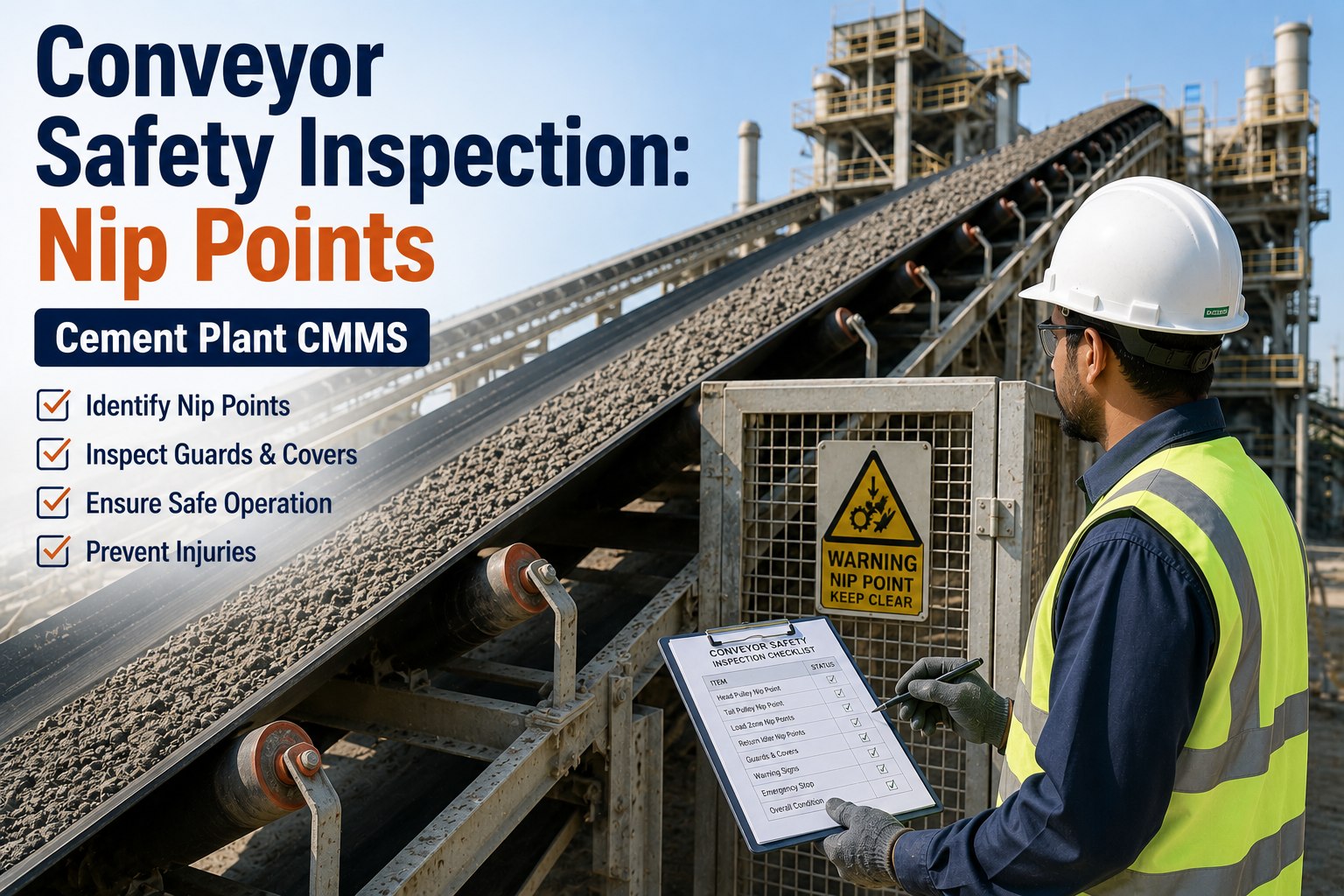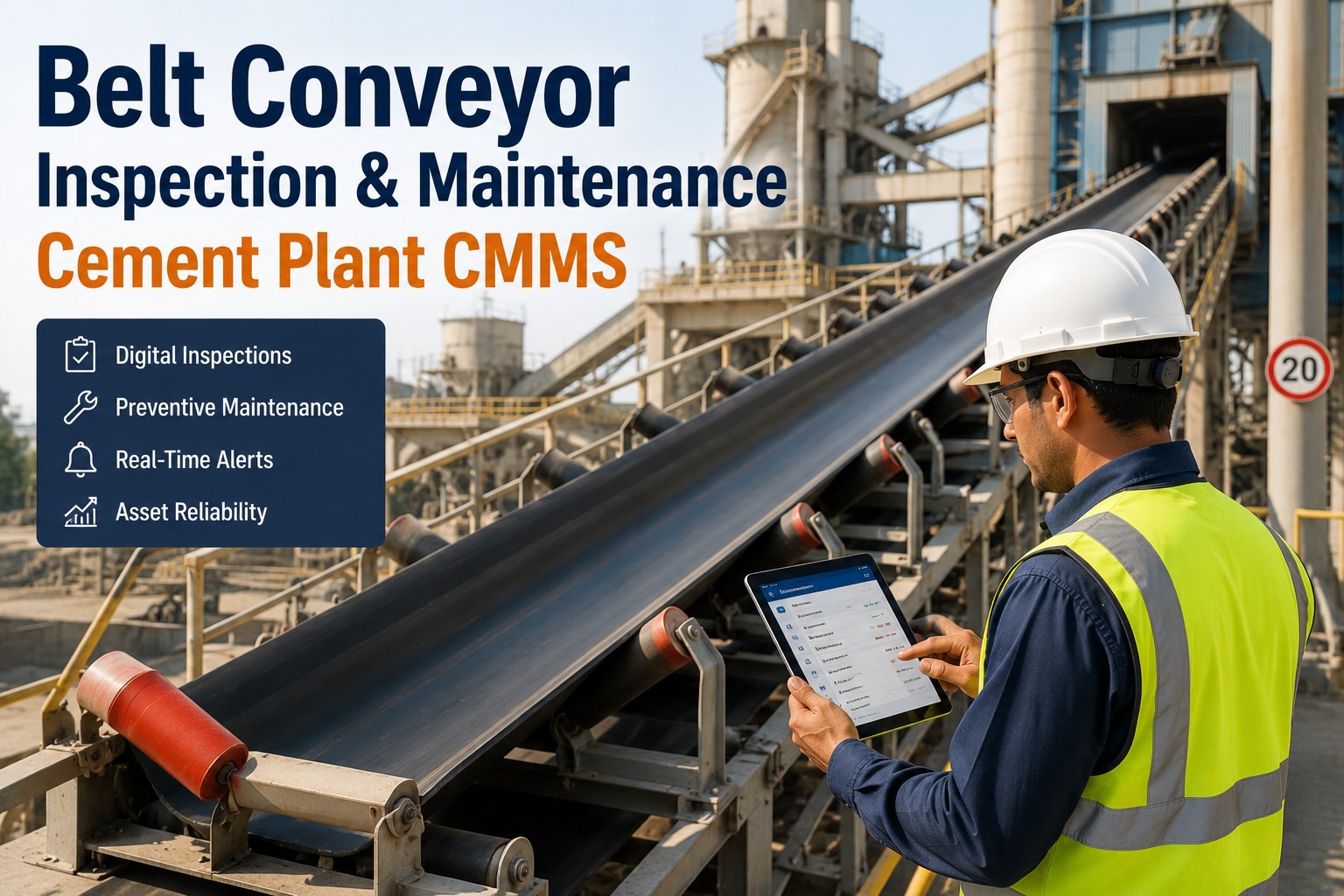
Raw material conveyors and quarry belts operate at the brutal intersection of heavy impact loads, abrasive limestone dust, and continuous weather exposure — making them the single most failure-prone asset class in a cement plant's upstream chain. A single unscheduled stoppage on an overland conveyor feeding the crusher can idle kiln feed stockpiles within 18 hours, turning a $200 belt rip into a six-figure production loss. This guide maps out a complete quarry conveyor inspection program — from crusher-to-stockpile preventive maintenance to weatherproofing and CMMS-driven work order control — that keeps raw material flow reliable through every season. To operationalize these checklists and automate PM scheduling, you can Start Free Trial and deploy a purpose-built cement maintenance workflow in under 48 hours.
Is your raw material conveyor one storm away from a kiln feed failure?
Belt tears, idler seizures, and misalignment cost cement plants an average of 14 production hours per quarter. A structured quarry inspection program catches 80% of failures before they escalate — protecting the crusher-to-stockpile chain through every season.
Why quarry belts fail first — and fail fast
Raw material conveyors handle unprocessed limestone, clay, and overburden at speeds of 2–5 m/s, carrying chunks up to 1.2 m across before the primary crusher. No other asset in the cement plant absorbs more impact, abrasion, or weather punishment — and neglect surfaces within days, not months.
A 1,200 mm overland conveyor carrying 1,800 tph of run-of-mine limestone sees belt tension spikes exceeding 180% of rated load during cold-start conditions. Without a pre-shift inspection protocol, those spikes translate directly to carcass fatigue and premature rip failure within 8–14 months.
Crusher-to-stockpile conveyor PM checklist
A tiered inspection program splits tasks by frequency and criticality. Daily walkdowns catch visible damage; weekly mechanical checks address alignment and wear; monthly deep inspections using NDT and thermal imaging identify internal carcass degradation before failure.
Visual Walkdown
- Belt surface scan for cuts, gouges, and edge fraying along full conveyor length
- Idler rotation check — listen for squealing, grinding, or seized rollers at transfer points
- Belt tracking and alignment verification at head, tail, and take-up pulleys
- Spillage and material buildup inspection at chute interfaces and skirt rubber seals
- Emergency stop pull-cord continuity test and trip wire freedom of movement
Wear & Alignment
- Pulley lagging condition assessment — check for rubber loss, bonding failure, and grooving wear
- Take-up tension measurement against OEM spec — gravity, screw, or hydraulic counterweight
- Bearing temperature audit at head, tail, bend, and snub pulleys using infrared probe
- Skirt board rubber replacement when clearance exceeds 8 mm or hardening is detected
- Scrapper and belt cleaner blade wear — replace at 60% material loss to prevent carryback
Structural & NDT
- Belt carcass ultrasonic thickness testing at high-stress zones — splice, transition, loading impact
- Splice integrity inspection — finger and step splices measured for elongation and delamination
- Structural vibration analysis on conveyor stringers, gantry supports, and transfer towers
- Motor and gearbox oil sampling — particle count, viscosity, and water contamination (target <0.1%)
- Thermal imaging scan of drive units, electrical panels, and braking resistors under full load
Quarry conveyor inspection matrix by component
This scannable matrix maps each conveyor subsystem to its inspection frequency, failure warning signs, and the corrective action window before production impact. Use it as the master reference when building CMMS work-order triggers.
| Component | Frequency | Warning Signs | Action Window | Risk if Ignored |
|---|---|---|---|---|
| Belt carcass | Monthly NDT | Thickness loss >15%, ply separation | 14 days | Catastrophic rip — $40K+ repair |
| Idler rollers | Daily listen | Squeal, seized rotation, grease leak | 48 hours | Belt friction fire, tracking loss |
| Pulley lagging | Weekly visual | Rubber debonding, groove wear >4 mm | 7 days | Belt slip, reduced traction, motor overload |
| Splice joints | Monthly measure | Elongation >2%, edge lifting | 10 days | Splice failure under load — full belt stop |
| Take-up system | Weekly check | Travel limit reached, uneven tension | 5 days | Belt sag, material spillage, premature wear |
| Belt cleaner | Weekly inspect | Blade wear >60%, carryback visible | 7 days | Material buildup on return idlers |
| Drive gearbox | Monthly sample | ISO 4406 >22/19, rising temp | 30 days | Gear failure — $25K+ rebuild, 48 hr downtime |
| Transfer chute | Daily observe | 72 hours | Chute blockage, belt overload, spillage |
Weather protection: the 12-month defense calendar
Quarry conveyors run through monsoons, freezes, and 45°C summer heat. Each season attacks a different failure mode — from belt hardening at –10°C to monsoon-driven slurry contamination of drive components. This timeline maps the defensive PM actions to the months that matter most.
Cold-start defense
Preheat drive oil to 10°C minimum before start. Inspect belt for cold-weather hardening and surface cracking. Verify anti-condensation heaters in motor junction boxes. Check pulley lagging adhesion — cold contraction causes debonding.
Thaw & runoff
Inspect drainage channels beneath overland conveyors. Clear mud and rock fall debris from gantry walkways. Audit take-up pit for water accumulation — submerged counterweights cause tension loss and tracking drift.
Pre-monsoon seal
Replace weather seals on drive houses and electrical panels. Verify IP65 rating integrity on pull-cord stations and junction boxes. Grease all bearings with water-resistant NLGI Grade 3 lithium complex. Stockpile emergency belt repair kits.
Monsoon vigilance
Increase walkdown frequency to twice daily. Monitor belt slip during wet starts — reduce feed rate to 70% during heavy rain. Inspect chute linings for accelerated wear from wet, abrasive slurry. Check motor bearing seals for water ingress weekly.
Post-monsoon recovery
Conduct full belt cleaning and under-belt inspection. Replace any idlers showing corrosion pitting. Re-torque all structural bolts on transfer towers — monsoon vibration loosens connections. Sample all gearboxes for water content.
Year-end audit
Full NDT belt scan, splice elongation mapping, and structural vibration baseline. Close out CMMS work orders and generate annual failure-mode report. Lock in PM schedule and spare parts forecast for the next 12 months.
The CMMS-driven inspection program
Inspection findings are only valuable if they trigger corrective work orders before failure. A CMMS-built raw material maintenance program converts walkdown checklists into time-stamped records, auto-generates work orders from threshold breaches, and maintains a complete asset failure history that drives predictive maintenance decisions.
Asset hierarchy build
Map every conveyor as a parent asset with children: belt, drive motor, gearbox, pulleys, idlers, take-up, chute, cleaner. Tag each with OEM spec, install date, and criticality rating (A/B/C) based on production impact.
PM schedule automation
Configure daily, weekly, and monthly PM triggers based on run-hours and calendar cycles. The CMMS auto-assigns technicians, attaches digital checklists, and sends mobile notifications — eliminating paper-based inspection gaps.
Threshold-triggered work orders
When an inspection reading breaches a threshold — bearing temp >75°C, belt thickness <85% nominal, oil ISO cleanliness >22/19 — the CMMS auto-generates a corrective work order with parts, labor estimate, and priority level.
Failure history & MTBF
Every failure event is logged with root cause, downtime duration, and repair cost. Over 6–12 months this builds MTBF and MTTR curves per asset — the foundation for shifting from preventive to condition-based maintenance.
A 180-asset quarry plant spending $42K/yr on reactive conveyor repairs
After deploying a CMMS-driven inspection program, the plant recorded 23 threshold-triggered work orders in the first quarter — catching 4 idler bearing failures, 2 splice elongation breaches, and 1 gearbox oil contamination event before they caused unplanned stops. Reactive repair spend dropped 61% to $16.4K, unplanned conveyor downtime fell from 44 hours/quarter to 9 hours, and the program achieved full payback in 4.2 months. Over a full year, the plant saved $51K in repair costs and recovered 140 production hours worth an estimated $310K in additional clinker output.
The cost of inaction — and the payback of acting
Quantifying what a structured raw material conveyor inspection program returns makes the investment case undeniable. The formula below captures the annual savings from moving reactive quarry maintenance to a CMMS-driven preventive model.
Stop reacting to conveyor failures. Start preventing them.
Deploy a CMMS-driven raw material inspection program in under 48 hours and cut unplanned quarry downtime by up to 79% in your first year.
Raw material conveyor inspection — answered
How often should I inspect a limestone conveyor belt in a cement quarry?
Daily visual walkdowns should cover the full belt length for surface damage, edge wear, and tracking. Weekly mechanical checks address pulley lagging, take-up tension, and bearing temperatures. Monthly deep inspections use ultrasonic thickness testing and thermal imaging to catch internal carcass degradation. High-impact zones near the crusher discharge may require twice-daily checks during peak production periods.
What is the most common failure mode on overland quarry conveyors?
Belt rip and splice failure account for approximately 38% of overland conveyor stoppages, driven by impact from oversized material and tension spikes during cold or loaded starts. Idler bearing seizures are the second most common at 24%, typically preceded by 2–6 weeks of audible warning. Both failure modes are detectable through routine inspection. You can set up automated inspection triggers and failure-history tracking when you Start Free Trial on the Oxmaint platform.
How does weather affect raw material conveyor maintenance scheduling?
Cold weather below 5°C increases belt stiffness and splice stress, requiring pre-start warm-up and more frequent splice inspection. Monsoon seasons accelerate idler corrosion and electrical component water ingress, demanding weekly seal audits and doubled walkdown frequency. A seasonal PM calendar built in your CMMS automatically adjusts task frequency and spare parts readiness based on historical weather patterns for your quarry location.
What belt thickness warrants replacement versus repair?
When ultrasonic thickness testing shows carcass loss exceeding 15% of nominal specification, plan replacement within 14 days. Localized damage under 200 mm in length can be repaired with a cold-cure patch if the surrounding belt retains full thickness. Damage exceeding 300 mm or involving multiple ply layers requires a full vulcanized splice repair. Never repair more than three splices on a single belt loop — replace the entire belt.
Can a CMMS integrate with existing quarry SCADA and PLC systems?
Yes. A modern CMMS for cement quarry maintenance receives conveyor run-hour data, motor current draw, and alarm events from SCADA via OPC-UA or MQTT protocols. This enables condition-based PM triggers — for example, auto-generating an idler inspection work order when a conveyor segment records 2,000 run-hours or when motor current exceeds 110% of baseline for more than 30 seconds.
Build your quarry conveyor inspection program today
Join cement plants that cut unplanned raw material downtime by 79% with CMMS-driven inspections — deployed in days, not months.
Free 14-day trial · No credit card