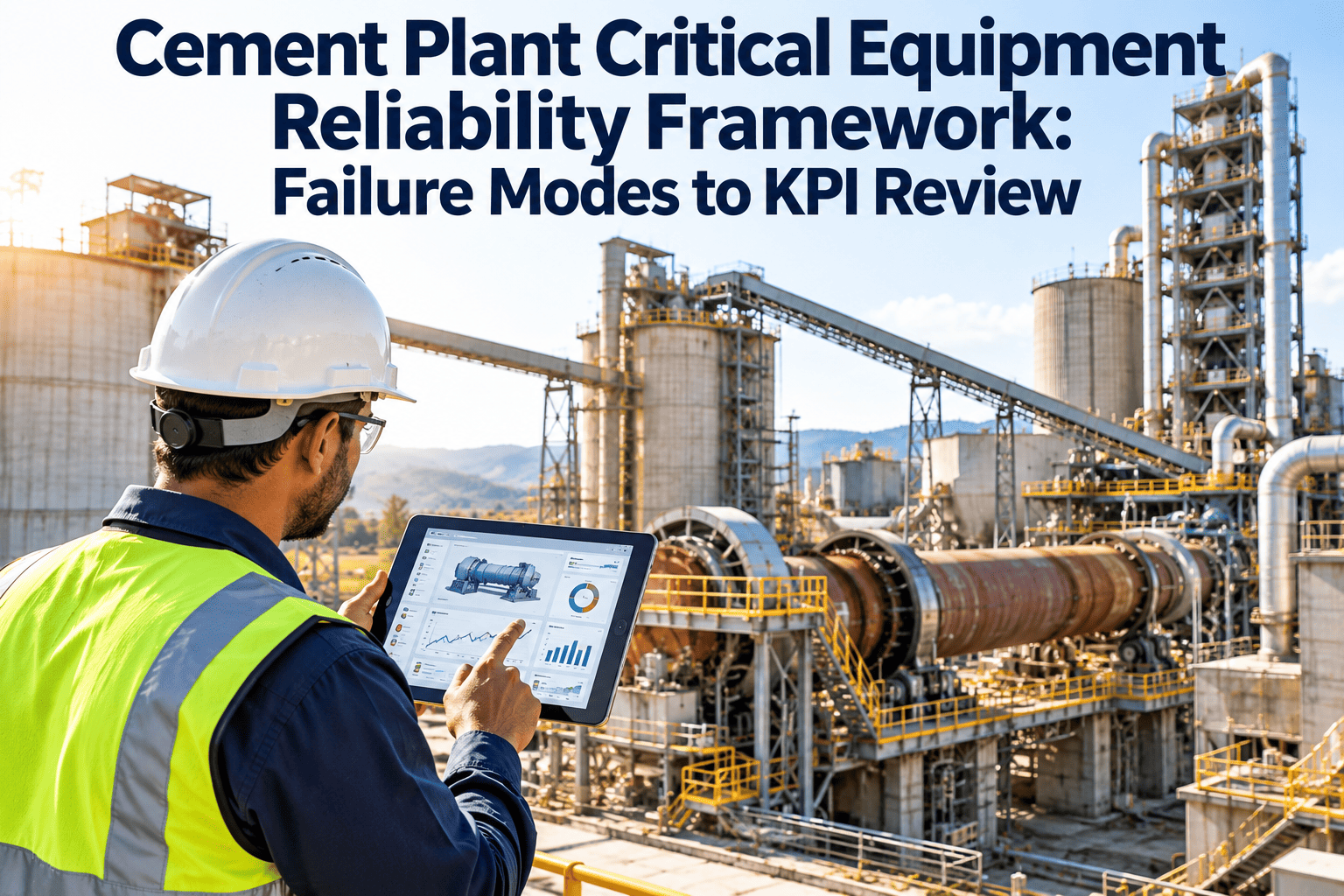
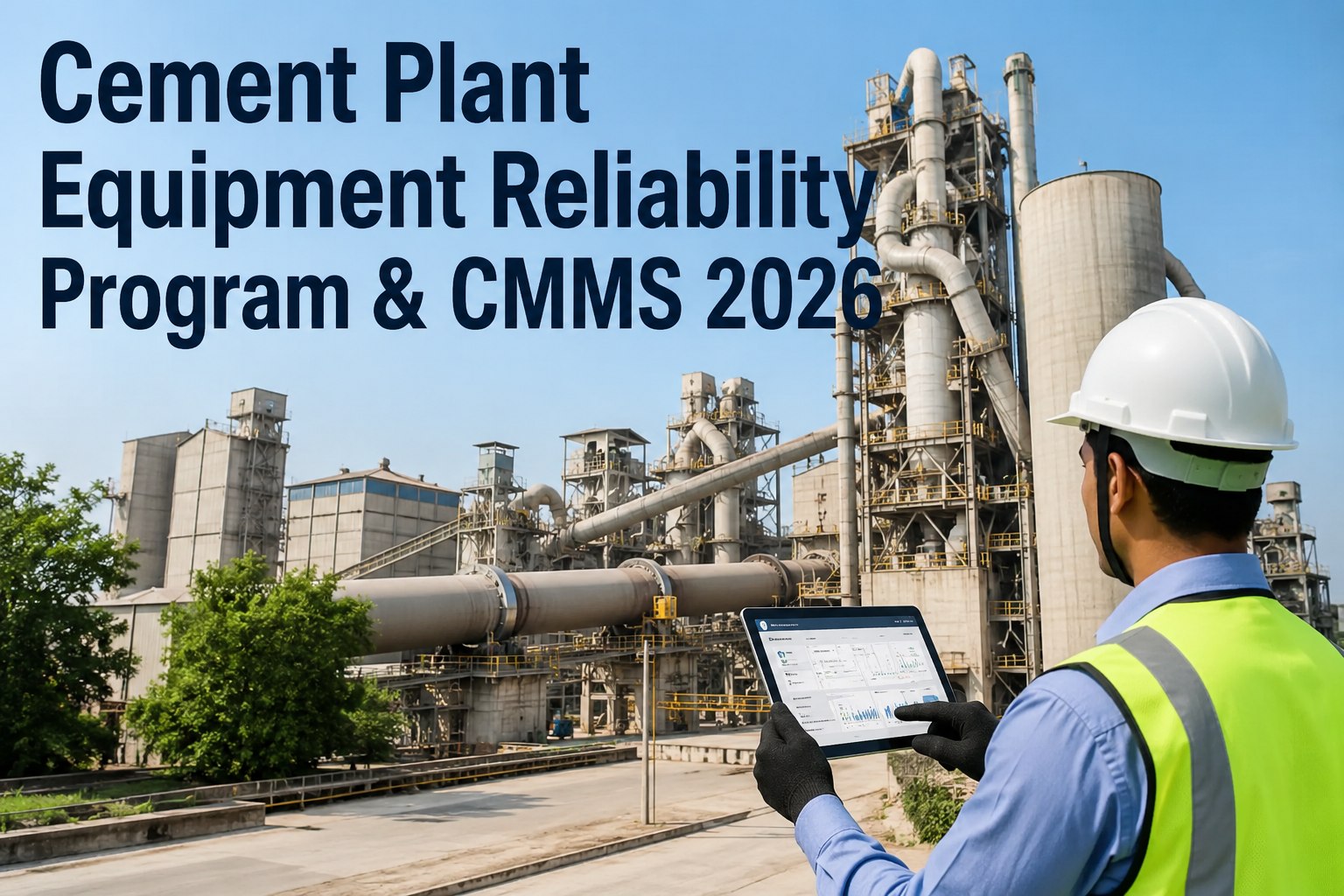
Cement manufacturing is a brutal environment for heavy machinery. In 2026, the leading plants no longer rely on rigid calendar-based maintenance or wait for equipment to break. They use Reliability Centered Maintenance (RCM). Operating 24/7 at temperatures exceeding 1450°C and handling highly abrasive materials, cement equipment degrades rapidly. The shift from reactive and time-based preventive maintenance to condition-based RCM is delivering results that directly impact the bottom line: facilities deploying RCM report a 40% reduction in unplanned downtime, 25% lower maintenance material costs, and millions saved in avoided kiln stoppages. A single prevented failure on a main kiln drive saves $20,000+ per hour in lost production. But with vibration sensors, thermal imaging, and acoustic monitoring generating terabytes of data, executing an RCM strategy requires a system that translates alerts into action. This guide breaks down how to implement RCM across your cement plant's most critical assets and build a business case your Plant Manager will approve. Already drowning in sensor data but lacking a workflow? Sign up for Oxmaint and connect your predictive maintenance data to automated work orders, parts inventory, and reliability analytics in one platform.
Reliability Centered Maintenance (RCM) for Cement Equipment: 2026 Guide
Why Calendar-Based Preventive Maintenance Fails
First-generation maintenance programs were strictly calendar-based—rebuilding gearboxes or replacing bearings every 12 months whether they needed it or not. If a part failed at month 10, the plant suffered catastrophic downtime. RCM fundamentally changes this equation by analyzing actual equipment condition in real time and intervening only when necessary:
Reactive vs. Proactive
Traditional strategies fix machines after they break, losing days to cooling and refractory repair. RCM uses continuous monitoring to detect micro-vibrations and thermal spikes weeks before a failure, allowing repairs during scheduled outages.
Over-Maintenance vs. Precision
Preventive maintenance often replaces perfectly good parts, wasting labor and materials. RCM ensures you only overhaul a Vertical Roller Mill (VRM) when oil analysis and acoustic data dictate it, maximizing the lifespan of expensive components.
Guesswork vs. Data-Driven
Plants that rely on "how the machine sounds" to operators experience high variability across shifts. Plants using RCM rely on Failure Mode, Effects, and Criticality Analysis (FMECA) to assign precise, data-backed maintenance strategies to every asset.
Cement plants utilizing full RCM frameworks achieve up to 95% Overall Equipment Effectiveness (OEE). Connect your condition-monitoring sensors to automated maintenance workflows with Oxmaint's reliability management platform and turn every anomaly into a planned, manageable task.
RCM in Cement Production: The Numbers That Matter
The business case for RCM in heavy building materials is proven. Here is what plant-wide deployment data shows across the industry in 2026:
The math is straightforward: preventing a single catastrophic failure on a raw mill or clinker cooler can justify your entire reliability program's budget for the year. By identifying root causes rather than treating symptoms, RCM drastically reduces maintenance overhead. Start building your reliability data trail today — sign up for Oxmaint to track asset health, generate FMECA reports, and demonstrate measurable uptime improvements to corporate leadership.
Top 5 Cement Assets Prioritized for RCM
We evaluated the most critical cement plant assets based on replacement cost, production bottleneck impact, and suitability for condition monitoring. Here is where leading plants focus their RCM efforts:
Rotary Kiln & Main Drive
The heart of the cement plant. RCM strategies here focus on continuous shell thermal scanning (to detect refractory thinning), tire/roller creep measurements, and vibration analysis on the main drive gearbox. A kiln stop halts the entire plant; predictive alerts here are non-negotiable for maximizing the 330-day run campaign.
Vertical Roller Mills (VRM)
Used for raw meal and coal grinding, VRMs endure massive dynamic loads. RCM implementation relies heavily on continuous oil analysis (particle count, viscosity) for the massive thrust bearings and acoustic emission sensors to detect roller wear and table anomalies before severe mechanical damage occurs.
Clinker Coolers & Exhaust Fans
Subject to extreme thermal shock and abrasive dust. RCM targets the grate drive hydraulics and massive ID (Induced Draft) fans. Vibration analysis on ID fan bearings is critical, as dust buildup on impeller blades causes severe unbalance that can destroy the fan housing if left unchecked.
Bucket Elevators & Conveyor Networks
The arteries of the plant. Instead of waiting for a belt to snap or a bucket to tear loose, RCM utilizes motor circuit analysis (MCA) to monitor amperage draw (indicating drag or overload) and ultrasonic sensors on gearbox bearings to detect early-stage lubrication failure.
Baghouses & Dust Collectors
Critical for environmental compliance and production. RCM shifts focus from changing bags every year to monitoring differential pressure across the compartments. Smart pulse-jet monitoring detects failed solenoids or torn bags instantly, avoiding costly EPA fines and material loss.
All of these condition-monitoring strategies integrate directly with Oxmaint's CMMS — connecting sensor alerts to maintenance work orders, spare parts staging, and reliability analytics. Book a free demo to see how predictive data flows into your operational workflows.
Turn Sensor Data Into Actionable Workorders
Oxmaint integrates with your SCADA, PLCs, and IoT sensors to automatically convert vibration spikes and thermal alerts into prioritized work orders, staging the right parts and procedures for your mechanics. Stop reacting to breakdowns.
What RCM Technologies Actually Detect in 2026
Modern RCM goes far beyond visual inspections. Here are the key predictive technologies that separate proactive plants from reactive ones:
Vibration Analysis
Tri-axial sensors identify imbalance, misalignment, and bearing defects months in advance. Essential for ID fans, raw mill drives, and large motors. Algorithms now automatically diagnose the specific fault type based on frequency harmonics.
Infrared Thermography
Detects electrical hotspots in switchgears, refractory brick degradation on the kiln shell, and friction in mechanical couplings. Regular IR routes prevent catastrophic electrical fires and catastrophic kiln shell burn-throughs.
Oil Analysis & Tribology
Monitoring the "blood" of your VRMs and gearboxes. Detects microscopic wear particles, water contamination, and chemical breakdown of additives. Allows you to safely extend oil drain intervals and identify gear wear early.
Ultrasonic Emission
Captures high-frequency sounds of friction before vibration even occurs. Used for early-stage bearing failure detection, identifying compressed air leaks, and ensuring hydraulic valves are seating properly.
Motor Circuit Analysis
Evaluates the electrical health of stators, rotors, and insulation. Prevents unexpected burnouts on massive medium-voltage motors driving ball mills and crushers by detecting insulation degradation early.
Root Cause Analytics
Automated failure reporting within the CMMS. Instead of just replacing a broken bearing, the system correlates historical data to show *why* it failed (e.g., poor lubrication routes), ensuring the failure never repeats.
These detection capabilities work together to build a complete reliability ecosystem. Book a demo to see how Oxmaint connects predictive technologies with your maintenance scheduling and execution.
Best Practices for RCM Deployment Success
Technology is only half the equation. Cement plants that get the highest ROI from RCM follow these operational practices consistently:
Conduct Thorough FMECA First
Don't just put sensors on everything. Perform a Failure Mode, Effects, and Criticality Analysis. Identify which assets cause the most downtime and determine the specific failure modes. Apply predictive tech only where it provides ROI.
Start with a Pilot on a Bottleneck Asset
Deploy RCM on your highest-risk asset first—often the kiln ID fan or the clinker cooler drive. Measure the reduction in unplanned downtime and maintenance costs for 90 days before full rollout. A pilot proves ROI and builds internal champions.
Shift from Calendar to Condition
Actively review your PMs (Preventive Maintenance schedules). If you install an online vibration monitor on a pump, eliminate the monthly manual vibration PM. Reallocate that mechanic's time to proactive defect elimination tasks.
Connect IoT Data to CMMS Workflows
An alert on a SCADA screen that isn't acted upon is useless. Integrate your condition monitoring software directly with Oxmaint. When an asset enters an alarm state, the CMMS must auto-generate an inspection work order instantly.
Upskill Your Workforce
RCM changes the mechanic's job from "parts replacer" to "reliability technician." Invest in training your team on precision alignment, proper lubrication techniques, and interpreting ultrasonic data. Give them the digital tools they need to succeed.
Implementing these practices alongside Oxmaint's safety and asset management tools turns data into measurable plant-wide uptime. Sign up today and start building your reliability data trail.
Who Benefits from Reliability Centered Maintenance
RCM creates value for every stakeholder in cement operations. Here is how different roles benefit from the same system:
Predictable production volumes, stable maintenance budgets, and massive reductions in catastrophic downtime. Quantify the ROI of the maintenance department with hard data instead of treating it merely as a cost center.
AI-powered analytics replace manual spreadsheet tracking. Focus on root cause analysis and asset lifecycle extension rather than firefighting daily breakdowns. Build a world-class predictive program.
Safer working conditions. Fixing a machine during a planned, locked-out shutdown is infinitely safer and less stressful than repairing a 1000°C clinker cooler in the middle of the night under emergency pressure.
Lower spare parts inventory holding costs. Because RCM provides months of lead time before a failure, procurement can order expensive parts (like massive bull gears) via standard shipping rather than paying premium emergency freight.
Whether you manage a single grinding terminal or an integrated multi-kiln plant, RCM scales to fit your operation. Book a demo to see how Oxmaint connects reliability data to your maintenance, inventory, and cost analytics workflows.
Predict Failures. Maximize Tonnage. Spend Less.
Oxmaint connects your condition monitoring data with maintenance workflows, specialized defect elimination tasks, and plant-wide reliability analytics — turning sensor alerts into measurable uptime and lower operating costs.
Frequently Asked Questions
Is RCM too expensive for an older cement plant?
Actually, older plants benefit the most. Aging equipment requires precise monitoring to squeeze out the remaining lifecycle. You don't need to wire the entire plant at once. Start with wireless vibration sensors on your top 10 most critical bottleneck assets. The cost is negligible compared to a single unplanned kiln outage, yielding ROI often within the first quarter.
Will our traditional mechanics resist RCM software?
Initial resistance is common when introducing digital tools to heavy industry. However, when mechanics realize RCM means fewer midnight emergency call-ins and safer planned repairs, adoption skyrockets. Using an intuitive, mobile-first CMMS like Oxmaint ensures the technology makes their job easier, not harder.
What is the typical ROI timeline for implementing RCM?
Most cement facilities see positive ROI within 6 to 9 months. Immediate savings come from catching early-stage bearing failures (preventing shaft damage) and optimizing lubrication intervals. Long-term savings apply to massive inventory reductions and a documented 20-40% drop in overall maintenance expenditures.
Does RCM integrate with our existing PLC and SCADA systems?
Yes. Modern CMMS platforms are designed to ingest data from your existing PLCs, SCADA systems, and third-party IoT sensors. Rather than operators staring at a separate condition-monitoring screen, the data flows via API to automatically trigger inspections or work orders based on predefined thresholds.
Can we do RCM without a dedicated CMMS?
Attempting RCM with spreadsheets or legacy ERPs leads to failure. RCM relies on tracking historical failure modes, triggering dynamic workflows based on meter readings, and assigning specialized precision-maintenance tasks. A modern, dedicated CMMS is the engine that converts predictive theory into mechanical reality.
How does Oxmaint facilitate RCM in cement?
Oxmaint acts as the central nervous system for your reliability program. It handles meter-based PM triggers, integrates with condition monitoring APIs, standardizes FMECA-based task lists for your mechanics, and tracks Mean Time Between Failures (MTBF). Book a demo to see the integration in action.
Does RCM improve environmental and safety compliance?
Absolutely. RCM on dust collectors prevents reportable opacity emissions. Ultrasonic monitoring prevents hazardous material spills. Furthermore, emergency reactive maintenance is inherently dangerous; shifting to planned, proactive maintenance dramatically reduces recordable safety incidents for your mechanical team.