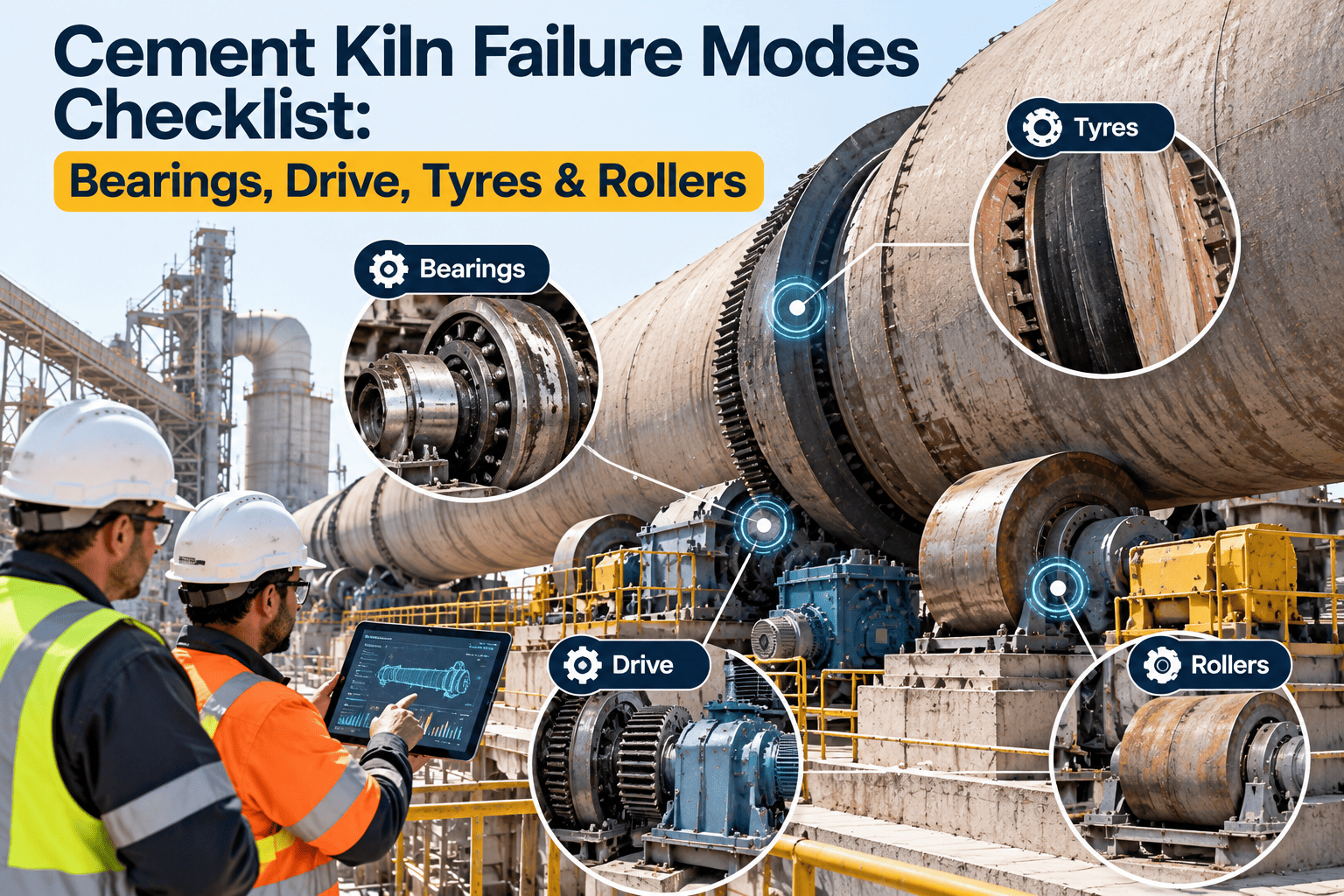
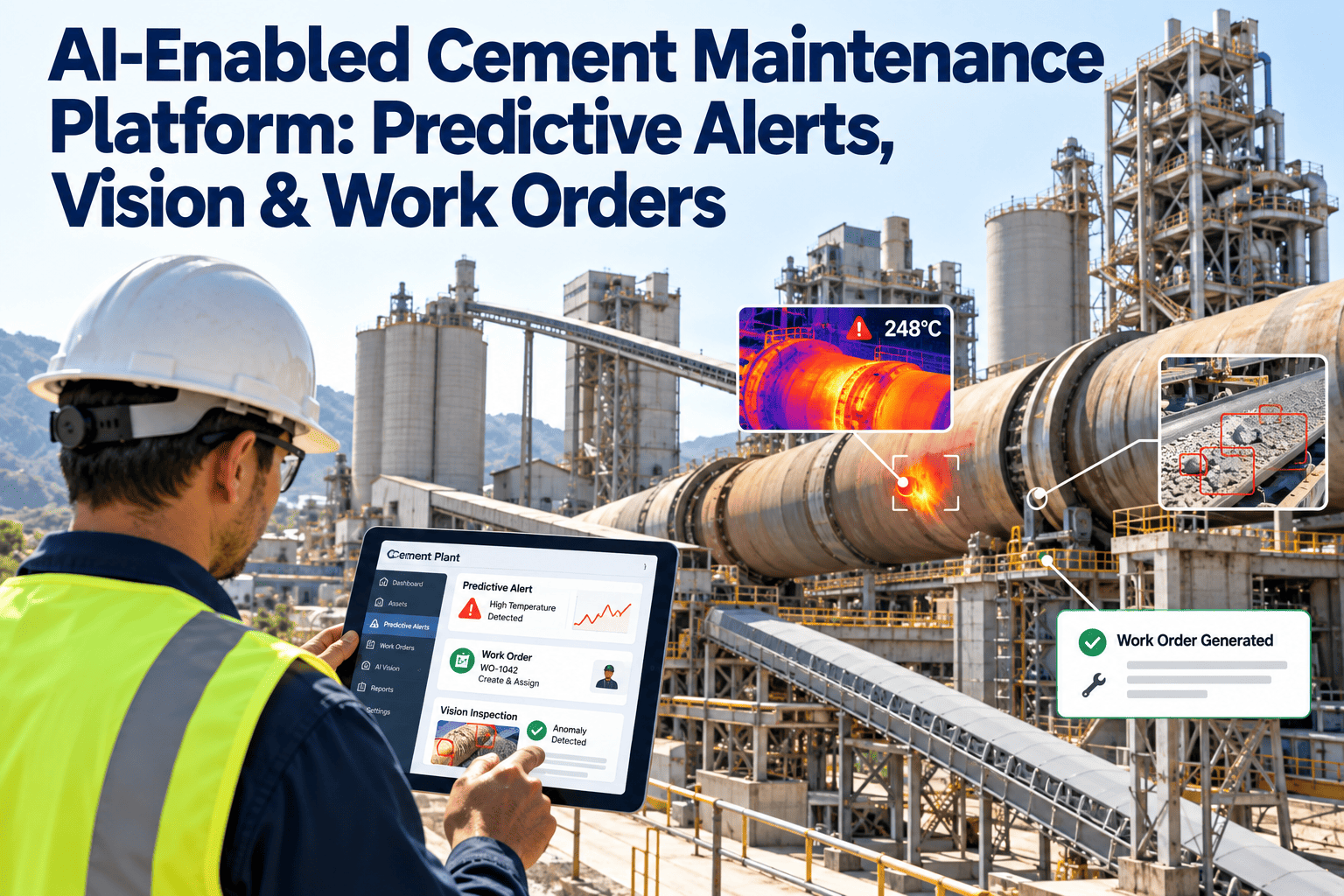
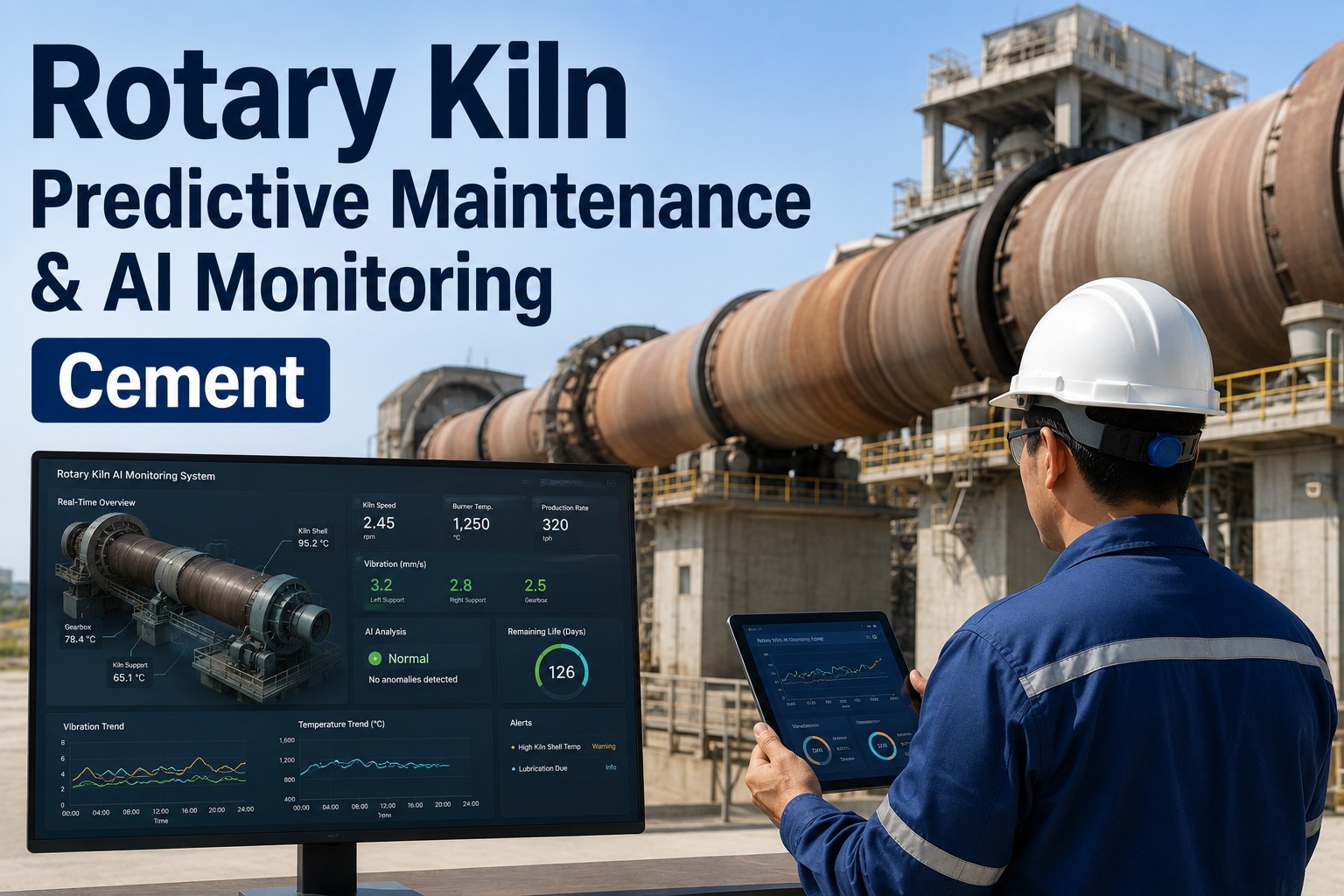
A rotary kiln running at 1,450°C is the single most expensive, highest-consequence asset in any cement plant. When it stops unexpectedly, clinker production halts instantly — and so does every downstream process. Emergency refractory repairs, forced shutdown labor, and lost production commonly exceed $300,000 per day, with major events stretching across 5 to 14 days. Most cement plants in 2026 still rely on calendar-based PM schedules and manual infrared scans — discovering critical wear patterns only after they've progressed beyond intervention. OxMaint AI connects your kiln sensor data, thermal imaging, and drive diagnostics to predictive work orders that surface failure signatures weeks before production is threatened. Teams using OxMaint detect shell hot spots 30+ days early, schedule refractory campaigns in planned windows, and protect uptime across the entire clinker circuit. Sign up free to connect your first kiln today.
AI Predictive Maintenance · Cement Plant
Rotary Kiln Predictive Maintenance Software
Detect tyre wear, shell hot spots, roller anomalies, and drive faults weeks before they stop production. OxMaint AI turns kiln sensor data into structured work orders — automatically.
30+
Days
Average hot spot detection lead time before emergency threshold
40–55%
Reduction
In unplanned kiln downtime within 12–18 months of AI monitoring deployment
$4.8M
Max Loss
Avoided per major unplanned kiln event — refractory, labor, and lost clinker
92%
AI Accuracy
Prediction accuracy on kiln-specific equipment after 12 months of model learning
Why Kilns Fail Unexpectedly
Every Unplanned Stop Has a Warning Sign — Are You Seeing It?
Every major kiln failure produces detectable signals weeks before catastrophic damage. The difference between plants that catch them and plants that don't is the monitoring technology in place.
01
Refractory Brick Thinning
Shell temperature elevations of just 15–20°C above baseline indicate brick thinning or spalling. Without continuous thermal scanning, this pattern goes undetected until a red shell emergency forces an immediate stop.
02
Tyre and Roller Wear
Tyre migration rates exceeding design spec cause progressive shell ovality and roller skew. Left unchecked, this damages the kiln shell permanently and demands a full axis realignment — a multi-week outage.
03
Main Drive Bearing Degradation
Bearing cage defect frequencies climb for 10–18 days before seizure. A main drive gearbox seizure at 3 AM on a weekend is a $300K+ event — completely preventable with continuous vibration monitoring.
04
Girth Gear and Pinion Wear
Gear mesh harmonics shift subtly as tooth wear progresses. AI tracking of these harmonics distinguishes early wear from process-driven vibration, giving 4–6 weeks of intervention lead time.
05
Seal Deterioration
Kiln inlet and outlet seal wear increases heat loss and false air ingress, degrading fuel efficiency by 3–5% before the mechanical failure triggers. Energy monitoring catches seal deterioration months in advance.
Stop Running Blind on a 1,450°C Asset
See What 30 Days of Early Warning Actually Looks Like
OxMaint connects infrared scanner data, vibration telemetry, and drive diagnostics to a single kiln asset record — surfacing failure signatures with enough lead time to plan, procure, and schedule at standard rates instead of emergency ones.
How OxMaint Works
From Sensor Signal to Scheduled Work Order — In Minutes
1
Sensor Data Ingestion
OxMaint connects to your existing SCADA, PI historian, OPC-UA feed, or vibration platform. Shell scanner thermal streams, bearing vibration, gearbox oil temperature, and motor current data all feed into the kiln asset record in real time.
2
AI Baseline and Anomaly Detection
The AI builds a behavioral model specific to your kiln — its rotation speed, refractory zones, drive configuration, and historical failure events. Deviations from this baseline trigger failure mode classification, severity scoring, and time-to-failure estimation.
3
Automatic Work Order Generation
When alert confidence crosses your configured threshold, OxMaint auto-generates a structured work order — diagnosed failure mode, required parts pulled from inventory, recommended repair window aligned with the next planned kiln stop. No manual handoff.
4
Closed-Loop Learning
Post-repair sensor data confirms recovery and trains the model further. By month 12, AI prediction accuracy on your specific kiln equipment reaches 92%+ — far beyond what any generic industry model delivers.
Results Benchmark
Reactive Maintenance vs. OxMaint AI — By the Numbers
| Metric |
Reactive Approach |
OxMaint AI |
Improvement |
| Hot spot detection lead time |
0 days (emergency stop) |
30+ days advance notice |
New capability |
| Unplanned kiln shutdowns per year |
4.2 average |
1.6 average |
-62% |
| Emergency refractory cost premium |
3.2× planned cost |
Planned rates only |
Eliminate premium |
| Gearbox failure prediction window |
Discovered at failure |
30–45 days advance |
+30–45 days |
| Kiln OEE |
71% average |
88% average |
+17 pts |
| Annual energy reduction |
Baseline |
5–8% saved |
-5 to -8% |
What Gets Monitored
Four Physical Systems. One Kiln Asset Record.
Shell and Refractory
Continuous IR scanner feeds track shell temperature profiles across all zones. AI correlates thermal data with refractory thickness estimates, brick grade records, and coating stability — forecasting reline timing from actual wear rather than supplier estimates.
Tyre and Roller System
Tyre migration rates, roller skew measurements, and axis alignment survey results are tracked in the kiln asset record. Deviation alerts are generated with enough lead time to schedule mechanical adjustments during planned stops.
Drive Train and Gearbox
Vibration spectrum analysis on the main drive gearbox tracks bearing defect frequencies and gear mesh harmonics. Oil temperature and particle count integration adds a second diagnostic layer — catching failure modes vibration alone may miss.
Seals and Preheater
Inlet and outlet seal condition, preheater differential pressure, and cyclone temperature trends are all tracked. Blockage precursors and false air indicators surface as maintenance alerts before they affect heat balance and fuel consumption.
Common Questions
What Cement Reliability Teams Ask Before Getting Started
Do we need to replace our existing kiln monitoring or SCADA system?
No. OxMaint connects alongside your existing control infrastructure via OPC-UA, PI historian, Modbus TCP/IP, or direct SCADA integration. Siemens, ABB, Rockwell, and Schneider drive systems are all supported. Your current instrumentation becomes the foundation — nothing gets replaced.
Book a demo to review your specific environment.
How quickly does the AI start producing reliable kiln failure predictions?
Plants with 12+ months of PI historian data typically see calibrated predictions within 4–6 weeks of go-live. Without historical data, the model runs in observation mode for 60–90 days before alert confidence reaches actionable levels. PM compliance improvements begin on day one regardless.
Can OxMaint manage multiple kiln lines across different plants?
Yes. Each kiln line is configured independently with its own drive specs, refractory zones, and PM intervals. Portfolio-level dashboards show comparative availability and PM compliance across all kiln lines simultaneously from a single login.
Does OxMaint integrate with SAP PM for work order creation?
Yes — bidirectional SAP PM, Oracle EAM, and IBM Maximo integration is supported. Predictive alerts can generate work orders natively in OxMaint or route structured notifications into SAP PM, depending on which system is your record of truth.
Sign up free to explore the integration setup.
What sensors are needed as a minimum to start kiln predictive monitoring?
The minimum viable configuration is bearing temperature on the main drive, at least one IR shell scanning point per major zone, and one vibration monitoring point per critical rotating machine. Most cement plants already have this — the typical gap is historian connectivity and model training, not additional sensors.
Start Protecting Your Kiln Today
Connect Your Kiln Data to OxMaint — See Your First Predictive Alert in Weeks
Cement reliability teams use OxMaint to bridge the gap between sensor data and structured maintenance action. Stop discovering kiln failures during production. Start planning every intervention during scheduled windows at standard rates.