The cement plant of the future doesn't just run—it thinks. While traditional operations rely on operators making hundreds of manual adjustments daily, smart cement plants leverage AI, MES platforms, and digital twins to optimize themselves continuously. These intelligent facilities predict equipment failures before they happen, adjust kiln parameters in milliseconds, and coordinate entire production lines without human intervention. The result? Plants that achieve 95%+ uptime, 8-15% energy savings, and consistent product quality all while freeing your team to focus on strategic improvements rather than firefighting. Book A 30 Min Demo Now to Integrate AI.
What Is a Smart Cement Plant?
A smart cement plant transforms data into autonomous decisions across every aspect of operations—from raw material handling to final product dispatch.
Traditional Plant
- Operators manually adjust parameters based on experience
- Maintenance scheduled by calendar, not condition
- Quality issues discovered after production
- Siloed systems with no data integration
- Reactive response to problems
Smart Plant
- AI optimizes parameters in real-time automatically
- Predictive maintenance based on equipment health
- Quality predicted and controlled proactively
- Unified data platform connects all systems
- Proactive and autonomous operations
Smart Plant Maturity Levels
The AI + MES Technology Stack
Smart cement plants are built on integrated layers of technology that work together to enable autonomous operations.
Manufacturing Execution System
The operational backbone that coordinates production activities, tracks work orders, and ensures quality compliance across the entire plant.
Production Scheduling
Optimizes production sequences based on demand, energy costs, and equipment availability
Quality Management
Tracks quality parameters from raw materials through finished product with full traceability
Resource Tracking
Monitors material consumption, energy usage, and labor allocation in real-time
Artificial Intelligence Layer
Machine learning algorithms that analyze data patterns, predict outcomes, and make optimization decisions faster than any human operator.
Process Optimization
Continuously adjusts kiln, mill, and cooler parameters to maximize efficiency
Predictive Analytics
Forecasts equipment failures, quality deviations, and production bottlenecks
Anomaly Detection
Identifies unusual patterns that indicate developing problems or opportunities
Industrial IoT Foundation
Thousands of sensors and connected devices that provide the real-time data foundation for all smart plant capabilities.
Sensor Networks
Vibration, temperature, pressure, and flow sensors across all critical equipment
Edge Computing
Local processing for time-critical decisions with cloud connectivity for analytics
SCADA Integration
Connects existing control systems to the modern data platform
Ready to Build Your Smart Plant?
Discover how OxMaint's AI platform integrates with your existing systems to enable autonomous operations without disrupting production.
The Digital Twin: Your Plant's Virtual Mirror
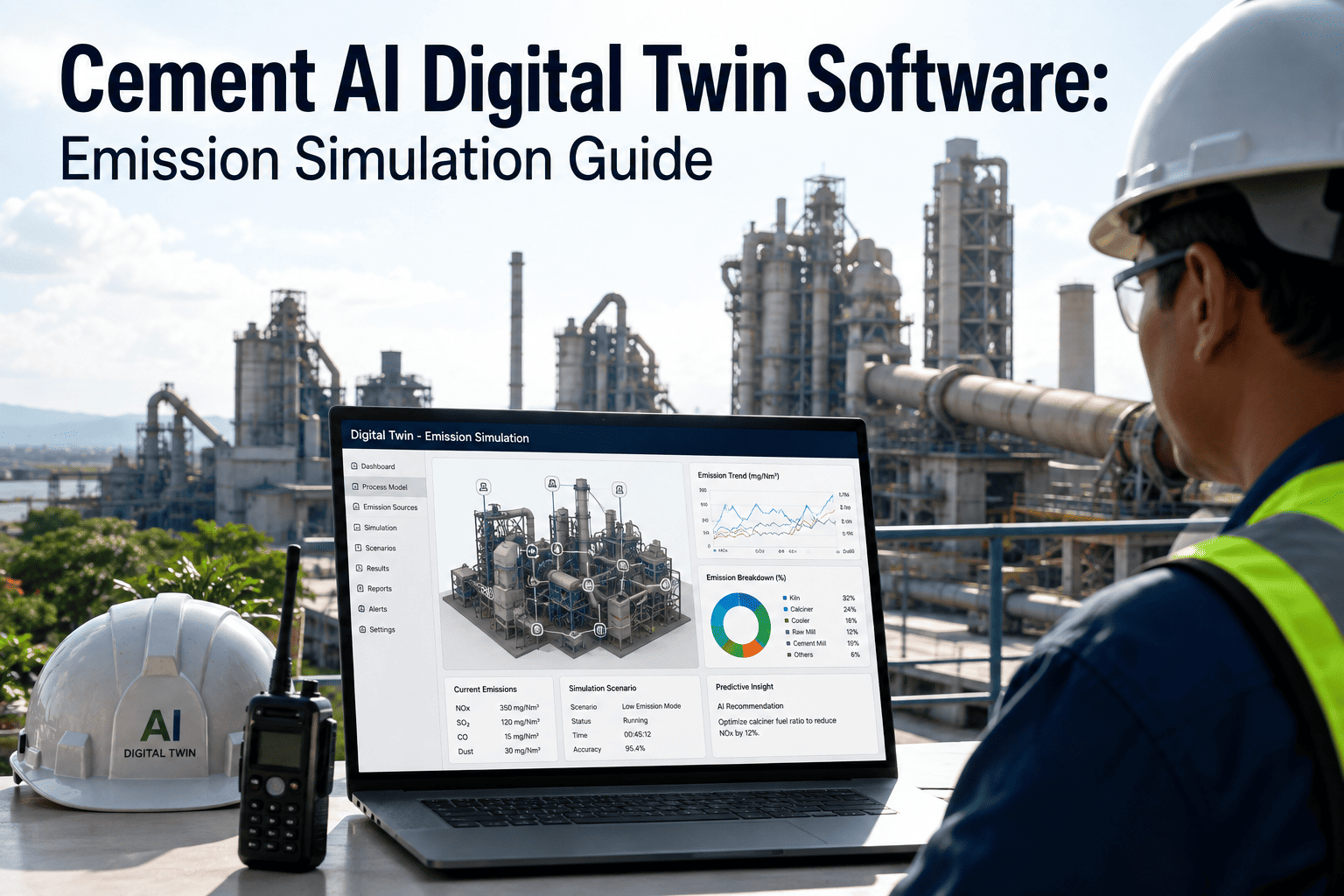
A digital twin creates a real-time virtual replica of your entire cement plant, enabling simulation, optimization, and predictive capabilities impossible with traditional systems.
What Is a Digital Twin?
A digital twin is a dynamic, data-driven model that mirrors your physical plant in real-time. Every sensor reading, equipment status, and process parameter is reflected in the virtual model, creating a living simulation that evolves with your actual operations.
How It Works
Thousands of data points flow continuously from your plant into the digital twin. AI algorithms process this data to maintain an accurate virtual representation, then use the model to simulate scenarios, predict outcomes, and optimize operations before changes are made in the physical world.
Digital Twin Capabilities
Scenario Simulation
Test operational changes virtually before implementing them in the real plant
Performance Prediction
Forecast how equipment will perform under different operating conditions
Optimization Testing
Evaluate multiple optimization strategies simultaneously without production risk
Training Environment
Train operators on realistic scenarios without affecting actual production
Digital Twin in Action: Kiln Optimization
Raw material composition changes detected
Digital twin tests 50+ parameter combinations
AI identifies optimal kiln settings
Changes applied automatically in 50ms
From Manual to Autonomous Operations
Smart cement plants progressively automate decision-making, moving from operator-dependent to fully autonomous control across key processes.
Kiln Control
Level 4 AutonomyAI continuously optimizes flame profile, feed rate, and rotation speed based on clinker quality predictions and energy efficiency targets.
Mill Optimization
Level 4 AutonomyGrinding circuits self-adjust based on material hardness, moisture content, and target fineness while minimizing energy consumption.
Quality Control
Level 3 AutonomyAI predicts cement properties before production completes, automatically adjusting blend ratios to maintain specifications.
Maintenance Planning
Level 3 AutonomyPredictive systems detect degradation patterns and automatically schedule maintenance during optimal production windows.
Smart Plant Performance Metrics
Cement manufacturers implementing smart plant technologies are achieving measurable improvements across all key performance indicators.
Energy Efficiency
AI optimization of kiln, mills, and auxiliary equipment reduces thermal and electrical energy consumption continuously.
Plant Uptime
Predictive maintenance and autonomous control eliminate most unplanned stops and reduce planned maintenance duration.
Quality Consistency
Real-time quality prediction and automated adjustments maintain tight specifications despite raw material variations.
Productivity
Optimized operations and reduced bottlenecks increase effective production capacity from existing equipment.
Typical Smart Plant ROI
Building Your Smart Plant: A Phased Approach
Transform your cement plant progressively, delivering value at each stage while building toward full autonomous operations. Book A 30 Min Demo Now
Connect and Visualize
- Deploy IoT sensors on critical equipment
- Integrate SCADA and existing systems
- Establish data platform and dashboards
- Enable real-time visibility plant-wide
Analyze and Predict
- Deploy AI analytics on collected data
- Implement predictive maintenance
- Enable quality prediction models
- Train teams on AI-assisted decisions
Optimize and Automate
- Deploy AI process optimization
- Implement MES for production coordination
- Enable closed-loop control for key processes
- Build digital twin foundation
Scale and Evolve
- Expand autonomous control scope
- Advance digital twin capabilities
- Integrate supply chain optimization
- Continuous AI model improvement
Frequently Asked Questions
How long does it take to become a smart plant?
Most cement plants can achieve significant smart plant capabilities within 12-18 months. The phased approach delivers value at each stage—you don't wait years to see benefits. Basic connectivity and visibility come within weeks, predictive capabilities within months, and autonomous control builds progressively over 1-2 years.
Do we need to replace our existing control systems?
No. Smart plant technologies are designed to layer on top of existing DCS and PLC systems. Your current control infrastructure continues operating while AI provides optimization recommendations or closed-loop adjustments through standard interfaces. This protects your existing investments.
What happens if the AI makes a wrong decision?
Smart plant systems include multiple safeguards. AI operates within pre-defined safety boundaries and cannot exceed physical or operational limits. Critical decisions can require human approval. The system continuously monitors outcomes and adjusts if results deviate from predictions. Human oversight remains available at all times.
How much does smart plant transformation cost?
Investment varies based on plant size and current digitization level. Typical Phase 1-2 investments range from $200K-$500K, with full transformation over 2 years totaling $1M-$3M. However, benefits typically exceed costs within 12-18 months, with ongoing savings of $2M-$8M annually.
Will this reduce our workforce?
Smart plants transform roles rather than eliminate them. Operators shift from manual control to supervision and exception handling. Maintenance technicians move from reactive repairs to predictive planning. The technology handles routine optimization while humans focus on strategic improvements, safety, and continuous innovation. Book A 30 Min Demo Now
Transform Your Plant Into an Intelligent Operation
Join forward-thinking cement manufacturers building self-optimizing plants that deliver consistent quality, maximum efficiency, and competitive advantage. Start your smart plant journey today.
Works with existing systems - No production disruption - Results in weeks