Modern cement plants lose 30–40% of their input energy as waste heat radiating off preheater exhaust and clinker coolers — energy that a well-instrumented WHR system converts into 6–12 MW of self-generated electricity and a measurable cut in purchased power. But the turbine, recovery boiler and ORC loop only deliver that payback when PM intervals, tube fouling thresholds and generator vibration trends are tracked with discipline, not paper logs. A CMMS built for heavy-process maintenance turns WHR from a capital project that drifts into a reliability program that compounds. Start a Start Free Trial to see the WHR asset hierarchy, PM triggers and downtime analytics in one place.
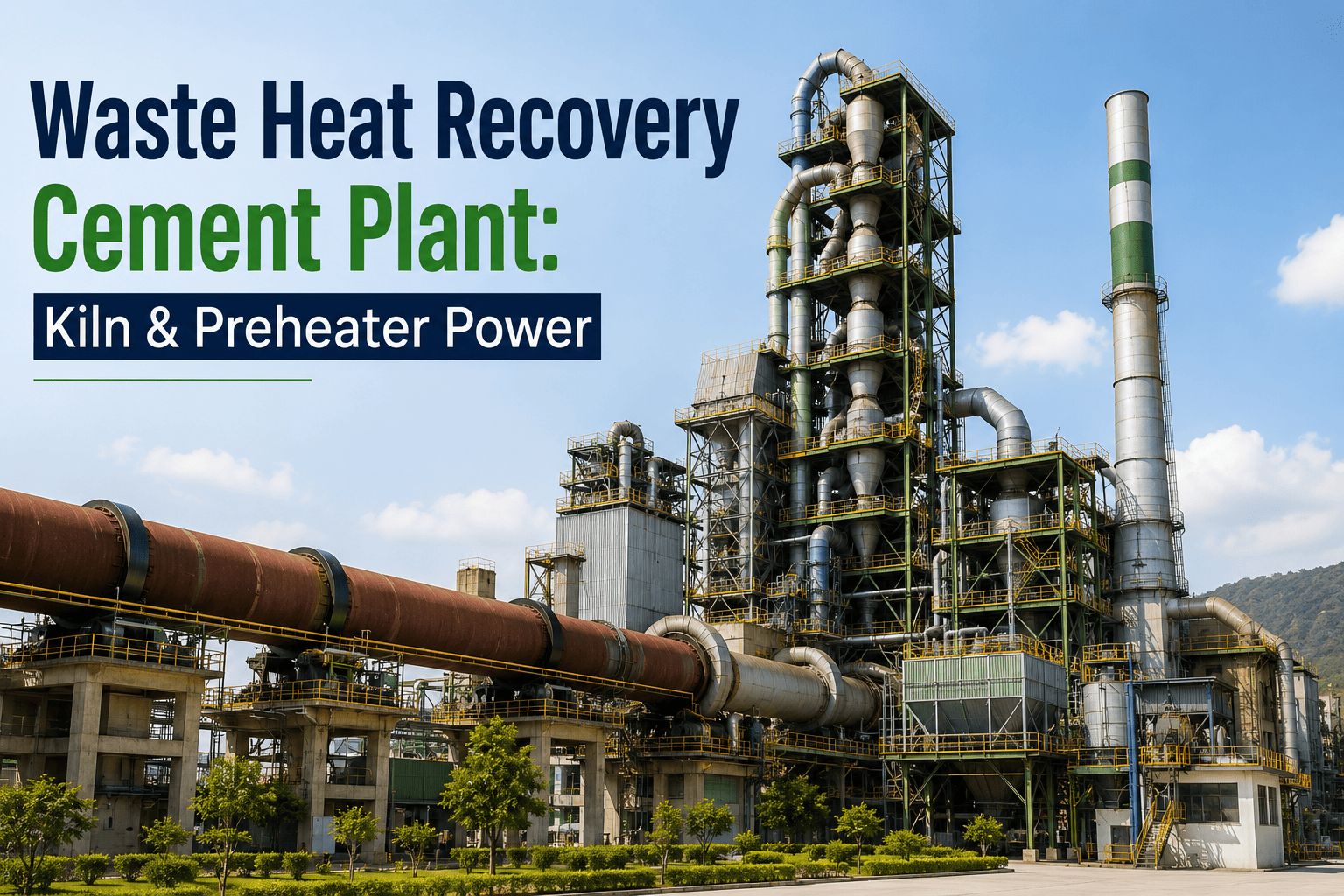
Waste Heat Recovery Cement Plant
How much recovered power is your kiln quietly losing to drift, fouling and missed PMs?
Most WHR systems run 18–30% below nameplate within three years of commissioning — not because the design is wrong, but because boiler tube cleaning, turbine governing and generator bearing service slip between disconnected spreadsheets. OxMaint closes that gap with a CMMS-driven reliability program for kiln and preheater heat recovery.
The Recovery Loop
Four pressure points where WHR plants bleed megawatts
A cement WHR system is a thermodynamic chain — one degraded link and the whole loop underperforms. Below are the four assets where 80% of recovered-power losses originate, ranked by typical annual impact on a 5,000 tpd line.
PH Boiler Dust Fouling
Preheater exhaust carries 60–90 g/Nm³ of fine dust. Without soot-blowing cadence and quarterly tube lancing, heat-transfer coefficient drops 12–18% inside six months, cutting steam flow to the turbine.
AQC Boiler Tube Erosion
Clinker-cooler air at 360°C abrades evaporator tubes. Wall-thickness checks every 8,000 hours and scheduled retubing at 4 mm prevent leaks that force WHR trips and lose 90+ hours of generation per event.
Turbine Governing & Blade Deposits
Steam-path silica and sodium salts reduce stage efficiency 6–10%. Coupled with governor linkage drift, the unit slides off its 3,000 RPM setpoint — recovering 4% less heat per tonne of clinker.
ORC Working-Fluid Degradation
In Organic Rankine Cycle loops, thermal degradation of pentane or siloxane fluid forms acids that foul the expander and regenerator. Untested fluid loses 0.5% cycle efficiency monthly — 3 MW/yr gone on a 12 MW plant.
WHR Boiler & Turbine PM
The maintenance checklist that keeps recovered power available
This tiered PM grid is the backbone of a CMMS-driven WHR reliability program. Each item carries an interval, a measurable acceptance threshold and a trigger condition — so technicians act on data, not memory.
Operational Surveillance
- Log PH boiler inlet/outlet gas ΔT — flag if ΔT narrows >8% week-on-week.
- Verify AQC boiler steam pressure within ±0.3 bar of setpoint at constant kiln load.
- Inspect turbine lube-oil level, sight glass clarity and bearing drain temperature <75°C.
- Confirm ORC working-fluid reservoir level and expander inlet vapor temperature.
- Walk down condenser cooling-water flow and CW pump differential pressure.
Preventive Servicing
- Execute PH boiler soot-blowing audit — verify all lances cycle on programmed cadence.
- Sample turbine lube oil — ISO 4406 cleanliness ≤ 18/16/13, moisture <200 ppm.
- Sample ORC fluid — acid number <0.05 mg KOH/g, no visible particulate.
- Trend generator winding IR (Megger) — minimum 100 MΩ, no >25% drop since baseline.
- Calibrate gas-temp, flow and pressure transmitters against reference standards.
Shutdown Overhaul
- Open PH & AQC boilers — ultrasonic tube thickness survey, retube at <4.0 mm wall.
- Turbine major inspection — blade deposits, journal bearing clearance, governor linkage.
- Generator electrical overhaul — wedge tightness, partial-discharge test, re-babbit bearings.
- ORC expander teardown — expander wheel profilometry, seal replacement, regenerator core clean.
- Re-certify safety valves, non-return valves and emergency trip logic per OEM spec.
The Payback Math
What 9.2 MW of recovered power is worth on your P&L
When a WHR system drifts, the megawatts you lose are the megawatts you buy back from the grid at industrial tariffs. The formula below is the one our CMMS dashboard runs every shift to quantify drift in dollars — and to trigger a work order before a small fouling problem becomes a multi-week generation shortfall.
| WHR Condition | Net Output | Self-Gen Share | Annual Grid Offset | CO₂ Avoided |
|---|---|---|---|---|
| As-commissioned (Year 1) | 9.2 MW | 32% | $6.69M | 28,400 t/yr |
| Typical drift (Year 3, no CMMS) | 7.1 MW | 24% | $5.16M | 21,900 t/yr |
| CMMS-driven PM (steady) | 8.9 MW | 31% | $6.47M | 27,400 t/yr |
| Best-in-class (ISO 55000 aligned) | 9.4 MW | 33% | $6.83M | 29,000 t/yr |
Reliability Timeline
The 12-month WHR reliability calendar
A WHR program is not a one-off project — it is a rotating cycle of inspection, testing and overhaul. This is the calendar a CMMS enforces automatically, with each milestone spawning work orders, parts reservations and sign-off workflows.
Baseline & Instrumentation
Establish clean-baseline ΔT, steam flow and vibration spectra for PH/AQC boilers, turbine and generator. Confirm all transmitters calibrated and tagged in the CMMS asset hierarchy.
First Fouling Audit
Compare live ΔT against baseline. Trigger soot-blowing cadence review and lance inspection. Sample ORC fluid for first-sign acid number drift. Trend generator winding IR.
Mid-Year Turbine Service
Turbine bearing inspection, lube-oil change, governor linkage calibration. Vibration spectrum re-baselined. AQC boiler ultrasonic spot-check on high-erosion zones.
ORC & Generator Focus
Full ORC fluid analysis and partial filter/regenerator clean. Generator partial-discharge test, wedge tightness check and bearing-oil seal inspection.
Annual Shutdown Planning
Compile 12 months of trended data into a shutdown scope: tube retubing list, turbine blade-cleaning plan, expander seal kit, safety-valve recertification. Lock parts, labour and 72-hour window.
Field Result
From drift to best-in-class in one overhaul cycle
"Our 9 MW WHR unit had slipped to 6.8 MW within four years — we blamed the kiln. After deploying OxMaint to enforce boiler soot-blowing cadence, monthly ORC fluid sampling and a proper turbine service calendar, we recovered to 8.7 MW inside one annual cycle. That is $1.4M of grid power back on the P&L."
Stop buying back the megawatts your WHR system already recovered.
Deploy OxMaint and turn your kiln waste-heat loop into a reliability program that protects 6–12 MW of self-generation, shift after shift.
FAQ
Waste heat recovery cement plant — answered
How much power can a cement plant WHR system realistically generate?
A modern 5,000 tpd kiln with PH and AQC boilers feeding an ORC or steam turbine typically yields 6–12 MW of self-generated power — equivalent to 25–35% of the plant's electricity demand, depending on exhaust-gas temperature, cooler-air volume and cycle efficiency.
Why does WHR output drift even when the kiln runs normally?
Drift comes from three silent culprits: PH boiler tube fouling that narrows ΔT, turbine steam-path deposits that lower stage efficiency, and ORC working-fluid degradation that reduces expander duty. None trigger an alarm — they only show up as a slow MW slide that a CMMS trend catches early.
How does a CMMS specifically improve WHR availability?
It enforces PM intervals on every asset in the recovery loop — boiler soot-blowing, turbine bearing service, ORC fluid sampling, generator Megger tests — and ties each task to a measurable threshold. Drift from baseline auto-triggers a work order, so fouling is corrected before it costs megawatts. You can see it in action — Start Free Trial.
Is ORC better than a steam turbine for cement WHR?
For lower-temperature exhaust (200–350°C) an ORC often delivers higher cycle efficiency and simpler unmanned operation. Steam Rankine suits larger plants with higher gas temperatures (>350°C). The maintenance profile differs — ORC demands strict fluid chemistry, steam demands strict water chemistry — and a CMMS manages both on the same asset register.
What is the typical payback for a WHR reliability program on an existing plant?
Most cement producers see CMMS-driven WHR maintenance pay back in 6–14 months, because recovered MW offset grid power at $80–110/MWh. A plant regaining just 1.5 MW at 7,900 hours and $92/MWh recovers over $1M annually — far more than the software and labour cost of running the program.
Recover the megawatts you already paid to capture
Put your kiln waste-heat loop on a reliability program that compounds.
OxMaint gives you the asset hierarchy, PM triggers, drift analytics and shutdown planning to keep 6–12 MW of cement WHR self-generation available — every shift, every year.
Free 14-day trial · No credit card