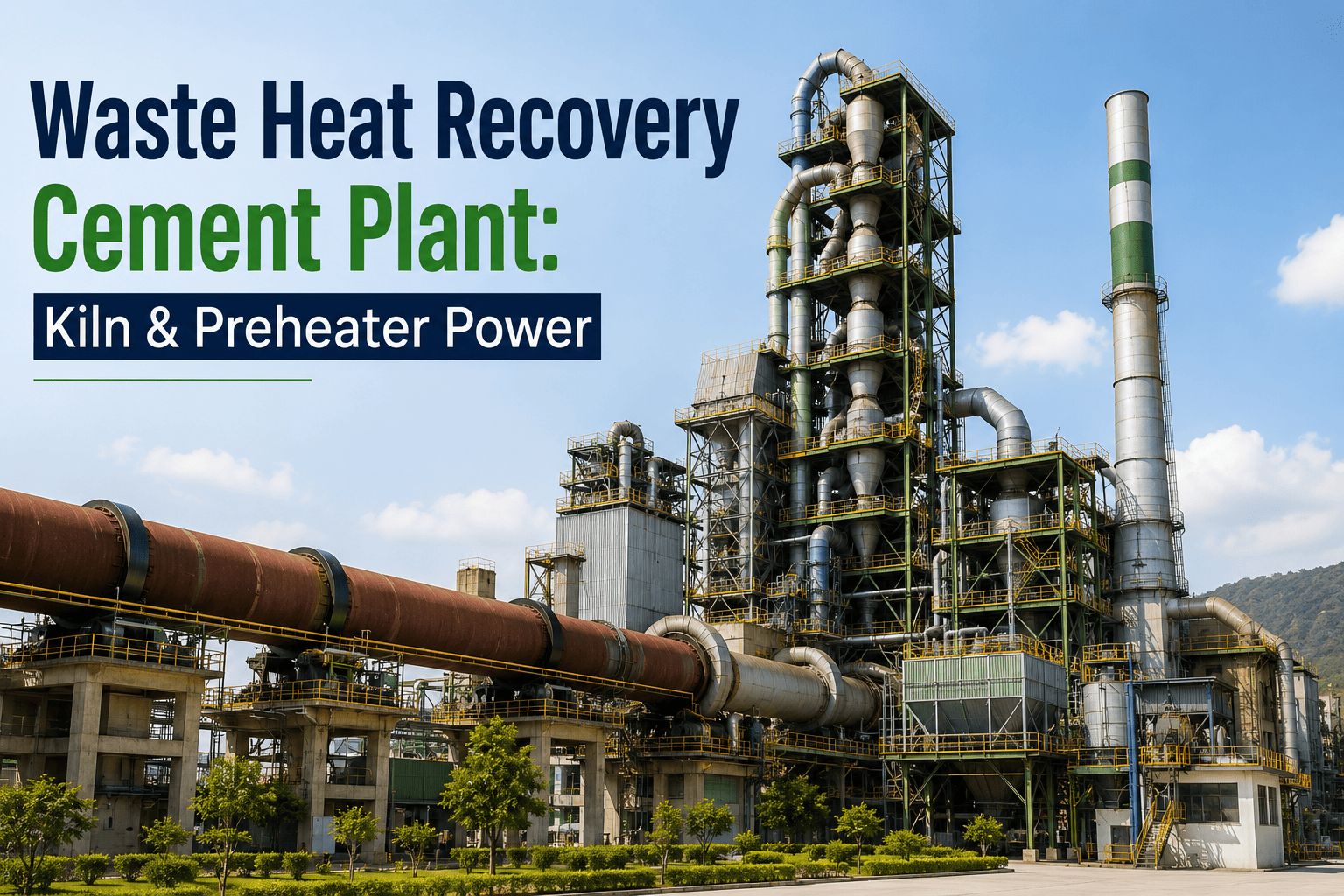
Waste heat recovery systems in cement plants represent $1.5M to $4M in annual energy value per kiln line — yet most WHR assets operate without structured PM schedules, relying on reactive responses to efficiency losses that have already cost weeks of degraded output. A single ORC turbine trip or fouled boiler circuit cuts WHR power generation by 30 to 60% within days of the missed maintenance window, and the degradation compounds silently until a full system outage forces inspection. See how Oxmaint structures a complete WHR asset PM program — book a demo with our cement team.
Kiln & Pyroprocessing
Waste Heat Recovery System Maintenance for Cement Plants
8 min read | Oxmaint Editorial Team
$3.2M
Average annual WHR energy value at a 5,000 TPD kiln line — at risk without a structured PM and monitoring program
22%
Typical WHR efficiency loss from fouled heat exchanger surfaces when cleaning PM intervals exceed 90 days
4.6x
Emergency ORC turbine repair cost versus scheduled maintenance intervention at the same component condition
18 mo
Average WHR boiler tube replacement interval without condition monitoring — versus 34 months with structured inspection
Quick Answer
Waste heat recovery system maintenance in cement plants is a structured PM program covering boiler surface cleaning and tube inspection, ORC turbine and steam turbine PM scheduling, heat exchanger fouling monitoring, bypass damper condition tracking, and hot gas duct refractory inspection — linked to asset condition records to preserve WHR energy output and enable capital replacement planning before efficiency losses become unrecoverable.
WHR System Asset Classes Requiring Structured PM
WHR Boiler Circuits
Tube surface fouling, soot blower function, drum level controls, safety valve calibration
ORC and Steam Turbines
Bearing vibration, seal condition, working fluid quality, inlet and outlet temperature trending
Heat Exchangers
Fouling index tracking, pressure drop monitoring, tube bundle inspection, cleaning interval scheduling
Bypass Dampers and Ducts
Damper actuator PM, hot gas duct refractory inspection, expansion joint condition, gas leakage checks
Four WHR Failure Modes Eroding Energy Recovery Output
01
Boiler Surface Fouling
Clinker dust accumulation on WHR boiler tube surfaces reduces heat transfer coefficient by 8 to 22% within a single campaign without cleaning PM. A 15% heat transfer loss at a 5,000 TPD plant reduces WHR power output by 1.8 to 2.4 MW — equivalent to $280,000 to $420,000 in lost annual energy value at US grid rates.
02
ORC Turbine Bearing and Seal Degradation
ORC turbine bearings operating in high-temperature organic fluid environments degrade at rates that cause seal failure within 14 to 20 months without vibration-based condition monitoring. A single unplanned turbine trip causes 4 to 12 weeks of WHR outage for bearing replacement and fluid recharging — averaging $380,000 in lost generation and emergency repair costs.
03
Bypass Damper Drift and Hot Gas Short-Circuiting
Bypass damper actuator wear causes gradual position drift that allows hot kiln or cooler exhaust gas to short-circuit around WHR boiler circuits. A damper drifting 15 to 20% from the set position reduces boiler gas inlet temperature by 40 to 80°C — cutting WHR output by 25 to 35% before process control systems detect the loss through declining power generation figures.
04
Hot Gas Duct Refractory Failure
Refractory castable in hot gas ducts connecting kiln preheater exit and cooler vent to WHR boilers degrades at 6 to 14mm per campaign under thermal cycling. Untracked lining failures cause structural duct damage and false air ingress that reduces gas inlet temperature to WHR boilers by 60 to 120°C — forcing system derate or shutdown for emergency castable replacement.
How Oxmaint Manages WHR System Assets
01
Register Every WHR Component in the Kiln Asset Hierarchy
Oxmaint structures the full WHR system under the kiln line hierarchy — boiler circuits by zone, ORC and steam turbine assemblies, heat exchanger bundles, bypass damper actuators, and hot gas duct sections each registered with installation date, design specifications, and performance baselines. Asset QR tags enable field technicians to access records and log readings without leaving the equipment.
02
Automate PM Work Orders by Asset Class and Frequency
Boiler surface cleaning, soot blower function checks, ORC turbine bearing vibration surveys, heat exchanger pressure drop logging, bypass damper actuator calibration, and hot gas duct refractory inspections are all generated automatically at the correct interval for each asset. No manual scheduling — escalating alerts at 30, 7, and 1 day before deadline keep WHR PM compliance above 90% across multi-kiln plants.
Book a demo to see WHR PM templates configured for your system type.
03
Track WHR Performance Metrics Against Asset Condition Records
Oxmaint's WHR performance tracking module links process data — boiler outlet temperature, turbine power output, heat exchanger pressure drop, and bypass damper position — to asset condition scores. When performance metrics drift below threshold, the system flags the responsible asset and generates an inspection work order before the efficiency loss compounds further.
04
Generate Capital Replacement Evidence for WHR Investment Decisions
Condition data from boiler tube inspections, turbine bearing trend logs, and heat exchanger fouling records feed Oxmaint's CapEx forecasting dashboard — producing rolling 5 and 10-year capital replacement forecasts for WHR system overhauls. Engineering and finance teams submit capital requests backed by condition evidence rather than age estimates, achieving an 88% council approval rate versus 47% without documented condition data.
WHR Performance Metrics: Before and After Structured PM
| Metric |
Without Structured PM |
With Oxmaint WHR Program |
| Boiler Surface Cleaning Interval |
Reactive — cleaned after output drop detected |
Scheduled every 45 to 60 days per asset record |
| ORC Turbine PM Compliance |
52% — missed intervals common during campaign pressure |
91% sustained compliance with automated escalation |
| WHR System Availability |
78 to 82% — unplanned trips reduce annual output |
94 to 97% — bearing and seal failures largely eliminated |
| Heat Exchanger Fouling Detection |
Detected after 15 to 22% efficiency loss |
Flagged at 5% pressure drop deviation from baseline |
| Bypass Damper Drift Events |
3 to 5 per year per kiln line |
0 to 1 per year with quarterly actuator calibration PM |
| CapEx Forecast Accuracy |
61% — age-based estimates without condition data |
91% — RUL projections from inspection trend records |
WHR Maintenance Investment vs Return
| Program Element |
Annual Investment |
Annual Return or Avoidance |
Payback Period |
| Boiler Surface Cleaning PM |
$5,200 per kiln |
$320,000 or more in WHR output preserved by eliminating fouling-driven efficiency loss annually |
Under 1 week |
| ORC Turbine PM Scheduling |
$6,800 per turbine |
$380,000 in avoided turbine trip downtime and emergency bearing replacement per event prevented |
Under 2 weeks |
| Heat Exchanger Fouling Monitoring |
$3,400 per system |
$140,000 in efficiency losses avoided through early detection and scheduled cleaning |
Under 3 weeks |
| Bypass Damper and Duct PM |
$2,800 per kiln |
$210,000 or more in WHR output preserved by eliminating short-circuit gas bypass events annually |
Under 2 weeks |
| Full Oxmaint WHR Program |
$20,000 per year |
$900,000 or more in combined energy output preservation and failure avoidance across all WHR assets |
Under 2 weeks |
Frequently Asked Questions
QHow does Oxmaint track ORC turbine condition across organic fluid changes and campaigns?
Each ORC turbine is registered as a discrete asset with bearing baseline vibration, seal design specifications, and working fluid quality thresholds. PM work orders for bearing vibration surveys and fluid sampling are generated automatically — condition scores update from each inspection and trigger escalation when readings approach intervention thresholds.
Book a demo to see ORC turbine PM configuration for your system.
QCan Oxmaint integrate with DCS or SCADA systems to pull WHR performance data automatically?
Yes. Oxmaint integrates with OPC-UA, Modbus, and standard DCS export formats to route boiler outlet temperature, turbine power output, and heat exchanger pressure drop directly into asset condition records. Performance deviations trigger PM work orders without manual operator intervention.
Schedule a technical demo to review your plant's integration path.
QHow does Oxmaint support ISO 50001 energy management documentation for WHR systems?
All WHR inspection records in Oxmaint are timestamped, GPS-located, and photo-evidenced — meeting ISO 50001 documentation requirements for energy system maintenance records and audit trails. Compliance packages export in under 4 hours from the documentation module.
Book a demo to see WHR compliance documentation templates.
QWhat ROI case should a VP of Operations expect from a WHR CMMS investment?
A single avoided ORC turbine trip saves $380,000 in lost generation and emergency repair — exceeding the annual platform cost for one kiln in the first prevented event. Boiler fouling PM alone preserves $280,000 to $420,000 in annual WHR output per kiln line at typical US energy rates.
Book a demo to build a site-specific ROI case for your leadership team.
QHow long does deployment take for a WHR system across two kiln lines?
Continue Reading
Stop Losing $3M in Annual WHR Output to Untracked Degradation
Oxmaint deploys a complete waste heat recovery PM program across boilers, ORC turbines, heat exchangers, and bypass systems — live in under 3 weeks across all kiln lines, no IT project, no consultant fees.
WHR Performance Tracking
ORC Turbine PM Scheduling
Boiler Fouling Monitoring
Energy CapEx Planning