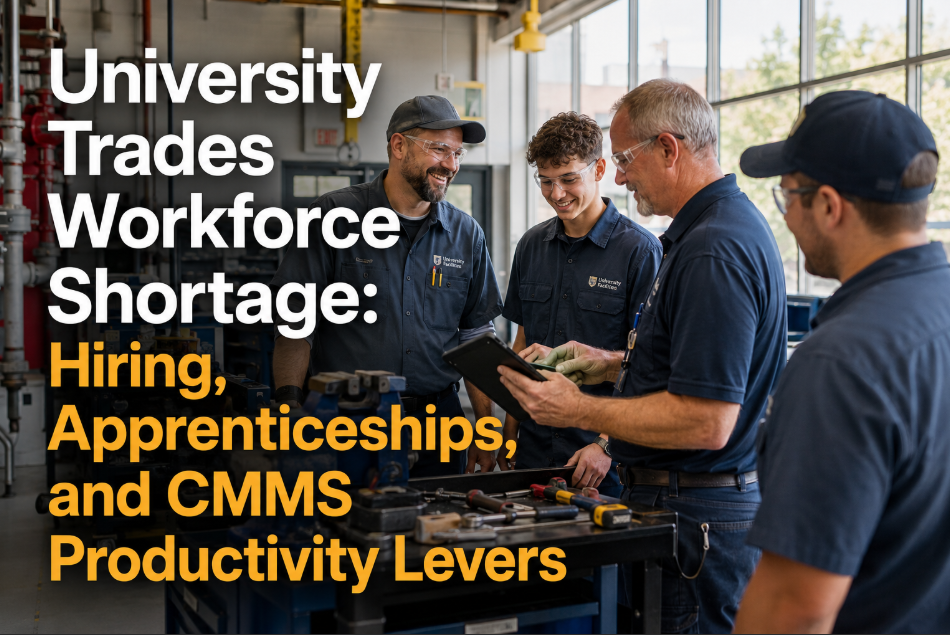
A university with 4.2 million square feet of campus buildings, 1,800 active assets, and a maintenance team running 34% below recommended staffing levels submits 14,000 work orders per year. The average response time is 6.3 days. Classrooms lose HVAC mid-lecture. Residence hall plumbing failures go unresolved over weekends. Lab equipment downtime delays funded research. The facilities director knows every building that needs attention—but the team physically cannot get to them all. Hiring is not the answer: the median time-to-fill for a skilled campus maintenance technician is now 97 days, and 42% of positions posted at public universities receive zero qualified applicants.
This is not a staffing problem that headcount can solve. It is an operational architecture problem that AI was built to solve. AI-driven maintenance platforms do not replace technicians—they multiply the capacity of every technician you have. Automated work order routing eliminates manual dispatch. Predictive failure detection prevents emergencies before they consume your team's day. Intelligent prioritization ensures student-facing spaces are serviced first. The result: the same team, covering more ground, with faster response times and fewer crisis calls. Start your free trial to see AI-driven maintenance in action.
Why the Traditional Staffing Model Is Broken
The facilities staffing model at most US universities was designed for a different era. Buildings were simpler. Systems were mechanical. A competent generalist could troubleshoot most issues with a wrench and a multimeter. Today's campus facilities include building automation systems, IoT-networked HVAC controls, electronic access systems, laboratory ventilation with real-time monitoring, and energy management platforms requiring specialized technical knowledge. The workforce has not kept pace with the complexity of the buildings it maintains.
Three compounding forces have made the gap permanent. First, the skilled trades pipeline has contracted—enrollment in vocational and technical programs declined 37% over the past decade while campus building square footage grew 18%. Second, compensation at public universities cannot compete with private-sector wages for HVAC technicians, electricians, and controls specialists. Third, the existing workforce is aging out: 31% of campus maintenance staff are within five years of retirement, carrying institutional knowledge that has never been documented in any system.
AI does not fix the pipeline. It changes the equation entirely—making the staff you have dramatically more productive while capturing institutional knowledge in digital workflows that survive turnover.
Shrinking Talent Supply
- Vocational program enrollment down 37% in a decade
- Campus square footage up 18% in the same period
- Building system complexity increasing exponentially
- Fewer generalists can service modern smart buildings
Public vs. Private Pay Delta
- University HVAC tech: $48K–$58K average
- Private sector HVAC tech: $62K–$78K average
- Benefits no longer offset the wage gap
- Overtime demands accelerate burnout and turnover
Institutional Knowledge Loss
- 31% of campus maintenance staff retiring within 5 years
- Building-specific knowledge undocumented
- Tribal knowledge disappears with each departure
- New hires take 12–18 months to reach full productivity
Building System Evolution
- IoT sensors, BAS networks, smart controls
- Lab ventilation with real-time airflow monitoring
- Cyber-physical security convergence
- Energy management and decarbonization systems
The 5 AI Capabilities Transforming Campus Maintenance
AI-driven maintenance is not a single feature—it is a connected set of capabilities that work together to fundamentally restructure how campus facilities teams operate. Each capability addresses a specific bottleneck that currently consumes technician time, delays response, or allows preventable failures to escalate into emergencies. Together, they transform a reactive, understaffed operation into a predictive, data-driven campus maintenance engine.
Intelligent Work Order Routing & Auto-Dispatch
Automatically assigns work orders based on technician skill set, real-time location, current workload, and building-specific certification requirements—eliminating the 45-minute daily dispatch meeting
When emergencies arrive, AI re-sequences the entire team's queue in seconds—rerouting the nearest qualified technician while redistributing displaced tasks across available staff without manual intervention
Groups work orders by building proximity to minimize travel time between tasks—recovering 60–90 minutes of productive wrench time per technician per day on large campuses
Tracks which work order types are queuing because no available technician holds the required certification—providing data to target training investments or contractor partnerships
Predictive Failure Detection & Prevention
AI analyzes maintenance history, runtime data, and failure patterns across similar equipment to identify assets approaching failure 2–6 weeks before breakdown—converting emergency calls into scheduled maintenance
Models historical failure spikes against weather patterns and academic calendar—pre-scheduling HVAC inspections before cooling season, boiler checks before heating season, and plumbing winterization before freeze events
Predicts which replacement parts will be needed based on upcoming failure probabilities—eliminating the 2–5 day delays caused by parts not being on hand when a technician arrives at the job
Measures the percentage of work orders that would have been emergencies without predictive intervention—documenting the ROI of prevention versus reaction for budget justification
Student-Impact Prioritization Engine
Automatically escalates work orders in classrooms, lecture halls, residence halls, dining facilities, and labs above back-of-house and administrative spaces—aligning maintenance priorities with enrollment retention
Adjusts priority scoring based on academic calendar: finals week classroom HVAC becomes critical, move-in week residence hall issues escalate automatically, and admissions tour routes receive priority maintenance windows
Integrates room scheduling data to prioritize spaces actively in use over vacant spaces—ensuring a broken projector in a 300-seat lecture hall outranks the same issue in an unused seminar room
Identifies when multiple work orders reference the same issue or building zone—triggering escalation for systemic problems like building-wide HVAC failures rather than treating each complaint as isolated
Institutional Knowledge Capture & Transfer
Every repair, part replacement, and diagnostic note is logged against the specific asset—building a complete service history that transfers institutional knowledge from experienced technicians into the system permanently
When a work order is created for a specific asset, AI surfaces the last 5 repairs, the most common failure modes, the parts used previously, and recommended diagnostic steps—giving new technicians veteran-level context
Mobile-first workflows capture before/after photos, equipment nameplate data, and video of complex repairs—creating a visual knowledge base that accelerates training for new hires by 40–60%
Common maintenance procedures are documented as step-by-step digital checklists—ensuring consistent quality regardless of which technician performs the work and reducing rework rates by 25%
Energy & Asset Lifecycle Optimization
Replaces calendar-based PM schedules with actual equipment runtime data—eliminating unnecessary maintenance on lightly used equipment while increasing frequency on heavily loaded systems
Flags buildings consuming energy outside expected patterns—identifying HVAC systems running simultaneously in heating and cooling mode, stuck dampers, and after-hours equipment operation wasting 15–25% of energy budgets
Models remaining useful life for every major asset based on condition data, maintenance history, and manufacturer benchmarks—feeding the 5-year Capital Improvement Plan with data-driven replacement timelines
Calculates lifetime maintenance cost per asset class—identifying equipment where repair costs have exceeded 60% of replacement value, triggering the repair-vs-replace decision with financial evidence
Measurable Outcomes: Before and After AI Implementation
The difference between a reactive campus maintenance operation and an AI-driven one is not incremental—it is structural. The metrics below represent documented shifts that occur within 90–180 days of deploying AI-driven maintenance platforms at institutions ranging from 500,000 to 15 million square feet under management. Schedule a demo to see these metrics modeled for your campus.
AI routing reduces average response from 6.3 days to under 24 hours by eliminating manual dispatch, clustering tasks geographically, and auto-assigning based on technician proximity and skill.
Predictive failure detection shifts work from emergency to scheduled. Institutions typically move from 45% emergency work orders to under 15% within two semesters of AI deployment.
Automated dispatch, geographic clustering, and pre-staged parts increase wrench time from the industry average of 35% to over 70%—effectively doubling each technician's output capacity.
Anomaly detection identifies simultaneous heating/cooling, stuck dampers, and after-hours equipment operation. Correcting these issues delivers 15% energy savings across the building portfolio.
Predictive and runtime-based maintenance extends equipment useful life by 30% compared to run-to-failure or rigid calendar-based PM—deferring capital replacement costs by 3–7 years per asset class.
Digital knowledge capture—asset histories, repair recommendations, photo documentation, and procedure checklists—reduces time to full productivity from 12–18 months to under 6 months for new technicians.
The Enrollment Connection: Why Facilities Are a Retention Strategy
The 2026 enrollment cliff makes every operational function an enrollment function. WICHE projects the sharpest decline in US high school graduates beginning this year, compressing tuition revenue for institutions that fail to retain enrolled students. Facility condition is a documented top-three factor in student satisfaction and retention. A campus where classroom HVAC fails during finals, where residence hall maintenance requests take a week, and where dining hall equipment breaks during meal service does not retain students—it accelerates attrition.
AI-driven maintenance directly impacts retention metrics because it ensures student-facing spaces are maintained at recruitment-grade condition consistently—not just during admissions tour seasons. The student-impact prioritization engine guarantees that every classroom, lab, residence hall, and common area receives the maintenance attention that shapes daily student experience. In a market where every retained student represents $20,000–$45,000 in annual tuition revenue, the ROI on AI-driven facilities maintenance is measured in enrollment margins, not just operational efficiency.
Compliance & Risk: AI as Your Audit-Readiness Engine
Understaffed maintenance teams do not just miss work orders—they miss compliance deadlines. OSHA inspections, NFPA fire safety documentation, ADA remediation tracking, EPA environmental monitoring, and the incoming 2026 Heat Illness Prevention standard all require documented maintenance records that reactive operations cannot reliably produce. AI-driven platforms generate compliance documentation as a byproduct of normal operations—every inspection, every PM task, and every corrective action is digitally logged with timestamps, technician IDs, and photo evidence. Book a demo to see automated compliance documentation for your campus.
AI Is Not Replacing Your Maintenance Team—It Is Rescuing It
The conversation about AI in campus facilities is often framed as automation versus employment. That framing misses the reality on the ground. University maintenance departments are not overstaffed and looking to cut—they are desperately understaffed and watching skilled workers leave for higher-paying private-sector jobs. AI is the only viable path to maintaining service levels with fewer people.
The institutions implementing AI-driven maintenance are not reducing headcount. They are stabilizing operations that were deteriorating under workforce shortages. Response times that had ballooned to a week are returning to same-day. Emergency work orders that consumed 45% of technician time are dropping below 15%. Asset life is extending because predictive maintenance is catching failures before they become catastrophic replacements.
Most importantly, AI-driven platforms are making campus maintenance jobs better. Technicians spend less time on paperwork, less time driving between buildings inefficiently, and less time responding to crises that could have been prevented. That improvement in work quality is itself a retention strategy—for your workforce, not just your students.
Implementation: From Reactive to AI-Driven in 90 Days
Transitioning to AI-driven maintenance does not require a multi-year IT project. Oxmaint deploys in phases designed to deliver measurable results within 90 days while building toward full predictive operations. The architecture integrates with existing Building Automation Systems, IoT sensors, and financial platforms—requiring no rip-and-replace of current infrastructure.
The phased approach ensures that facilities teams see immediate productivity gains from AI routing in the first month—building buy-in before the more advanced predictive and compliance capabilities come online. By week 12, the entire operation runs on data-driven workflows that document every action, predict every failure pattern, and prioritize every task by student impact. Start your free trial and begin the 90-day transformation.
Frequently Asked Questions
Will AI-driven maintenance replace campus maintenance jobs?
No. AI-driven maintenance addresses the opposite problem—chronic understaffing that universities cannot solve through hiring alone. The platform multiplies each technician's productive capacity by automating dispatch, predicting failures before they become emergencies, and eliminating administrative tasks. Institutions deploying AI maintenance are not cutting staff; they are stabilizing operations that were degrading under workforce shortages. Technician roles shift from reactive crisis response to skilled predictive maintenance work—a higher-value, more sustainable position that improves job satisfaction and retention.
How quickly will we see measurable results after deploying Oxmaint?
Most institutions see measurable improvement within 30 days. AI-powered work order routing delivers immediate results: response times decrease as manual dispatch is eliminated and geographic clustering reduces technician travel time. Within 60–90 days, predictive failure models begin generating proactive work orders that prevent emergencies. By the end of the first semester, institutions typically report a 60% reduction in response time, a 65% decrease in emergency work orders, and measurable energy savings from anomaly detection. Schedule a demo to see projected timelines for your campus.
Does Oxmaint integrate with our existing Building Automation System?
Yes. Oxmaint integrates with major BAS platforms including Siemens, Johnson Controls, Honeywell, Tridium/Niagara, and Schneider Electric. The integration enables real-time equipment monitoring, automated alert-to-work-order conversion, and energy anomaly detection without replacing existing controls infrastructure. API connectivity also extends to campus ERP systems, student information systems, and financial platforms for unified reporting. Most BAS integrations are completed within 2–3 weeks of project start. Start a free trial to begin the integration assessment for your campus.
How does AI prioritization work for student-facing spaces?
The student-impact prioritization engine assigns weight scores to every space type on campus. Classrooms, lecture halls, residence halls, dining facilities, and research labs receive the highest priority weights. The system also integrates with room scheduling data so that actively occupied spaces are prioritized over vacant ones. During critical academic calendar events—finals week, move-in day, admissions tours—priority weights automatically adjust to ensure the spaces that matter most to student experience and enrollment receive immediate maintenance attention.
What is the ROI justification for presenting AI maintenance to our board?
The business case rests on four quantifiable pillars: (1) Workforce productivity—doubling effective technician capacity avoids $180K–$350K annually in unfilled position costs. (2) Energy savings—anomaly detection delivers 15% energy cost reduction, typically $150K–$500K per year. (3) Asset life extension—30% longer equipment life defers $2M–$8M in capital replacements over 5 years. (4) Enrollment protection—facility condition as a retention factor means every percentage point of improved student satisfaction protects $500K–$2M in annual tuition revenue. Combined, the platform typically delivers 5–8× return on investment within the first year. Book a demo and we will model the specific ROI for your institution.