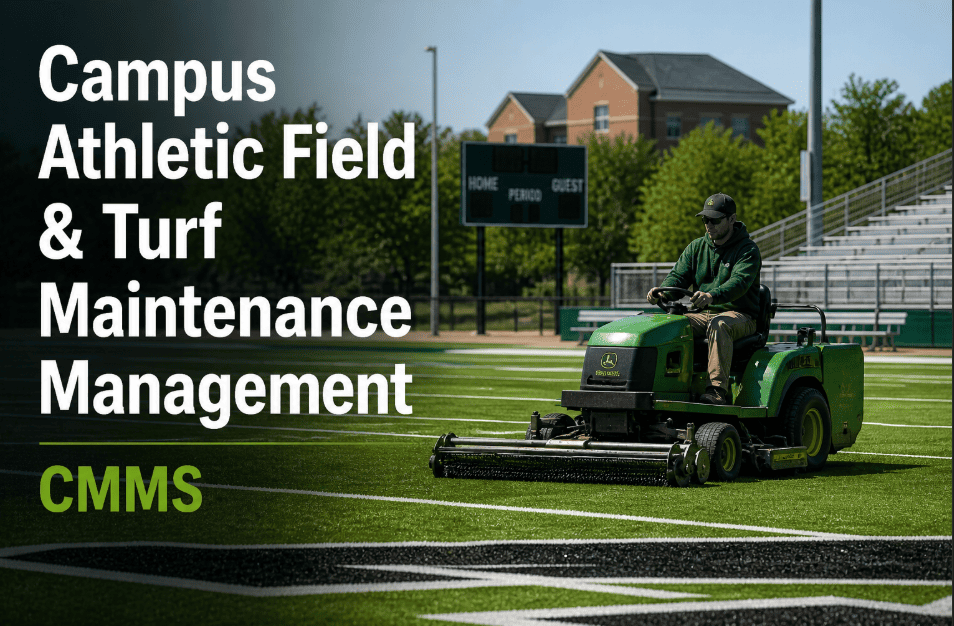
A Division I university with eight natural grass fields and four synthetic turf surfaces managing maintenance on spreadsheets and gut instinct is already behind. Natural turf fields require precise aeration, overseeding, and fertilization windows tied to growth cycles and game schedules. Synthetic fields need seam inspections, infill replenishment, and shock absorption testing on a compliance calendar that most groundskeeping teams track in notebooks or not at all. When a field fails a safety inspection two days before a conference championship game, the liability exposure is significant and the question from administration is always the same: where was the maintenance record? Start a free trial of OxMaint and build your first turf maintenance schedule today, or book a demo to see how athletic field CMMS scheduling works for multi-surface campus portfolios.
Campus Athletic Field and Turf Maintenance Management: Schedule, Document, and Protect Every Playing Surface
A failed ASTM shock-absorption test on game day. Synthetic seams failing under load during competition. An overwatered grass pitch that forces a mid-season surface switch. Every one of these scenarios is preventable with condition-based turf maintenance scheduling — and every one has happened to a campus that relied on manual tracking.
Your Athletic Surfaces Deserve the Same CMMS Discipline as Your HVAC
OxMaint tracks every field as an asset — with PM schedules, condition scores, usage-based triggers, and sensor integration — so every turf decision is data-driven and documented, not a judgment call on the day of inspection.
Natural vs Synthetic Turf: Two Completely Different Maintenance Regimes
Natural grass and synthetic turf fields require fundamentally different maintenance programs — and most campus groundskeeping operations are managing both types simultaneously without tools that distinguish between them. Natural fields follow biological growth cycles, seasonal renovation schedules, and weather-dependent irrigation windows. Synthetic fields follow usage cycles, infill degradation curves, seam stress patterns, and mandatory safety testing intervals tied to ASTM standards and manufacturer warranty terms. A single CMMS that models both asset types — with separate PM templates, condition scoring criteria, and compliance documentation per surface type — is what modern athletic facility management requires. Want to see how OxMaint handles multi-surface athletic facility scheduling? Start a free trial for 30 days and build your first turf asset hierarchy, or book a demo and walk through a live field maintenance calendar for your specific surface mix.
The Maintenance Calendar Every Turf Surface Requires
Core aeration, overseeding, and fertilization must align with soil temperature thresholds (above 10°C for germination), post-season recovery windows, and the spring game schedule. Miss the window by two weeks and the renovation fails.
Rubber crumb or sand infill compacts and redistributes with use — especially in goalmouth and high-traffic zones. Infill depth must be checked every 6 to 8 weeks and topped up before shock absorption falls below ASTM F1936 thresholds.
Cutting height, mowing direction, and irrigation schedule all vary by grass species, season, and weather forecast. Sensor-connected CMMS adjusts irrigation triggers based on real-time soil moisture and evapotranspiration data — not a fixed weekly schedule.
Field seams and perimeter anchors are the most common failure points on synthetic surfaces. Full seam inspection at the start and end of every competitive season, with spot checks after heavy-use events, catches failures before they become safety incidents.
Scarification, deep-tine aeration, and topdressing close the competitive season and prepare the surface for winter dormancy or winter sports use. Missed post-season renovation compounds into a full resod requirement the following spring.
Mandatory shock absorption (Gmax) and rotational resistance testing to ASTM standards must occur annually at minimum, and before any return to play after a significant surface repair. Documentation must be retained for insurance and warranty compliance.
Why Manual Turf Maintenance Tracking Creates Liability
When a player is injured on a field surface, the first question from legal and insurers is whether the surface met safety standards and when it was last inspected. Notebooks and spreadsheets do not produce credible documentation chains. CMMS work order records do.
Fixed irrigation schedules water after rain and under-water during heat stress. Campus natural grass pitches running manual irrigation programs typically use 30 to 40% more water than sensor-optimized fields, with worse turf quality outcomes from root zone saturation.
Most synthetic turf warranties — typically 8 to 12 years — require documented maintenance records including infill inspections, seam checks, and ASTM testing at defined intervals. Gaps in documentation void the warranty regardless of whether the actual maintenance was performed.
Renovation decisions made on calendar dates rather than actual wear data result in either under-renovating (fields fail early) or over-renovating (budget waste). Usage-hour tracking per field — hours played, events hosted, practice sessions — drives renovation timing with real data.
How OxMaint Manages Athletic Field and Turf Assets
Every playing surface is an asset in OxMaint with full specifications: surface type, installation date, manufacturer, warranty terms, certified area, and usage-hour counter. Condition scores update with every inspection work order.
Separate PM templates for natural grass and synthetic turf — each with the correct task sequence, frequency, required equipment, and documentation checklist. Templates clone across multiple fields of the same type in seconds.
Every event booked on a field increments the usage counter. When accumulated hours hit the defined threshold — e.g., every 200 hours of use for infill top-up — OxMaint fires the PM automatically, tied to a maintenance window before the next scheduled event.
Soil sensors feed moisture and temperature data directly into OxMaint. When soil moisture drops below the defined threshold for a natural grass field, an irrigation work order fires automatically. Overwatering alerts trigger equally from the upper threshold.
Annual Gmax and rotational resistance tests schedule automatically from the field installation date. Test results attach directly to the work order and the asset record — forming the documented history required for warranty compliance and post-incident defense.
OxMaint integrates with your athletics scheduling system to block maintenance windows around competitive fixtures. Maintenance PMs auto-schedule in the clear windows before and after games — never conflicting with events that cannot move.
Reactive Field Management vs OxMaint Condition-Based Scheduling
| Field Maintenance Area | Manual / Calendar-Based | OxMaint Condition-Based |
|---|---|---|
| Irrigation Scheduling | Fixed weekly schedule, 30–40% water overuse | Sensor-triggered, only when soil moisture threshold breached — 35% water savings |
| Infill Top-Up (Synthetic) | Visual inspection when someone notices, 2–4x per year | Usage-hour trigger fires PM automatically, never falls below safety threshold |
| Safety Test Documentation | Paper records, often lost or incomplete, warranty risk | ASTM test results attach to asset record digitally, warranty-compliant forever |
| Renovation Timing | Same calendar date every year, regardless of actual wear | Usage-hours data drives timing — renovate when needed, not on a fixed date |
| Post-Incident Documentation | Notebooks and memory — defensible only if the notebook survives | Complete digital work order history per field, exportable for legal review |
What Campuses Gain From CMMS-Managed Athletic Fields
Frequently Asked Questions
How does OxMaint track usage hours per athletic field?
Can OxMaint document ASTM Gmax testing results for synthetic turf compliance?
Does OxMaint integrate with soil moisture and temperature sensors for natural turf?
How does OxMaint avoid scheduling maintenance that conflicts with athletic events?
Protect Your Fields, Your Players, and Your Warranty — With Data
OxMaint manages natural grass and synthetic turf fields as condition-tracked assets with usage-based PM triggers, sensor-driven irrigation, ASTM compliance documentation, and event-synchronized scheduling. Every decision is documented. Every surface is protected.