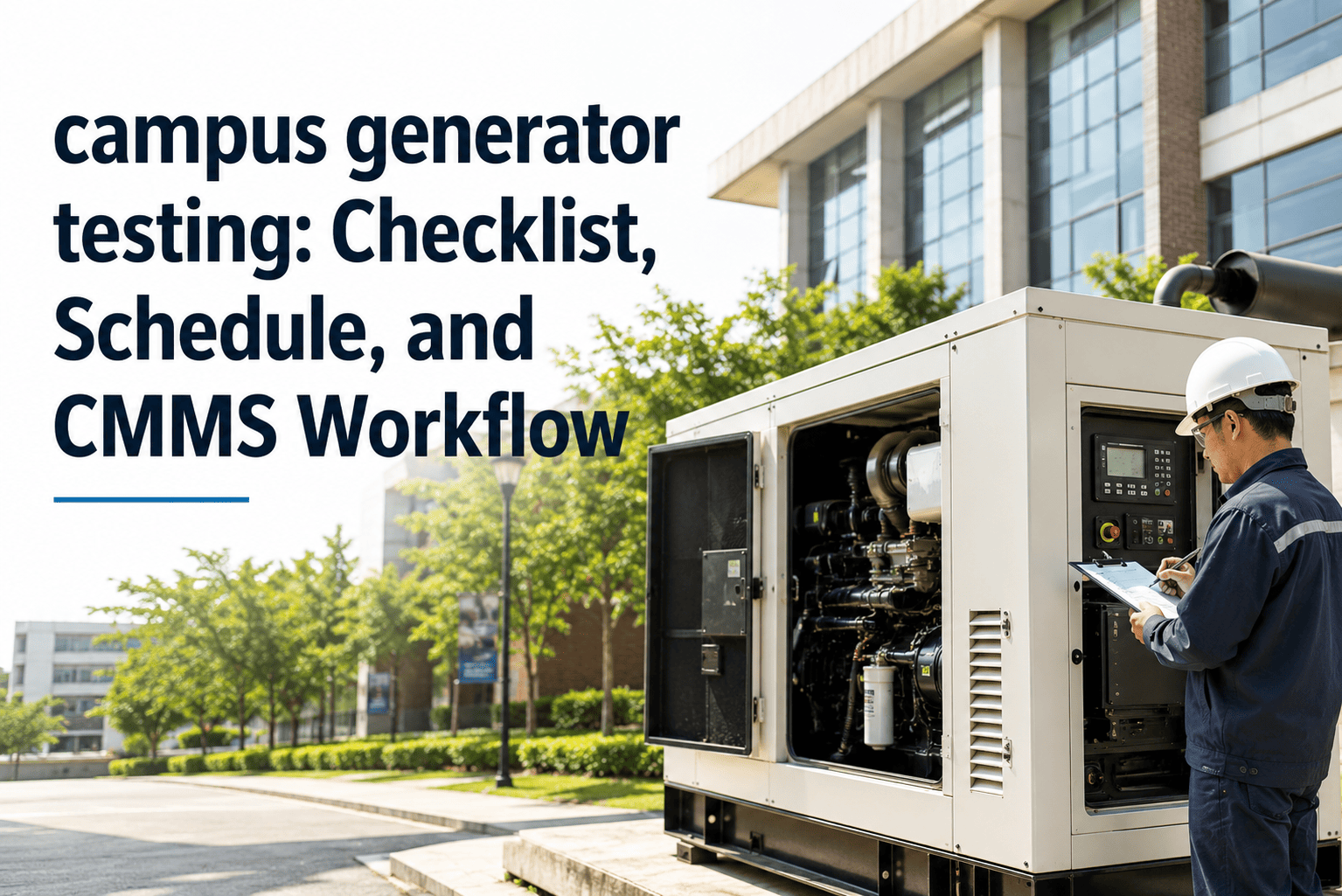
A standby generator that has not completed a loaded weekly run test is not a verified emergency power source — it is a dormant engine whose battery may be discharged, whose fuel may be stale, whose coolant may be below the minimum level, and whose automatic transfer switch may have silently failed to its off position since the last inspection. In universities, emergency power is not a convenience backup — it is the difference between a controlled shutdown of life-safety systems and a building-wide simultaneous failure of exit lighting, fire alarm panels, elevator rescue phones, laboratory fume hood exhaust fans, and critical research equipment. This checklist gives your facilities, safety, and compliance teams a complete NFPA 110 weekly generator run test framework covering engine starting, voltage and frequency output, fuel system, cooling system, ATS verification, and audit documentation — structured so every test is traceable in your OxMaint compliance tracking platform with timestamped records that prove your emergency power systems are tested and ready, not just installed, when a NFPA inspector, insurance surveyor, or accreditation auditor arrives.
University Campus · Safety & Compliance · Emergency Power
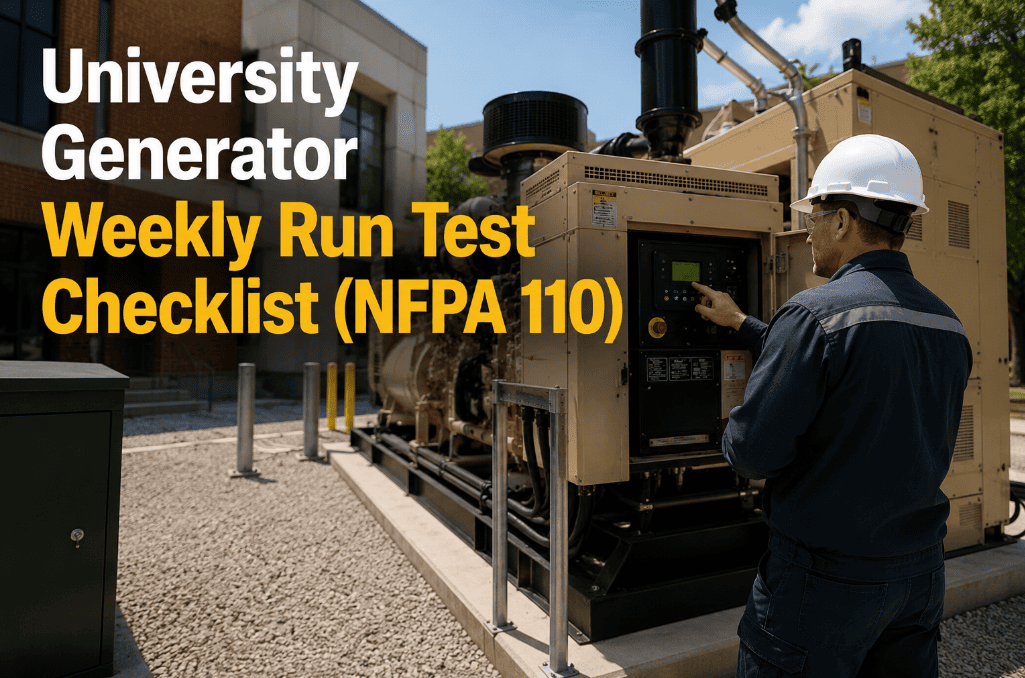
University Generator Weekly Run Test Checklist (NFPA 110)
A system-by-system NFPA 110 weekly generator run test framework covering engine start, voltage and frequency output, fuel level, coolant temperature, oil pressure, ATS transfer verification, and compliance documentation — built for universities where a failed generator test becomes a life-safety failure during the next utility outage.
7
Test Categories
50+
Check Points
100%
Compliance Target
P1
Safety Priority
High-Risk Generator Failure Scenarios on a University Campus
Failed Auto-Start
Generator that fails to start on loss of utility power leaves all critical loads without power
ATS Failure
An ATS that does not transfer means generator output never reaches the critical load panel
Fuel Starvation
Diesel below 75% tank level risks running out during extended utility outages
Wet Stacking
Unloaded diesel running accumulates unburned fuel in exhaust causing engine damage
Battery Discharge
Discharged starting batteries prevent engine crank on the first cold start attempt
Missing Test Records
Absent NFPA 110 weekly test logs create accreditation findings and insurance exposure
DDaily
WWeekly
MMonthly
QQuarterly
AAnnual
Category 01
Pre-Start Visual Inspection
A generator that starts and runs for 30 minutes every week without a pre-start inspection is an engine that can develop an oil leak, a coolant leak, a loose battery connection, or a bird's nest in the air intake between tests — and none of these conditions will be detected until the engine either fails to start or fails catastrophically during a run. Pre-start inspection is the 5 minutes that determines whether the weekly test produces meaningful confidence in the system or simply accumulates run hours on a machine with undetected deficiencies.
Engine oil level checked on dipstick — oil level confirmed between the MIN and MAX marks on the dipstick; oil that appears milky white indicates coolant contamination requiring immediate shutdown and investigation; oil below MIN mark topped up before the test run begins
WFacilities Operator · Pre-start oil level log
Coolant level checked at the expansion tank sight glass — coolant level confirmed within the normal operating band; a coolant level that drops by more than 10% between weekly tests indicates a leak in the cooling system requiring investigation before the next scheduled run
WFacilities Operator · Pre-start coolant level log
Starting battery condition inspected — battery terminals inspected for corrosion; battery charger confirmed in float mode with charge indicator lit; a battery charger that has tripped off between tests has allowed the battery to self-discharge and may not support a cold start
WFacilities Operator · Battery condition pre-start log
Generator enclosure and air intake inspected for obstructions — enclosure vents, air intake louvers, and exhaust outlet confirmed clear of debris, bird nesting material, or vegetation growth; blocked air intake causes engine overheating within minutes of start under load
WFacilities Operator · Enclosure pre-start inspection log
Fuel level confirmed at minimum 75% of tank capacity before test — NFPA 110 Section 8.3.8 requires fuel tank to be maintained at minimum 75% capacity; a tank below 75% before a weekly test will drop further during the test run and may be insufficient for a real emergency event
WFacilities Operator · Fuel level pre-test log
Category 02
Auto-Start & Transfer Verification
NFPA 110 Section 8.4.2 requires the weekly test to be initiated by simulating a loss of normal power — not by manually starting the generator from the local control panel. A manual start bypasses the entire automatic transfer sequence and proves nothing about the system's ability to respond to an actual utility failure. The test must begin with a normal-power-loss signal so that the ATS initiates the transfer, the generator receives the start command from the ATS, and the complete automatic sequence is verified end-to-end.
Weekly test initiated by simulating loss of normal power at the ATS — utility power interrupted at the ATS test switch (not at the generator local control panel); this simulates a real outage and verifies the complete automatic start and transfer sequence as required by NFPA 110 Section 8.4.2
WFacilities Operator · Auto-start test initiation log
Generator start time recorded — time from normal-power-loss signal to generator reaching rated voltage and frequency logged; NFPA 110 Level 1 systems must reach full rated voltage and frequency within 10 seconds; Level 2 systems must do so within 60 seconds
WFacilities Operator · Start time measurement log
ATS transfer to emergency position confirmed — ATS transfer confirmed by indicator light on ATS panel and by verification that emergency loads (exit lighting, fire alarm, elevator phones) are energized from generator output; ATS that does not transfer requires immediate contractor attention
WFacilities Operator · ATS transfer confirmation log
ATS retransfer to normal power verified at test end — after minimum 30-minute run, normal power restored and ATS confirmed to retransfer to utility power after the time delay; generator confirmed to cool down and shut down automatically after retransfer without manual intervention
WFacilities Operator · ATS retransfer log
NFPA 110 weekly test records are reviewed by every accreditation body that inspects a university — Joint Commission, ABET, state fire marshals, and insurers all treat missing generator test logs as evidence of a non-compliant emergency power system. OxMaint timestamps every weekly test, captures voltage and frequency readings, and flags any generator not tested within 7 days — giving your facilities team complete, audit-ready emergency power records on demand.
Category 03
Voltage, Frequency & Load Output Verification
A generator that starts and transfers but delivers voltage at 5% below nominal will cause variable-speed drives to fault, UPS systems to switch to bypass, and some microprocessor-controlled laboratory equipment to shut down — exactly the equipment the generator was installed to protect. Output quality measurement is not an optional advanced check; it is the verification that determines whether the power the generator delivers meets the specifications of the equipment it is supposed to power.
Output voltage measured on all three phases — voltage measured at the generator output terminals after load transfer; all three phases must be within ±5% of rated voltage (e.g., 208V ±10V for a 208V system); a phase voltage more than 5% below nominal indicates a voltage regulator or exciter issue
WFacilities Operator · Output voltage measurement log
Output frequency measured — frequency confirmed at 60 Hz ±0.5 Hz under load conditions; frequency below 59.5 Hz or above 60.5 Hz indicates engine speed (governor) adjustment required; frequency excursion during load pickup must recover to within specification within 3 seconds
WFacilities Operator · Output frequency measurement log
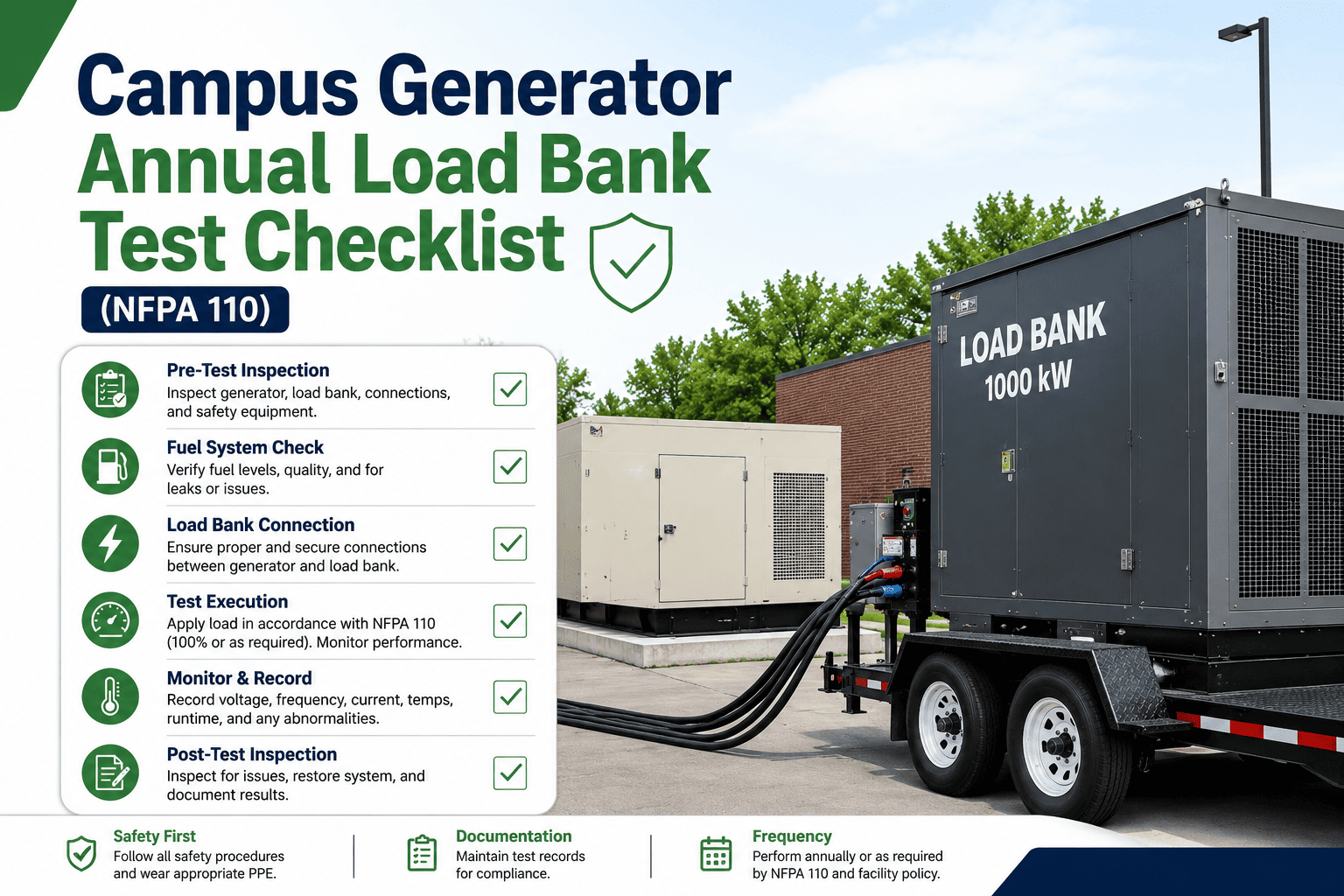
Load on generator measured and compared to rated capacity — kW output measured during test; NFPA 110 Section 8.4.2 requires the generator to be loaded to minimum 30% of nameplate rating to prevent wet stacking; if building load is below 30%, a resistive load bank must be connected to supplement building load
WFacilities Operator · Load measurement log
Monthly load bank test at minimum 50% rated load — generators running at less than 30% building load during weekly tests must be supplemented with a load bank monthly to burn off accumulated wet stack deposits and verify performance at higher load levels
MFacilities Engineer · Monthly load bank test record
Category 04
Engine Operating Parameters During Run
An engine that starts, transfers load, and delivers correct voltage can still be in the early stages of a cooling system failure, an oil pressure drop, or a turbocharger fault — none of which will trigger an automatic shutdown until the condition reaches a critical threshold. Monitoring and logging engine parameters during the weekly run test is the early warning system that detects developing deficiencies before they become emergency failures.
Engine coolant temperature monitored and logged during run — temperature measured at the 15-minute and 30-minute marks during the weekly run; temperature above the engine manufacturer's normal operating range (typically 82–96°C) indicates a cooling system restriction, thermostat failure, or coolant level issue
WFacilities Operator · Engine temperature run log
Engine oil pressure logged during run — oil pressure confirmed within the manufacturer's normal operating range (typically 40–80 psi at operating temperature); an oil pressure reading below the minimum or trending downward between weekly tests indicates a lubrication system issue requiring investigation before the next test
WFacilities Operator · Oil pressure run log
Exhaust smoke colour observed — clear to light grey exhaust is normal at operating temperature and load; black smoke indicates over-fuelling, turbocharger fault, or clogged air filter; white smoke after warm-up indicates coolant entry into combustion; blue smoke indicates oil burning; all abnormal smoke colours require investigation
WFacilities Operator · Exhaust condition observation log
Fuel consumption compared to baseline — fuel level before and after the test recorded; consumption per hour calculated and compared to the established baseline for this generator at the tested load; fuel consumption more than 15% above baseline indicates an engine efficiency issue requiring investigation
WFacilities Operator · Fuel consumption tracking log
Category 05
Fuel System Inspection
A diesel fuel system that has not been inspected for water contamination, microbial growth, or sediment accumulation is one utility outage away from a fuel starvation event caused not by a lack of fuel but by contaminated fuel that plugs the primary filter within minutes of a full-load start. Diesel fuel degrades, absorbs water from tank condensation, and supports microbial growth in warm climates — and none of this is visible from the fuel gauge.
Fuel tank level recorded after test and refuelling need assessed — tank topped up to above 90% capacity after any test that brings the level below 75%; bulk fuel delivery scheduled before the level reaches 75% to ensure sufficient reserve for the next test and for any real emergency event
WFacilities Operator · Fuel level post-test log
Fuel primary filter differential pressure checked — differential pressure across the primary fuel filter confirmed below the manufacturer's replacement threshold; a filter approaching maximum differential pressure requires replacement before the next weekly test to prevent fuel starvation under high load
MFacilities Operator · Fuel filter differential pressure log
Fuel sample taken for water and microbial analysis — quarterly fuel sample drawn from the tank bottom and tested for water content, microbial contamination (Pseudomonas and Cladosporium), and sediment; fuel failing analysis treated with biocide and polished or replaced before the next scheduled run
QFacilities Engineer · Fuel quality analysis report
Fuel tank vent and fill cap condition inspected — vent confirmed unobstructed and breather filter in good condition; fill cap confirmed intact with no cracks or missing seal; a blocked vent creates a vacuum in the tank that prevents fuel flow to the engine under high load demand
MFacilities Operator · Fuel tank vent inspection log
Category 06
Automatic Transfer Switch (ATS) Detailed Inspection
The automatic transfer switch is the single component that connects the generator's output to the critical load panel — and it is the component that is most frequently confirmed by proxy (verifying that the generator runs) rather than by direct inspection of its own mechanism, contacts, and control logic. An ATS with oxidised contacts, a time-delay relay that has drifted 30 seconds from specification, or a neutral position that does not isolate the load from both sources simultaneously is a fault that will only reveal itself during a real emergency transfer.
ATS normal and emergency contact positions confirmed by indicator — ATS panel indicators confirm transfer to emergency source and retransfer to normal source at the correct times during the test; an ATS indicator that shows the incorrect position requires immediate panel inspection by an electrician
WFacilities Operator · ATS position indicator log
ATS transfer time delay verified — time from normal power loss signal to ATS transfer to emergency source measured and confirmed within the programmed delay (typically 3–10 seconds); a transfer time delay that has drifted more than 2 seconds from the set point requires controller recalibration
MFacilities Engineer · ATS transfer delay measurement log
ATS contacts inspected for oxidation and pitting — ATS contacts inspected during annual maintenance shutdown; contact resistance measured and compared to manufacturer specification; contacts with resistance more than 10% above new specification require cleaning or replacement before the next test season
ALicensed Electrician · ATS contact inspection report
ATS bypass function tested (where fitted) — bypass switch confirmed to energize the load from normal power directly while the ATS mechanism is in the maintenance position; bypass function must restore load power within 30 seconds; a non-functional bypass means the load must be de-energised during all ATS maintenance
ALicensed Electrician · ATS bypass test record
Category 07
Compliance Records & NFPA 110 Documentation
NFPA 110 Section 8.4.1 requires that a written record be maintained of each inspection, test, and maintenance activity. An inspection that is not recorded in a format that includes the date, the inspector's name, the generator identifier, the test parameters measured, and the results is not a compliant test under NFPA 110 — regardless of how thoroughly it was conducted. Accreditation bodies, state fire marshals, and insurance underwriters treat a missing test log as a missing test.
Weekly test log completed in CMMS for each generator — log includes generator asset ID, test date and time, test initiation method (ATS simulation confirmed), start time, voltage and frequency readings, load measured, ATS transfer confirmed, and any abnormal observations or deficiencies found
WFacilities Operator · CMMS weekly test record
Exception items logged as CMMS work orders with priority classification — any parameter outside specification documented as a deficiency work order with the corrective action required, the assigned technician, and the target completion date; no generator with an open critical deficiency returned to standby mode without documented management approval
WFacilities Manager · CMMS deficiency work order log
Annual load test at 100% rated load for minimum 2 hours — NFPA 110 Section 8.4.9 requires annual full-load test; this test is typically performed by the generator service contractor using a resistive load bank; test report filed in CMMS against the generator asset record
AGenerator Contractor · Annual full-load test report
Emergency power systems tested under building emergency conditions quarterly — selected quarterly tests conducted as facility-wide drills with all emergency power loads active; drill confirms that generator capacity is sufficient for the actual building emergency load and that all critical systems remain powered throughout the transfer sequence
QFacilities Manager · Quarterly drill test record
Compliance KPIs
Six Metrics That Prove Your University Generator Programme Is NFPA 110 Current
| Metric |
How to Measure |
Target |
Frequency |
| Weekly Test Completion Rate |
Generators tested this week / Total campus generators |
100% |
Weekly |
| Auto-Start Reliability |
Successful auto-starts / Total test initiations |
100% |
Weekly |
| Start Time Compliance |
Generators meeting 10-sec (L1) or 60-sec (L2) start / Total |
100% |
Weekly |
| Output Voltage Compliance |
Phases within ±5% of rated voltage / Total phases tested |
100% |
Weekly |
| Fuel Level Compliance |
Generators at ≥75% tank capacity before test / Total |
100% |
Weekly |
| Annual Load Test Completion |
Generators completing 2-hr full load test / Total |
100% per year |
Annual |
FAQs
Frequently Asked Questions
What standard governs emergency generator testing requirements at universities?
NFPA 110 — Standard for Emergency and Standby Power Systems — is the primary standard governing the installation, testing, and maintenance of emergency generators and automatic transfer switches in the United States. NFPA 110 classifies systems by Level (1 for life-safety critical loads, 2 for less critical loads), Type (by transfer time), and Class (by required operating duration). Most university life-safety loads (exit lighting, fire alarm, elevator emergency phones) are served by Level 1, Type 10 (10-second start), Class 2 (2-hour duration) systems. Joint Commission accreditation standards for healthcare-affiliated university buildings also reference NFPA 110 weekly testing requirements. OxMaint tracks NFPA 110 weekly test schedules and flags missed tests before accreditation review periods.
Why must the weekly generator test be initiated by simulating a loss of normal power rather than by manual start?
NFPA 110 Section 8.4.2 specifically requires the weekly test to simulate loss of normal power because a manual start bypasses the automatic transfer switch control circuit entirely. A manual start tests only the engine's ability to run — it does not verify that the ATS voltage sensing relays are functioning, that the ATS time delay is set correctly, that the ATS transfer mechanism can operate under load, or that the generator's output is connected to the critical load panel. All four of these components can fail independently of the engine, and a manual-start weekly test will not detect any of them. See how OxMaint captures ATS transfer confirmation as a mandatory checklist field in the weekly test record.
What is wet stacking and how does the weekly test prevent it?
Wet stacking occurs when a diesel engine operates at less than 30% of its rated load for extended periods. At low loads, the engine does not reach sufficient combustion temperature to completely burn the injected fuel, and unburned fuel accumulates as a dark, oily deposit in the exhaust manifold, turbocharger, and exhaust system. Wet stacking reduces engine efficiency, increases fuel consumption, causes carbon fouling of injectors, and can lead to turbocharger failure. NFPA 110 requires a minimum 30% load during weekly tests specifically to prevent wet stacking. Generators whose building load during tests is consistently below 30% must be supplemented with a resistive load bank during at least monthly tests.
How long must a university generator run during a weekly test?
NFPA 110 Section 8.4.2 requires the weekly test to run for a minimum of 30 minutes under load conditions that meet or exceed 30% of the nameplate kW rating. The 30-minute duration is the minimum required to bring the engine to full operating temperature, exercise all lubricated surfaces, exercise the cooling system thermostat, and allow any latent wet stacking deposits to burn off. Tests of less than 30 minutes do not satisfy the NFPA 110 weekly test requirement and will not prevent wet stacking accumulation in generators used in light-load building applications.
What records must a university maintain to demonstrate NFPA 110 compliance?
NFPA 110 Section 8.4.1 requires a written record of each inspection, test, and maintenance activity. At a minimum, the weekly test record must include: the date and time of the test; the identity of the person conducting the test; the generator identifier; confirmation that the test was initiated by simulating normal power loss; the time from power loss signal to full output voltage (start time); the voltage and frequency output; the load percentage; the duration of the test; and any deficiencies observed. Annual full-load test reports from the service contractor must also be retained. NFPA 110 does not specify a retention period, but most state authorities and accreditation bodies expect a minimum of 3 years of records to be available on demand. OxMaint stores all weekly test records with timestamps, measured values, and inspector identification in a format ready for immediate production during an inspection.
Digitize Emergency Power Compliance
Every Generator Tested. Every ATS Verified. Every Audit Record Ready.
OxMaint converts your NFPA 110 weekly generator test programme into mobile inspection rounds with voltage and frequency data capture, ATS transfer confirmation, fuel level tracking, and one-click compliance reports — so the next accreditation audit or fire marshal inspection is a formality, not a finding.