An eyewash station that has not been activated in six months has a corroded nozzle, stagnant water in the supply line, and a spray pattern that will deliver contaminated flow directly into an injured researcher's eyes at the moment they need clean water most. A safety shower that has never been flow-tested may have a pull handle seized by corrosion, a showerhead that drips rather than drenches, or a drain that backs up and floods the lab. ANSI Z358.1 exists precisely because emergency eyewash and shower equipment fails silently — it shows no warning light, raises no alarm, and gives no indication of its condition until the second it is needed in an emergency. This checklist gives your EHS, facilities, and laboratory safety teams a complete weekly activation framework covering flow verification, spray pattern, signage, accessibility, drain condition, and CMMS documentation — structured so every activation is traceable in your Oxmaint compliance tracking platform with timestamped records that prove your emergency equipment is functional, not just installed, when a regulatory inspector, accreditation auditor, or insurance surveyor arrives.
University Labs · Safety & Compliance · Emergency Equipment
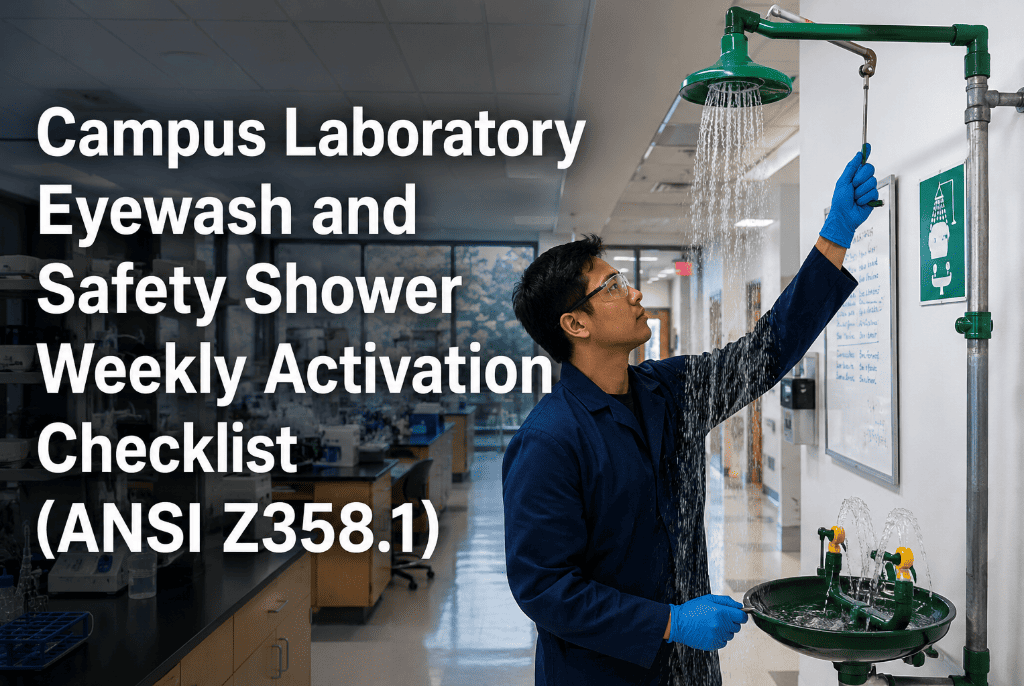
Campus Laboratory Eyewash and Safety Shower Weekly Activation Checklist (ANSI Z358.1)
A unit-by-unit emergency eyewash and safety shower activation framework covering flow rate, spray pattern, water temperature, signage, accessibility, drain condition, and compliance documentation — built for campus labs where a non-functional unit at the moment of a chemical splash becomes a personnel injury and an institutional liability.
6
Inspection Categories
45+
Check Points
100%
Compliance Target
P1
Safety Priority
High-Risk Failure Scenarios for Campus Emergency Eyewash & Shower Equipment
Stagnant Water Contamination
Unactivated units harbour Legionella and microbial growth in supply lines
Obstructed Access Path
Equipment blocked by stored materials adds critical seconds in a splash emergency
Corroded Nozzle Spray Pattern
Mineral deposits and corrosion distort spray coverage below ANSI minimum
Inadequate Water Temperature
Water above 38°C accelerates chemical absorption; below 16°C causes hypothermia in 15-minute flush
Seized Activation Handle
Corroded or stiff pull handles delay activation by seconds that determine injury severity
Missing Signage
Absent or obscured signage prevents unfamiliar personnel from locating units under stress
DDaily
WWeekly
MMonthly
QQuarterly
AAnnual
Category 01
Accessibility & Signage Verification
ANSI Z358.1 requires that an emergency eyewash or shower be reachable within 10 seconds — approximately 15 metres — from any point where a hazardous chemical is used, and that the path of travel be unobstructed. A unit that is present but blocked by a storage rack, a parked equipment trolley, or a closed and locked door does not satisfy this requirement and provides no protection to the researcher who needs it. Accessibility verification before the flow test is the check that most labs skip and most injuries reveal.
Path of travel to eyewash and shower confirmed clear and unobstructed — no equipment, boxes, chairs, or stored materials within the travel path; door between work area and unit confirmed to be openable without a key during an emergency
WLab Safety Officer · Accessibility inspection log
1-metre exclusion zone around safety shower and eyewash unit confirmed clear — ANSI Z358.1 requires the area immediately surrounding the unit to be free of obstructions at all times; signage on floor marking is intact and legible
WLab Safety Officer · Zone clearance log
Green ANSI Z358.1 safety sign present, illuminated, and visible from 15 metres — sign must be mounted at 2.0–2.1 metres height and face the direction of approach from the hazard area; faded, torn, or missing signs replaced before next shift
WLab Safety Officer · Signage condition log
Unit location confirmed on posted lab emergency map — emergency response map on lab entry door shows current location of all eyewash and shower units; any unit relocated or decommissioned triggers immediate map update
MEHS Officer · Lab emergency map review log
Category 02
Weekly Activation — Eyewash Station Flow Test
ANSI Z358.1 requires eyewash stations to be activated weekly to flush stagnant water from the supply line and verify continuous flow. Stagnant water in an unactivated plumbed eyewash unit can reach temperatures that support Legionella growth within 72 hours and can accumulate biofilm on the nozzle internals within weeks. The weekly activation is simultaneously a microbiological control measure and a mechanical function verification — both of which are voided if the activation is performed without running water to drain for the full prescribed period.
Eyewash activation handle or push plate operated in a single hands-free motion — ANSI Z358.1 requires the valve to remain open without the operator holding it; any unit requiring continuous hand pressure to maintain flow is non-compliant and must be repaired before the next working day
WLab Safety Officer · Eyewash activation log
Water flow confirmed for minimum 3 minutes to flush stagnant supply line — flow maintained continuously until water temperature stabilises and supply line is fully flushed; activation duration logged with start and stop time in CMMS
WLab Safety Officer · Activation duration log
Both nozzles confirmed to flow simultaneously — eyewash units must produce bilateral flow; a single-nozzle unit or a unit where one nozzle is blocked by mineral scale does not meet the simultaneous bilateral flushing requirement of ANSI Z358.1
WLab Safety Officer · Bilateral flow confirmation log
Spray pattern verified — water stream from both nozzles rises to minimum 152 mm (6 inches) above nozzle orifice and delivers a gentle, non-injurious flow pattern; a stream that jets rather than sprays, or that deflects sideways due to mineral deposits, requires nozzle cleaning or replacement
WLab Safety Officer · Spray pattern observation log
Nozzle dust covers confirmed present and functional — covers must be dislodged automatically upon activation without manual removal; covers that require the user to manually remove them before activating delay response and are non-compliant
WLab Safety Officer · Dust cover function log
Water temperature measured during flow — tepid water between 16°C and 38°C required by ANSI Z358.1; temperature logged with calibrated thermometer; units outside range referred to facilities for thermostatic mixing valve adjustment before next activation
WLab Safety Officer · Water temperature log
ANSI Z358.1 compliance is weekly — and a missed week is a compliance gap. Oxmaint assigns weekly eyewash and shower activation rounds to named technicians, captures flow duration and temperature readings, and flags overdue activations before a regulatory visit turns a missed log entry into a citation.
Category 03
Weekly Activation — Safety Shower Flow Test
A safety shower that delivers 75.7 litres per minute for 15 minutes is the physical requirement that ANSI Z358.1 specifies for decontamination of a chemical splash to the body. A shower that delivers adequate flow for the first 30 seconds and then reduces due to line pressure drop, a corroded showerhead restrictor, or a partially closed supply valve does not provide 15-minute protection — it provides initial dilution followed by inadequate decontamination. Flow rate verification is the test that separates a functioning shower from one that will fail the user in the second half of the required flush period.
Safety shower pull handle operation confirmed — handle pulled in a single downward motion; valve must open fully and remain open without manual support; pull handle must be located between 1.4 and 1.75 metres above the floor standing surface
WLab Safety Officer · Shower activation log
Minimum flow rate of 75.7 L/min confirmed — flow rate measured or estimated against calibrated container; showerhead spray pattern must cover a circular area of minimum 508 mm diameter at 1524 mm below the showerhead; a weak or asymmetric pattern indicates showerhead blockage or low supply pressure
WLab Safety Officer · Flow rate and pattern log
Water temperature measured during shower flow — tepid water between 16°C and 38°C required; temperature logged with calibrated thermometer; emergency showers in unheated mechanical spaces or outdoor locations require thermostatic mixing valve verification each winter season
WLab Safety Officer · Shower temperature log
Floor drain condition verified — drain below safety shower confirmed open and flowing freely; a blocked drain floods the lab within 60 seconds of shower activation and creates a slip hazard and water damage event in addition to the original chemical emergency
WLab Safety Officer · Drain condition log
Shower valve closure confirmed after test — valve closes fully when handle is returned to rest position; a valve that does not close completely wastes water and indicates a worn seat requiring replacement before the unit can be returned to service
WLab Safety Officer · Valve closure confirmation log
Category 04
Self-Contained & Portable Eyewash Station Checks
Self-contained eyewash stations — gravity-fed units, portable units, and personal eyewash bottles — are installed in locations where plumbed water is not available. Their limitation is finite capacity: a self-contained unit that has not been refilled, that has expired its preservative solution, or that has been stored in a location where solution temperature exceeds 38°C cannot deliver 15 minutes of continuous flushing. The weekly check that confirms solution level, preservative expiry date, and storage temperature is the only verification that stands between a non-functional unit and a chemical splash event with no flushing water available.
Self-contained unit solution level confirmed at full capacity — gravity-fed units checked by visual indicator or level gauge; solution volume must support minimum 15 minutes of continuous flow at rated flow rate; units below full capacity refilled immediately
WLab Safety Officer · Solution level log
Preservative solution expiry date verified — saline or preserved buffered solution has a manufacturer-specified shelf life; expired solution may contain microbial growth that worsens a chemical splash injury; any unit with expired solution taken out of service and refilled before return to use
MLab Safety Officer · Expiry date verification log
Personal eyewash bottles at each bench confirmed present, sealed, and within expiry — single-use personal eyewash bottles must be sealed to prevent contamination; open or expired bottles replaced immediately; bottles are first-aid supplements, not substitutes for ANSI Z358.1 primary units
WLab Safety Officer · Personal eyewash bottle log
Storage temperature of self-contained units verified — units in direct sunlight, near heat sources, or in unventilated spaces may have solution temperatures above 38°C; units with elevated solution temperature relocated or shielded; temperature log entry made with contact thermometer reading
WLab Safety Officer · Storage temperature log
Category 05
Annual Performance Verification & Plumbing Inspection
Annual performance verification goes beyond the weekly activation check to confirm that the plumbed supply system — the isolation valves, thermostatic mixing valves, and backflow preventers that the weekly activator never sees — is in the condition required to sustain 15 minutes of compliant tepid water flow. A thermostatic mixing valve that has drifted to 42°C will pass every weekly temperature check in winter and fail in summer. A backflow preventer that has failed internally allows supply contamination that the weekly user cannot detect. Annual inspection by a qualified plumber closes the verification gaps that weekly activation cannot.
Thermostatic mixing valve calibration verified by facilities plumber — mixing valve output temperature measured at full flow for 15-minute sustained period; temperature must remain within 16–38°C throughout; valve recalibrated or replaced if temperature drifts outside range during sustained flow
AFacilities Plumber · Annual TMV calibration record
Supply isolation valve confirmed fully open and tagged — isolation valve in open position and tagged with lock-out warning; any valve found partially closed investigated for unauthorised closure; valve position logged with photograph in CMMS
AFacilities Plumber · Isolation valve audit record
Backflow preventer tested by certified plumber — backflow preventer on eyewash and shower supply lines tested in accordance with local plumbing code; failed backflow preventer replaced before unit is returned to service; test certificate filed in CMMS
ACertified Plumber · Backflow prevention test certificate
Nozzle orifices descaled and cleaned — eyewash nozzle orifices cleared of mineral deposits with approved descaling solution; orifice diameter verified with appropriate gauge after cleaning; nozzles with irrecoverable blockage or corrosion damage replaced
AFacilities Plumber · Annual nozzle maintenance record
Full 15-minute flow test performed and water temperature logged at 5-minute intervals — annual sustained flow test confirms that supply system pressure and thermostatic mixing valve can maintain compliant tepid water for the complete ANSI Z358.1 flush duration, not just the first minute
AEHS Officer · Annual 15-minute flow test record
Category 06
Compliance Records & CMMS Documentation
OSHA 29 CFR 1910.151, ANSI Z358.1, and most institutional biosafety and chemical hygiene policies require that eyewash and safety shower inspections be documented with a date, the identity of the person performing the check, and the result of each activation. An EHS programme where activations are performed but not logged is indistinguishable from one where activations are never performed — and in the event of a chemical splash injury, the absence of inspection records is treated as evidence of a failed safety programme regardless of how diligently the physical checks were conducted.
Weekly activation logged in CMMS with date, unit ID, technician name, flow duration, temperature reading, and pass/fail status — paper logs are not acceptable as primary records if they are not transferred to a traceable CMMS within 24 hours of the inspection
WLab Safety Officer · CMMS weekly activation log
Deficiency work orders generated and tracked to closure — any unit failing weekly activation generates a CMMS corrective maintenance work order; unit tagged out of service and adjacent lab areas notified; work order closed only when retest confirms compliant performance
WEHS Officer · CMMS deficiency work order log
Campus-wide eyewash and shower asset register maintained and current — register lists unit ID, type, location, installation date, last activation date, next due date, and responsible lab; any new installation or decommissioning updated in register within 5 working days
MEHS Officer · Asset register review log
Annual EHS audit of eyewash and shower programme — EHS officer reviews 12 months of activation records for completeness; any unit with more than one missed weekly activation in 12 months triggers a root cause investigation and corrective action plan
AEHS Officer · Annual programme audit report
Compliance KPIs
Six Metrics That Prove Your Emergency Eyewash & Shower Programme Is ANSI Z358.1 Compliant
| Metric |
How to Measure |
Target |
Frequency |
| Weekly Activation Completion Rate |
Units activated on schedule / Total installed units |
100% per week |
Weekly |
| Water Temperature Compliance |
Units delivering 16–38°C / Total units tested |
100% |
Weekly |
| Spray Pattern Pass Rate |
Units with compliant bilateral spray / Total units activated |
100% |
Weekly |
| Deficiency Closure Time |
Calendar days from deficiency raised to verified closure |
Maximum 5 working days |
Per deficiency |
| Accessibility Compliance Rate |
Units with clear 1-metre zone and unobstructed path / Total units |
100% |
Weekly |
| Annual Verification Completion |
Units receiving 15-minute flow test / Total units |
100% per year |
Annual |
FAQs
Frequently Asked Questions
What standard governs emergency eyewash and safety shower equipment in US university labs?+
ANSI/ISEA Z358.1 — American National Standard for Emergency Eyewash and Shower Equipment — is the primary standard governing the design, performance, installation, and maintenance of emergency eyewash and shower units. OSHA 29 CFR 1910.151(c) requires that suitable facilities be provided where the eyes or body of any person may be exposed to injurious corrosive materials, and OSHA references ANSI Z358.1 as the accepted specification. Many university chemical hygiene plans and institutional biosafety policies explicitly require ANSI Z358.1 compliance for all laboratories using corrosive, oxidizing, or biological agents. Oxmaint tracks weekly activation schedules and compliance rates across your entire campus unit inventory.
Why must eyewash stations be activated weekly rather than monthly?+
ANSI Z358.1 specifies weekly activation for two distinct reasons. First, stagnant water in unactivated supply lines accumulates microbial growth, biofilm, and in warm climates or poorly insulated lines, Legionella — meaning that the first water to reach an injured researcher's eyes in an emergency may itself be a contamination source. Second, weekly activation verifies that the supply valve is open, the nozzles are unclogged, the flow is bilateral, and the activation mechanism operates correctly — mechanical failures that develop gradually and are invisible without activation. Monthly activation is not adequate to control microbial contamination risk in standing supply lines. Oxmaint automates weekly activation reminders and escalation for missed checks.
What is the tepid water requirement and why does it matter for a 15-minute flush?+
ANSI Z358.1 defines tepid water as between 16°C and 38°C. Water below 16°C causes the injured person to terminate the flush prematurely due to cold shock and hypothermia risk — the most common reason chemical splash injuries are under-flushed in practice. Water above 38°C accelerates percutaneous absorption of many chemicals, increases blood flow to the affected area, and may cause thermal injury on skin already compromised by chemical exposure. Thermostatic mixing valves are required wherever supply water temperature cannot be controlled within the tepid range at the point of use, and those valves must be calibrated annually to confirm they maintain the target range throughout a full 15-minute flow cycle.
What documentation is required to demonstrate ANSI Z358.1 compliance to an OSHA inspector?+
OSHA inspectors and institutional auditors typically request records showing that weekly activations have been performed for every unit, that the responsible person is identified for each activation, that any deficiencies were logged and corrected within a reasonable timeframe, and that an annual or periodic inspection programme is in place. Records that show consistent weekly activation with no gaps for any unit are the strongest evidence of compliance. A pattern of missed weeks, unresolved deficiency work orders, or activations logged without temperature or flow data are the findings most commonly cited. Oxmaint generates a single-page compliance report showing every unit's activation history, temperature log, and open deficiencies — ready for an inspector visit on demand.
Digitize Eyewash & Shower Compliance
Every Unit Activated. Every Temperature Logged. Every Audit Record Ready.
Oxmaint converts your ANSI Z358.1 activation programme into mobile weekly rounds with temperature capture, photo evidence, deficiency work orders, and one-click compliance reports — so the next OSHA visit or accreditation inspection is a formality, not an exposure.


.png)
