Campus HVAC systems are uniquely demanding. Academic buildings cycle between empty and fully occupied within minutes as class periods change. Laboratories require precise temperature and humidity control that residential or commercial systems never face. Residence halls run 24/7 with occupants who treat thermostats like toys. Historic buildings have ductwork designed for an era before computers, projectors, and bodies generated the heat loads they do today. And all of this equipment must maintain indoor air quality standards that directly affect student health, cognitive performance, and institutional liability. Reactive HVAC maintenance on a campus doesn't just waste money—it disrupts the institution's core mission of education.
Preventive and predictive HVAC maintenance transforms campus climate control from a source of constant complaints into invisible infrastructure that simply works. The key is structuring maintenance around the unique rhythms of academic life—leveraging breaks and low-occupancy periods for major work while maintaining continuous monitoring during peak usage. Campuses ready to modernize their HVAC maintenance program can sign up for Oxmaint to centralize scheduling, track every asset, and automate the entire PM cycle.
Campus HVAC System Categories
University campuses contain HVAC equipment spanning decades of technology and design philosophy. A single campus may have steam-heated buildings from the 1920s alongside LEED-certified structures with variable refrigerant flow systems installed last year. Effective maintenance programs must address every system type with appropriate procedures and frequencies.
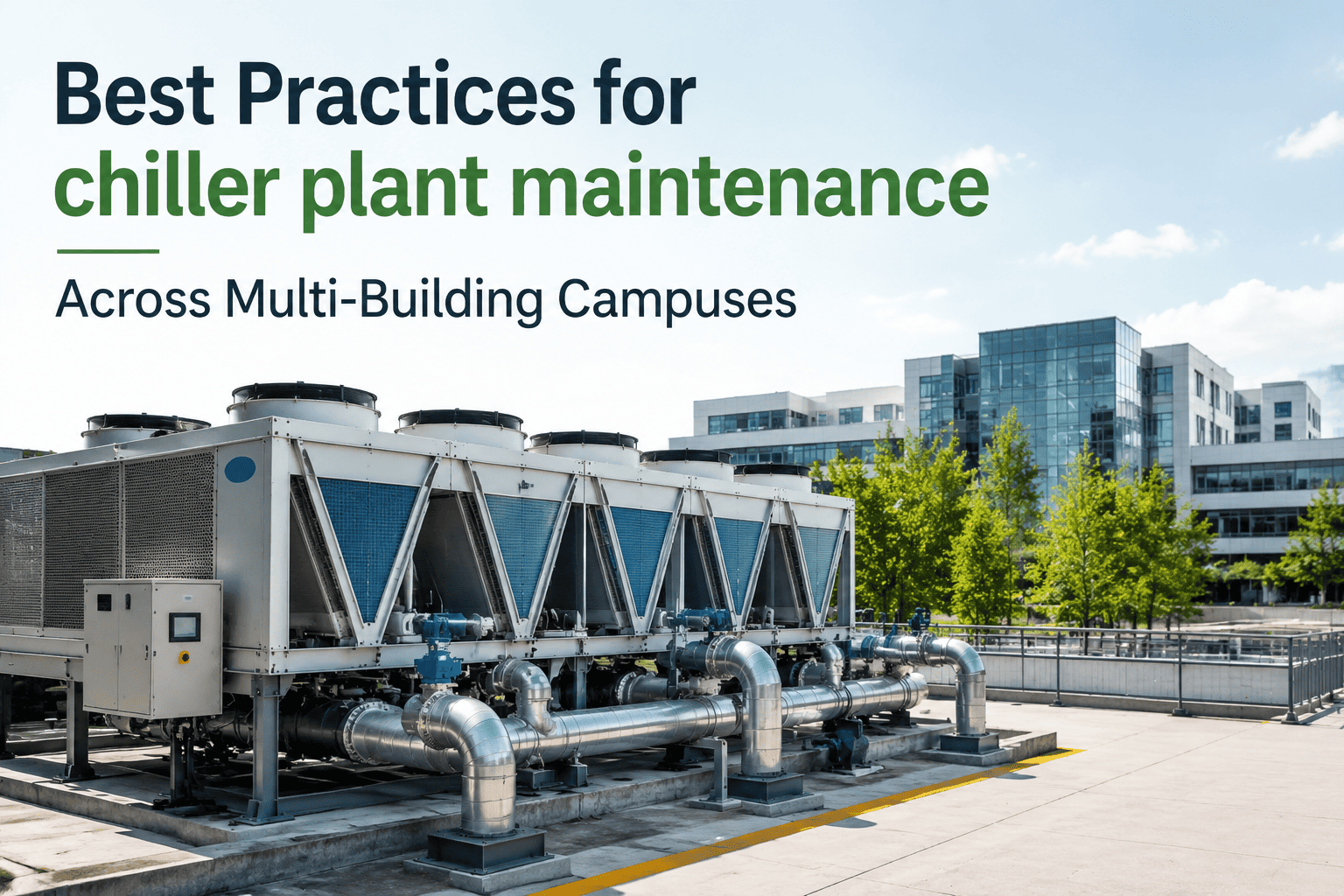
Central plant equipment demands the most rigorous maintenance attention because failures cascade across the entire campus. A chiller going offline during a September heat wave doesn't just affect one building—it degrades cooling capacity for every building on the chilled water loop. Yet many campuses defer chiller maintenance because the equipment is physically remote, staffing is thin during summer when maintenance should happen, and the cost of professional chiller service feels expensive compared to fixing the broken thermostat a dean just complained about. This prioritization inversion—responding to visible complaints over invisible degradation—is the root cause of most campus HVAC crises.
Laboratory ventilation is the category where maintenance failures carry the most serious consequences. A fume hood that doesn't maintain proper face velocity exposes researchers and students to chemical vapors. A biosafety cabinet with a failed HEPA filter can release biological agents. These systems require annual certification, continuous airflow monitoring, and immediate response when alarms activate. Campuses managing laboratory HVAC can book a demo to see how Oxmaint tracks certification schedules and links alarm events to corrective work orders.
Preventive Maintenance Schedule Framework
Campus HVAC preventive maintenance must align with the academic calendar. Major maintenance windows—filter changes on large AHUs, chiller teardowns, boiler inspections—should coincide with break periods when buildings can tolerate temporary shutdowns. Routine tasks like belt inspections and thermostat calibration happen continuously throughout the year.
Maintenance Task Matrix
Each HVAC component requires specific maintenance tasks at defined intervals. The following matrix maps the critical tasks, frequencies, and consequences of deferral for the most common campus HVAC equipment.
| Component | PM Task | Frequency | Deferral Consequence |
|---|---|---|---|
| Air Filters | Inspect and replace MERV-13+ filters | Monthly (high occupancy), Quarterly (low) | Increased energy use 5–15%, degraded IAQ, coil fouling |
| Coils (Heating/Cooling) | Clean, inspect for leaks, check fin condition | Annually (minimum), Semi-annually (high-use) | Capacity loss 20–40%, energy waste, mold growth risk |
| Belts & Bearings | Tension check, alignment, vibration reading | Quarterly | Catastrophic fan failure, belt shred debris in ductwork |
| Economizer Dampers | Actuator test, linkage lubrication, sensor cal | Semi-annually | Stuck dampers waste 20–30% of cooling energy |
| Condensate Drains | Flush, treat with biocide, verify trap | Monthly during cooling season | Overflow causes ceiling damage, mold, slip hazards |
| Chiller | Tube cleaning, refrigerant analysis, oil test | Annually (pre-season) | Efficiency loss 10–25%, compressor damage risk |
| Cooling Tower | Basin cleaning, fill inspection, water treatment | Monthly treatment, annual cleaning | Legionella risk, scale buildup, capacity loss |
| BAS Controls | Sensor calibration, schedule verification, alarm audit | Semi-annually | Simultaneous heating/cooling, incorrect setpoints, energy waste |
The single most impactful maintenance task on any campus is filter replacement. Dirty filters are the root cause of more HVAC complaints, energy waste, and secondary equipment damage than any other single factor. A clogged filter restricts airflow, which reduces coil heat transfer, which causes the compressor to work harder, which increases energy consumption, which shortens compressor life—a cascade triggered by a $15 filter that wasn't changed. Campuses that implement rigorous filter change schedules—tracked digitally with photo verification of completion—typically see a 10–15% energy reduction within the first year before any other maintenance improvements are made.
Reactive vs. Preventive Maintenance
Campuses that rely on reactive maintenance spend 3–5x more per equipment failure than those with structured PM programs. The comparison below quantifies why preventive HVAC maintenance is the single highest-ROI investment a facilities department can make.
- Fix equipment only when it fails
- Emergency overtime and expedited parts
- No visibility into equipment condition
- Disrupts classes, labs, and events
- Comfort complaints drive priorities
- Scheduled maintenance aligned to calendar
- Planned parts and normal-rate labor
- Continuous equipment health monitoring
- Repairs during breaks and low-use periods
- Data-driven priorities based on condition
Energy Impact of HVAC Maintenance
HVAC systems consume 40–60% of total campus energy. Maintenance quality directly determines whether that energy is used efficiently or wasted. The metrics below quantify the energy impact of specific maintenance activities based on campus deployment data.
These savings compound. A campus spending $4 million annually on HVAC energy that implements a comprehensive maintenance program addressing all four areas can realistically reduce energy costs by $800,000–$1.2 million per year. The maintenance program itself costs a fraction of those savings—typically $150,000–$300,000 in additional labor, filters, and materials. The net return funds itself many times over, and the energy savings persist year after year as long as the maintenance program continues. Campuses that let maintenance programs lapse see energy costs creep back up within 12–18 months as coils foul, economizers stick, and controls drift out of calibration.
Implementation Timeline
Building a structured campus HVAC maintenance program doesn't require replacing equipment or hiring consultants. It requires documenting what you have, defining what each asset needs, and building the recurring schedule that ensures nothing is missed. Most campuses can go from reactive chaos to structured PM within 90 days.
The asset inventory phase is where most programs stall. Many campuses have incomplete or outdated equipment records—especially for buildings acquired through mergers, constructed decades ago, or maintained by departed staff who kept everything in their heads. Walking every mechanical room and documenting every AHU, fan coil, VAV box, and split system is tedious but essential. Without a complete asset list, PM schedules have gaps, work orders reference equipment that doesn't exist, and technicians waste time finding machines that nobody documented. Digital CMMS platforms with mobile barcode scanning make this inventory process significantly faster—technicians scan the asset nameplate, enter key data on their phone, and the system creates the asset record with location, photos, and specifications in minutes. Institutions ready to build their asset inventory can sign up free for Oxmaint and start documenting equipment immediately.