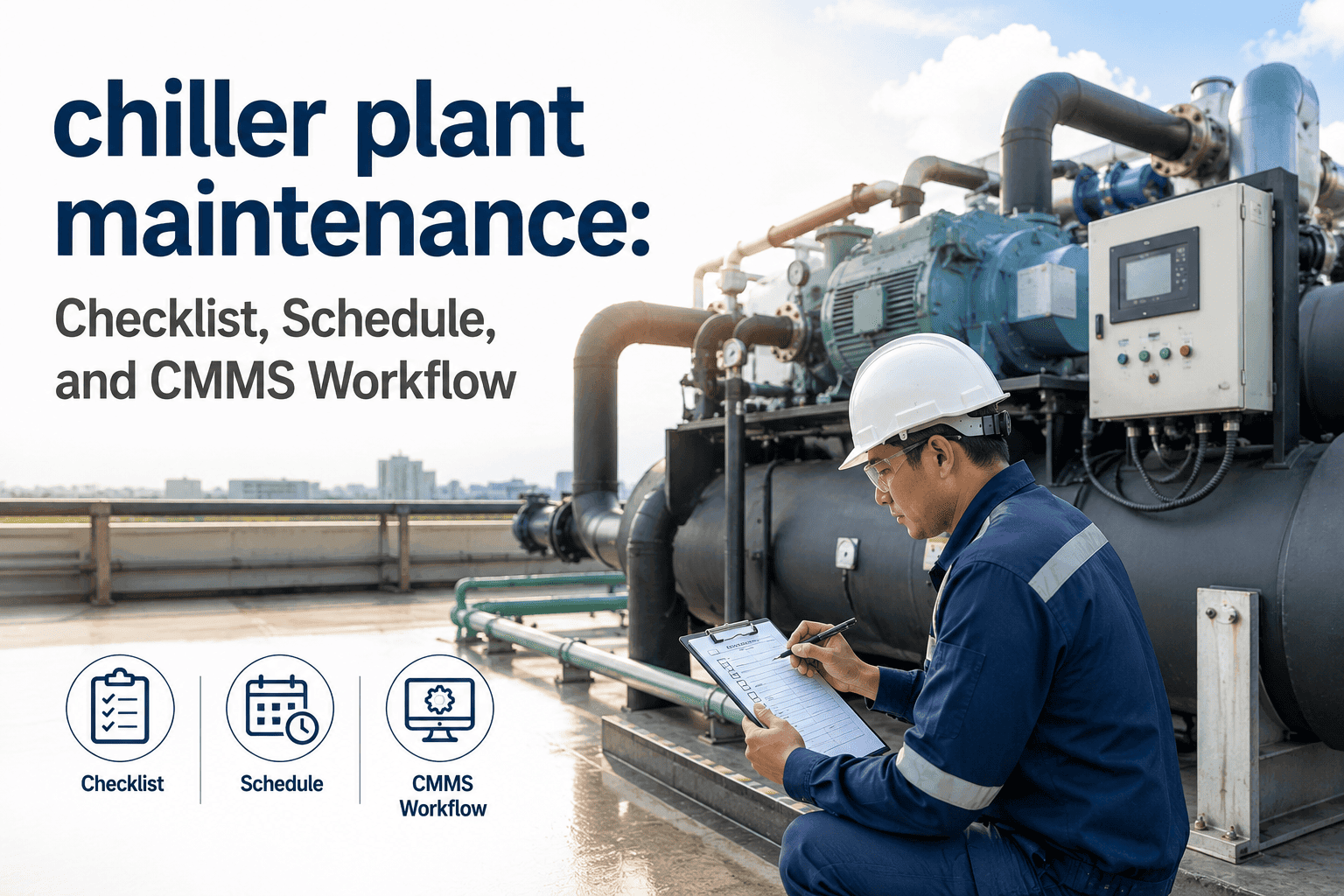
chiller plant maintenance: Checklist, Schedule, and CMMS Workflow

By Corin Hale on June 20, 2026

chiller-plant-maintenance-checklist-schedule-and-cmms-workflow

A chiller plant failure during peak cooling season does not just mean discomfort — it means flooded server rooms, halted manufacturing lines, unsafe hospital environments, and universities canceling exams. Yet the majority of chiller failures are not random; they are preceded by weeks of detectable warning signs that go unnoticed because no structured inspection routine is in place. Facilities running documented daily check routines, calibrated performance schedules, and CMMS-integrated escalation workflows consistently achieve 96–99% chiller availability while spending 30 to 40 percent less per ton of cooling compared to reactive operations. This checklist gives your team the complete framework — every inspection, every frequency, every escalation trigger — built to run through a CMMS mobile workflow from day one. OxMaint is the CMMS purpose-built for exactly this kind of operation.

HVAC Maintenance · Chiller Plant · CMMS Workflow

Chiller Plant Maintenance Checklist, Schedule, and CMMS Workflow

The complete field-ready checklist for facility and HVAC maintenance teams — daily, weekly, monthly, and annual inspection tasks for centrifugal, screw, and absorption chillers, cooling towers, pumps, and ancillary systems, with a full CMMS-guided escalation and work order workflow.

96–99%
Chiller Availability Target
40%
Lower Maintenance Cost
15 min
Escalation Response Time
3–4 wk
Earlier Failure Detection
DDaily
WWeekly
MMonthly
QQuarterly
AAnnual

Centrifugal and Screw Chiller Inspection Checklist

D Compressor bearing temperature logged — acceptable below 75°C; immediate escalation if above 85°C or if reading rises more than 8°C in a single shift
D Refrigerant suction and discharge pressure recorded — both values entered in CMMS with time stamp; trend deviation of more than 5% from baseline triggers engineer review
D Compressor motor current draw confirmed — log actual amperage; rising current at same load is a compressor mechanical degradation indicator
D Oil pressure confirmed within OEM operating band — low oil pressure activates compressor safety shutdown; pre-empt with daily monitoring
D Chilled water supply and return temperature delta-T logged — design delta-T of 10–14°F; narrowing gap below 8°F indicates fouling or low flow
D Refrigerant leak check at all joints, sight glasses, and purge unit — any visible frost, oily residue, or refrigerant odor triggers immediate work order and EPA leak log entry
W COP calculated and logged — actual COP compared to design COP at current load; greater than 8% degradation triggers evaporator tube cleaning assessment
W Approach temperature measured at evaporator and condenser — rise above 3°C from clean baseline confirms tube fouling and schedules chemical cleaning work order
W Vibration spot check on compressor and motor — any increase of more than 0.5 mm/s from prior reading escalated to reliability engineer for full vibration analysis
M Oil sample collected and sent for analysis — viscosity, acid number, moisture, and metal particle content evaluated; out-of-spec result triggers oil change work order
M Purge unit operation checked — excessive purge cycles indicate refrigerant contamination with air and moisture; log purge run hours monthly
Q Evaporator and condenser tube eddy current testing — detects wall thinning and pitting before tube failure causes refrigerant-to-water contamination
A Full refrigerant charge verification — weigh-in method confirms charge within 2% of design; deviation indicates leak or incorrect previous charge
A Compressor motor insulation resistance test (megger) — reading below 1 megohm on any winding indicates moisture ingress or insulation breakdown; schedule rewinding or replacement

Cooling Tower Inspection Checklist

D Condenser water supply temperature logged — target 85°F at design wet bulb; rising supply temperature degrades chiller efficiency by 2–3% per degree above target
D Basin water level confirmed adequate — makeup valve operating normally without running continuously; continuous makeup indicates leak or excessive drift loss
D Water treatment chemical readings logged — pH 7.0–8.5, conductivity within blowdown setpoint, biocide residual confirmed adequate for Legionella suppression
D Fan motor operation verified — no abnormal vibration, noise, or overheating; VFD status confirmed with no active fault codes
W Fill media condition inspected — fouling, scaling, or physical damage to fill reduces thermal performance and water distribution uniformity
W Drift eliminators inspected for gaps, damage, or improper seating — dislodged eliminators increase water carryover and raise Legionella compliance risk
M Legionella risk assessment sample collected and sent to lab — results logged in CMMS against site water management plan; exceedance triggers immediate remediation protocol
Q Basin cleaned and descaled — sediment accumulation in basin reduces water quality and provides nutrient source for biological growth
A Full mechanical inspection — fan blades, shaft, gearbox, spray nozzles, basin structure, and casing inspected during annual cleaning and chemical disinfection

OxMaint delivers the right checklist to the right technician at the right frequency — automatically. Every reading is logged with a timestamp, trending against your baselines, and escalating to engineers before thresholds are breached, not after.

Chilled Water and Condenser Water Pump Checklist

D All primary and secondary pump bearing temperatures logged — acceptable below 80°C; abnormal heat pattern compared to adjacent bearing indicates alignment or lubrication issue
D Pump mechanical seal condition observed — minor weeping within allowable OEM limits noted; active seal failure with continuous drip triggers work order for planned seal replacement
D Differential pressure across each pump confirmed — abnormal drop indicates wear ring erosion or impeller damage; abnormal rise indicates downstream blockage or valve misalignment
D VFD drive status and drive temperature confirmed — review fault log on each drive; accumulated faults indicate power quality issue or drive end-of-life approaching
W Standby pump rotation confirmed — run standby pumps for minimum 15 minutes each week to prevent seal drying and bearing brinelling on static equipment
M Expansion tank pressure and level checked — confirm pressurization is within design range; low pressure allows system to go sub-atmospheric and introduces air at high points
Q Pump alignment verified — thermal growth during operation can shift couplings out of alignment; misalignment over 0.002 inch TIR accelerates bearing and seal wear

Chiller Plant CMMS Escalation and Work Order Workflow

The checklist identifies the problem. The CMMS workflow ensures the right person acts on it at the right speed — turning a logged reading into a closed work order with full audit trail.

Reading Entered
Technician enters actual value in CMMS mobile app — bearing temp, pressure, delta-T, or visual finding — with timestamp and photo evidence attached automatically.
→
Threshold Check
CMMS compares reading against configured normal range — value within range closes the check; value outside range auto-generates escalation alert to on-call engineer.
→
Engineer Reviews
Engineer receives mobile push notification with full equipment history and trend data — reviews remotely and authorizes either immediate shutdown or scheduled repair window.
→
Work Order Created
CMMS auto-generates work order with scope, parts list, and assigned technician — scheduled against available labor and equipment availability without phone coordination.
→
Repair Verified
Technician completes work and confirms closure in CMMS with after-repair readings — creating a closed-loop record from first detection to verified resolution.

Frequently Asked Questions

What readings should be logged during every chiller inspection?
At minimum: compressor bearing temperature, refrigerant suction and discharge pressure, chilled water supply and return temperature, condenser water temperatures, motor current draw, and oil pressure. Entering actual values — not just pass/fail — is what enables trend-based early detection that prevents failures before they occur. OxMaint checklists capture and trend all these readings automatically.
How do you prevent Legionella risk in a chiller plant cooling tower?
A documented water management plan with daily chemical testing, monthly Legionella sampling, quarterly basin cleaning, and annual chemical disinfection — all logged in a CMMS with timestamped records — forms the defensible compliance framework required by ASHRAE 188 and most local health regulations. Evidence of the program in your CMMS is what protects the facility in an audit or outbreak investigation.
What is the most reliable early warning sign of chiller tube fouling?
Rising approach temperature is the clearest early indicator of tube fouling on both the evaporator and condenser. When approach temperature increases by 2–3°C above the clean-coil baseline at the same operating load, tube fouling has reached the point where chemical cleaning will measurably improve COP and reduce energy costs. CMMS trending catches this drift before it escalates. Book a demo to see how OxMaint tracks approach temperature trends.
How often should chiller oil analysis be performed?
Monthly oil sampling is the industry standard for compressors operating more than 2,000 hours per year, which applies to most commercial and industrial chillers in continuous cooling season operation. Analysis for viscosity, acid number, moisture, and wear metals provides early warning of compressor internal degradation weeks before any external symptom is detectable by a technician.
Can a CMMS work order system replace manual chiller maintenance logs?
Yes — and it outperforms paper logs on every dimension that matters for compliance and reliability. A CMMS provides automatic escalation, real-time compliance visibility, trend analysis across multiple readings, and a defensible audit trail that paper records cannot match. Most facilities that switch to digital checklists see inspection compliance rates rise from below 65% to above 98% within 60 days.
Deploy This Checklist Today

Every Chiller Reading Logged. Every Alert Escalated. Every Shutdown Prevented.

OxMaint transforms this checklist from a PDF into a live operational system — daily mobile checklists delivered to your technicians, readings trending automatically against baselines, escalations routed to engineers in seconds, and a real-time compliance dashboard your facility manager can see from anywhere. Built for chiller plants that cannot afford unplanned downtime.

Share This Story, Choose Your Platform!