
A maintenance worker walks past the swing set every morning. The chains look fine from a distance. Three weeks later, a third-grader falls when a worn link snaps mid-swing. The injury report lands on the principal's desk. The lawsuit follows six months later.
This isn't a rare scenario. With 200,000+ playground injuries sending children to emergency rooms annually—and 75% occurring at schools and daycares—understanding playground equipment common failures isn't optional. It's the difference between a safe recess and a preventable tragedy.
Stop equipment failures before they cause injuries.
Digital inspection tracking catches problems early and creates audit-ready documentation.
Where Playground Injuries Actually Happen
Not all equipment is equally dangerous. CPSC data reveals clear patterns that should guide your inspection priorities. Climbing equipment accounts for 53% of injuries, making it the highest-risk category. Swings follow at 26%, and slides at 21%. But here's the critical insight: 79% of all playground injuries result from falls, regardless of equipment type. This means both equipment integrity and protective surfacing are paramount for safety.
Schools face unique challenges compared to home playgrounds. A swing set serving 30 students at recess experiences more stress in one school year than a backyard swing endures in a decade. Budget constraints often force deferred maintenance, creating a dangerous cycle where minor issues compound into serious hazards.
Source: U.S. Consumer Product Safety Commission playground injury data
The takeaway: climbing structures deserve the most attention during inspections, but every piece of equipment has specific failure modes that demand systematic monitoring. Sign up free to build custom inspection checklists for your specific equipment.
The 7 Most Common Playground Equipment Failures
Understanding failure modes helps you inspect smarter and catch problems earlier. Here's what actually breaks down on school playgrounds and why it happens.
Loose and missing hardware is one of the most dangerous failures because it's often invisible from ground level. Daily vibration loosens bolts incrementally. Temperature changes cause metal to expand and contract, accelerating the process. Warning signs include visible gaps between components, rattling during use, bolts protruding more than 2 threads, and missing caps. This can cause sudden structural failure and entanglement injuries.
Rust and corrosion fundamentally compromise structural strength. Moisture, salt air in coastal areas, and chemical exposure from cleaning agents all accelerate deterioration. Look for orange/brown discoloration, flaking or pitting on metal surfaces, structural thinning at joints, and ground staining. This weakens structural integrity while creating sharp edges and cut hazards.
Swing chain and seat wear occurs through predictable fatigue mechanisms. Constant motion creates millions of stress cycles that fatigue metal. UV exposure breaks down plastic and rubber seats. The standard is clear: any chain showing more than 15% wear must be replaced immediately—this isn't a guideline, it's a safety threshold. S-hooks that open beyond 0.04 inches allow chains to slip out. This is critical because chain failure causes catastrophic falls with no warning.
Surfacing deterioration undermines your last defense against injury. Heavy traffic compacts loose-fill materials, cutting protective capacity in half. Weather displaces material through wind and water. Poor drainage causes washout creating bare spots. Watch for depth below 9 inches under equipment, compacted hard-packed areas, and cracks in poured rubber surfaces. With 79% of injuries from falls, compromised surfacing transforms routine tumbles into serious injuries.
Wood rot and decay attacks equipment through biological processes. Moisture creates conditions where fungi break down cellular structure. Insect damage hollows out structural members from inside. Warning signs include soft spongy areas when probed, visible fungal growth, splintering, and insect holes with sawdust. This can lead to sudden structural collapse and splinter injuries.
Plastic cracking and fading results from UV exposure breaking down polymer chains. Temperature extremes create internal stresses. Look for hairline cracks near bolt holes, significant color fading, brittle texture, and warping. While medium risk, this creates sharp edges and can cause structural failure on slides and platforms.
Entrapment hazards cause 56% of playground deaths, making them the most critical concern. Equipment settling creates new gaps. Vandalism damages barriers. The critical measurement: any opening between 3.5 and 9 inches creates a head entrapment zone where a child's head can enter but cannot withdraw. Also watch for V-angles trapping clothing, gaps in guardrails, and protrusions catching drawstrings. This is non-negotiable—head entrapment can cause strangulation in minutes.
Don't rely on memory to track equipment issues.
Digital inspections create photo evidence, track repairs, and prove due diligence.
Equipment-Specific Troubleshooting Guide
When you find a problem, you need to know how to respond immediately. For swings: if chain wear exceeds 15%, replace immediately—never repair. S-hook gaps over 0.04 inches require closing or replacement. Cracked seats must be removed from service. Bearing noise needs lubrication or replacement if noise persists.
For climbing equipment: loose rungs require tightening, but replace if holes are stripped. Rope fraying over 10% of strands demands full replacement. Platform wobble signals potential structural issues—check all connection points. Worn grip coating must be recoated or replaced as slippery surfaces cause falls.
For slides: minor surface cracks can be sanded smooth, but structural cracks require section replacement. Excessive heat on metal slides needs shade structures or plastic replacement. Missing sidewalls create immediate fall hazards—close until repaired. Exit height must be 7-15 inches above surfacing.
For spinning equipment: bearing grinding needs lubrication, then replacement if noise continues. Ground clearance under 9 inches creates entrapment risk—adjust height or add surfacing. Damaged handholds must be replaced immediately. Excessive speed requires a governor or resistance adjustment.
Inspection Frequency That Actually Prevents Failures
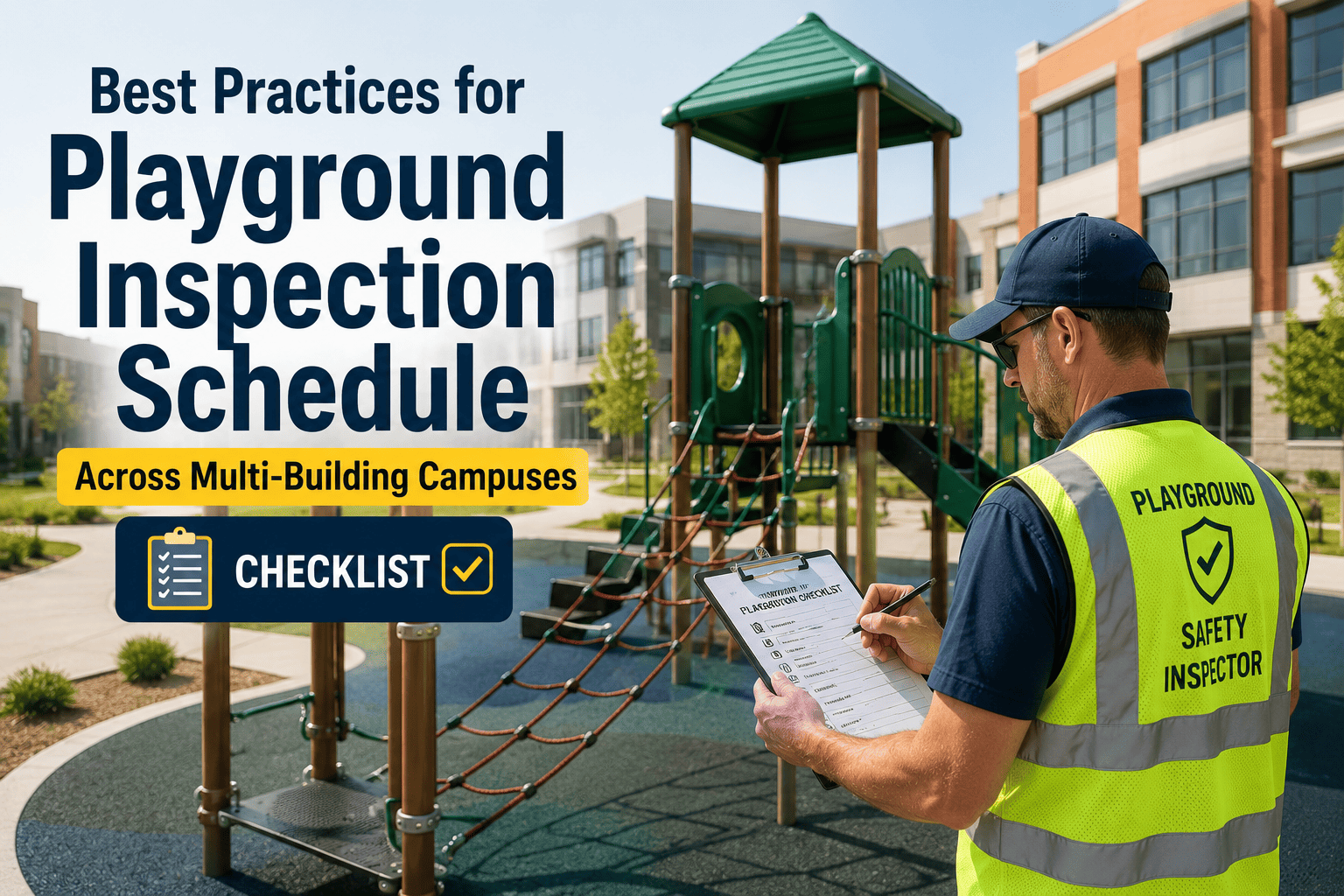
Random inspections don't work—systematic schedules matched to failure modes do. Daily inspections take 5-10 minutes before students arrive, catching vandalism, debris, standing water, and visible damage. Weekly inspections require 20-30 minutes to test moving parts, check hardware tightness, and verify surfacing depth in high-use areas.
Monthly inspections need 45-60 minutes for comprehensive documentation with photos, measurements, and condition ratings. This creates the audit trail proving due diligence and tracks degradation trends. Annual certified inspections by a CPSI professional validate ASTM F1487 compliance and provide independent assessment your internal program might miss. Book a demo to see how automated scheduling ensures nothing gets missed.
When to Repair vs. Replace
Not every problem requires new equipment, but some definitely do. Repair makes sense when equipment is under 15 years old with good maintenance history, OEM parts are available, damage affects less than 25% of a component, current standards are met, and repair costs stay below 40% of replacement.
Replace when equipment exceeds 20 years or has unknown history, the manufacturer discontinued parts, damage exceeds 50% of decking or structural members, equipment pre-dates current safety standards, or multiple repairs approach replacement cost.
Documentation Matters for Both
Whether you repair or replace, document everything. Repair records prove maintenance diligence in liability cases. Replacement records establish equipment age and validate warranty claims. Digital systems like Oxmaint keep this history organized and accessible for audits, insurance reviews, and legal defense.
The Real Cost of Reactive Maintenance
Waiting for equipment to fail costs dramatically more in every dimension. The reactive approach leads to injury settlements of $50,000-$500,000+, insurance premium increases of 15-40% annually, emergency repair costs at 2-3x standard rates, and equipment lifespan of just 10-12 years.
The preventive approach costs $500-$2,000 annually for inspection programs, repairs at standard rates, 60-80% liability risk reduction, and equipment lifespan of 18-25 years. The return on investment isn't measured in hundreds of percent—it's measured in thousands when you factor in avoided lawsuits, stable insurance, and extended equipment life.
Frequently Asked Questions
What's the most dangerous playground equipment? Climbing equipment causes 53% of injuries, followed by swings at 26% and slides at 21%. However, the equipment itself isn't inherently dangerous—inadequate maintenance, improper surfacing, and lack of supervision are the real culprits.
How often should playground equipment be inspected? CPSC recommends daily visual checks, weekly operational inspections, monthly comprehensive assessments, and annual certified audits. High-traffic school playgrounds may need more frequent inspections during peak use periods.
When should we remove equipment from service? Immediately remove equipment with structural cracks, head entrapment hazards (3.5-9 inch openings), missing guardrails on platforms, chain wear exceeding 15%, or any condition creating imminent injury risk.
What surfacing depth is required? Minimum 9 inches for equipment up to 7 feet tall; 12 inches for equipment up to 10 feet. Surfacing must extend at least 6 feet in all directions (farther for swings—twice the pivot height front and back).
Protect Your Students. Protect Your School.
Playground failures are predictable—and preventable. Systematic inspections, documented maintenance, and proactive repairs are your best defense against injuries and liability.
Start tracking inspections in minutes. No credit card required.


.png)

