Preventive Maintenance Strategies for University Buildings
By Oxmaint on February 8, 2026
A mid-size university in the Pacific Northwest lost its main library for eleven days in January when a 30-year-old steam heating coil burst inside the air handling unit serving the building's four floors. The failure flooded the mechanical room, destroyed a variable frequency drive, and sent 140-degree water cascading through the basement-level archives. The coil had been leaking intermittently for two years—maintenance staff had applied temporary patches three times—but a full replacement kept getting pushed to "next summer" because the $14,000 coil replacement required a building shutdown that nobody wanted to schedule during the academic year. The emergency repair cost $187,000: the coil itself, the destroyed VFD, water damage remediation, temporary heating units, and overtime labor. The archive damage—irreplaceable special collections exposed to steam and standing water—was incalculable. Eleven days of a closed library during finals preparation affected 8,400 students.
University buildings are aging faster than institutions can fund their repair. The average campus building in the United States is over 40 years old. Deferred maintenance backlogs at public universities now exceed $112 billion nationally, growing at roughly 6–8% annually as institutions prioritize new construction over existing building care. Every dollar of deferred maintenance today becomes three to five dollars of emergency repair tomorrow—and that multiplier does not account for the instructional disruption, student dissatisfaction, and reputational damage that follow every preventable building failure. Preventive maintenance is not optional for universities—it is the only strategy that keeps aging infrastructure functional while budgets remain constrained. Build structured PM programs that prevent the cascade before it starts — Sign Up
The Campus Deferred Maintenance Crisis
Why preventive maintenance is the highest-ROI investment for university facilities
$112B
Deferred maintenance backlog across U.S. public universities—growing 6–8% annually
40+ Yrs
Average age of campus buildings in the U.S.—most MEP systems past designed lifespan
3–5x
Cost multiplier when deferred maintenance becomes emergency repair—plus disruption costs
Critical Building Systems Requiring Preventive Maintenance
University buildings contain interdependent systems where the failure of one cascades into others. A roof leak damages insulation, which degrades HVAC efficiency, which increases energy costs, which strains the operating budget, which delays the roof repair further. Breaking this cycle requires structured preventive maintenance across all major building systems simultaneously.
University Building System Categories
Four interdependent systems requiring coordinated preventive maintenance
HVAC and Mechanical Systems
Air handling units, chillers, boilers, cooling towers, pumps, VAV boxes, and building automation controls—consuming 40–60% of campus energy and generating the most occupant complaints
Roofing membranes, flashing, caulking, windows, masonry, waterproofing, and exterior finishes—the first line of defense against water intrusion that damages every other system
PM Impact:Roof life extended from 15 to 25+ years, 90% fewer water damage incidents
Switchgear, transformers, panels, emergency generators, UPS systems, lighting fixtures, and controls—aging electrical infrastructure is the leading cause of campus building fires
PM Impact:75% reduction in electrical failures, fire risk prevention, 20% energy savings from lighting upgrades
Domestic water distribution, sanitary waste, storm drainage, water heaters, backflow preventers, and fire protection piping—hidden failures cause the most expensive secondary damage
PM Impact:80% fewer water damage claims, Legionella prevention, regulatory compliance
Annual backflow testing, water heater flushing, drain cleaning, fixture maintenance, water quality monitoring
The interdependency of these systems means that preventive maintenance cannot be managed in isolation. A roof inspection program without corresponding HVAC maintenance allows water damage to destroy mechanical equipment that proper roofing would have protected. An electrical PM program without plumbing inspection misses the corroded pipe above the switchgear that will eventually flood the electrical room. Effective university maintenance requires a unified platform that tracks every system, schedules every task, and reveals the connections between building components. See how coordinated multi-system PM programs work across entire campus portfolios — Book a Demo
The True Cost of Deferred Maintenance
Deferred maintenance does not save money—it borrows against future budgets at catastrophic interest rates. When a $3,000 annual roof maintenance program is skipped for five years, the result is not $15,000 in savings—it is a $180,000 emergency roof replacement triggered by water damage that also destroys $60,000 in ceiling, flooring, and equipment below. The cascade effect turns every deferred dollar into five to ten dollars of emergency spending.
How Deferred Maintenance Cascades into Crisis
The compounding cost of skipping preventive maintenance on a single building system
Year 1
PM Deferred
$3K maintenance skipped
→
Year 3
System Degrades
Efficiency drops 25%
→
Year 5
Catastrophic Failure
Building closed for weeks
→
Emergency
Emergency Repair
$150K–$300K total cost
Cost of Deferral vs. Prevention
$15,000 PM → $150,000–$300,000 Emergency
Oxmaint auto-schedules every PM task so nothing gets deferred—eliminating the cascade before it starts
APPA (the Association of Physical Plant Administrators) research quantifies this precisely: facilities maintained at APPA Level 1 (Showpiece) spend $1.50–$2.00 per square foot annually on preventive maintenance and experience minimal emergencies. Facilities at Level 4 (Crisis) spend $0.50–$0.75 per square foot on PM but $4.00–$6.00 per square foot on reactive repairs—three to four times more total spending for dramatically worse building conditions. The math is unambiguous: preventive maintenance is cheaper than the alternative. The challenge is execution—which is why digital CMMS platforms exist. Start documenting your asset condition and building your PM baseline — Sign Up
Preventive Maintenance Task Framework
A comprehensive university PM program assigns specific maintenance tasks to every building system at defined intervals. The following matrix maps the critical tasks, frequencies, and consequences of deferral for the major building systems found on every campus.
University Building PM Task Schedule
Maintenance frequencies based on APPA and ASHRAE guidelines
Fire code violations, insurance surcharges, life safety risk
$1.50–$2
per sq ft annual PM cost at APPA Level 1 (Showpiece)
$4–$6
per sq ft total cost at APPA Level 4 (Crisis/reactive)
3–5x
more total spending for worse conditions without PM
Automate Your Campus PM Program
Spreadsheets cannot track filter changes across 200 air handlers, schedule roof inspections after every storm, or prove to auditors that generators were load-tested on time. Oxmaint auto-schedules every task, sends mobile assignments to technicians, and builds the documentation trail that protects your institution.
University maintenance must work around the academic schedule—not against it. Major building shutdowns during midterms or finals are unacceptable. The key is mapping maintenance windows to occupancy patterns: summer break for major work, winter break for secondary projects, and semester periods for routine tasks that do not require building disruption.
Academic Calendar Maintenance Alignment
Five planning horizons that structure the annual PM cycle
Summer Break (May–August) — Primary Window
Execute all major work: chiller overhauls, boiler inspections, roof repairs, elevator modernization, electrical upgrades, and any task requiring building shutdown or heavy noise
Fall Semester (Sept–Dec) — Routine Operations
Monthly filter inspections, weekly BAS alarm review, quarterly belt checks, heating system activation in October, energy monitoring against summer baselines
Winter Break (Dec–Jan) — Secondary Window
Heating optimization, steam trap surveys, economizer calibration, filter replacements across all buildings, emergency system testing, and backlog reduction
Spring Semester (Jan–May) — Transition Planning
Spring break mini-window for filter changes and controls calibration, cooling system pre-season prep, capital project scoping for summer execution
Continuous — Year-Round Monitoring
BAS alarm monitoring, energy consumption tracking, comfort complaint logging, work order completion rates, and condition assessment updates fed into dashboards
Oxmaint auto-schedules PM tasks aligned to your specific academic calendar—major work during breaks, routine tasks during semesters, emergency protocols year-round
Building Condition Assessment: Knowing What You Have
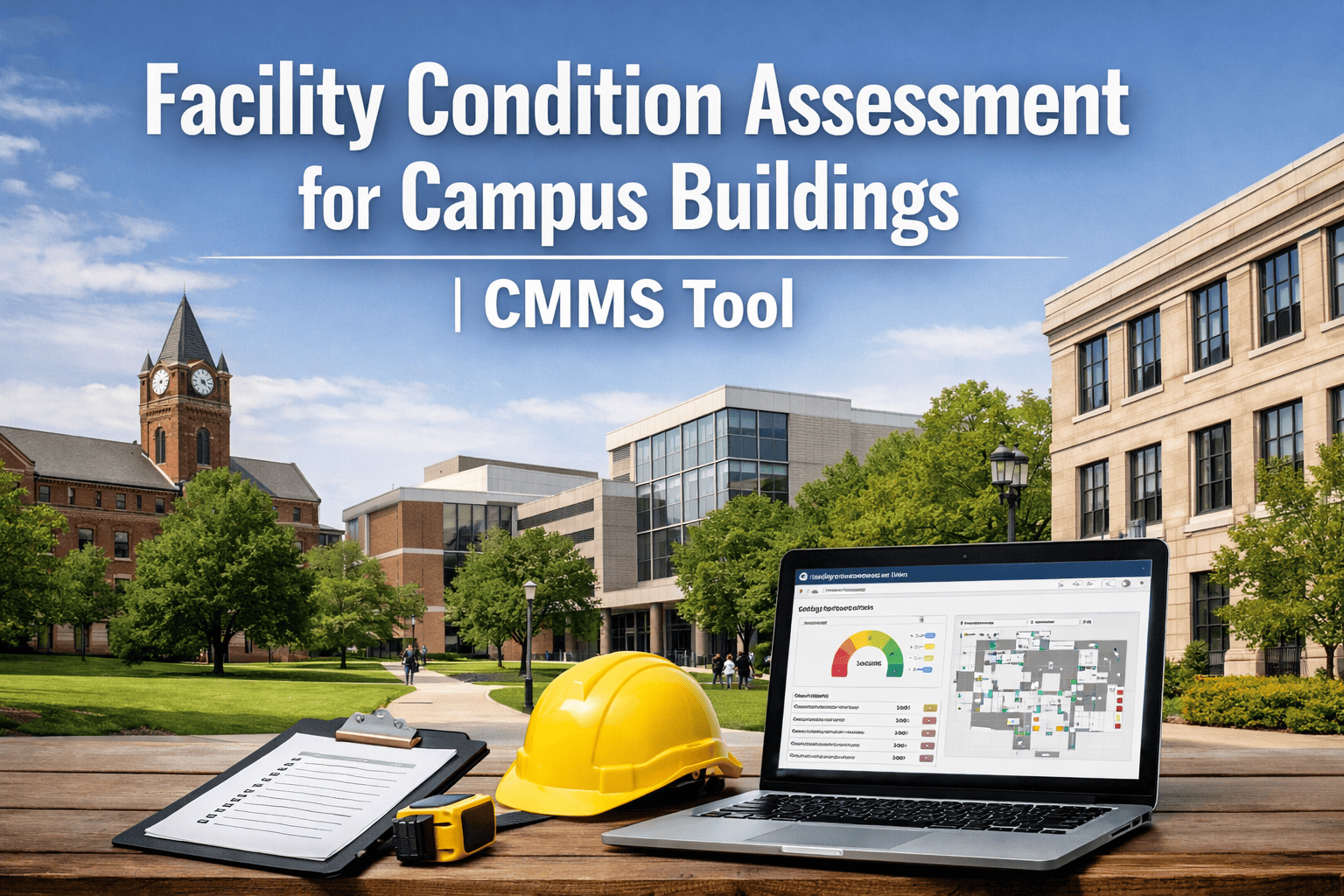
You cannot maintain what you have not documented. The foundation of every successful university PM program is a comprehensive building condition assessment that catalogs every major system, rates its current condition, estimates its remaining useful life, and establishes the maintenance requirements needed to reach that lifespan. Without this baseline, maintenance is guesswork—technicians respond to complaints rather than preventing failures.
Condition Assessment Framework by Building System
HVAC Systems (20–25 Year Lifecycle)
Document every AHU, chiller, boiler, cooling tower, pump, and VAV box with nameplate data, installation date, maintenance history, and current condition rating on a 1–5 scale
Assessment Output:Remaining useful life estimate, annual PM cost projection, capital replacement timeline
Roofing Systems (15–30 Year Lifecycle)
Infrared moisture surveys identify trapped water under membranes, core samples reveal adhesion quality, and visual inspection maps flashing condition and drainage patterns
Thermographic scanning reveals hot spots in switchgear, breaker testing confirms trip curves, and load analysis identifies panels operating near capacity limits
Assessment Output:Arc flash hazard ratings, upgrade priority ranking, capacity planning for building renovations
Plumbing and Piping (40–60 Year Lifecycle)
Ultrasonic pipe thickness testing on concealed piping, water quality analysis for corrosion indicators, fixture condition survey for replacement planning
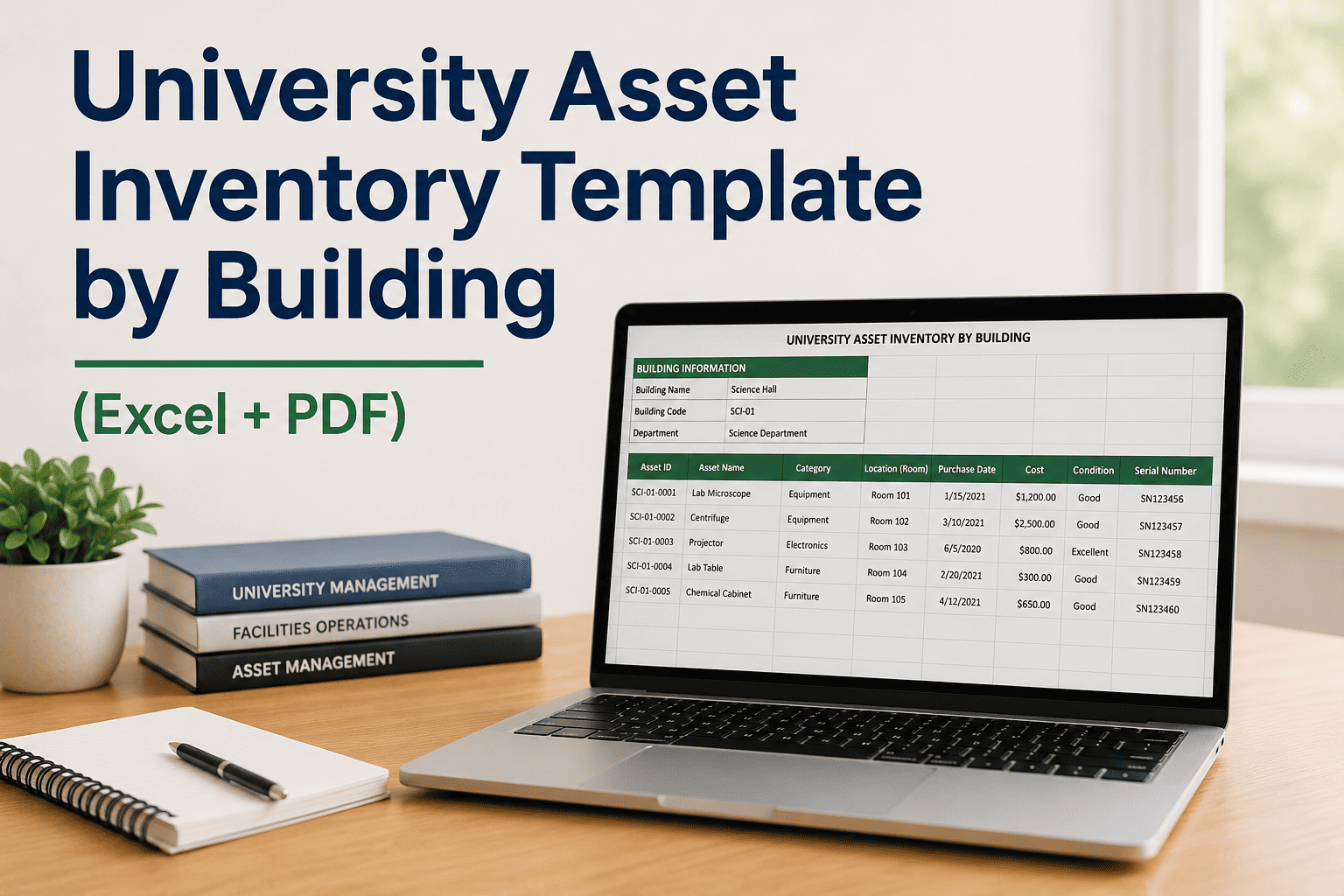
The condition assessment feeds directly into the CMMS asset registry. Each system documented during assessment becomes an asset record with its condition rating, maintenance history, PM schedule, and replacement timeline. This transforms the assessment from a one-time report into a living database that technicians update with every work order. Over time, the system accumulates the operational intelligence needed to make data-driven capital planning decisions—replacing equipment based on actual condition data rather than arbitrary age thresholds. Start building your campus asset registry and documenting condition baselines — Sign Up
Implementation Roadmap
Building a structured campus PM program does not require consultants or new equipment. It requires documenting what you have, defining what each asset needs, and building the recurring schedule that ensures nothing is missed. Most universities can transition from reactive chaos to structured preventive maintenance within 16 weeks.
Your Path to Structured Campus Maintenance
How universities deploy preventive maintenance programs
Phase 1
Building and Asset Inventory
Walk every mechanical room, roof, and electrical room. Document every AHU, boiler, chiller, panel, and major system with nameplate data, photos, and condition ratings in the mobile app
Weeks 1–4
Phase 2
PM Schedule Definition
Map maintenance tasks and frequencies to each asset type using APPA/ASHRAE guidelines. Configure recurring work orders aligned to your academic calendar—major work during breaks, routine tasks during semesters
Weeks 5–8
Phase 3
Team Training and Zone Assignment
Assign technicians to building zones, train staff on mobile workflow, establish escalation procedures for critical findings, and onboard contractors for specialized work
Weeks 9–12
Phase 4
Execute, Measure and Optimize
Launch the first PM cycle, track completion rates weekly, baseline energy consumption and complaint data, and refine frequencies based on actual equipment condition feedback
Weeks 13–16 and ongoing
The universities succeeding with preventive maintenance are not the ones with the biggest budgets—they are the ones with the best systems. A campus with 50 buildings and a $3 million maintenance budget that uses structured digital PM to schedule, track, and document every task will outperform a campus with 50 buildings and a $5 million budget that operates reactively from spreadsheets and email. The difference is not money—it is the discipline that digital systems enforce. When every filter change, coil cleaning, roof inspection, and generator test is auto-scheduled with mobile assignments, photo verification, and completion tracking, nothing gets deferred. Nothing gets forgotten. Nothing cascades into a crisis.
Structured Execution
Auto-generated work orders at APPA-recommended frequencies eliminate the human memory failures that cause deferrals.
Institutional Knowledge
Every completed work order preserves technician observations digitally—protecting your campus when experienced staff retire or transfer.
Data-Driven Capital Planning
Maintenance history accumulated over time provides the evidence needed to justify capital requests to administrators and trustees.
Build a Campus Maintenance Program That Prevents Failures
Your deferred maintenance backlog is growing, your emergency repairs are consuming capital budgets, and your building complaints are increasing because systems are degrading faster than your team can react. Oxmaint structures the entire preventive maintenance cycle—auto-scheduling every task across every building, sending mobile assignments to technicians, documenting completion with photos and timestamps, and generating the reports that justify budget requests to administration.
How much should a university spend on preventive maintenance
APPA recommends 2–4% of Current Replacement Value (CRV) annually for total facilities maintenance, with 60–70% allocated to preventive and predictive activities. For a campus with $500 million in building replacement value, that translates to $10–$20 million annually in total maintenance, with $6–$14 million dedicated to PM. Spending below 1.5% of CRV almost certainly means the deferred maintenance backlog is growing. The most useful benchmark is cost per square foot: $1.50–$2.00/sq ft for PM at APPA Level 1 conditions. The analytics dashboard tracks your actual spending per square foot against these benchmarks so you can demonstrate funding needs with data rather than anecdotes.
How do we prioritize which buildings to maintain first
Prioritize using a combination of building criticality, condition, and consequence of failure. Academic buildings serving the most students and generating the most revenue deserve highest priority. Buildings housing research facilities with irreplaceable equipment or specimens come next. Then residence halls where failures directly impact student experience and retention. Within each building, prioritize systems where failure creates the worst cascade: roofing (because water damages everything below), electrical (because failures are dangerous and affect the entire building), then HVAC (because failures disrupt occupancy but rarely cause secondary damage).
What is the best ratio of in-house staff to contracted maintenance
Most universities handle 70–80% of preventive maintenance with in-house staff and contract 20–30% of specialized work. In-house teams should own routine PM—filter changes, belt inspections, basic plumbing, general electrical, and building rounds—because they know the buildings intimately and can respond quickly. Contract out specialized services: elevator maintenance, fire alarm testing, chiller teardowns, roof repairs, controls programming, and any work requiring specific licenses. The platform manages both in-house and contractor work orders against the same asset records, ensuring complete maintenance visibility regardless of who performs the work.
How do we justify increased maintenance funding to university leadership
Build the business case with three data points that the system tracks automatically. First, document emergency repair costs over the past 3–5 years and show which failures were preventable with routine PM—this demonstrates the cost of inaction. Second, calculate the Facility Condition Index (FCI) for each building (deferred maintenance backlog divided by current replacement value)—buildings with FCI above 0.10 are deteriorating, above 0.30 may warrant replacement rather than continued investment. Third, benchmark your spending per square foot against APPA peer institutions to show whether your campus is under-funded relative to comparable universities. Data-driven requests succeed where anecdotal complaints fail.
Can one CMMS platform manage maintenance across an entire campus
Yes—this is exactly what modern CMMS platforms are designed for. A single platform manages work orders, PM schedules, asset records, and compliance documentation across every building on campus. Technicians receive mobile assignments organized by building zone, supervisors see campus-wide completion dashboards, and administrators access budget and condition reports for the entire portfolio. The alternative—separate systems per building or department—creates the same information silos that cause maintenance failures in the first place. Centralized visibility is the entire point of modern maintenance management. See campus-wide maintenance management in action — Book a Demo