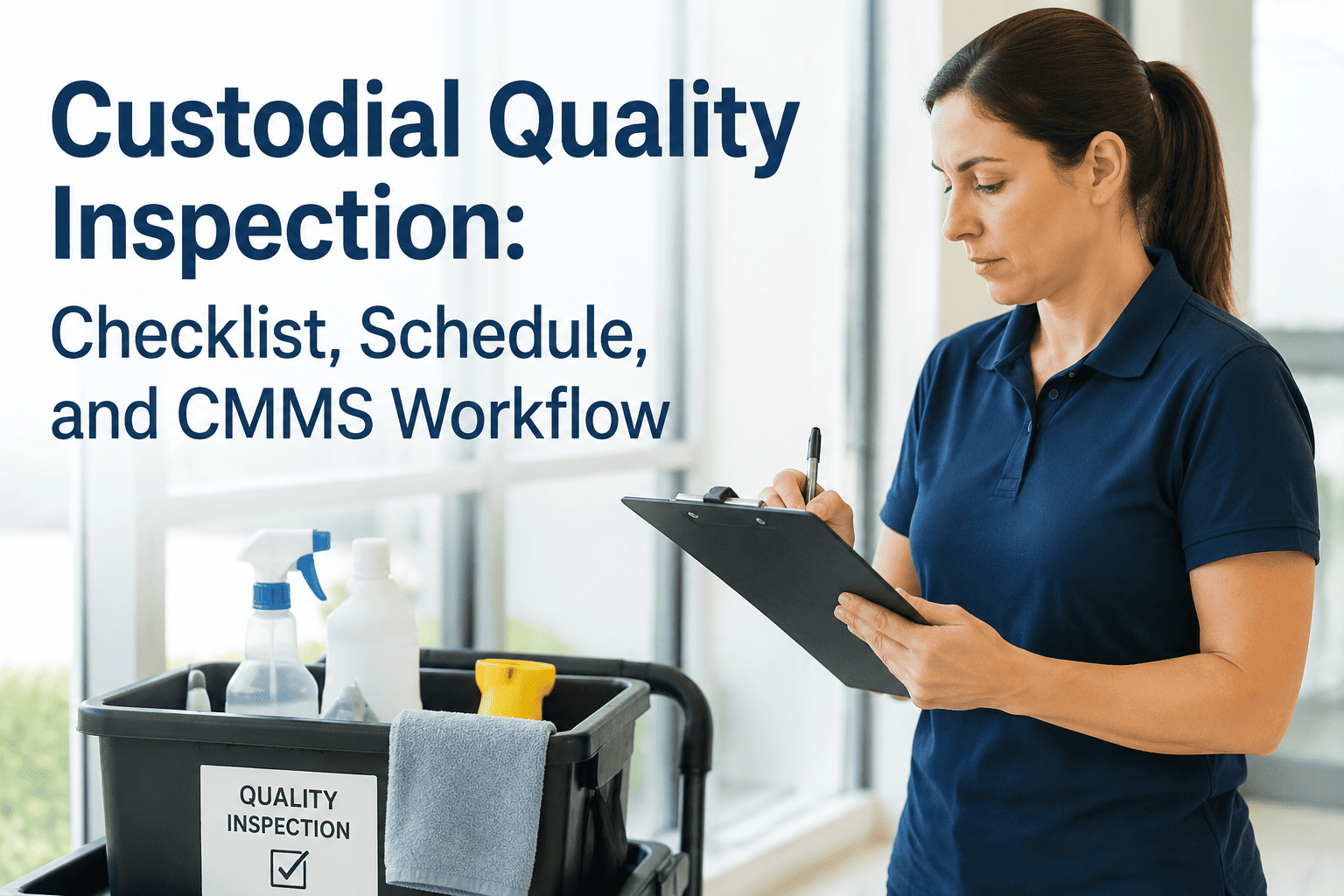
School and campus restrooms fail fast — a single broken soap dispenser or clogged drain logged at 7 AM becomes a health complaint by noon and a parent email by evening. Facilities teams at K–12 districts and universities are managing 40 to 120 restroom units per campus with custodial staff stretched across competing priorities, no unified log, and no automatic escalation when a check is missed. The result: reactive cleaning instead of systematic maintenance, compliance gaps during state inspections, and recurring odor and hygiene complaints that damage institutional reputation. This checklist covers every restroom maintenance task — daily cleaning, fixture inspection, supply restocking, drain and plumbing checks, deep cleaning cycles, and CMMS workflow — structured to run as a scheduled, documented programme in OxMaint. If you want to see how automated work orders eliminate missed checks entirely, book a demo.
Custodial Maintenance — OxMaint CMMS
Restroom Maintenance Checklist, Schedule & CMMS Workflow
Every task your custodial team needs — daily, weekly, monthly, and deep clean — with a CMMS workflow that auto-schedules, escalates, and documents every check.
How to Use This Checklist
Daily tasks apply during every occupied school day. Weekly tasks cover fixture and supply checks. Monthly tasks include drain maintenance and deep cleaning. Tasks marked Close Now require immediate room closure. Tasks marked Escalate require facilities supervisor sign-off before the space reopens.
Daily Cleaning Tasks
Daily restroom cleaning is the single highest-impact custodial activity on campus. A restroom cleaned once at 6 AM and not checked again until 3 PM will show visible failure by mid-morning in a busy school corridor. High-traffic school restrooms need a minimum of three timed checks per day — logged, not estimated — and a documented corrective action every time a check finds a deficiency.
Before School Opens (6:30–7:30 AM)
Sweep and mop all floor areas; apply disinfectant to high-traffic zones near entry and sinks
Wipe all surfaces — counters, sinks, mirrors, partitions — with EPA-registered disinfectant; note any staining requiring follow-up
Scrub toilet bowls and urinals; confirm flush mechanism operational on every unit
Restock all paper towel, toilet paper, and hand soap dispensers to full before occupancy
Empty all waste receptacles; replace liners; no waste bin more than 75% full at start of day
Confirm all lighting operational; report any burned-out fixtures on work order before school opens
Midday Check (11:00 AM–1:00 PM)
Spot clean floors — wet mopping where needed; confirm no standing water or slip hazards
Wipe toilet seats and sink counters; re-disinfect if visible soiling found
Restock soap, paper towels, and toilet paper at any dispenser below 50% capacity
Empty waste bins if more than 50% full; confirm no waste on floor
Check for any clogged drains or running fixtures; log and escalate if found
Close NowAny blocked drain causing standing water — place out-of-order sign, log work order, and notify facilities immediately
End of Day (3:00–4:30 PM)
Full mop and disinfect all floor areas; allow drying time before evening events if applicable
Scrub toilet bowls and urinals; apply overnight bowl cleaner if protocol requires
Clean and polish mirrors; wipe all chrome fixtures dry to prevent water spotting
Final supply restock — confirm paper, soap, and seat covers fully restocked for next morning
Final waste collection; confirm all bins emptied and relined; close day log in OxMaint
Fixture Inspection Programme
Fixture failures have a direct, measurable cost: a running toilet wastes 200 gallons of water per day, costing the district $300–$500 per year per unit. A broken hand dryer forces students to use paper towels and increases supply costs by 60% in that restroom. Systematic weekly fixture checks with logged corrective actions turn what looks like a cleaning problem into an asset management programme.
Weekly
Plumbing Fixtures
Flush test every toilet and urinal; confirm full flush cycle, no running water after flush, and handle/sensor operational
Check all faucets for dripping; tighten packing or replace washer if drip rate exceeds 1 drop per 2 seconds
Confirm hot water temperature at handwashing sinks between 100–120°F; cold water available at all units
Inspect toilet tank and supply lines for any visible leaks; check floor around base for moisture indicating wax ring failure
Check P-trap cleanouts under sinks; no visible corrosion, no moisture on cabinet floor beneath
EscalateAny toilet with confirmed continuous running after flush — tag out of service; do not defer for more than 24 hours
Weekly
Hardware and Accessories
Test all door locks and latches on stall partitions; any broken hardware logged and repaired within 48 hours for student privacy compliance
Inspect partition hardware — hinges, brackets, and mounting bolts; tighten any loose hardware; replace missing fasteners
Check hand dryer operation; confirm adequate air output; clean intake filters on electric dryers per manufacturer schedule
Inspect soap dispensers for correct operation; no dispenser clogged with dried soap; clean nozzle if buildup found
Check all paper towel and toilet paper holder mounting; no fixture loose from wall; confirm correct orientation for easy roll access
Baby changing stations — confirm hinge function, weight limit label visible, sanitation supply present, no torn or cracked surface
Supply Management and Restocking
Supply stockouts are the most common and most avoidable restroom complaint. A student who cannot wash their hands because soap ran out at 10 AM is a health and liability issue, not just a comfort issue. Supply management is not a daily task — it is an inventory programme with par levels, auto-reorder triggers, and documented consumption tracking per unit.
| Supply Item |
Check Frequency |
Minimum Par Level |
Reorder Trigger |
Log in OxMaint |
| Liquid Hand Soap |
3x Daily |
25% remaining |
Below 25% |
Per dispenser |
| Toilet Paper |
3x Daily |
1 full roll remaining |
Below 1 roll |
Per stall |
| Paper Towels |
3x Daily |
50% dispenser capacity |
Below 50% |
Per dispenser |
| Seat Covers |
Daily |
Full dispenser |
Below 25% |
Per stall |
| Hand Sanitizer |
Daily |
50% dispenser capacity |
Below 50% |
Per unit |
| Waste Bag Liners |
Weekly |
5 liners per bin |
Below 5 count |
Per restroom |
| Cleaning Chemicals |
Weekly |
2-week supply on shelf |
Below 1-week supply |
Per custodial closet |
Plumbing and Drain Maintenance
Floor drain maintenance is the most neglected task in school restroom programmes — and the most common source of odour complaints. A dry P-trap in a floor drain allows sewer gas into the restroom within days of disuse. Monthly drain flushing and quarterly enzymatic treatment prevent 80% of odour complaints without any plumbing intervention.
Monthly
Drain Maintenance
Pour 2 litres of water into each floor drain to recharge P-trap seal; dry traps allow sewer gas infiltration — the most common source of persistent restroom odour
Apply enzymatic drain treatment to all floor drains and sink drains; confirm product contact time per manufacturer instructions before flushing
Remove and clean all drain covers; inspect for debris accumulation in drain bowl; any blocked drain cleared same day
Check grout lines around floor drains for cracking or separation; any gap is a moisture pathway and a slip risk — log for tile repair
Confirm drain flow rate by running each fixture for 30 seconds; any slow drain treated immediately — do not defer to avoid larger blockages
Quarterly
Plumbing System Check
Water pressure test at end-of-run fixtures — confirm minimum 20 psi at any restroom furthest from the main; low pressure indicates clogged aerator or undersized supply line
Inspect shutoff valves at every fixture — confirm valves turn freely; seized shutoffs are a critical liability during a plumbing emergency
Check all grout and caulk around toilet bases and tub/shower surrounds; re-caulk any gap wider than 1mm to prevent subfloor moisture infiltration
Inspect water heater serving restroom hot water — confirm temperature setting, anode rod condition, and no signs of corrosion at tank base
EscalateAny evidence of water damage — stained ceiling tiles below restroom, wall discoloration, or musty odour in adjacent spaces — requires plumber inspection within 24 hours
OxMaint Auto-Schedules Every Restroom Check
Every restroom is an individual asset in OxMaint. Daily, weekly, and monthly work orders generate automatically — custodians check off tasks on mobile, supervisors see real-time completion status across the entire campus. Missed checks escalate automatically. No paper logs. No guessing what was done.
Deep Clean and Seasonal Maintenance
Monthly deep cleaning addresses what daily cleaning cannot: grout discoloration, scale buildup on fixtures, ventilation grille fouling, and partition surface degradation. Without a scheduled deep clean cycle, school restrooms drift from acceptable to unacceptable over a single semester, requiring costly restoration work during summer break that would not have been necessary with monthly maintenance.
01
Grout and Tile Deep Clean
Monthly
Steam clean or chemical clean all floor and wall grout; confirm no discoloration remaining after treatment. Document grout condition with photo — any grout requiring replacement flagged for capital maintenance before full deterioration.
02
Fixture Descaling
Monthly
Apply descaling agent to all chrome faucets, spouts, and shower heads; remove mineral buildup that restricts flow and harbors bacteria. In hard water districts, descaling every 3–4 weeks prevents fixture replacement cycles from shortening below 5 years.
03
Ventilation and Exhaust Fans
Monthly
Remove and clean exhaust fan grilles; inspect fan blade for dust accumulation; confirm fan operation. A fouled exhaust fan running at 40% capacity is the primary driver of humidity buildup and mould risk in restrooms — cleaning takes 10 minutes and prevents remediation costs 100x higher.
04
Partition Surface Treatment
Quarterly
Apply graffiti-resistant coating to stall partitions after cleaning; fill any chips or gouges in solid plastic partitions with matching color filler. Partition condition is the first thing a parent or inspector notices — visibly damaged partitions trigger complaints regardless of cleaning standard.
05
Caulk and Sealant Renewal
Quarterly
Remove and replace any caulk showing mould growth, cracking, or separation. Mould in caulk cannot be cleaned — it must be replaced. Document all caulk renewal locations with photos for compliance records.
06
Annual Condition Survey
Annual
Full restroom condition assessment with photos per unit — fixture condition, partition condition, flooring, lighting, ventilation, and accessibility compliance. Report filed in OxMaint as the capital planning input for the following year's deferred maintenance budget.
CMMS Workflow for Restroom Maintenance
A paper-based restroom log answers the question "was this restroom checked?" It does not answer "what was found, what was done, who did it, and how long did it take?" A CMMS-based workflow answers all four — and generates the compliance evidence a district needs when a parent complaint or state inspection arrives. The difference between a programme and a paper log is accountability at the work-order level.
1
Asset Setup — Every Restroom as an Individual Unit
Each restroom is a named asset in OxMaint with building, floor, wing, and occupancy type (student, staff, visitor). Fixture count, last inspection date, and recurring schedule are stored per unit. Multi-building districts manage 40–120 units from a single dashboard.
2
Auto-Generated Work Orders on Schedule
Daily cleaning work orders generate at 5:30 AM for every occupied restroom. Weekly fixture checks generate Monday morning. Monthly deep clean work orders generate on the first of each month. No scheduler required — the programme runs itself once set up.
3
Mobile Task Completion with Photo Documentation
Custodians complete checklist tasks on mobile — tap to confirm each item, photograph any deficiency, add a note. Supervisors see real-time completion status from any device. A check that is not logged in the system is treated as a missed check — no ambiguity.
4
Automatic Escalation for Overdue Tasks
Any work order not completed within its scheduled window triggers a supervisor notification automatically. Facilities managers do not need to chase completion — the system alerts them. Escalation rules are configurable per restroom priority level and occupancy type.
5
Compliance Records Exportable in Minutes
Every completed work order — task detail, technician, timestamp, photo, corrective action — is stored permanently per restroom. Any state inspection, parent request, or board review is answered with a filtered export in under five minutes. No paper binders. No reconstructed logs.
Frequently Asked Questions
Restroom Maintenance — OxMaint CMMS
Every Restroom Checked. Every Task Logged. Every Complaint Answered.
Auto-generated daily, weekly, and monthly work orders per restroom unit
Mobile task completion with photo documentation by custodial staff
Supervisor dashboard showing real-time completion status across all buildings
Full compliance record exportable for state audits and parent requests