A failed health department inspection in a school cafeteria is not a paperwork problem — it is a public event that reaches parents, school boards, and local media within hours. Most cafeteria inspection failures are preventable: a cold holding unit running at 48°F instead of 41°F, a handwashing sink without soap, pest evidence that accumulated over a week without a daily check. This checklist covers the complete school cafeteria daily inspection — food temperatures, equipment function, sanitation, employee hygiene, allergen management, and pest evidence — structured for use before service opens each day. Deploy it in OxMaint to auto-schedule every check, log results with timestamps, and produce health department-ready records on demand. Book a demo.
School Cafeteria Daily Inspection Checklist
Food temperature, equipment function, sanitation, employee hygiene, allergen management, and pest evidence — every check required before service opens, structured for CMMS deployment and health department compliance.
Complete before service opens each day. Items marked Close require immediate corrective action and must be resolved before food service begins. Items marked Report must be logged and reported to the Food Service Director but do not automatically prevent service. All temperature readings must be logged with time, location, and thermometer ID.
1. Food Temperatures
Temperature control is the single most critical food safety factor in a school cafeteria. The FDA Food Code requires cold holding at or below 41°F and hot holding at or above 135°F. Any unit found out of range before service opens must be corrected before food is served — a student who becomes ill from temperature-abused food creates a district-level incident.
Pre-ServiceCold Holding — 41°F or Below
Pre-ServiceHot Holding — 135°F or Above
During ServiceCooking Temperatures — Minimum Internal Temps
Temperature Logs Auto-Generated Before Every Service in OxMaint
Daily temperature check work orders generated before service opens — staff logs all unit readings on mobile with timestamp. Any out-of-range reading flags an immediate corrective action. Health department-ready temperature log exportable per date range in under 2 minutes.
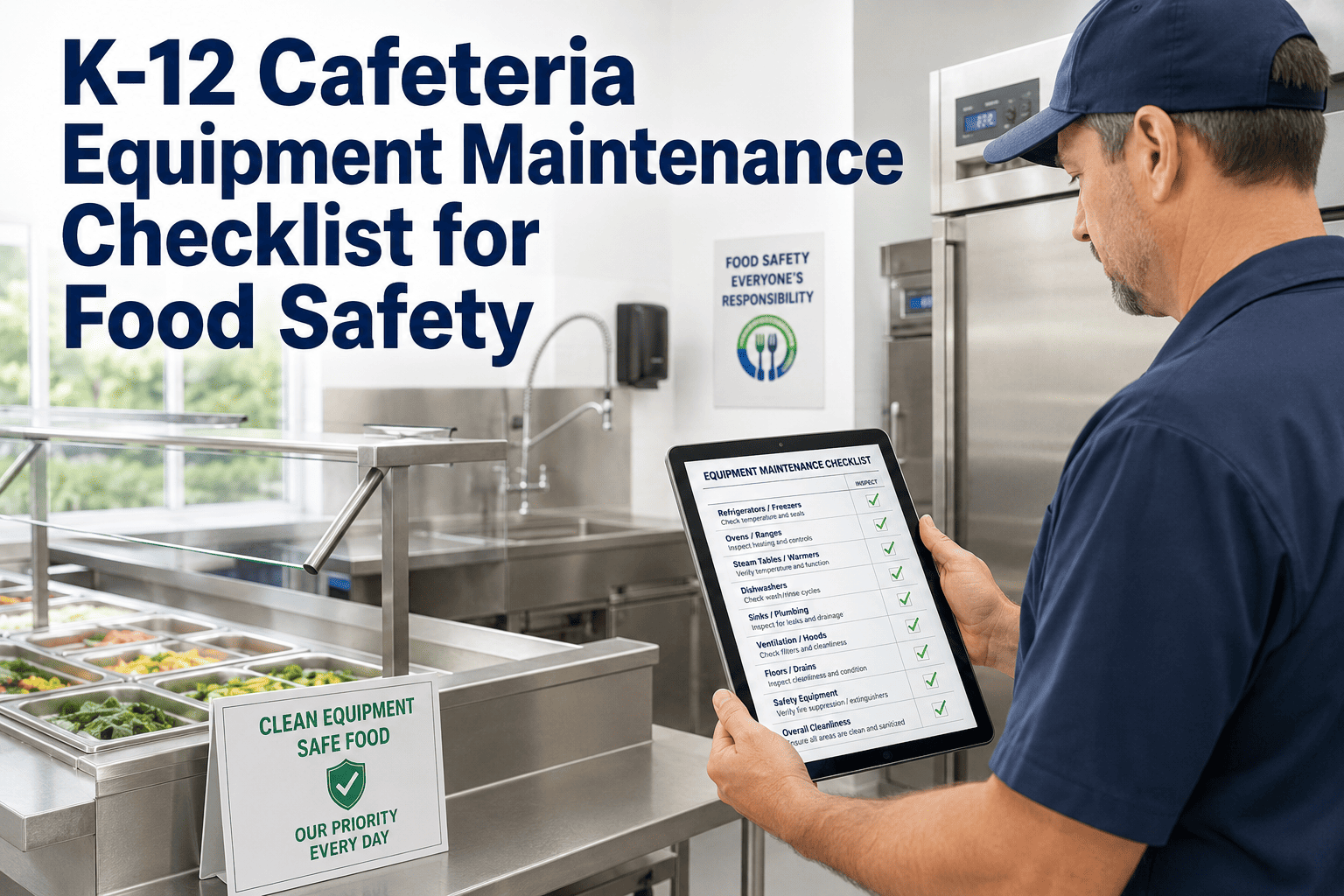
Equipment failures discovered mid-service are more expensive and disruptive than those caught before service opens. A daily pre-service equipment check — running for less than 10 minutes — prevents the scenarios that close a cafeteria line at 11:30 AM on a school day.
Pre-ServiceCooking Equipment
Pre-ServiceWarewashing and Sanitation Equipment
Pre-ServiceRefrigeration and Storage Equipment
3. Sanitation and Cleaning
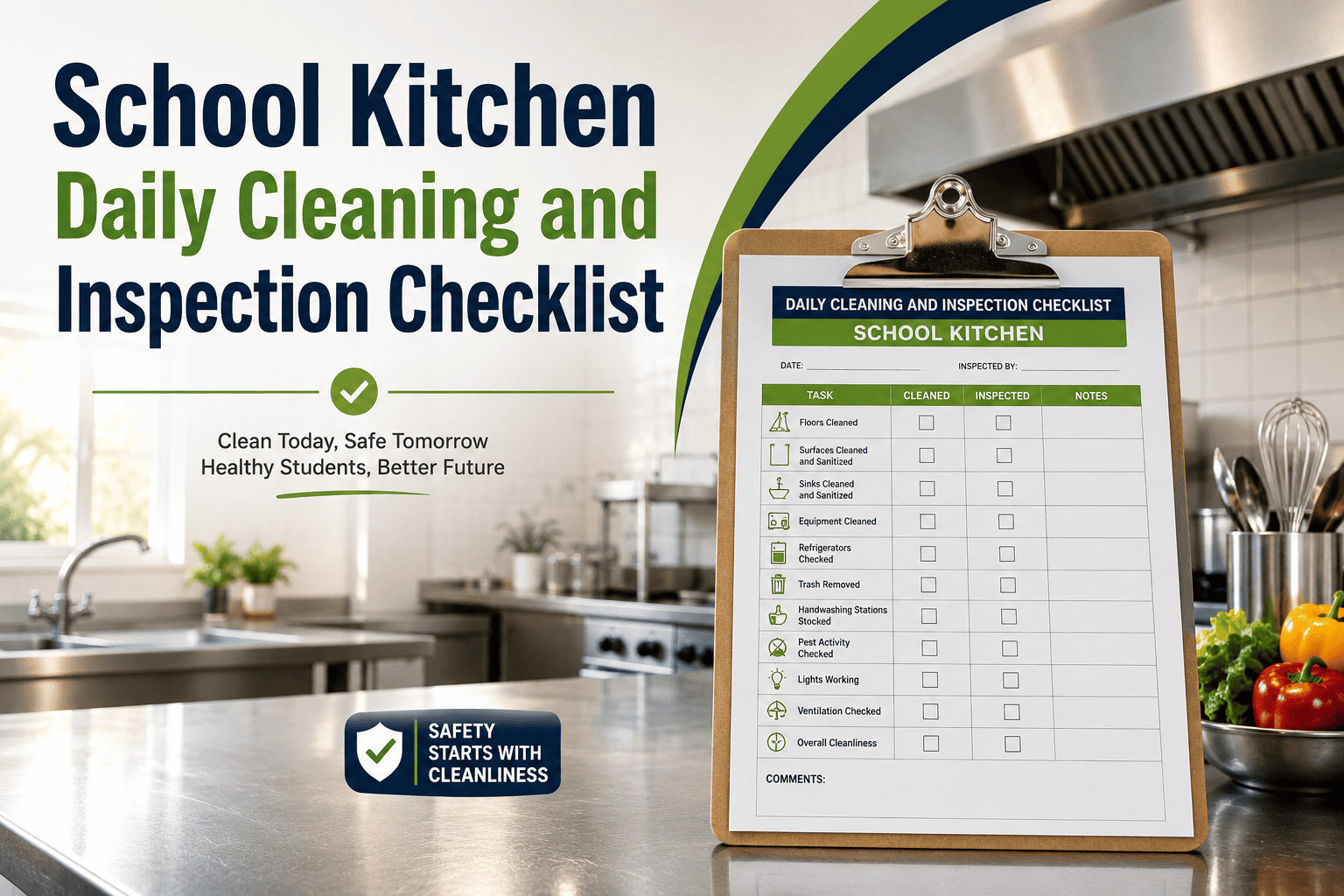
Sanitation failures are the most common reason for health department citations in school cafeterias. A clean kitchen that fails to sanitise contact surfaces is as dangerous as a dirty one. All food contact surfaces must be cleaned and sanitised before service, and the sanitiser concentration must be verified and documented.
Pre-ServiceFood Contact Surfaces
Pre-ServiceNon-Contact Surfaces and General Cleanliness
During ServiceSanitiser Wiping Cloths
Sanitiser Logs and Equipment Checks Auto-Scheduled in OxMaint
Pre-service equipment and sanitation checks generated before every service — staff logs sanitiser readings, equipment temperatures, and surface conditions on mobile. Any out-of-range reading triggers a corrective action work order before the first tray is served.
Employee hygiene violations are the most commonly cited personal health and hygiene deficiencies in school food service inspections. Bare-hand contact with ready-to-eat food and failure to wash hands at required moments are both critical violations under the FDA Food Code. The supervisor completing this checklist is responsible for confirming all staff entering the kitchen meet these requirements.
Before ServiceStaff Health and Appearance
During ServiceHandwashing and Glove Use
5. Allergen Management
Allergen management is a life-safety obligation in school cafeterias. The USDA requires school food programmes to accommodate students with documented food allergies on medical statements. A failure to prevent allergen cross-contact can cause anaphylaxis — an event that results in district liability, regulatory action, and reputational damage that no cafeteria manager wants to navigate.
Pre-ServiceAllergen Procedure Verification
During ServiceAllergen Cross-Contact Prevention
6. Pest Evidence and Facility Condition
Pest evidence discovered by a health inspector triggers an immediate critical violation and can result in same-day closure. A daily visual inspection — taking less than 5 minutes — catches rodent activity, cockroach evidence, and fly breeding conditions before they escalate to the point where the inspector finds them.
Pre-ServicePest Evidence Check
Pre-ServiceFacility Physical Condition
Pest Checks and Facility Condition Auto-Logged in OxMaint
Daily pest evidence check generated before service opens — any finding triggers an immediate corrective work order and notification to management. Full inspection history per kitchen exportable for health department visits — shows consistent daily monitoring programme.
A health inspector who arrives and is shown a complete, dated, signed daily inspection log from the past 12 months has already answered their first three questions. OxMaint stores every daily inspection result against the kitchen asset — the complete compliance history is exportable in under 2 minutes for any unannounced visit.
Pre-ServiceDocumentation and Certifications
Post-ServiceEnd-of-Service Checks
Weekly / PeriodicAdditional Compliance Checks
Frequently Asked Questions
Most state health departments inspect school cafeterias 1–2 times per year, often unannounced. Some jurisdictions inspect more frequently based on prior violation history. A school with a documented daily self-inspection programme — logged and timestamped in OxMaint — demonstrates ongoing compliance and typically receives faster resolution of any cited issues.
Per the FDA Food Code: cold holding foods (TCS — Temperature Control for Safety) must be held at 41°F (5°C) or below. Hot holding foods must be held at 135°F (57°C) or above. Food left in the temperature danger zone (41°F–135°F) for more than 4 cumulative hours must be discarded. All temperature readings must be documented with time, unit, and thermometer ID.
The FALCPA and FASTER Act identify the top 9 allergens: milk, eggs, fish, shellfish, tree nuts, peanuts, wheat, soybeans, and sesame (added 2023). School food programmes must accommodate students with documented allergies on medical statements under USDA regulations. All menu items must be reviewed against these allergens before service, and any substitutions must be verified safe.
For chlorine-based sanitisers: 50–200 ppm. For quaternary ammonium (quat): 200–400 ppm. Sanitiser concentration must be verified with test strips at the start of service and every 2 hours, with results logged. Wiping cloths must be stored in sanitiser solution between uses — never left on surfaces. Sanitiser concentration below minimum is a health code violation.
Yes — each school kitchen is an individual asset in OxMaint with its own daily inspection schedule, temperature logs, equipment service history, and compliance records. The Food Service Director dashboard shows completion status across all kitchens, any open corrective actions, and equipment due for service. The complete daily inspection history for any kitchen is exportable in under 2 minutes for any health department visit. Start free today.
School Cafeteria — OxMaint CMMS
Pass Every Health Inspection. Document Every Check.
FDA
Food Code compliant
<2 min
health dept. report export
Daily
auto-scheduled checks
Free
to start today
✓Temperature logs auto-generated before every service period


.png)


