US School Infrastructure Crisis 2026: Why $85 Billion in Repairs Can’t Wait
By Oxmaint on February 27, 2026
In January 2026, a middle school in suburban Atlanta was evacuated when a corroded cast-iron waste pipe burst above the library ceiling, sending raw sewage cascading across 4,200 square feet of instructional space. The pipe was original to the 1972 construction. It had been identified in a 2019 facility condition assessment as "approaching end of useful life" with a recommended replacement cost of $38,000. The replacement was deferred — twice — because the district's capital budget was consumed by emergency HVAC repairs at two other schools. The burst pipe cost $287,000 in emergency remediation, $165,000 in library contents replacement, 11 days of lost instruction for 840 students, and an insurance claim that triggered a 14% premium increase across the entire district portfolio. One $38,000 deferral became a $452,000 crisis — and that story is playing out in every state, every week, across America's 130,000 public school buildings. The nation's public school infrastructure is deteriorating faster than districts can fund repairs, creating a compounding backlog that now exceeds $85 billion by conservative federal estimates and approaches $197 billion when higher education facilities are included. This is not a maintenance problem. This is a fiscal, educational, and public health crisis that demands systematic intervention. Sign up for Oxmaint to begin documenting facility conditions and building the data-driven capital plans that break the deferral cycle.
Industry Authority Report — Education Facilities 2026
US School Infrastructure Crisis 2026: Why $85 Billion in Repairs Can't Wait
America's 130,000 public school buildings are aging faster than districts can fund repairs. The deferred maintenance backlog is compounding at 6–8% annually — degrading indoor air quality, increasing energy waste, threatening structural integrity, and creating the compliance exposures that cost districts millions in avoidable emergency spending. This report quantifies the crisis and provides the systematic framework for reversing it.
54%of US schools need major building system repairs
6–8%Annual backlog growth rate from compounding deferrals
3–5×Cost multiplier: emergency vs. planned repairs
The Scale of the Crisis: By the Numbers
The U.S. school infrastructure crisis is not a single problem — it is five interconnected failure domains that compound each other. A deferred roof creates water intrusion that damages HVAC ductwork that degrades indoor air quality that triggers health complaints that generate litigation that consumes the budget that should have replaced the roof. Understanding these five domains is the first step toward systematic intervention — because addressing any one in isolation allows the others to continue compounding.
Five Interconnected Failure Domains Driving the $85B Crisis
01
Structural & Envelope
Aging roofs, deteriorating masonry, failing windows, and compromised foundations. Average U.S. school building is 49 years old. 36% of districts report at least one building with a roof past useful life. Water intrusion from envelope failures causes $2.1B in secondary damage annually.
02
HVAC & Indoor Air Quality
41% of U.S. school districts report HVAC systems needing repair or replacement. Failed ventilation creates IAQ conditions linked to 13% higher student absenteeism. Post-COVID ASHRAE 62.1 ventilation standards require systems most schools cannot currently deliver.
03
Plumbing & Water Systems
An estimated 36,000 U.S. schools still have lead-bearing pipes or fixtures. Cast-iron waste systems from the 1960s–1970s are past rated service life. Pipe failures cause the most expensive emergency events — $150K–$450K per incident including remediation and instructional loss.
04
Electrical & Fire Safety
Electrical panels at capacity cannot support modern classroom technology, EV charging, or heat pump conversions. Fire safety systems — sprinklers, alarms, doors — require continuous compliance documentation (NFPA 25/72/80). 23% of schools report electrical system deficiencies.
05
Accessibility & Compliance
ADA Title II requires physical accessibility across every campus. EPA mandates asbestos management (AHERA), lead testing (3Ts), and IAQ standards. OSHA 2026 Heat Illness Prevention applies to maintenance workers. OCR complaints for accessibility gaps generate $85K–$500K+ resolution costs.
The Compounding Math: Why Deferral Gets Exponentially Worse
The most dangerous aspect of the school infrastructure crisis is not the current backlog — it is the rate at which that backlog compounds. Deferred maintenance is not static. Every year a repair is postponed, the cost of that repair increases (equipment degrades further, parts become obsolete, secondary damage accumulates), and new deferrals are added as other systems reach end of life. The result is exponential growth that no linear budget increase can overtake. Districts that defer $1 million this year face $1.08–$1.12 million in deferred costs next year — without adding a single new building or system to the inventory.
The Deferral Compounding Cascade
How a $50,000 repair becomes a $200,000 emergency in five years
1
Year 1: Planned Replacement Deferred — $50,000
Facility condition assessment identifies aging rooftop unit operating at 72% efficiency with refrigerant leak. Replacement recommended. Capital budget exhausted by emergency boiler replacement at another school. RTU repair authorized instead — $8,500 temporary fix.
RTU efficiency drops to 65%. Energy costs for that building increase $6,200/year. Two additional service calls at $2,400 each. Compressor shows early failure indicators. Replacement cost increases 8% (supply chain, refrigerant transition). Total cumulative cost: $80,000.
Failed economizer damper causes humidity infiltration. Condensation on cold supply ducts creates mold conditions above ceiling tiles. IAQ complaints from three classrooms. Emergency mold remediation: $24,000. Energy waste now $8,400/year above baseline. Equipment at 58% efficiency.
Secondary Damage
4
Year 5: Catastrophic Failure — $120K–$200K Total Including Collateral
Compressor fails mid-August during first week of school. Emergency replacement at 2× cost: $95,000. Portable cooling units for 12 classrooms during 3-week lead time: $18,000. Ductwork cleaning and mold remediation from years of humidity: $35,000. Classroom relocation costs: $12,000. Insurance premium increase: ongoing.
Emergency Failure
5
The Math: $50K Planned → $200K+ Actual (4× Cost Multiplier)
Total cost of deferral: $95K emergency replacement + $42K cumulative energy waste + $24K mold remediation + $18K temporary cooling + $35K ductwork cleaning + $12K relocation = $226,000. The $50,000 planned replacement would have cost $50,000. Deferral cost the district 4.5× more — and consumed capital that could have funded three other planned replacements.
4.5× Multiplier
Every Deferred Dollar Becomes Four. Break the Cycle with Data.
Oxmaint documents facility conditions, tracks maintenance costs per building, calculates Facility Condition Index scores, and generates the data-driven capital replacement schedules that boards actually fund — because they're built on documented evidence, not anecdotal requests. Stop deferring. Start documenting.
Reactive vs. Predictive: Two Funding Models, Two Outcomes
The school infrastructure crisis is fundamentally a systems problem — not a funding problem. Districts spending identical per-pupil amounts on facilities produce dramatically different outcomes depending on whether they operate reactively (waiting for failures) or predictively (using data to prevent failures). Reactive districts spend 60–75% of their maintenance budget on emergency repairs at 3–5× planned costs. Predictive districts spend 80%+ on planned maintenance at lowest-possible cost — and generate the documented condition data that justifies capital investment to school boards, voters, and bond rating agencies.
Reactive Budgeting vs. Predictive Capital Planning
Predictive Capital Planning (CMMS-Driven)
80/20 planned-to-reactive ratio — lowest cost per work order
FCI tracked per building — capital allocated by documented condition
Equipment replaced at optimal timing — 30–40% life extension through PM
Board presentations backed by per-building cost data — 40–60% higher approval
Energy costs managed — 15–25% reduction through maintenance optimization
100% compliance documentation — zero regulatory exposure
vs
Reactive Emergency Budgeting (Paper/Spreadsheet)
40/60 planned-to-reactive ratio — 3–5× cost multiplier on emergency work
No FCI data — capital allocated by loudest complaint or worst failure
Equipment run to failure — 30–40% shorter life, catastrophic replacement costs
Board requests anecdotal — "we need money, things are breaking" — boards defer
Energy waste compounds — 25–40% of spend attributable to deferred maintenance
Compliance gaps invisible until inspector arrives — $16K–$156K per OSHA violation
The Human Cost: How Failing Infrastructure Affects Students and Staff
The infrastructure crisis is not an abstraction. It is the teacher who brings a personal space heater to a classroom where the heating system failed in November and won't be repaired until spring break. It is the student with asthma whose attacks correlate directly with the mold behind the gymnasium wall that was identified two years ago and deferred. It is the custodian who spends 60% of the day responding to emergencies — leaking pipes, broken toilets, tripped breakers — instead of performing the preventive maintenance that would prevent those emergencies. It is the superintendent who presents a $4.2 million capital request to the board with nothing but a spreadsheet and a prayer, because the district has no per-building condition data, no documented cost history, and no way to quantify what happens if the board says no. The crisis is not buildings. The crisis is the absence of information systems that would let us manage buildings intelligently.
— Facilities Director, 38-School K-12 District, Southeastern United States
13%
Higher absenteeism in schools with poor IAQ (EPA/Harvard studies)
49 yrs
Average age of U.S. public school buildings
$197B
Combined K-12 + higher ed deferred maintenance backlog
Research consistently demonstrates that facility quality directly affects educational outcomes. Students in buildings with adequate ventilation, natural lighting, thermal comfort, and acoustic control perform 5–17% better on standardized assessments compared to students in deteriorating facilities. Teacher retention is 15–23% higher in well-maintained schools. And facility condition is now a "top three factor" in family school choice decisions — meaning that infrastructure quality directly affects enrollment, which directly affects per-pupil funding, which directly affects the budget available for infrastructure. The spiral works in both directions: invest in facilities and enrollment stabilizes; defer maintenance and enrollment declines, reducing the revenue needed to fund repairs. Book a demo to see how documented facility investment supports enrollment retention strategies.
The Systematic Solution: Five Steps to Reversing the Backlog
Reversing the school infrastructure crisis requires a systematic approach — not one-time bond measures that address symptoms without building the ongoing capacity to manage facilities intelligently. The following five-step framework transforms facilities management from reactive emergency response into data-driven capital stewardship that reduces the backlog year over year:
Infrastructure Recovery Framework: From Crisis to Stewardship
Five steps that reverse the compounding backlog and build sustainable facility management capacity
1
Step 1: Deploy Digital Work Orders — Capture Every Dollar (Week 1)
Implement CMMS across all buildings. Every work order captures labor, materials, contractor costs, building, and asset. From Day 1, the district accumulates the cost-per-building data that transforms budget requests from anecdotal to analytical. This single action — replacing paper logs with digital work orders — creates the data foundation for every subsequent step.
Immediate
2
Step 2: Register Critical Assets — Know What You Own (Month 1–2)
Walk every building and register critical MEP equipment in CMMS: HVAC units, boilers, chillers, rooftop units, elevators, fire suppression, kitchen equipment, generators. Capture manufacturer, model, install date, rated capacity, and current condition. QR-code tag everything above $5,000 replacement value. This registry enables lifecycle analysis — you cannot plan capital replacements for equipment you haven't inventoried.
Configure automated PM schedules for all registered critical assets: HVAC filter changes, belt inspections, fire extinguisher visuals, boiler blowdowns, roof drain inspections, fire door inspections. Every PM task is a recurring CMMS work order that cannot be forgotten. Preventive maintenance extends equipment life 30–40% and reduces emergency failures 60–75% within 12 months — immediately slowing the rate at which new deferrals are created.
Month 2–3
4
Step 4: Calculate FCI Per Building — Prioritize by Data (Month 6–12)
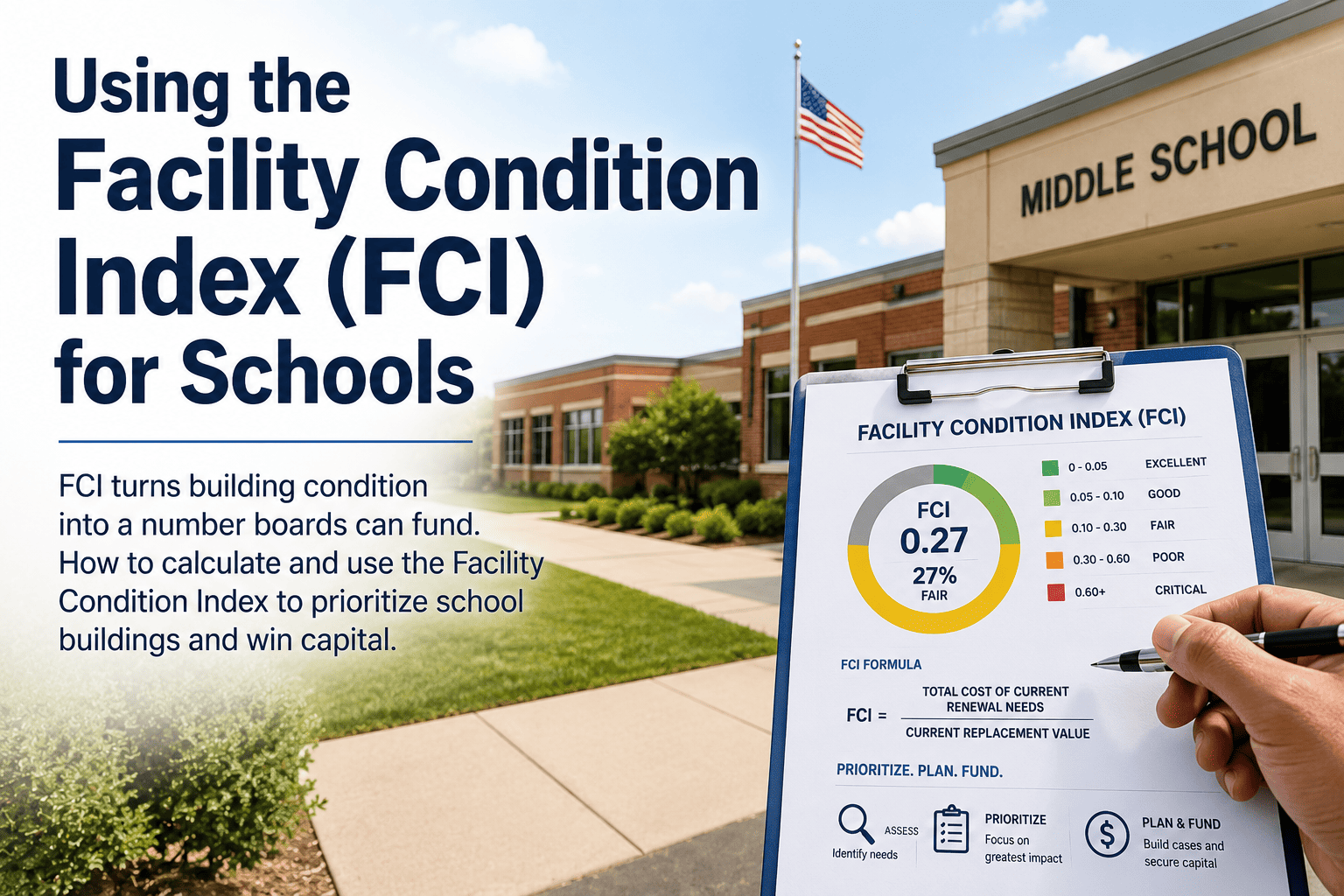
After 6–12 months of CMMS data accumulation, calculate Facility Condition Index (deferred backlog ÷ current replacement value) per building. Buildings with FCI above 0.30 (Poor) require different strategies than buildings at 0.10 (Good). FCI data transforms board presentations: "Building 7 has FCI of 0.34 and consumed 23% of district maintenance budget last year — here is the documented cost of continued deferral versus planned replacement." Boards fund math.
Month 6–12
5
Step 5: Data-Driven Capital Planning — Reverse the Backlog (Year 2+)
With 12+ months of documented per-building cost data, FCI scores, and equipment lifecycle analysis, present the first truly data-driven capital plan to the board. Compare continued maintenance costs versus replacement for each major system. Project 5/10/15-year scenarios. Support bond measures with per-building condition evidence that voters can verify. Districts with CMMS-documented capital requests achieve 40–60% higher approval rates than anecdotal presentations — because the data removes the guesswork that makes boards say "defer."
Year 2+
$85 Billion in Deferred Repairs. Your District's Share Is Growing 6–8% Per Year. Start Reversing It Today.
Oxmaint gives school districts the digital infrastructure to document facility conditions, track maintenance costs per building, calculate FCI scores, automate compliance, and generate the board-ready capital plans that get funded. The districts that deploy CMMS now will present their first data-driven capital plan within 12 months. The districts that wait will still be explaining why another pipe burst.
How large is the actual U.S. school infrastructure backlog in 2026?
The most widely cited federal estimate is $85 billion for K-12 facilities, based on GAO analysis of facility condition data. However, this figure is almost certainly understated because it relies on voluntary reporting and many districts — particularly those without CMMS systems — have not conducted formal facility condition assessments. The American Society of Civil Engineers grades U.S. school infrastructure at D+. When higher education deferred maintenance is included (APPA estimates $197 billion), the combined education facility backlog approaches $282 billion. The critical metric is not the absolute number but the growth rate: the backlog compounds at 6–8% annually as existing deferrals worsen and new systems reach end of life. A district with a $15 million backlog today faces an $18–$19 million backlog in two years without intervention — even if no additional buildings are added to the portfolio. Sign up for Oxmaint to begin quantifying your district's specific backlog with documented facility condition data.
Why does deferred maintenance cost 3–5× more than planned maintenance?
The 3–5× cost multiplier is driven by four compounding factors: (1) Emergency labor rates — after-hours service calls, weekend overtime, and expedited contractor mobilization cost 1.5–2.5× standard rates. (2) Expedited parts — components that could be sourced at standard pricing with 4–6 week lead times cost 30–80% more when needed urgently. (3) Collateral damage — a failed pipe doesn't just need pipe replacement; it requires ceiling repair, floor remediation, content replacement, and potentially mold remediation. The Atlanta school example in this report turned a $38,000 planned repair into a $452,000 crisis — an 11.9× multiplier. (4) Operational disruption — classroom relocation, temporary equipment rental, and lost instructional days carry real costs that planned summer maintenance avoids entirely. The CMMS makes this multiplier visible and measurable for every building — enabling districts to present the actual cost of deferral to boards rather than abstract warnings.
What is Facility Condition Index (FCI) and why should every district track it?
FCI is the single most important metric in education facility financial planning. The formula: deferred maintenance backlog ÷ current replacement value = FCI. A building with $20 million replacement value and $2 million in deferred maintenance has FCI of 0.10 (Good). The same building with $6 million deferred has FCI of 0.30 (Poor) — approaching the threshold where renovation costs exceed new construction. FCI matters for four financial decisions: (1) Capital allocation — invest in buildings deteriorating fastest before they cross the 0.30 threshold. (2) Bond measure sizing — aggregate FCI determines total amount and per-building allocation. (3) Insurance valuation — FCI affects condition assessments that insurers use for coverage and premiums. (4) Long-range planning — FCI trending over time shows whether your portfolio is improving or deteriorating. CMMS generates FCI from accumulated work order and condition data — continuously updated rather than requiring expensive periodic consultant assessments.
How does school infrastructure affect student achievement and enrollment?
Research consistently links facility quality to educational outcomes. Students in buildings with adequate ventilation, thermal comfort, natural lighting, and acoustic control perform 5–17% better on standardized assessments. Teacher retention is 15–23% higher in well-maintained schools — directly reducing the recruitment and training costs associated with the national teacher shortage. Perhaps most critically for district finances, facility condition is now a "top three factor" in family school choice decisions. This creates a feedback loop: deteriorating facilities drive enrollment decline, reducing per-pupil funding, further reducing maintenance budgets, accelerating deterioration. Conversely, documented facility investment — a renovated science lab, a new HVAC system that eliminated IAQ complaints, a modernized entrance — signals institutional quality that retains families. Districts with CMMS can quantify this connection: building-level maintenance investment correlated with building-level enrollment trends. Schedule a consultation to explore how facility data supports your enrollment retention strategy.
What role does Moody's credit assessment play in the school infrastructure crisis?
Moody's and other credit rating agencies increasingly evaluate deferred maintenance backlogs as a component of municipal and school district credit risk assessment. A large, undocumented, or growing deferred maintenance backlog signals fiscal management weakness — it represents an unfunded liability that will eventually require either large capital outlays or emergency spending that strains operating budgets. Districts with documented facility condition data, systematic preventive maintenance programs, and data-driven capital plans demonstrate the fiscal stewardship that supports favorable credit ratings. Favorable ratings reduce borrowing costs on bond issues — the primary mechanism most districts use to fund major capital improvements. A district issuing $50 million in bonds at a 0.25% lower interest rate saves approximately $1.25 million over the bond term. CMMS data directly supports this outcome: documented FCI trends, systematic PM programs, and per-building cost analytics demonstrate the proactive management that rating agencies recognize as creditworthy fiscal behavior.