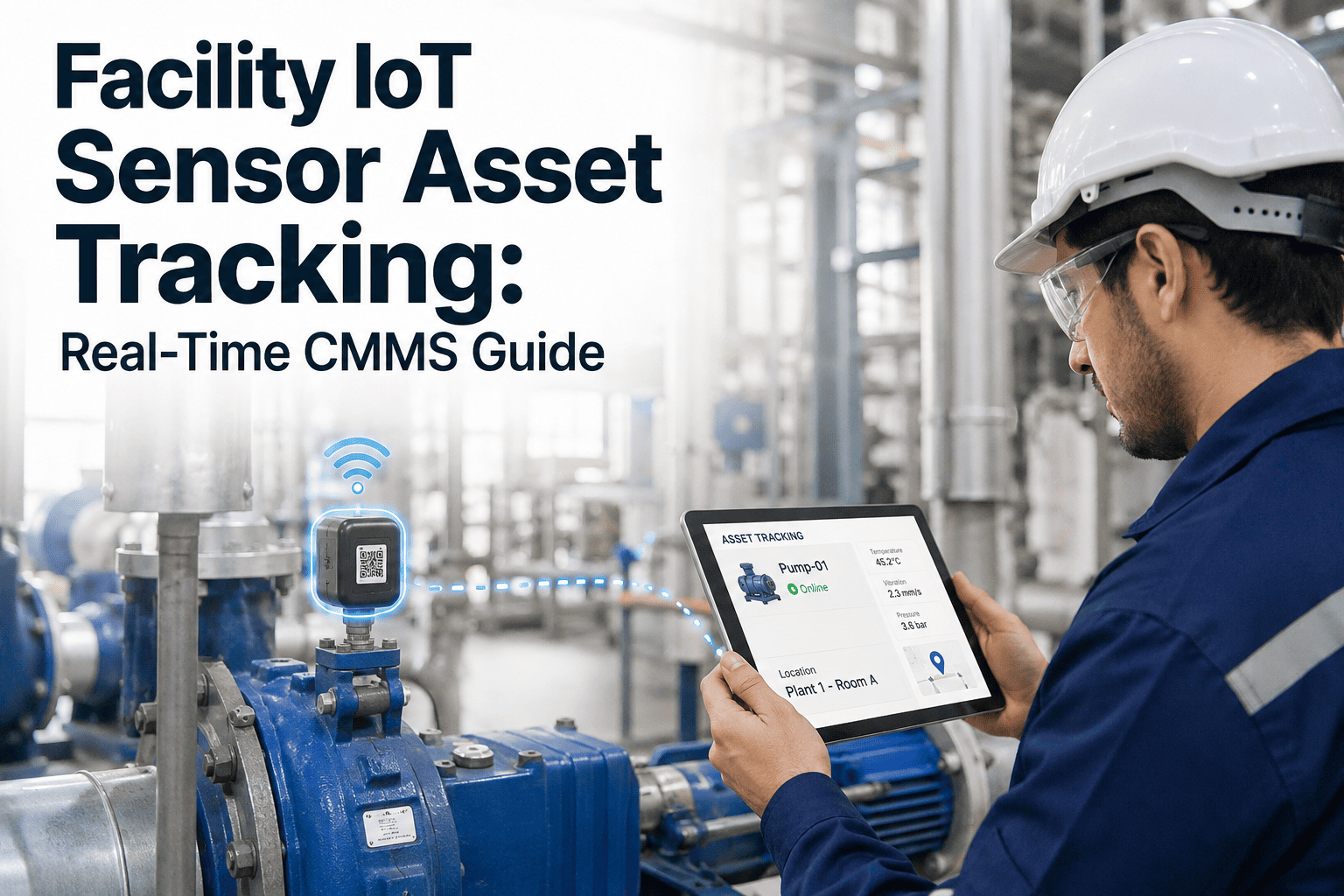
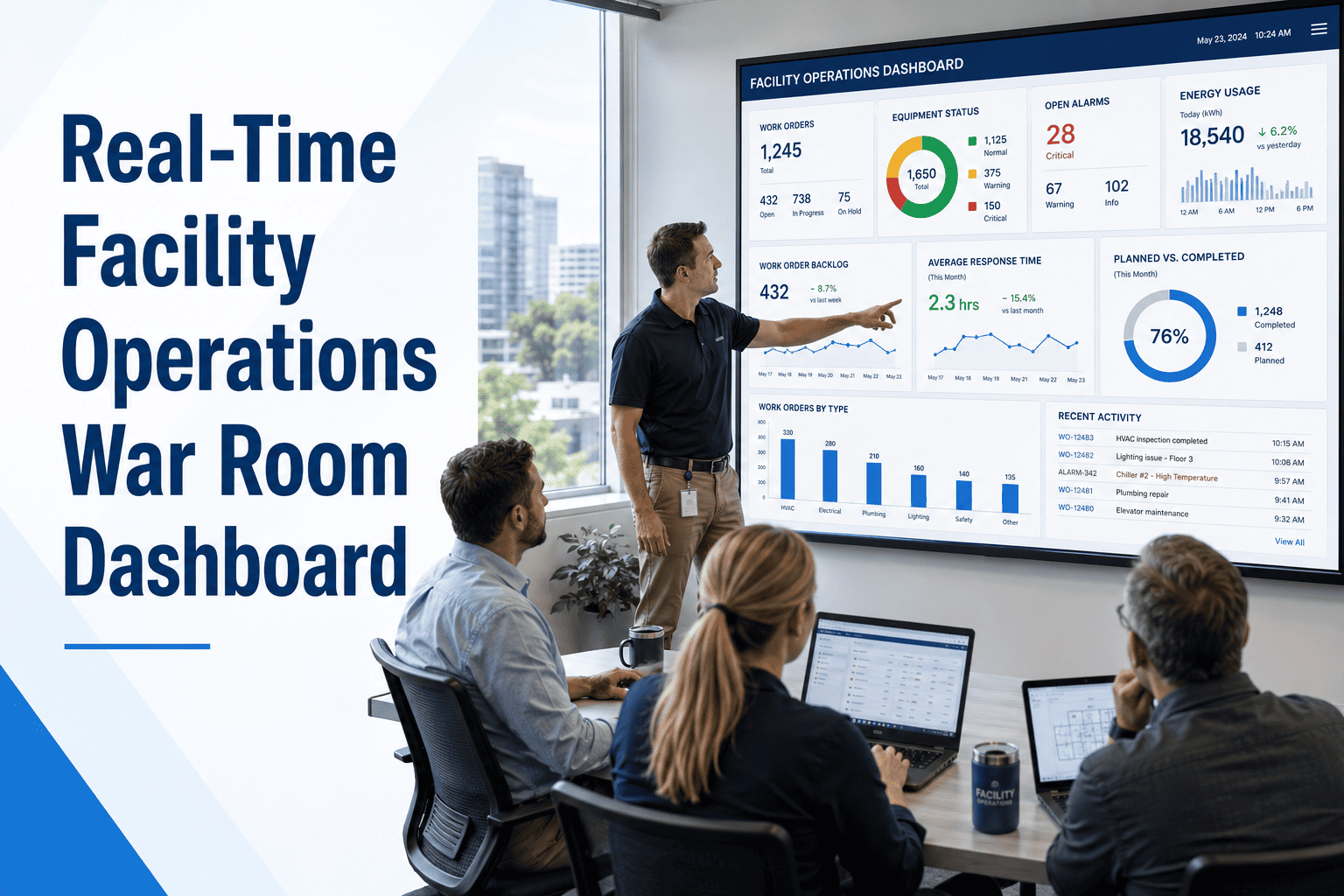
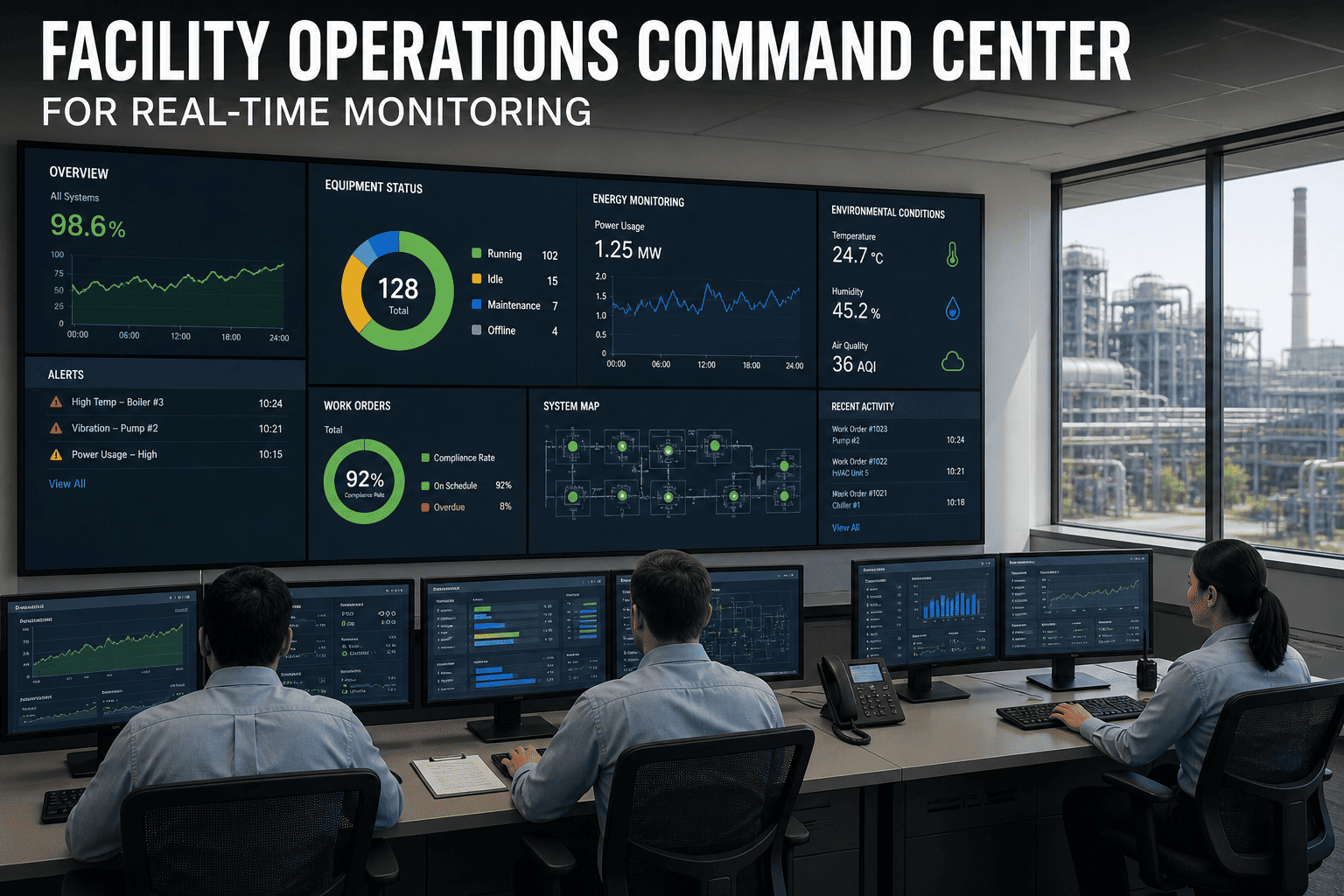
A water leak forming behind a mechanical room wall. A hot spot building on a switchgear panel for eleven days before anyone notices. An unauthorized contractor accessing a restricted plant room at 2:17 AM. Traditional facility monitoring — rounds-based inspections, manual sensor checks, and reactive alarm responses — cannot catch these events at the speed and scale that modern buildings require. AI vision cameras with edge-deployed deep learning change the model entirely: instead of recording footage that no one watches, they analyze every frame continuously and surface actionable alerts seconds after an anomaly begins. Sign in to OxMaint to connect your AI camera network to a CMMS work order system that converts detections into maintenance actions automatically, or book a demo to see real-time facility monitoring in action.
Article · AI Facility Analytics · Real-Time Monitoring
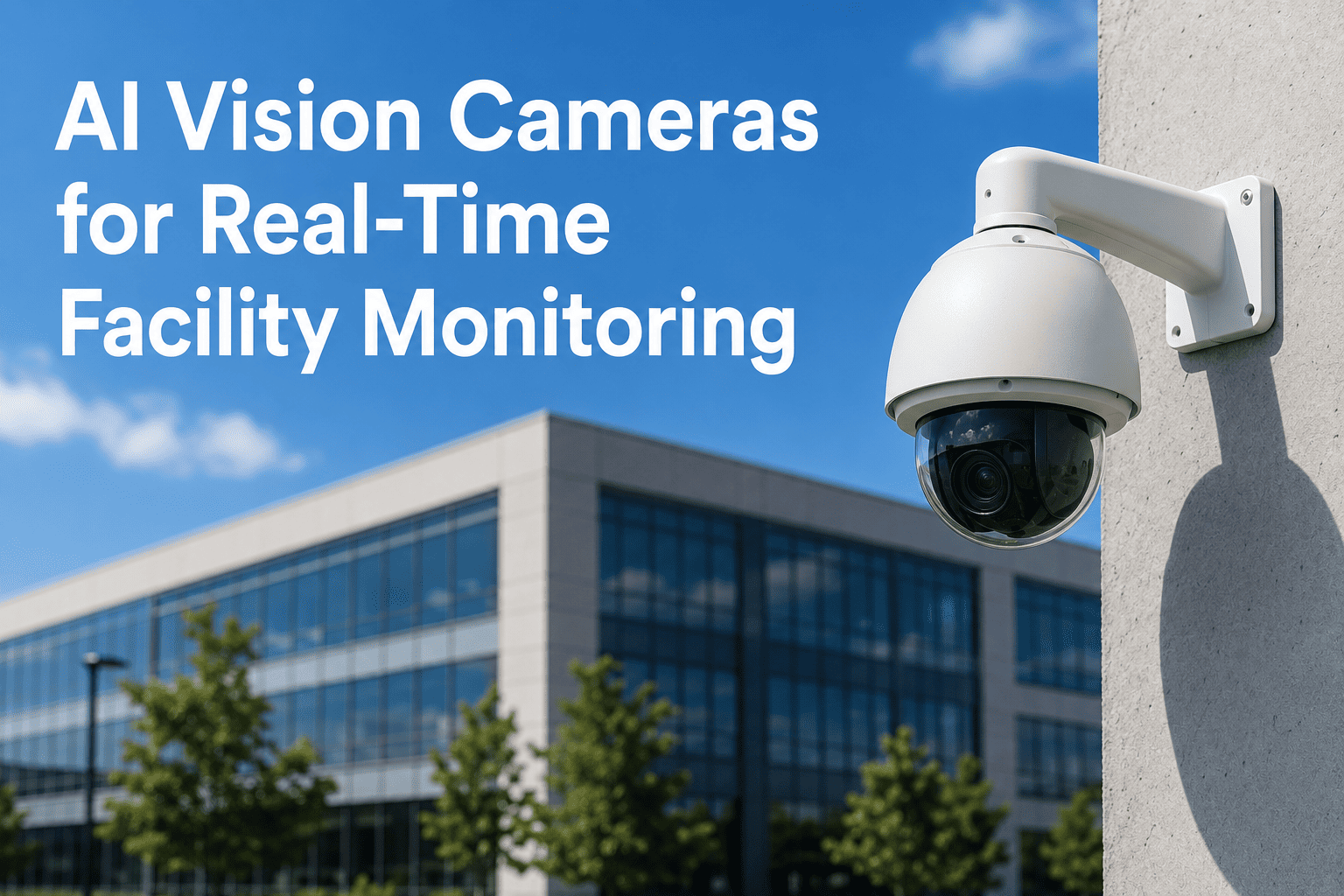
AI Vision Cameras for Real-Time Facility Monitoring
Edge-deployed deep learning models continuously analyze camera feeds across HVAC plant rooms, electrical rooms, corridors, and building perimeters — detecting anomalies, identifying leaks, flagging safety violations, and generating work orders before issues escalate into failures.
90%
Reduction in false alerts with AI analytics vs motion-only detection
30.6%
CAGR — AI video surveillance market growth 2025–2030 (Grand View Research)
86%
Of end users see ROI from video analytics within one year (ISC West)
$28.7B
Global AI video surveillance market by 2030
Core Use Cases
What AI Vision Cameras Monitor in Commercial Facilities
The most valuable applications are not security — they are operational. HVAC anomaly detection, water leak identification, structural assessment, and safety monitoring all generate maintenance work orders faster and more reliably than scheduled inspections.
01
HVAC Anomaly Detection
Thermal AI cameras detect heat anomalies on compressors, motors, and electrical connections before they become failures. Vibration patterns visible in high-speed imaging identify fan belt wear and misalignment 2–4 weeks before an alarm triggers. Condensate overflow and ice formation on coils detected visually and flagged as work orders instantly.
Detection lead: 2–4 weeks
02
Water Leak Identification
Computer vision models trained on leak signatures detect pooling water, wet surfaces, and condensation anomalies in mechanical rooms, pipe corridors, and basement areas. AI distinguishes standing water from wet floor markings — false alerts eliminated. Response time drops from discovery-at-next-inspection to alert-in-seconds.
Detection speed: seconds
03
Safety Monitoring
Real-time PPE compliance detection — hard hats, hi-vis vests, and safety glasses confirmed before work begins in controlled areas. Unauthorized access to restricted zones flagged immediately with CMMS notification and door alert integration. Personnel fall detection in high-risk areas with automatic emergency escalation.
Response: real-time alert
04
Structural Assessment
Time-lapse AI analysis of ceiling, wall, and structural element conditions identifies crack propagation, surface degradation, and water staining patterns over time — changes invisible in single inspections become clear trends when AI compares frames across weeks or months. Inspection intervals extended with documented visual evidence.
Analysis: continuous
Edge vs Cloud AI
Why Edge-Deployed AI Matters for Facility Monitoring
Latency: 2–8 seconds from detection to alert — too slow for safety events
Bandwidth: 4K streams require 8–12 Mbps per camera — bandwidth-prohibitive at scale
Connectivity dependency: No internet = no monitoring in critical rooms
Privacy exposure: Raw video transmitted and stored outside facility perimeter
Latency: Sub-100ms detection — safety and security events actioned instantly
Bandwidth: Only metadata and alerts transmitted — 95% bandwidth reduction
Offline capable: Detection continues independently of internet connectivity
Privacy compliant: Raw video never leaves the facility — only structured alert data shared
Connect AI Camera Detections to Automatic Work Orders in OxMaint
Every AI vision alert — HVAC anomaly, water leak, safety violation — converts automatically into a CMMS work order with asset ID, photo evidence, and priority level. No dispatcher bottleneck.
Detection Performance
AI Vision vs Traditional Inspection — Detection Speed Comparison
Water leak detected
Manual rounds
4–8 hrs avg
AI vision camera
Under 15 sec
HVAC heat anomaly detected
Scheduled inspection
Weeks or never
Thermal AI camera
Continuous
PPE violation in restricted zone
Security guard patrol
Not detected
AI vision analytics
Real-time alert
Structural crack progression
Annual visual inspection
Months undetected
AI time-lapse analysis
Weekly trend alert
Deployment Guide
What Facility Teams Need to Deploy AI Vision Monitoring
| Requirement |
Specification |
Notes |
Status |
| IP cameras (existing or new) |
1080p minimum; 4K preferred for thermal anomaly detection |
Most facilities already have IP cameras from security installs |
Often existing |
| Edge compute appliance |
NVIDIA Jetson / equivalent — one appliance per 8–16 cameras |
Processes AI models locally; no cloud dependency for detection |
New hardware required |
| Network connectivity |
PoE switch per camera zone; LAN to edge appliance |
Existing PoE network infrastructure typically reused |
Often existing |
| CMMS integration |
API connection from AI system to OxMaint work order engine |
Converts detections into work orders automatically — no dispatcher |
OxMaint native |
| Thermal cameras (HVAC zones) |
FLIR or equivalent; 25Hz minimum refresh rate |
Required only for electrical panel and compressor heat anomaly detection |
Optional — asset specific |
"
The facility management industry spent a decade deploying cameras for security and doing almost nothing else with the footage. The transition to AI vision analytics is not about replacing the security use case — it is about finally capturing the operational value that was always sitting in those camera streams but had no model to read it. A thermal camera on a chiller room wall that was installed for access control can now simultaneously flag compressor heat anomalies, detect water pooling on the floor, and confirm that the technician who just arrived is wearing the correct PPE — all from the same device, all feeding into the CMMS as structured work orders. That is not a future capability. That is deployable in most commercial facilities today with existing hardware, and the facilities that figure that out first will have a significant operating cost advantage over those still doing manual rounds.
ST
Sophia Teramoto, IFMA CFM, LEED AP BD+C
Certified Facility Manager · LEED Accredited Professional · 16 years commercial real estate and smart building technology · Former Head of Facilities Technology, 3.2M sq ft mixed-use portfolio · Specialist in AI-integrated facility operations, IoT sensor deployment, and CMMS-driven analytics
Frequently Asked Questions
Can existing security cameras be used for AI facility monitoring without replacement?
In most cases, yes. If your facility has 1080p or higher IP cameras with accessible network streams, an edge AI appliance can be added to the network to analyze the existing feeds without replacing any cameras. Thermal anomaly detection for HVAC and electrical systems does require thermal cameras specifically — standard visible-light cameras cannot detect heat signatures. For water leak detection, safety compliance, and structural monitoring, existing IP cameras are sufficient in the large majority of commercial facility installations.
Sign in to OxMaint to assess your facility's camera readiness for AI analytics deployment.
How does AI vision monitoring connect to maintenance work orders in OxMaint?
OxMaint's API integration receives structured alert data from the edge AI layer — including detection type, confidence score, camera location, and attached image evidence — and automatically creates a work order in the CMMS with the asset ID pre-populated, priority level assigned based on detection severity, and photo documentation attached. The work order goes into the maintenance queue and follows the same workflow as any PM task. No separate alert management interface is required — detections become maintenance actions without any manual bridging step.
Book a demo to see the AI-to-work order integration live.
How are false alerts managed in AI facility monitoring systems?
Edge AI systems achieve 90% false alert reduction compared to motion-only detection by using contextual deep learning models that distinguish between genuine anomalies and normal facility activity — cleaning crews, maintenance rounds, vendor deliveries. Each model is calibrated to the specific facility environment during a 2–4 week baseline period where the AI learns what normal looks like for that building. Confidence thresholds can be set per detection type — a 95% confidence threshold for electrical heat anomalies, for example, versus 70% for general water detection — giving facility teams control over alert sensitivity by use case.
Sign in to configure detection thresholds for your facility.
What is the ROI timeline for AI vision cameras in commercial facility management?
Research from ISC West shows 86% of end users achieve positive ROI from video analytics within one year. For facility management specifically, the primary value drivers are avoided water damage events (average commercial water damage claim: $89,000), HVAC failure prevention from early thermal detection (compressor replacement: $18,000–$45,000 reactive vs $3,500–$8,000 planned), and safety incident reduction. A single prevented major water event or HVAC compressor failure typically exceeds the full-year cost of an AI vision monitoring deployment.
Book a demo to get a site-specific ROI estimate for your building portfolio.
Every Room. Every System. Monitored Continuously. Every Anomaly a Work Order.
OxMaint connects AI vision camera detections to automatic work order creation — so every HVAC anomaly, water leak, safety violation, and structural change becomes a maintenance action in seconds, not days.