A semiconductor wafer fabrication cleanroom classified at ISO Class 3 with particle limits of just 35.2 particles ≥0.1 μm per cubic metre is not maintained by cleaning harder — it is maintained by measuring more precisely and responding faster. ISO 14644-2 requires documented monitoring plans and recertification intervals of 6 to 12 months depending on classification; ISO 14644-3 mandates specific test methods for pressure differentials, filter integrity, and airflow velocity; and every exceedance event, every HEPA test deviation, every pressure cascade breach must be documented with the corrective action trail that a regulator, customer auditor, or ISO body can reconstruct end-to-end. Most cleanroom compliance failures occur not because the engineering failed, but because the maintenance programme was not structured to catch drift before it became a classification event. Book a 30-minute demo to see how Oxmaint's Compliance Tracking platform structures the HVAC maintenance, monitoring schedules, and documentation workflows that keep cleanrooms continuously certified — or start a free trial on your highest-risk controlled environment today.
Compliance Tracking · ISO 14644 · Controlled Environments
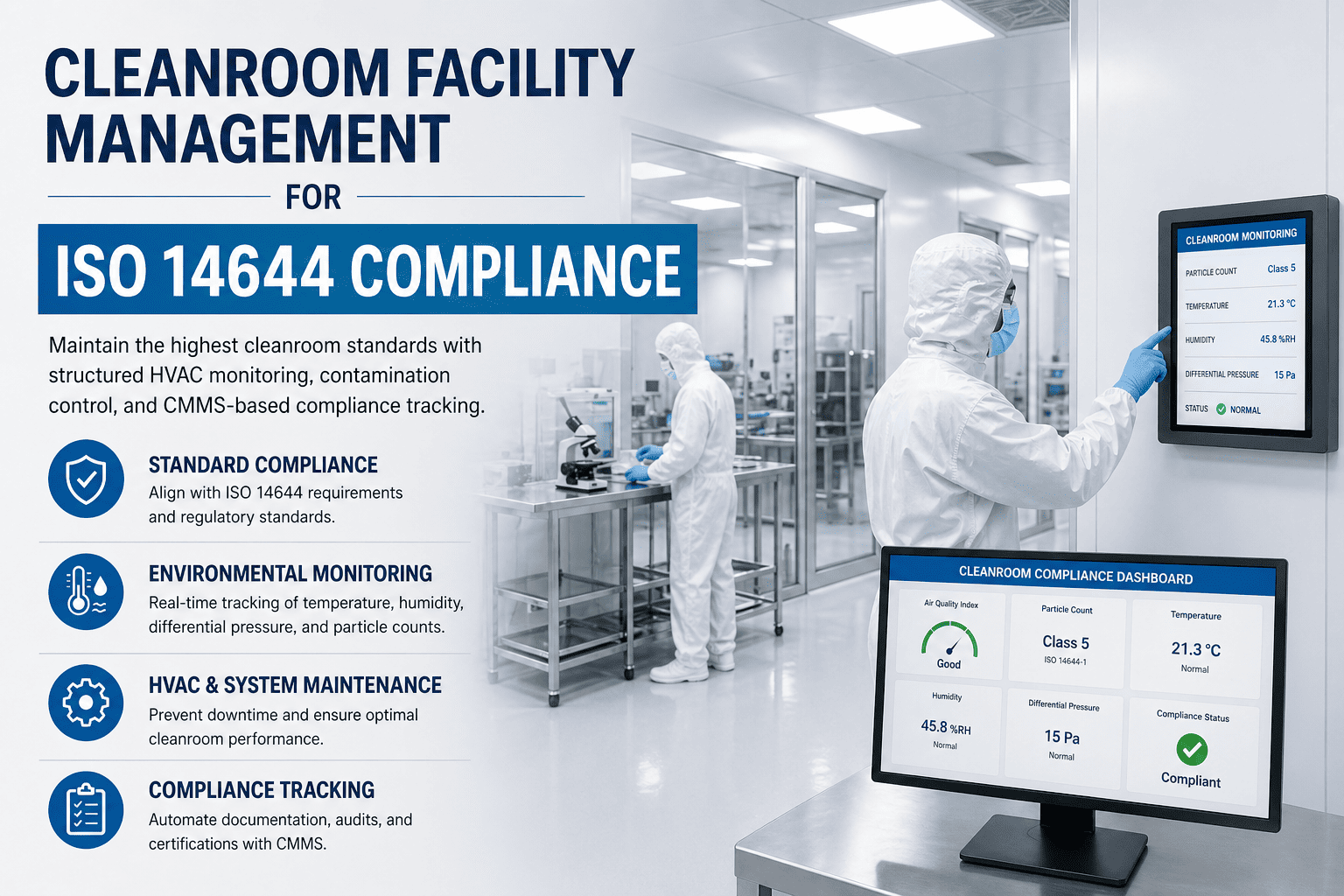
Cleanroom Facility Management for ISO 14644 Compliance
A structured guide to ISO classification tiers, HVAC maintenance disciplines, contamination control frameworks, and the CMMS workflows that keep pharmaceutical, semiconductor, and biotech cleanrooms continuously certified and inspection-ready.
ISO 1–9
Classification tiers — ISO 1 is strictest, ISO 9 is ambient
6–12 mo
Recertification interval per ISO 14644-2 for most pharma cleanrooms
10–15 Pa
Pressure differential between cleanroom zones to prevent particle migration
ALCOA+
FDA data integrity standard every maintenance record must satisfy
ISO 14644 Classification — What Each Tier Requires From Facility Management
ISO 14644-1 defines nine cleanroom classes based on maximum allowable airborne particle concentration per cubic metre. Lower numbers mean stricter limits and more intensive HVAC and monitoring requirements. Each class has a distinct maintenance and monitoring regime — the same PM schedule cannot serve an ISO 5 pharmaceutical cleanroom and an ISO 8 packaging area.
| ISO Class |
Particles ≥0.5μm / m³ |
Typical Industry |
Recertification |
Key Monitoring Obligation |
| ISO 3 | 35.2 | Semiconductor wafer fab, critical process zones | 6 months | Continuous particle monitoring, 100% HEPA coverage |
| ISO 4 | 352 | Hard disk manufacturing, optical components | 6 months | Continuous monitoring, pressure cascade documentation |
| ISO 5 | 3,520 | Aseptic pharma filling, biotech open-product zones | 6 months | Particle + microbiological monitoring at rest and in operation |
| ISO 6 | 35,200 | Sterile device assembly, medical implant prep | 6–12 months | Periodic particle counts, pressure differential records |
| ISO 7 | 352,000 | Pharmaceutical secondary processing, compounding | 12 months | Periodic monitoring, cleaning validation records |
| ISO 8 | 3,520,000 | Packaging, gowning areas, support zones | 12–24 months | Scheduled monitoring, documented HVAC PM |
Five HVAC Disciplines That Determine Whether a Cleanroom Holds Its Classification
The cleanroom's ISO class is maintained or lost at the HVAC system level. These five disciplines are the maintenance programmes that every FM team managing a controlled environment must execute on schedule — and document with the rigour that an ISO auditor or FDA inspector will require.
01
Filtration
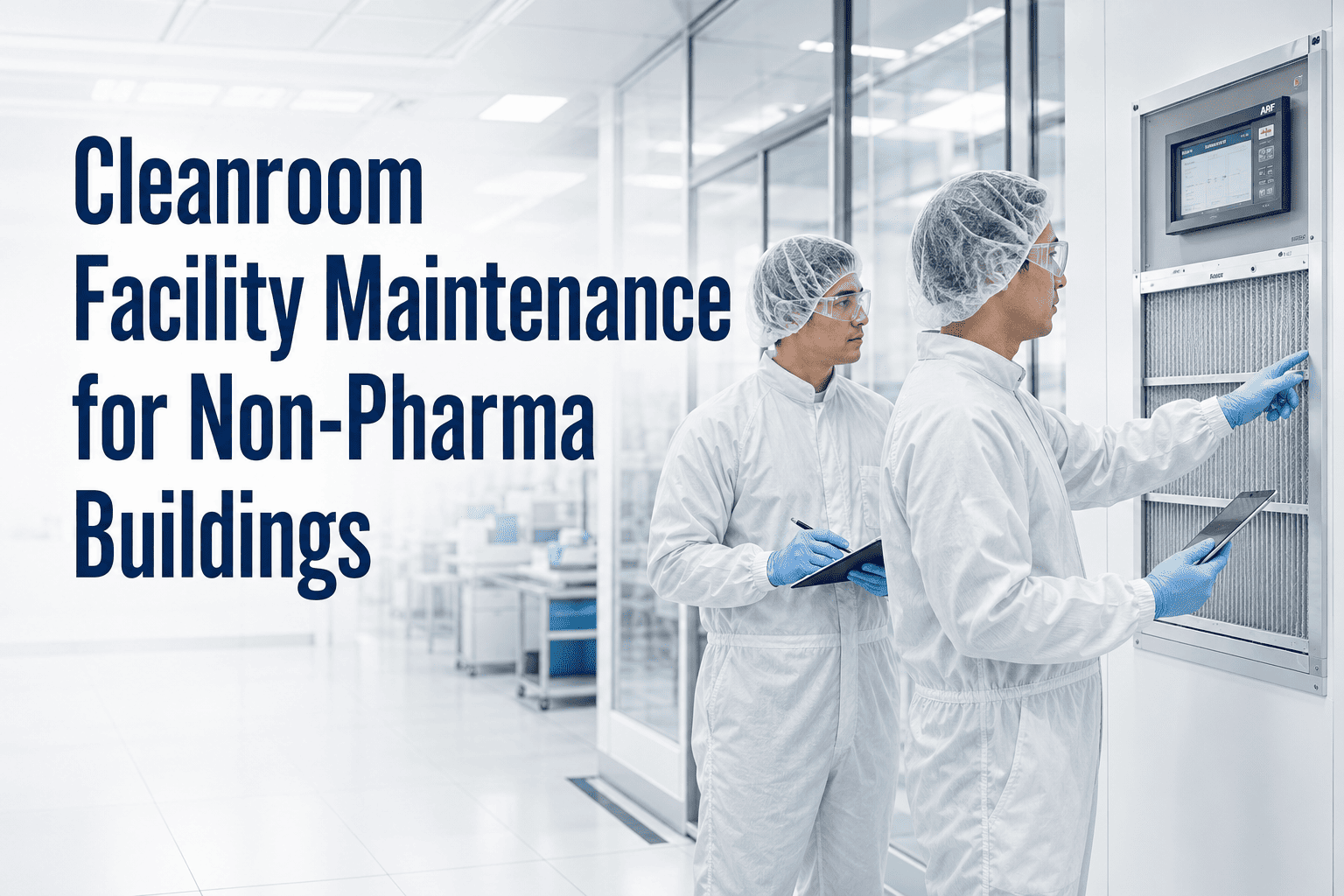
HEPA & ULPA filter integrity — the first barrier
HEPA filters (≥99.97% efficient at 0.3μm) and ULPA filters (≥99.999%) are tested using the DOP/PAO aerosol challenge method per ISO 14644-3. Any penetration above 0.01% requires immediate filter replacement and re-test before the cleanroom returns to service. Routine integrity testing must be performed after every filter change, any ceiling modification, and at the scheduled recertification interval regardless of visual condition.
PM TriggerAfter each filter change + recertification schedule
02
Pressure Cascade
10–15 Pa differential — the contamination barrier
Positive pressure of 10 to 15 Pascals between adjacent cleanroom zones prevents particle migration from less clean to cleaner areas. Continuous pressure differential monitoring is required for ISO 5 and stricter — every alarm event must generate a maintenance work order with timestamp, corrective action, and resolution evidence. A fan that runs marginally slower due to a worn belt will lose the pressure differential before any particle count alarm triggers.
PM TriggerContinuous monitoring + monthly belt and fan inspection
03
Air Changes
ACH rates — dilution as the control mechanism
ISO 5 cleanrooms typically require 240 to 480 air changes per hour; ISO 7 requires 60 to 90 ACH; ISO 8 requires 10 to 25 ACH. Any fan belt degradation, filter loading, or VFD parameter drift that reduces airflow silently lowers the effective air change rate — reducing dilution efficiency without triggering a visible alarm. Quarterly airflow velocity surveys at each supply diffuser are the only way to confirm ACH is maintained between recertification tests.
PM TriggerQuarterly velocity survey per diffuser + annual TAB
04
Temperature & Humidity
18–22°C and 30–60% RH — product and process stability
Temperature and humidity control prevents electrostatic discharge in semiconductor cleanrooms, maintains product stability in pharmaceutical environments, and prevents biological growth in biotech facilities. Sensor calibration must be performed annually at minimum — a sensor that has drifted 1.5°C will not trigger an alarm but will silently allow conditions outside the controlled range. ISO 14644-4 requires documented setpoint verification and sensor calibration records that demonstrate traceability to national standards.
PM TriggerAnnual sensor calibration + monthly setpoint verification
05
Energy Efficiency
ISO 14644-16 — VAV and adaptive control without compromising classification
Cleanrooms are among the most energy-intensive buildings in any industrial portfolio — HVAC accounts for 55 to 75% of total energy use. ISO 14644-16 provides guidance for reducing energy consumption using Variable Air Volume systems with adaptive control that matches airflow to occupancy and process load. The FM team's role is maintaining the VFD setpoints and occupancy sensor calibrations that enable energy reduction — ensuring the control strategy the energy model assumed is the strategy the plant actually runs.
PM TriggerQuarterly VFD parameter check + occupancy sensor calibration
See Oxmaint Schedule Every ISO 14644 PM Task — Per Cleanroom Zone, Per Classification
Walk through a live cleanroom compliance configuration showing HEPA PM scheduling, pressure differential alarm-to-work-order integration, and the recertification tracking dashboard that confirms every zone is within its ISO 14644-2 window.
The Compliance Evidence Stack — What Regulators Actually Ask For
ISO 14644 compliance is not proved by clean particle counts on certification day. It is proved by the documentation trail that shows continuous control between certification events. The four layers below are what an ISO auditor, FDA inspector, or customer quality team will request — in roughly the order they will ask for them.
L1
Recertification reports and test records
ISO 14644-2 classification test results, HEPA integrity test reports, airflow visualisation studies, and pressure differential maps — with NIST-traceable calibration certificates for every instrument used. These are the foundational documents; an audit that cannot produce the last two recertification packages is already in a serious finding.
Foundation layer — present before any other question is asked
L2
Continuous monitoring logs and alarm records
Continuous particle count data, pressure differential logs, temperature and humidity records — with timestamps, instrument IDs, and documented exceedances. Every out-of-limit event must have a corresponding corrective action record. Monitoring logs with gaps, exceedances with no CAPAs, or alarm records with no resolution evidence are the most common ISO 14644 audit findings globally.
Continuous records — cover every day between certification events
L3
HVAC preventive maintenance records
Filter change records, belt inspection logs, coil cleaning certificates, VFD parameter audits, and fan performance measurements — all with technician name, date, and instrument used. The ALCOA+ principle applies: an HVAC PM record that cannot prove who did it, when they did it, and what they measured is not a valid GMP record and will not satisfy an FDA inspector. Cloud CMMS with real-time mobile capture eliminates the transcription gap that defeats paper-based PM systems.
PM records — prove the engineering controls were maintained
L4
Change control and modification history
Every modification to a classified cleanroom — HVAC controls upgrade, layout change, new equipment installation, ceiling tile replacement — requires a documented change control that triggers the appropriate re-qualification. EU GMP Annex 1 (revised 2023) made modification-triggered re-qualification a central audit focus. The CMMS that automatically flags re-qualification requirements when a work order modifies a regulated asset is the only system that reliably prevents the "we modified it but forgot to re-test it" finding.
Change control — closes the loop from modification to requalification evidence
Expert Review — What Cleanroom Audits Reveal About FM Discipline
22 years of ISO 14644 audits across pharmaceutical, semiconductor, and biotech facilities consistently expose the same pattern of documentation failures that structured CMMS programmes prevent.
"The cleanrooms that fail ISO 14644 audits are almost never the ones with design or engineering problems. They are the ones where the HVAC PM records cannot satisfy ALCOA+ — where someone hand-wrote a filter change date two weeks after the event, or where a fan belt inspection was marked complete but no tension reading was recorded, or where an out-of-spec pressure differential alarm was acknowledged at the BMS and then nothing happened in the maintenance system. Regulators have become very sophisticated about the difference between a cleanroom that is controlled and a cleanroom that looks controlled on paper. When an FDA inspector pulls the last 18 months of HEPA integrity test records and cross-references them against the PM work orders showing who changed each filter, with what calibrated instrument, on what verified date — that is ALCOA+ in action. The cleanroom teams that have all of that in a searchable CMMS with timestamped mobile completion records sail through inspections. The ones still assembling evidence from binders and spreadsheets two days before an audit know exactly what I mean."
Dr. Amelia Thornton, BSCS, RAC, CPIA
Regulatory Affairs Certified · Certified Pharmaceutical Industry Auditor · 22 years ISO 14644 and EU GMP Annex 1 compliance auditing · Former MHRA inspector · Specialist in cleanroom HVAC qualification deficiencies across semiconductor and pharmaceutical sectors
Frequently Asked Questions
How often must cleanrooms be recertified under ISO 14644-2?
ISO 14644-2 requires a documented monitoring plan with recertification intervals based on risk — typically
6 months for ISO Class 5 and stricter, 12 months for ISO 6–7, and up to 24 months for ISO 8 in lower-risk applications. Additional recertification is mandatory after any modification that could affect classification — HVAC changes, layout alterations, or new equipment.
Book a demo to see how Oxmaint tracks recertification due dates per cleanroom zone.
What is the ISO 14644 standard series and which parts apply to facility management?
ISO 14644-1 defines classification; ISO 14644-2 covers monitoring and recertification; ISO 14644-3 specifies test methods (HEPA integrity, pressure, airflow, recovery); ISO 14644-4 addresses HVAC design; ISO 14644-5 covers operations and cleaning; ISO 14644-16 guides energy efficiency. FM teams primarily work with Parts 2, 3, 4, and 5 — the ongoing operational and maintenance obligations that determine whether the design classification is sustained through daily operations.
What pressure differential must cleanrooms maintain between zones?
ISO 14644 practice and EU GMP Annex 1 both specify a minimum 10 to 15 Pascals positive pressure between adjacent cleanroom zones, with higher-classified areas maintained at greater positive pressure than adjacent lower-classified spaces. Any fan belt wear, filter loading, or VFD drift that reduces the differential below 10 Pa must trigger an immediate corrective work order — loss of pressure cascade is the fastest route to a classification event.
How does Oxmaint support ISO 14644 compliance tracking in cleanroom facilities?
Oxmaint structures each cleanroom zone as an asset with its ISO class, recertification schedule, and HVAC equipment dependencies. Every HEPA integrity test, pressure differential record, and PM work order is captured with the ALCOA+ attributes required by FDA. When an alarm exceeds the threshold, a corrective work order is auto-generated before anyone manually notices the event.
Start a free trial to build your first cleanroom compliance programme.
What triggers a mandatory recertification outside the scheduled interval?
Any modification to the cleanroom or its HVAC system — filter bank changes, ceiling tile replacement, equipment additions, HVAC controls upgrades, layout alterations — requires documented change control and re-qualification testing appropriate to the modification scope. EU GMP Annex 1 (August 2023) made this requirement explicit with its Contamination Control Strategy mandate. The CMMS must flag re-qualification requirements automatically when a work order records a regulated modification.
A Cleanroom Audit Is Won Between Certification Events, Not At Them
Oxmaint Compliance Tracking structures the HVAC maintenance schedules, monitoring alarm-to-work-order workflows, HEPA integrity tracking, and ALCOA+-compliant documentation that keep cleanrooms certified — and keeps your FM team producing the evidence that inspectors require in hours, not days of binder assembly.