Grease is the leading cause of restaurant fires in the United States — and NFPA 96 §11.4 places the responsibility for preventing it squarely and explicitly on the system owner. When a commercial kitchen exhaust fire occurs and the hood cleaning documentation is missing, out of date, or does not cover the full system from hood to rooftop fan, the insurance denial arrives before the fire marshal's citation does. The 2025 update to NFPA 96 tightened this further: digital documentation is now required for all cleaning and inspection activity, all new fire suppression systems must be UL-300 listed, and access panel requirements for vertical duct runs have been expanded. A paper sticker on the hood is no longer sufficient evidence of compliance for an authority having jurisdiction that knows the current standard. Book a 30-minute demo to see how Oxmaint's Compliance Tracking platform schedules, documents, and auto-generates the NFPA 96 evidence package that protects your kitchen from fire marshal citations, insurance claim denials, and licence suspension — or start a free trial today.
NFPA 96 Compliance · Fire Safety · Compliance Tracking
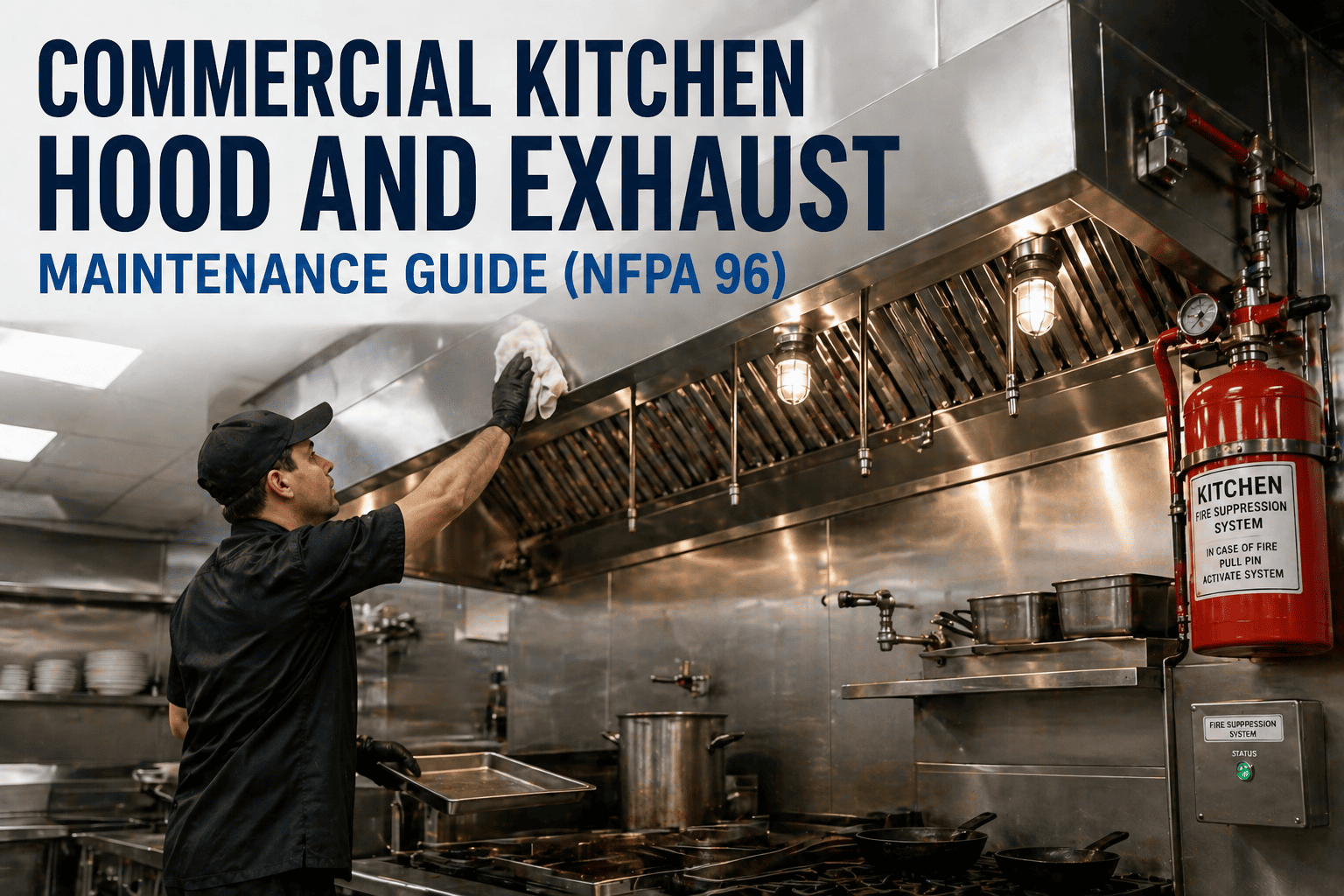
Commercial Kitchen Hood & Exhaust Maintenance Guide (NFPA 96)
Complete maintenance checklist by frequency — daily, monthly, quarterly, semi-annual, and annual — covering hood filters, ductwork, exhaust fans, fire suppression, and grease management with NFPA 96 code references.
NFPA 96 Table 11.4 — Required Cleaning Frequency
Monthly
Solid fuel (wood, charcoal) operations
Quarterly
24-hr cooking, charbroiling, wok operations
Semi-Annual
Moderate-volume cooking, seasonal operations
Annual
Low-volume — day camps, churches, seasonal
⚠
NFPA 96 §11.6.1 — Non-Negotiable Cleaning Standard
Upon inspection, if the exhaust system is found to be contaminated with deposits, the entire contaminated system shall be cleaned to bare metal by a properly trained, qualified, and certified company. Cleaning must begin immediately upon finding — not at the next scheduled service date. Insurance policies treating a sticker on the hood as compliance evidence are now misaligned with the 2025 NFPA 96 digital documentation requirement.
Daily / Shift
Monthly
Quarterly
Semi-Annual
Annual
DAILY / EACH SHIFT
Operator-level · No certification required
Visually inspect hood filters for grease accumulation — filters with visible grease pooling or dripping indicate immediate cleaning is required per NFPA 96 §11.6.2, not next scheduled service
Record: Operator log entry with shift and date · Role: Kitchen operator or supervisor
Confirm exhaust fan is running at all cooking stations — zero airflow through the hood face when cooking equipment is operating is a fire safety violation, not a comfort issue
Record: Opening checklist · Role: Kitchen supervisor
Empty and clean grease collection cups / drip trays at each cooking station — NFPA 96 §8.1.1.3 limits upblast fan grease receptacles to 3.8 L (1 gal); overflow creates a rooftop fire hazard
Record: Shift checklist with volume noted · Role: Kitchen staff
Check fire suppression system pull station is unobstructed, visible, and accessible — do not store any items within 18 inches of the pull station location or the nozzle coverage zone above cooking equipment
Record: Opening inspection sign-off · Role: Kitchen supervisor
MONTHLY
Required for solid fuel operations · Best practice for all high-volume kitchens
Remove, inspect, and clean all grease filters (baffles) — listed filters per UL 1046 must be cleaned in a degreasing solution, rinsed, dried, and reinstalled at correct 45-degree angle (NFPA 96 §6.2.3.5). Filters showing structural damage or deformation must be replaced before reinstallation
Record: Filter cleaning log with condition noted · Role: Kitchen staff or hood cleaning technician
Inspect hood interior plenum visible from filter access — look for grease accumulation beyond filter zone, particularly at seams, joints, and welds. NFPA 96 §5.1.2 requires liquid-tight continuous external welds on all seams; confirm no cracks or separation
Record: Photo log with date of inspection · Role: Maintenance technician or hood service company
Verify rooftop grease containment system — check that grease collection container is emptied, intact, and properly sealed. Grease on the rooftop surface from an overflowing or failed containment unit is both a fire hazard and an insurance violation per 2025 NFPA 96 rooftop requirements
Record: Rooftop inspection with container volume noted · Role: Maintenance technician
Inspect all accessible ductwork through cleanout panels for grease accumulation — note depth of grease deposit at each access point. Any accumulation exceeding 3mm anywhere in the duct triggers a full system cleaning requirement under NFPA 96 §11.4 before the next service cycle
Record: Duct inspection form with grease depth measurement per access point · Role: NFPA 96-certified technician
Oxmaint schedules every task above by kitchen system ID — with photo evidence required at completion, automatic escalation when cleaning is overdue, and NFPA 96 compliance documentation generated as a byproduct of the maintenance programme.
QUARTERLY
NFPA 96 required for high-volume, 24-hr, charbroiling, wok operations
Full hood and duct system cleaning by NFPA 96-certified company — complete system from hood throat to rooftop fan housing cleaned to bare metal per §11.6.2. Service report must document extent of cleaning and note any areas that could not be accessed (ANSI/IKECA C10 requirement)
Record: Certified cleaning certificate with photo evidence + hood sticker · Role: NFPA 96-certified hood cleaning company
Inspect exhaust fan housing, blades, and belt — check fan blade condition for grease accumulation and physical damage, belt tension and wear, and verify hinged fan access mechanism operates correctly per NFPA 96 §8.1.5.3. Record fan amperage under operating load
Record: Fan inspection report with amperage reading · Role: HVAC/kitchen exhaust technician
Verify all duct access panels (cleanout openings) — confirm all required access openings per NFPA 96 §7.3.1 and §7.4.1.2 are present, grease-tight, and accessible. 2025 NFPA 96 update increased access panel requirements in vertical duct runs; confirm compliance with current AHJ-adopted edition
Record: Access panel inventory with location map · Role: Hood cleaning company or maintenance contractor
Inspect make-up air unit operation and balance against exhaust — confirm make-up air volume is 80–85% of exhaust volume to maintain negative pressure at the hood face. Imbalanced make-up air is the most common cause of smoke and grease escaping the hood capture zone
Record: Airflow balance reading (exhaust cfm vs make-up cfm) · Role: HVAC technician
SEMI-ANNUAL
NFPA 96 required for moderate-volume operations · Best practice for all operations
Full fire suppression system inspection by UL-300 certified contractor — verify nozzle positions have not been disturbed since last cleaning, fusible link condition, manual pull station function, automatic fuel shutoff test, and agent cylinder pressure. 2025 NFPA 96 requires all new and replacement systems to be UL-300 listed
Record: Fire suppression inspection certificate with technician licence number · Role: UL-300 certified fire suppression contractor
Inspect grease trap (interceptor) for restaurant operations — measure grease cap and solids depth. Pumping is required when combined depth exceeds 25% of hydraulic depth; failure to pump results in FOG (fats, oils, grease) passing to municipal sewer, triggering environmental violations separate from NFPA 96 citations
Record: Grease trap service record with depth measurements · Role: Licensed grease trap service company
Full system cleaning for moderate-volume operations per NFPA 96 Table 11.4 — hood, duct, and exhaust fan to bare metal by certified company with documented service report and ANSI/IKECA C10-compliant deficiency reporting for any areas not fully accessible
Record: Certified cleaning certificate + deficiency report if applicable · Role: NFPA 96-certified hood cleaning company
ANNUAL
All operations · Comprehensive system review + low-volume cleaning requirement
Full system cleaning for low-volume operations per NFPA 96 Table 11.4 — complete certified cleaning with service report, photo documentation per 2025 digital requirement, and copy provided to Authority Having Jurisdiction upon request
Record: Certified cleaning certificate with digital photo evidence · Role: NFPA 96-certified company
Complete exhaust fan mechanical inspection — motor winding insulation test (megohm), bearing condition, belt replacement if wear indicator is reached, VFD parameter audit if variable speed fan, rooftop grease discharge protection inspection per 2025 NFPA 96 fan standards
Record: Full mechanical inspection report with megohm and amperage readings · Role: Licensed HVAC contractor
Annual fire suppression system inspection for low-volume operations — same scope as semi-annual inspection above, with additional review of system design drawings against current hood and equipment layout. Any equipment addition or relocation since last inspection requires formal re-evaluation of suppression nozzle coverage
Record: Annual fire suppression inspection certificate · Role: UL-300 certified fire suppression contractor
Review and update the NFPA 96 compliance documentation file — confirm all cleaning certificates, inspection records, suppression service reports, and grease trap service records are current, filed, and accessible to the AHJ on request. Assemble 24-month trailing compliance package for insurance renewal
Record: Compliance file index with document list and expiry dates · Role: Facility manager or operations manager
NFPA 96 Compliance KPIs — The Metrics That Prove Your Kitchen Is Covered
| Compliance KPI |
Measurement |
Target |
Failure Consequence |
| Hood cleaning compliance rate | Cleanings on schedule / Required cleanings | 100% | Fire marshal citation, insurance denial |
| Fire suppression inspection currency | Days since last UL-300 inspection | < 180 days (semi-annual) | System deemed non-compliant by AHJ |
| Documentation completeness | Records with photo evidence / Total cleanings | 100% (2025 digital requirement) | Cleaning records invalid under 2025 NFPA 96 |
| Grease trap pump-out cadence | Days between pump-outs vs grease depth | Before 25% hydraulic depth | FOG violation, sewer authority penalty |
| Deficiency closure rate | Closed deficiencies / Total deficiencies raised | > 90% within 30 days | Unclosed fire safety findings = enforcement risk |
"The fire that shuts a restaurant down is almost never a surprise to the insurance adjuster. They pull the service records, see the last cleaning was eleven months ago on a high-volume charbroiler operation that NFPA 96 requires quarterly, and the denial letter goes out the same day. What surprises most operators is not the standard itself — most know hoods need to be cleaned — it is the combination of the correct frequency for their specific cooking volume and the 2025 requirement that documentation be digital, time-stamped, and available on demand for the AHJ. A paper certificate in a filing cabinet does not meet the 2025 standard. A CMMS that schedules each cleaning at the correct interval for each kitchen system, captures photo evidence at completion, and maintains the searchable compliance record that an inspector or insurance company can review in five minutes — that is what compliance looks like in 2026."
Marcus Webb, CFPS, RHH
Certified Fire Protection Specialist · Registered Hood & Hood Cleaning Practitioner · 20 years commercial kitchen fire suppression and NFPA 96 compliance · Former Authority Having Jurisdiction inspector, multi-state territory
Frequently Asked Questions
How often must a commercial kitchen hood be cleaned under NFPA 96?
NFPA 96 Table 11.4 sets four frequency tiers:
monthly for solid fuel (wood, charcoal) operations;
quarterly for high-volume cooking including 24-hour operations, charbroiling, and wok cooking;
semi-annually for moderate-volume cooking; and
annually for low-volume operations such as day camps or seasonal facilities. The AHJ may require more frequent cleaning than the table minimum if an inspection finds contamination.
Book a demo to see how Oxmaint sets the correct frequency per kitchen system automatically.
What does the 2025 NFPA 96 update change for kitchen exhaust maintenance?
The 2025 edition introduced three significant changes: digital documentation is now required for all cleaning and inspection activity (a paper hood sticker alone no longer satisfies the standard); all new and replacement fire suppression systems must be UL-300 listed (pre-UL-300 grandfathered systems must be upgraded); and access panel requirements in vertical duct runs have been expanded. Facilities that have not reviewed their access panel count against the 2025 requirement should schedule an assessment before their next AHJ inspection.
What certification must the hood cleaning company hold?
NFPA 96 §11.4 requires cleaning by a "properly trained, qualified, and certified company acceptable to the AHJ." In practice, most AHJs require companies certified under ANSI/IKECA C10 or equivalent programmes. Fire suppression inspection must be performed by a UL-300 certified contractor. Using an uncertified cleaner voids the compliance record even if cleaning was physically performed — the documentation is as important as the work.
How does Oxmaint help with NFPA 96 compliance tracking?
Oxmaint schedules each cleaning and inspection at the correct NFPA 96 frequency for each kitchen system, requires photo evidence at work order completion, stores all certificates in a searchable compliance file per asset, and alerts the facility manager when any obligation is approaching its due date. The result is a complete, auditable compliance trail that satisfies the 2025 digital documentation requirement — and can be produced for an AHJ or insurance company in minutes.
Start a free trial to set up your first kitchen compliance programme.
What happens if a kitchen fails an NFPA 96 inspection?
Most AHJs allow a 30-day correction window for non-imminent hazards. For immediate hazards — an expired or non-functional fire suppression system, inoperable exhaust, or heavily contaminated ductwork — the kitchen may be required to cease cooking operations until the deficiency is corrected. Insurance policies not supported by current cleaning and inspection certificates can be voided for fire claims. Recurring non-compliance leads to escalating fines and potential licence suspension.
Every Missed Cleaning Interval Is a Liability Event Waiting to Happen
Oxmaint Compliance Tracking schedules every NFPA 96 obligation at the correct frequency for each kitchen system, captures the digital photo evidence the 2025 standard requires, and maintains the inspection-ready compliance file that protects your kitchen, your insurance, and your licence.