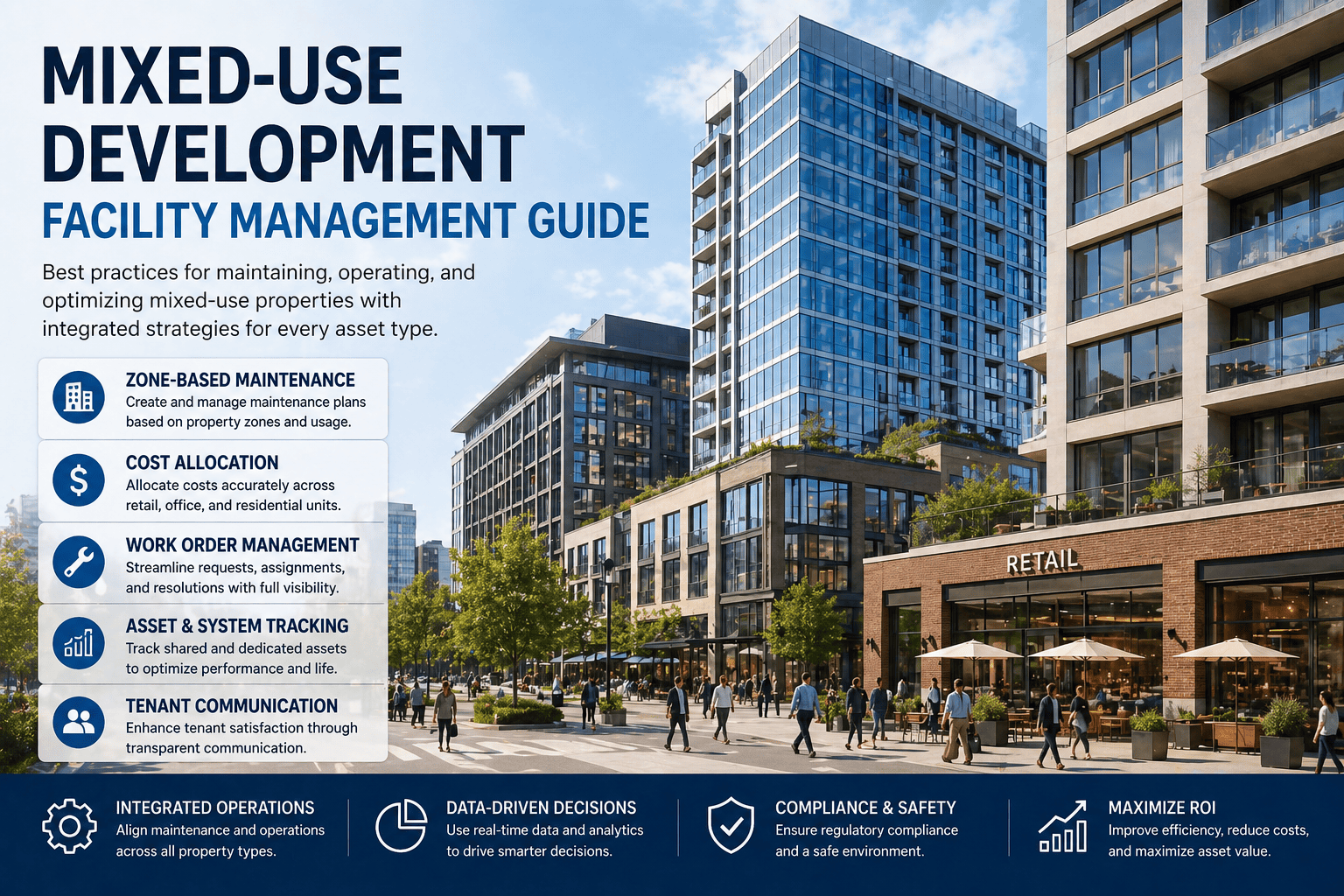
A 28-storey mixed-use tower in an urban centre running retail on floors 1–3, Class A office on floors 4–18, and luxury residential on floors 19–28 does not have a facility management problem — it has three facility management problems sharing one building envelope, one HVAC plant room, and one service elevator. The retail tenant's grease trap needs weekly inspection. The residential fire suppression system needs testing on a schedule the office tenants cannot be notified about in advance. The shared podium car park needs ventilation maintenance that affects three different cost centres in three different lease agreements. And when the rooftop cooling tower requires a chemical treatment, the FM team needs a system that knows which fraction of that cost is allocated to the retail common area, the office CAM charge, and the residential amenity levy — before the invoice is issued, not after the dispute. Book a 30-minute demo to see how Oxmaint's Work Order Management platform handles zone-based cost allocation, multi-tenant work order routing, and shared infrastructure maintenance across every use type in a mixed-use development — or start a free trial on your first building today.
Work Order Management · Mixed-Use · Industry Verticals
Mixed-Use Development Facility Management Guide
Zone-based maintenance planning, shared infrastructure cost allocation, multi-tenant work order routing, and the operational disciplines that keep retail, office, and residential occupants satisfied from the same FM platform.
3 uses
Typical mixed-use tower: retail + office + residential in one asset
4.8×
Cost of reactive repairs vs the same work planned in advance
$2–3
Per sq ft per year benchmark for commercial building maintenance
55.7%
Of facility managers report increasing work order volumes year-on-year
Why Mixed-Use FM Is Harder Than Single-Use FM
A single-use commercial building has one tenant type, one lease structure, one maintenance regime, and one set of compliance requirements. A mixed-use development stacks three or four of these on top of each other, connects them through shared infrastructure, and then asks a single FM team to operate them under separate lease agreements, separate regulatory frameworks, and separate cost allocation methodologies — simultaneously. The table below shows what makes each use type's FM requirements genuinely distinct.
Retail
Service-intensive, high footfall
Hours0600–2300 / 7 days
Top assetsGrease traps, kitchen exhaust, shopfront doors, refrigeration
ComplianceNFPA 96 kitchen exhaust, health inspection, signage permits
Work order urgencySame-hour response to trading impact defects
Cost allocationNNN lease — tenant pays unit costs; landlord pays common area
Office
HVAC-driven, hours-sensitive
Hours0700–2000 Mon–Fri, limited weekend
Top assetsAir handling units, VAV boxes, lifts, BMS, access control
ComplianceASHRAE 62.1 ventilation, OSHA, fire code, lift certification
Work order urgencyNext business day for most; same day for HVAC in occupied hours
Cost allocationCAM charges — pro-rata by rentable sq ft per BOMA standard
Residential
24/7 occupied, amenity-led
Hours24/7 — residents present at all maintenance windows
Top assetsFan coil units, hot water systems, lifts, amenity HVAC, door entry
ComplianceLandlord Act obligations, Legionella L8, fire safety, gas safety
Work order urgencyEmergency response to habitability defects: 2-hour target
Cost allocationService charge — allocated by unit share per lease schedule
Five Operational Disciplines That Make Mixed-Use FM Work
Mixed-use FM does not fail on technical knowledge. It fails on operational discipline — the structured workflows that ensure the right work order goes to the right contractor at the right time, with the right cost code, regardless of which use type triggered the request. These five disciplines are the difference between a mixed-use building that runs smoothly and one where the management office receives complaints every Monday morning.
01
Zone Architecture
Asset hierarchy mapped to use-type zones from day one
Every asset in the CMMS must be tagged to its zone — retail podium, office floors, residential tower, shared infrastructure, or common areas — before the first work order is raised. Without zone architecture, cost allocation is manual and error-prone, SLA tracking is impossible per use type, and the FM team cannot demonstrate to any single tenant that their service charge is being fairly applied. Zone architecture is not a configuration preference; it is the foundation on which every other operational discipline depends.
What it solvesCost disputes, SLA tracking, tenant reporting
02
Cost Allocation
Shared infrastructure costs split at work order level
Rooftop cooling towers, building lifts, shared HVAC plant, car park ventilation, and podium landscaping serve multiple tenants and use types — but their maintenance costs must be apportioned correctly to each NNN, CAM, or service charge account before invoicing. The CMMS that carries the allocation split on every asset record distributes costs automatically when a work order is closed, producing audit-ready cost statements for each tenant category without manual spreadsheet work.
What it solvesCAM audit exposure, service charge disputes, invoice accuracy
03
SLA Tiering
Different response targets for different use types — in one system
A leaking pipe in a retail unit affects trading. The same pipe in an unoccupied office storeroom does not. A failed fan coil in a residential apartment at 2 AM triggers a habitability obligation. The same fault in an office at 11 PM waits until morning. Configuring three SLA tiers — retail emergency, residential urgent, office standard — within a single work order system means dispatch automatically assigns the correct response target from the first notification. No triage calls. No missed SLA because the system did not know what type of space the fault was in.
What it solvesSLA breaches, contractor misdispatch, tenant complaints
04
Contractor Routing
Right contractor for each zone — automatically
A mixed-use building typically uses 8 to 15 contractors — specialist retail refrigeration, office-grade HVAC, residential gas safety, building-wide lift maintenance, podium landscaping, and more. Manually routing work orders to the correct contractor for each zone is the single most time-consuming daily task for a mixed-use FM team and the most common source of delay. Zone-based contractor assignment in the CMMS routes every work order to the correct contractor at creation, with the correct access protocol and hazmat consideration for the zone involved.
What it solvesRouting errors, contractor delay, access protocol failures
05
Compliance Tracking
Multiple regulatory frameworks tracked per zone — not per building
A mixed-use building simultaneously needs NFPA 96 kitchen exhaust cleaning records for retail, ASHRAE 62.1 ventilation compliance for office, Legionella L8 risk assessment for residential, and unified fire safety compliance for all three. A single compliance dashboard that tracks all statutory obligations by zone — with expiry alerts per obligation type per use type — eliminates the annual scramble to assemble evidence for health inspectors, fire officers, and building certifiers who visit the same building but ask for entirely different documentation packages.
What it solvesCompliance gaps, missed certifications, regulatory exposure
See Zone-Based Cost Allocation and Multi-Tenant Work Order Routing in 30 Minutes
Walk through a live mixed-use building configuration showing retail, office, and residential zones — with SLA tiers, contractor routing, and cost allocation split demonstrated on actual work order examples.
The Implementation Path — Going Live Across a Mixed-Use Asset
Mixed-use CMMS implementations fail when the system tries to go live across all use types simultaneously before the zone architecture and cost allocation rules are validated. The four-phase approach below has been proven across mixed-use portfolios in North America, UK, and Asia-Pacific.
Phase 1
Zone mapping and asset registry
Define zone boundaries per use type and shared infrastructure. Register every asset with zone tag, cost allocation rule, and applicable SLA tier. Import existing PM schedules. This phase takes 2 to 4 weeks and is the most important investment in the programme — errors here compound through every subsequent phase.
Outcome by week 4Complete asset register with zone and cost tags
Phase 2
Contractor routing and SLA configuration
Configure contractor assignments per zone, SLA response targets per use type and priority, and notification chains for SLA breach. Test with 20 to 30 historical work orders to validate routing accuracy before go-live. Adjust contractor zone assignments where test cases reveal mis-routing.
Outcome by week 6Validated routing and SLA configuration
Phase 3
Live work order operations across all zones
Go live with all three use types on the same platform. All reactive and PM work orders raised in one system, routed automatically, closed with cost code attached. Generate first cost allocation report at month end and reconcile against manual records to validate accuracy. Expect a 2 to 4 week adjustment period before cost allocation matches 95%+ accuracy.
Outcome by week 10Single platform, all use types, cost allocation live
Phase 4
Tenant reporting and compliance dashboard
Activate per-zone compliance tracking, tenant-specific cost allocation reports, and SLA performance summaries. Each use type's management team or tenant can receive automated monthly performance reports. CAM, NNN, and service charge reconciliations are generated from work order data rather than assembled manually. Disputes drop significantly.
Outcome by week 16Automated tenant reporting, zero manual assembly
Expert Review — What Mixed-Use FM Gets Wrong in the First Year
The operational failures that follow mixed-use FM deployments follow a consistent pattern that structured CMMS implementation prevents.
"The number-one failure mode in mixed-use facility management — and I have seen it in every market from London to Singapore to Los Angeles — is the FM team treating it as three separate buildings that happen to share a postcode. You end up with three sets of spreadsheets, three contractor rosters, three compliance filing systems, and nobody with a single view of what the shared infrastructure actually costs any given use type to serve. The first CAM reconciliation dispute with an office tenant, the first service charge challenge from a residential management company, the first health inspection finding on the kitchen exhaust records that were filed under 'building' rather than 'retail' — these are all symptoms of the same root cause: the work order system did not know what type of space it was maintaining. Every work order in a mixed-use building must carry a zone tag and a cost allocation rule from the moment it is created. That is not an administrative overhead. That is the operational foundation that makes every financial and compliance conversation with every tenant either easy or impossible."
Priya Nair, CFM, RPA, FMP
Certified Facility Manager · Real Property Administrator · Facility Management Professional · 17 years mixed-use portfolio management across three continents · IFMA Board contributor on multi-tenancy FM standards
Frequently Asked Questions
How is maintenance cost allocated between retail, office, and residential in a mixed-use building?
Retail tenants typically operate under NNN (triple-net) leases where they pay unit-specific maintenance costs and a proportionate share of common area maintenance (CAM) charges. Office tenants pay CAM charges allocated by rentable square foot under BOMA standards. Residential tenants pay service charges allocated by unit share per the lease schedule.
Shared infrastructure costs — lifts, rooftop plant, podium landscaping — are split across all three at the ratio defined in each lease, recorded per asset in the CMMS.
Book a demo to see zone-based cost allocation in a live configuration.
What SLA response targets apply to different use types in a mixed-use building?
Retail emergency defects affecting trading should target a 1 to 2 hour response. Residential habitability defects (heating, hot water, security) should target 2 hours at any time of day or night. Office HVAC faults in occupied hours should target 4 hours same business day. Non-urgent planned maintenance is scheduled per PM calendar. A CMMS with configurable SLA tiers per zone ensures the right response target is applied automatically at work order creation without manual triage.
How does Oxmaint handle different compliance requirements per zone?
Each zone carries its own compliance template in Oxmaint — NFPA 96 kitchen exhaust schedules for retail, ASHRAE ventilation records for office, Legionella L8 and gas safety for residential, fire safety across all zones.
Expiry alerts are generated per obligation per zone before the due date, and compliance evidence from completed work orders populates each zone's audit file automatically. No binder assembly, no manual cross-referencing.
Start a free trial to configure your first zone compliance programme.
How long does it take to implement Oxmaint across a mixed-use development?
A single mixed-use building — retail podium, office floors, residential tower — typically goes fully live in 10 to 14 weeks using the four-phase approach: zone mapping and asset registry (weeks 1–4), contractor routing and SLA configuration (weeks 5–6), live operations (weeks 7–10), and tenant reporting activation (weeks 11–16). The critical path is the zone mapping and cost allocation rule validation in Phase 1 — errors here are corrected quickly but must be found before live operations begin.
Can Oxmaint generate separate maintenance reports for each tenant or management company?
Yes. Each use-type zone produces a separate cost allocation report showing work order volumes, maintenance costs, PM completion rates, and SLA performance for the assets and shared infrastructure attributed to that zone. Retail tenants receive their NNN cost summary. Office CAM managers receive their pro-rata report. Residential managing agents receive their service charge breakdown.
All three are generated from the same work order data — no manual preparation.
Book a demo to see a live tenant report export.
A Mixed-Use Building Is Not Three Problems. It Is One Platform With Three Zone Configurations.
Oxmaint Work Order Management handles zone-based cost allocation, SLA tiering per use type, multi-contractor routing, and per-tenant compliance tracking from a single platform — eliminating the spreadsheets, the routing errors, and the CAM disputes that characterise mixed-use FM without it.