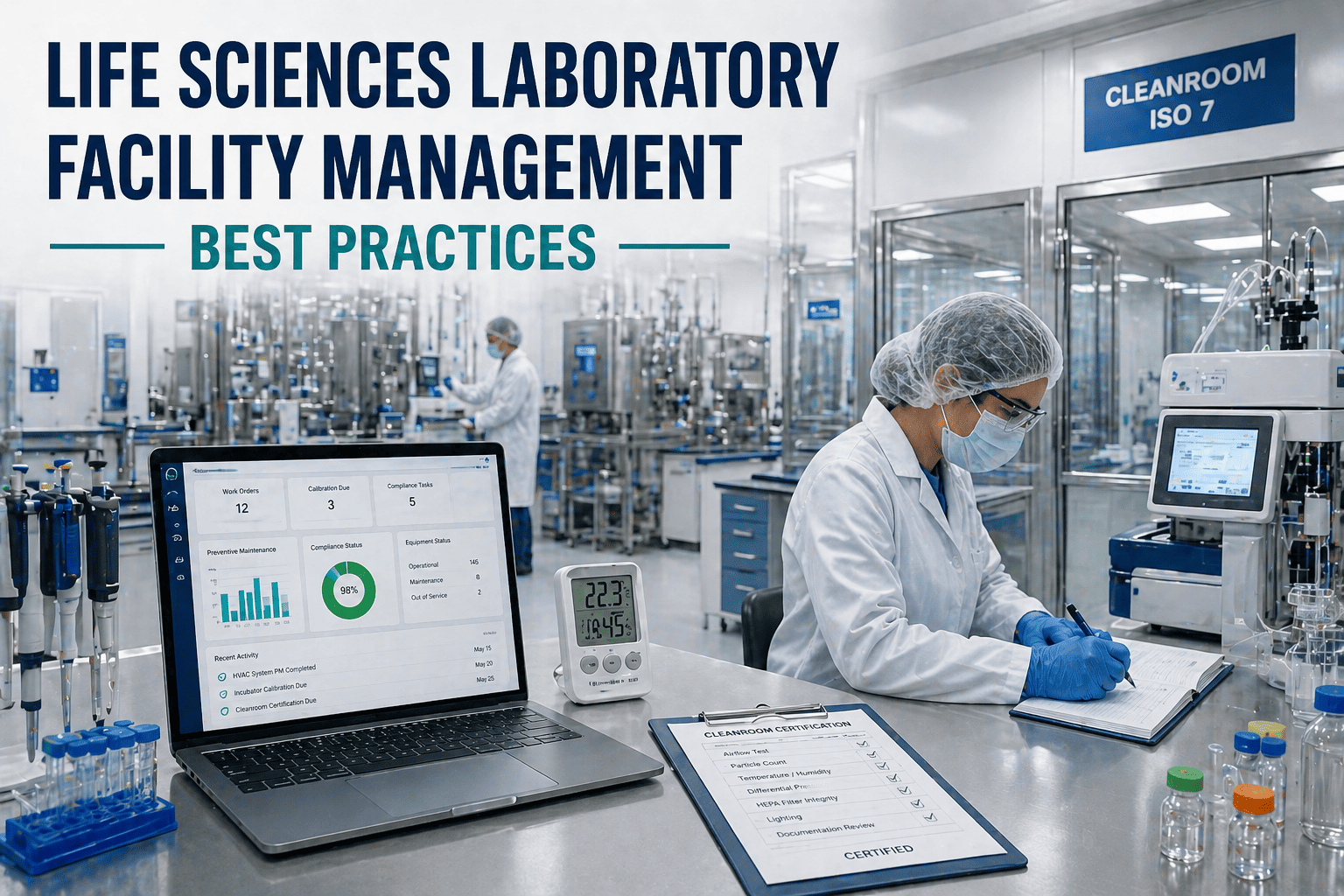
A Grade A cleanroom producing aseptic injectables is not simply a very clean room. It is a qualified, validated, continuously monitored controlled environment whose every maintenance event must be documented to a standard that an FDA inspector, EU Annex 1 auditor, or ISO 14644-2 review can verify on demand. When the pressure differential between Grade B and Grade C drops by 3 Pa because a supply fan bearing is beginning to fail, that is not a comfort issue — it is a potential batch rejection, an audit observation, and a deviation report waiting to be written. Most life sciences facility failures during regulatory inspections are not technical failures; they are documentation failures. The HVAC was maintained — but the record does not prove it. The instrument was calibrated — but the out-of-tolerance finding was never closed. The cleanroom was certified — but nobody tracked when recertification was due. Book a 30-minute demo to see how Oxmaint's Compliance Tracking platform builds the GxP-aligned maintenance documentation discipline that stands up to audits — or start a free trial and map your facility's highest compliance risk.
Life Sciences Laboratory Facility Management Best Practices
GMP cleanroom grades, qualification frameworks, calibration schedules, environmental monitoring, and the CMMS discipline that keeps life sciences facilities inspection-ready every day.
GMP Grades A–D — What Each Level Demands from Facility Management
EU GMP Annex 1 (revised August 2023) and FDA cGMP define four grades of cleanroom environment for sterile pharmaceutical manufacturing. Each grade carries distinct particle limits, microbial monitoring requirements, pressure differential obligations, and HVAC qualification standards. Facility management responsibilities escalate with grade — Grade A demands real-time particle monitoring with alarms; Grade D requires documented cleaning SOPs and periodic environmental sampling. Understanding which grade applies to each operational zone is the foundation of every compliant life sciences facility management programme.
| Grade | ISO Equivalent | Typical Operations | Particle Limit (≥0.5μm, at rest) | FM Monitoring Requirement |
|---|---|---|---|---|
| Grade A | ISO 4.8 | Filling zones, stopper bowls, aseptic connections, open product | 3,520 / m³ | Continuous real-time particle monitoring + alarm |
| Grade B | ISO 5 | Background environment for Grade A; aseptic preparation and filling | 3,520 / m³ | Continuous monitoring + alarm; sinks/drains prohibited |
| Grade C | ISO 7 (at rest) / ISO 8 (operation) | Less critical aseptic steps; solution preparation; washing | 352,000 / m³ | Risk-based periodic monitoring; pressure differential records |
| Grade D | ISO 8 | Handling of sealed containers; primary packaging; less critical steps | 3,520,000 / m³ | Defined cleaning SOPs; periodic environmental sampling |
DQ / IQ / OQ / PQ — The Four Qualification Stages Every FM Lead Must Own
Cleanroom qualification is not a one-time commissioning event. The DQ/IQ/OQ/PQ framework creates a living evidence base that regulators expect to see updated whenever equipment is modified, HVAC is altered, or a pressure cascade is adjusted. Facility management owns the ongoing re-qualification obligations — and a CMMS that does not track what triggered a re-qualification is a CMMS that will fail an audit.
Verifies that the design of the facility and systems meets user requirements and applicable standards before installation. FM input: URS definition, pressure cascade design, material/personnel flow, HEPA layout review.
Confirms that equipment and systems are installed according to design specifications. Includes factory acceptance testing (FAT), site acceptance testing (SAT), P&ID verification, and instrument calibration status at installation.
Demonstrates systems operate as intended under at-rest conditions. HVAC calibration, HEPA filter integrity testing, pressure differential verification, temperature and humidity range confirmation. Triggers: any controls modification.
Confirms consistent performance under real operating conditions. Simulates actual manufacturing processes. Includes airflow visualisation studies (smoke tests), microbiological monitoring under occupancy, and recovery time testing.
The Maintenance and Calibration Schedule GxP Facilities Cannot Abbreviate
GxP-regulated maintenance is not discretionary. The schedule below reflects the minimum inspection and calibration obligations imposed by FDA 21 CFR Part 211, EU GMP Annex 1, and ISO 14644-2. Each item must be completed on time, with an out-of-tolerance procedure documented when instruments fail calibration, and a change control raised when any regulated system is modified. Oxmaint's Compliance Tracking platform schedules, triggers, and documents every item below with the ALCOA+ data integrity attributes regulators require.
| Task | Frequency | Applicable Grade | Re-trigger Condition |
|---|---|---|---|
| HEPA filter integrity (DOP/PAO test) | 6–12 months | All grades | After filter change, ceiling modification, or significant airflow event |
| Airborne particle count classification | 6 months (pharma); ISO 14644-2 Table A1 | A, B, C, D | After any HVAC modification or personnel flow change |
| Pressure differential monitoring & record | Continuous (A/B); Periodic (C/D) | All grades | Alarm event; fan fault; door modification |
| Temperature & humidity calibration | 12 months | All grades | Out-of-spec reading; probe replacement |
| Microbiological air and surface sampling | Risk-based; minimum per SOP | A, B, C | Exceedance of action limit; process change |
| UV lamp intensity verification | Monthly (intensity); 500 hr (replacement) | A, B | Lamp change; intensity drop below threshold |
| Airflow visualisation study | Periodic (per Annex 1 CCS) and after any modification | A, B | Any change to room layout, equipment, or personnel gowning practice |
| Autoclave / steriliser validation | Annual requalification cycle | A, B, C | Loading pattern change; equipment modification; PQ failure |
| Compressed air quality testing | 6 months (ISO 8573) | All grades (process contact) | Compressor service; oil-free failure event |
| HVAC preventive maintenance | Quarterly (belts, filters, coils); Annual (full survey) | All grades | Pressure drop exceedance; BMS alarm; out-of-spec classification result |
Every item in the table above must be tracked, completed on time, and documented to ALCOA+ standards. Oxmaint schedules them automatically, flags overdue items before they become audit observations, and generates the evidence package an inspector will request.
The Five Documentation Gaps That Most Often Trigger FDA and Annex 1 Observations
An instrument that failed calibration and was recalibrated without a documented out-of-tolerance impact assessment is a 483 observation waiting to happen. Every OOT calibration must generate a deviation record, an impact assessment on any batch produced during the non-compliant period, and a closed CAPA before the instrument is returned to service.
An HVAC controls upgrade that did not trigger a re-OQ. A new HEPA filter bank installed without a subsequent HEPA integrity test. An equipment relocation that was not followed by an airflow visualisation study. Annex 1's updated Contamination Control Strategy (CCS) requirements since August 2023 have made modification-triggered re-qualification a central audit focus.
Continuous monitoring that captures pressure differential exceedances but does not automatically generate a maintenance work order produces an evidence trail that reads as systemic neglect to an inspector. Every alarm event must have a corresponding corrective action record, however minor the event.
Attributable, Legible, Contemporaneous, Original, Accurate — plus Complete, Consistent, Enduring, Available. A maintenance record completed in pencil, backdated, or missing a technician signature is not ALCOA+-compliant. FDA data integrity guidance is explicit: paper-based maintenance records that cannot meet ALCOA+ are a systemic compliance risk.
ISO 14644-2 requires documented monitoring plans; USP <797> requires cleanroom certification every six months; cGMP facilities operating beyond their recertification date with no documented risk assessment or documented justification for the delay are operating in an unqualified state. Most facilities that miss recertification dates do so because nobody tracked the due date against the ISO 14644-2 schedule.
What 22 Years of GMP Facility Auditing Reveals About Documentation Failures
Frequently Asked Questions
If an Inspector Knocked on Your Door in 15 Minutes, Would Your Documentation Pass?
Oxmaint's Compliance Tracking platform gives life sciences facilities the GxP-aligned PM scheduling, real-time ALCOA+ documentation, calibration certificate tracking, and qualification status management that turns audit readiness from a scramble into a continuous state.






.jpeg)
