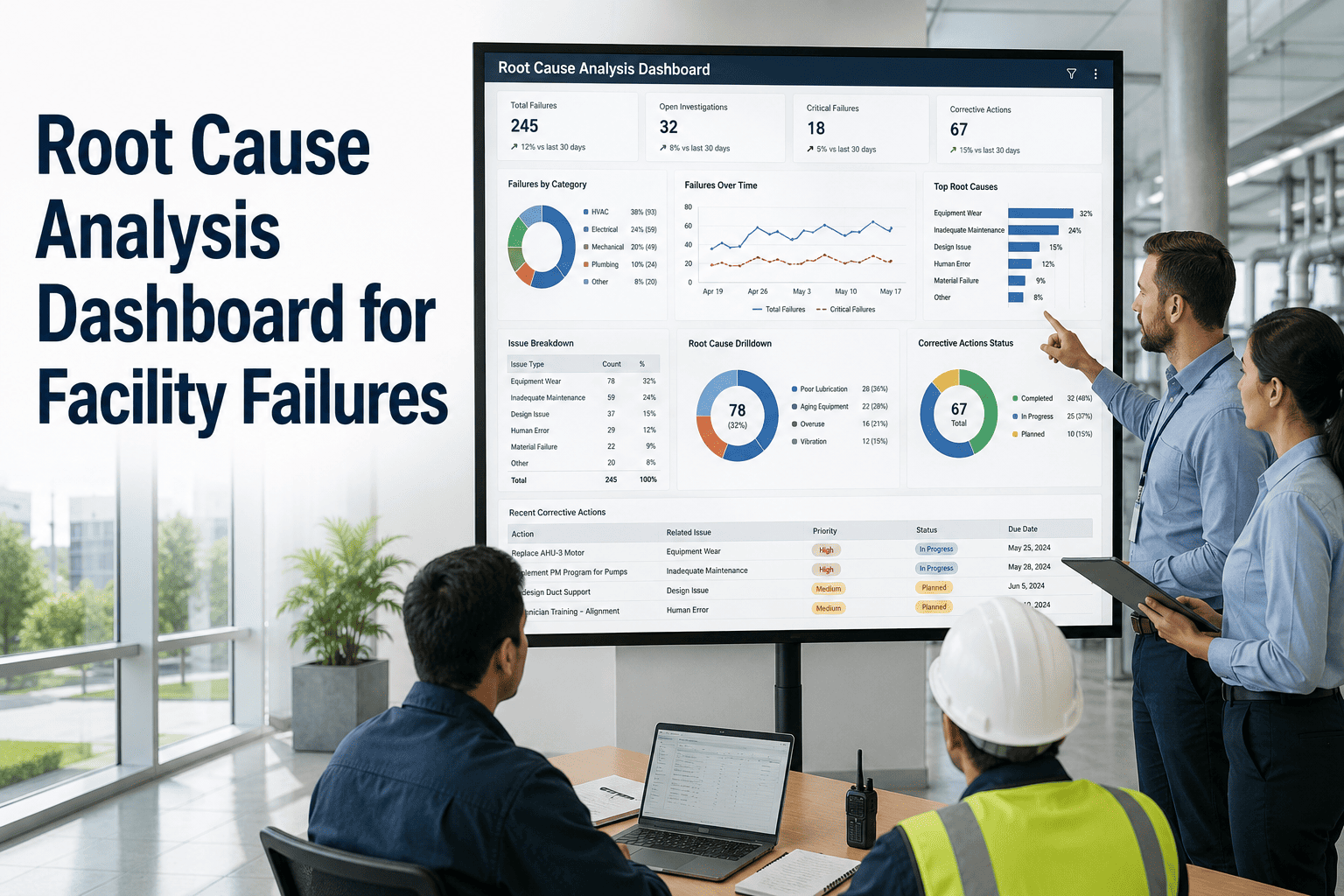
Root Cause Analysis for Electrical Panel Failures in Facilities
By Shreen on January 22, 2026
When an electrical panel fails, the pressure to get back online is immense. This leads to "shotgun troubleshooting"—replacing the breaker, the wire, and the contactor, hoping one of them was the culprit. While this might restore power temporarily, it destroys the evidence needed to understand the failure mechanism. Was the breaker actually bad, or was it doing its job protecting against an intermittent short? Without RCA, you are throwing money at symptoms while the disease remains.
OXmaint changes this by enforcing data capture at the point of failure. Technicians are prompted to log "Failure Codes" (e.g., Burnt Smell, Tripped on Start, Vibration Present) before closing a work order. This data builds a forensic history that allows engineers to spot patterns invisible to the naked eye.
The 5 Levels of Electrical Failure
01
The Symptom
"The panel is hot" or "The lights are flickering." This is what triggers the work order, but it is not the cause.
02
Physical Cause
"High resistance at the B-Phase lug." The immediate physical reason for the heat or failure.
03
Human Cause
"The lug was not torqued to spec." An error in execution or maintenance procedure.
04
Latent Cause
"The torque wrench was out of calibration." The underlying organizational or tooling issue.
05
The Root Cause
"No calibration schedule exists for tools." The systemic gap that allows the failure to happen repeatedly.
Solving the problem at Level 1 buys you a week. Solving it at Level 5 buys you a decade. Schedule a demo with OXmaint to learn how to operationalize this depth of analysis.
Stop the "Fix-Break" Cycle
OXmaint's RCA tools help you document the "5 Whys" directly in the work order, ensuring knowledge is captured and solutions are shared across teams.
Effective Root Cause Analysis requires structure. It cannot be an ad-hoc conversation in the breakroom. OXmaint digitizes the RCA workflow, ensuring that every critical failure triggers a structured investigation process.
From Failure to Forensics
A structured path to finding the truth
1
Event Trigger
Critical asset failure or 3rd repeat breakdown in 30 days auto-triggers an RCA request.
2
Data Gathering
Technicians upload photos of burnt components, thermal logs, and recent load data to the case.
3
Analysis (5 Whys)
Team collaborates to drill down: Why did it overheat? Why was it loose? Why wasn't it checked?
4
Corrective Action
New PM task created (e.g., "Calibrate Torque Wrench") to prevent recurrence.
Result:Systemic Improvement, Not Band-Aids
This process transforms a negative event into a positive organizational asset. Try OXmaint free to digitize your RCA process.
The choice is clear. Organizations that adopt RCA see a measurable drop in emergency work orders. Book your personalized demo to start your journey.
Build a Culture of Reliability
OXmaint provides the framework to make RCA a habit, not a chore. Embed failure codes and mandatory photos into your technician's mobile workflow today.
The cost of RCA is time (investigation), but the cost of *not* doing it is exponential. Recurring failures consume spare parts, overtime labor, and production capacity.
Cost of Recurrence Calculator
Impact of a single recurring electrical fault over 1 year
Repeated Repairs
6 "quick fixes" (Labor + Parts)
$12,000
Production Scrap
Material lost during sudden stops
$45,000
Collateral Damage
Motor damage due to phase loss
$15,000
Emergency Callouts
Overtime/Contractor rates
$8,000
Management Overhead
Time spent managing the crisis
$5,000
Total Annual Waste:
$85,000
ROI of 1 RCA Session: Instant
Solving just one chronic issue pays for your OXmaint subscription. Schedule a demo to see the savings potential.
Industry Applications
Critical Environments for RCA
Food & Beverage
Investigating washdown-related shorts and corrosion in control panels.
Hygiene & Safety
Plastics & Molding
Tracing heater band failures to voltage fluctuations or thermocouple errors.
Quality Consistency
Hospitals
Analyzing successful vs. failed generator transfer tests to ensure code compliance.
Life Safety
Operationalize Your Knowledge
Don't let valuable troubleshooting knowledge walk out the door when your senior technician retires. Capture it in OXmaint's RCA database.
Not every loose screw needs a full investigation. Use this guide to decide when to trigger an RCA.
When to Perform RCA
Perform Full RCA When:
Safety incident or near miss occurred
Production downtime exceeded 2 hours
Repair cost exceeded $2,500
Same failure occurred 3x in 6 months
Critical asset (Main Switchgear) involved
Standard Repair (Quick Fix) OK When:
Consumable part (fuse, bulb) reached end of life
Cause is obvious accidental damage
Low-criticality asset (Office Lighting)
First-time occurrence on minor component
Cost of investigation > Cost of replacement
Frequently Asked Questions
What are the "5 Whys"?
The 5 Whys is an iterative interrogation technique used to explore the cause-and-effect relationships underlying a particular problem. By repeating the question "Why?" five times, you can peel back the layers of symptoms to find the root cause. (e.g., Why did the fuse blow? Overload. Why overload? Motor seized. Why seized? No lubrication. Why no lubrication? PM missed. Why PM missed? Scheduler error -> Root Cause).
How does OXmaint help with RCA?
OXmaint forces structured data collection. It provides fields for failure codes, allows photo uploads of the failure state, and links the asset's entire history to the work order. This gives the investigator all the clues needed to solve the case without digging through paper files.
Do I need an engineer to do RCA?
Not always. While complex failures benefit from engineering analysis, frontline technicians are often the best at performing the initial "5 Whys" because they know the equipment best. OXmaint empowers them to capture their insights immediately.
Can RCA prevent arc flashes?
Indirectly, yes. Most arc flashes are caused by equipment failure or human error during interaction. By identifying and eliminating the root causes of equipment instability (e.g., tracking down why moisture is entering a panel), you reduce the probability of a catastrophic fault occurring.
Solve it Once, Solve it Forever
Join the facility leaders who use OXmaint to turn failures into learning opportunities. Stop fighting fires and start engineering reliability.