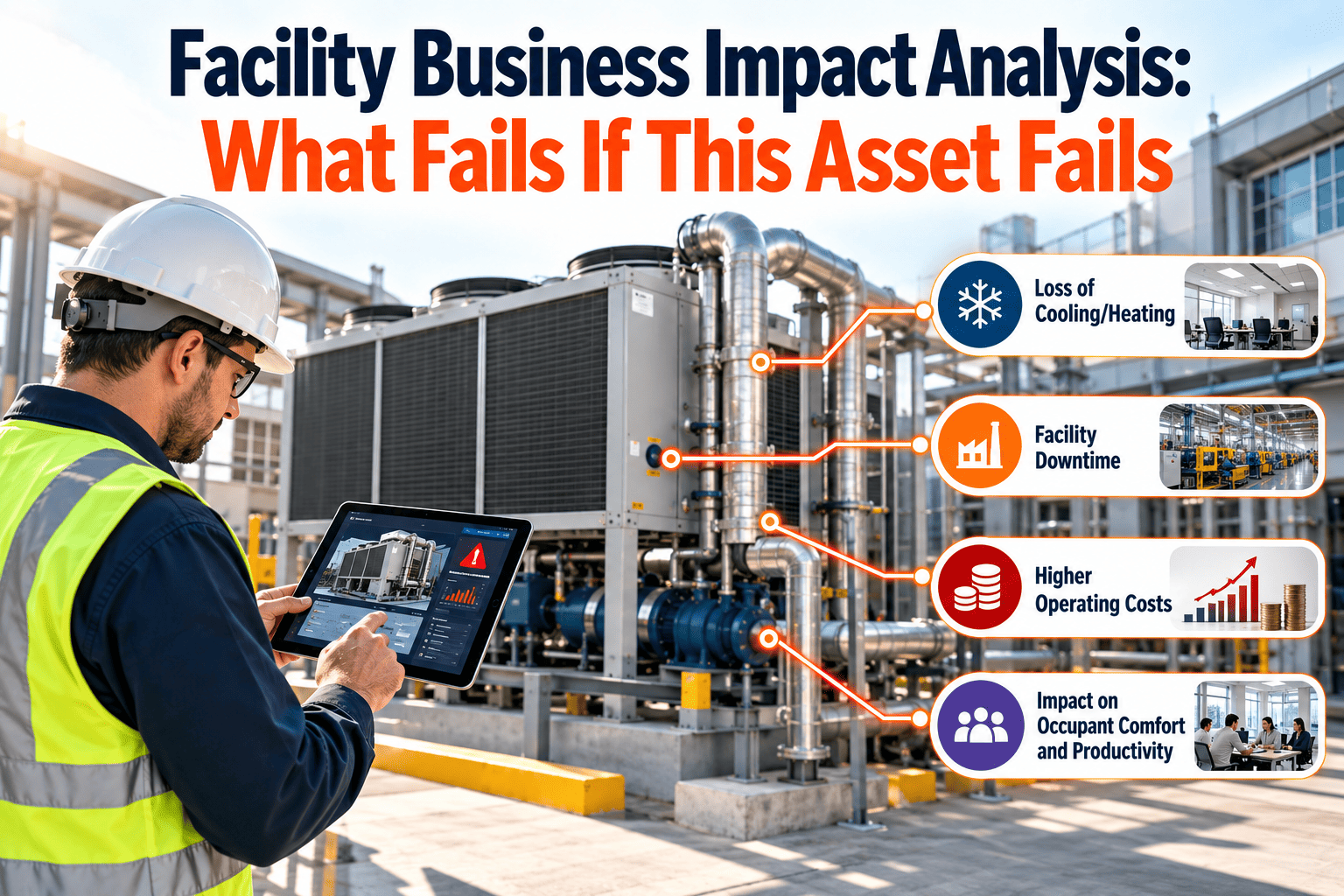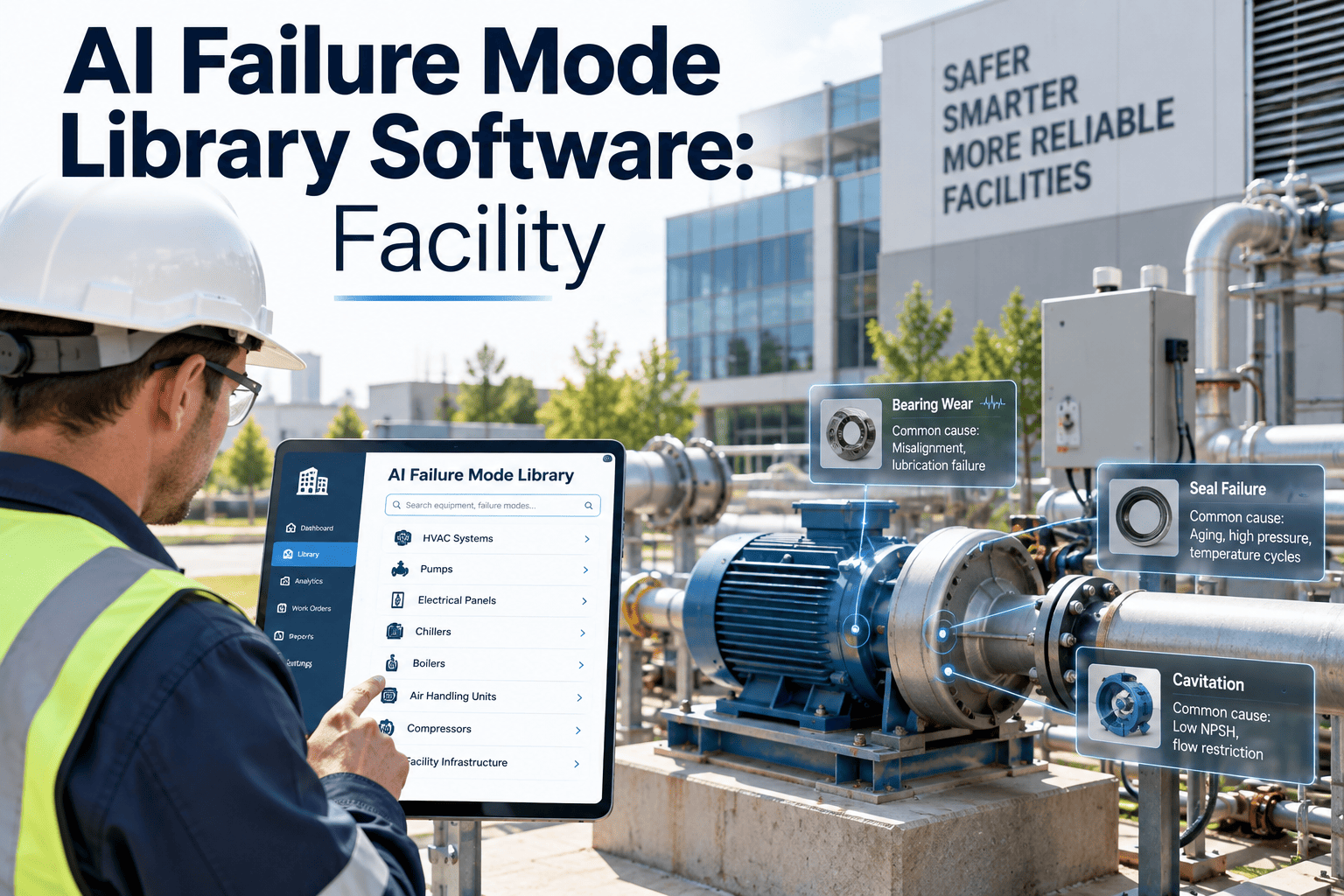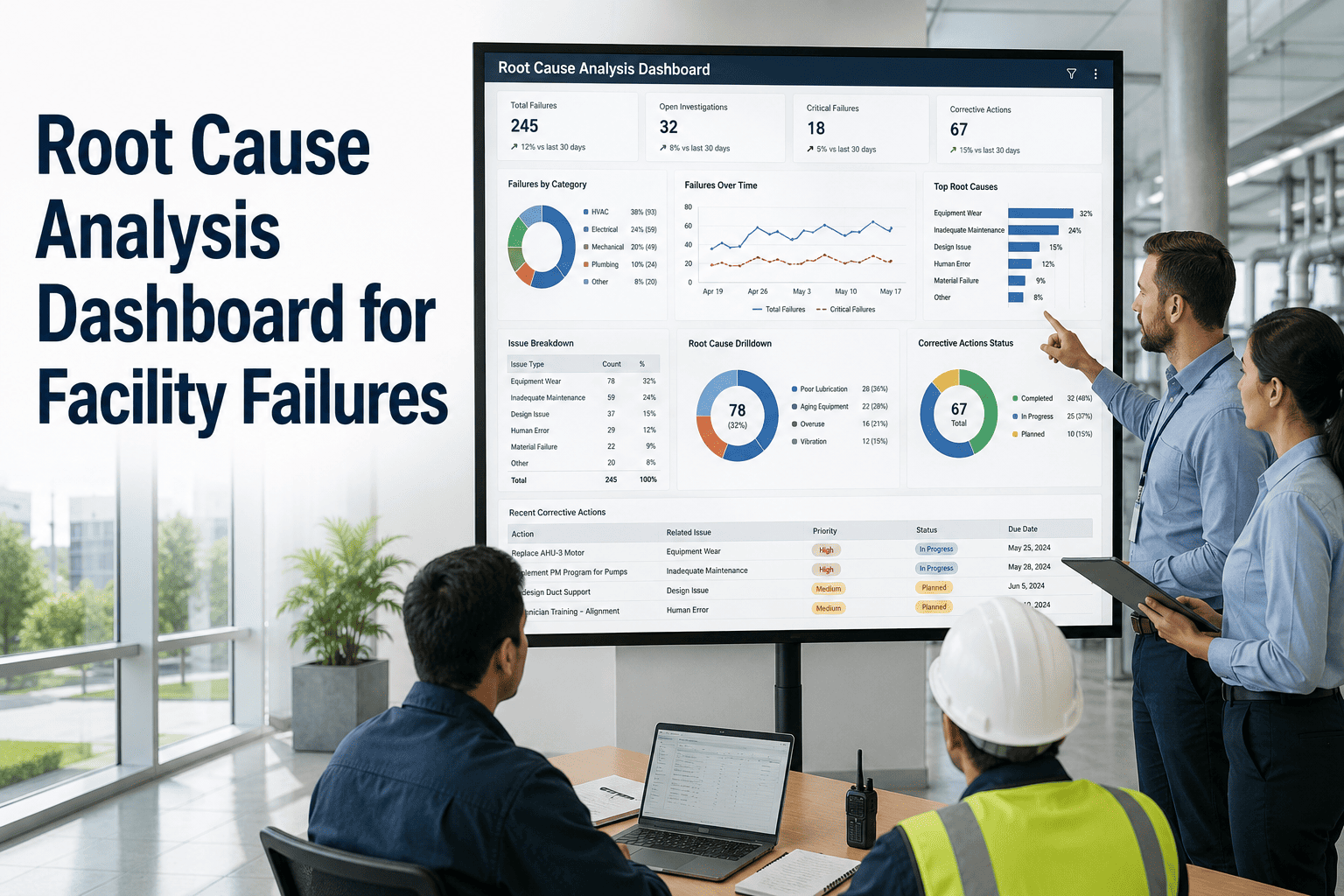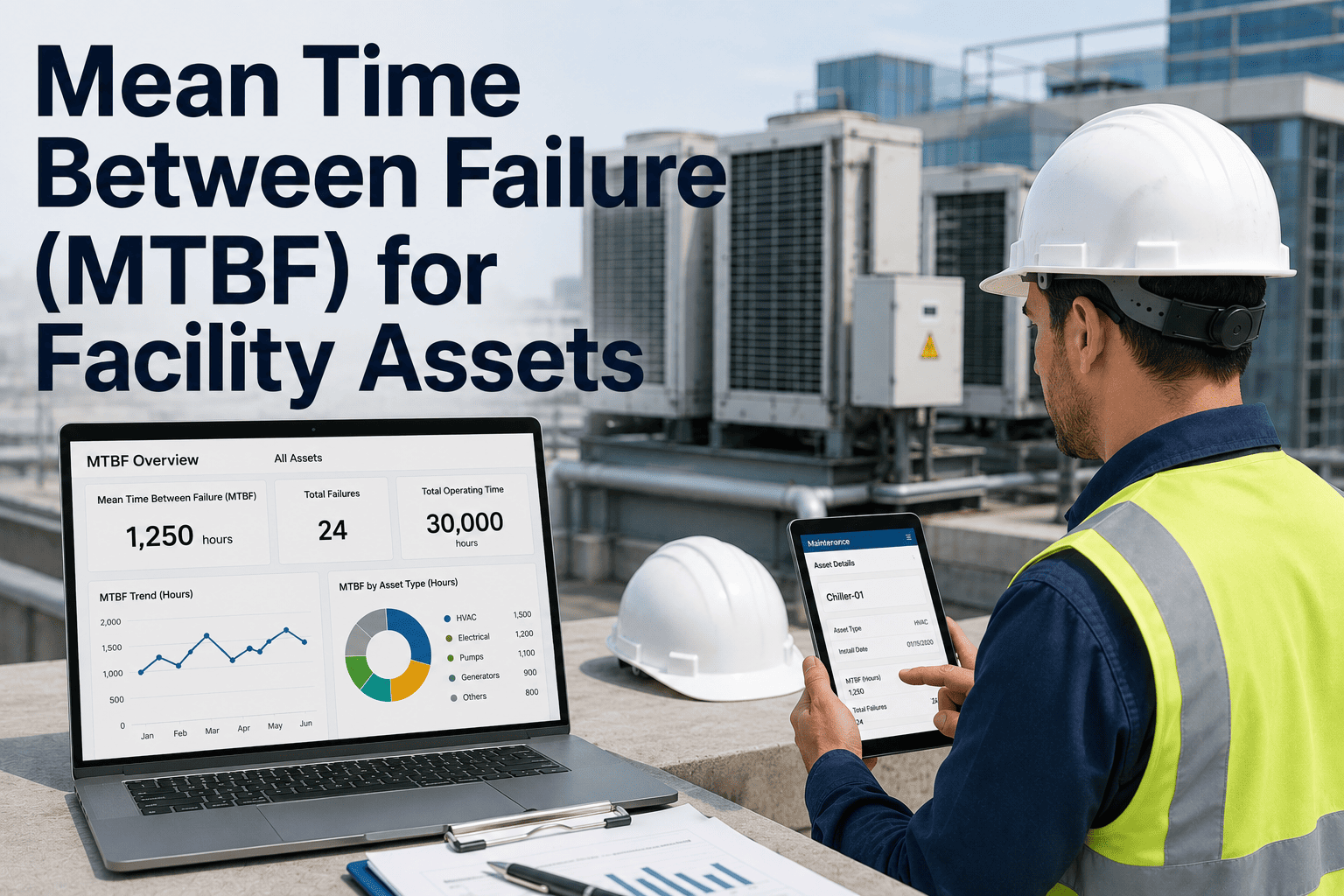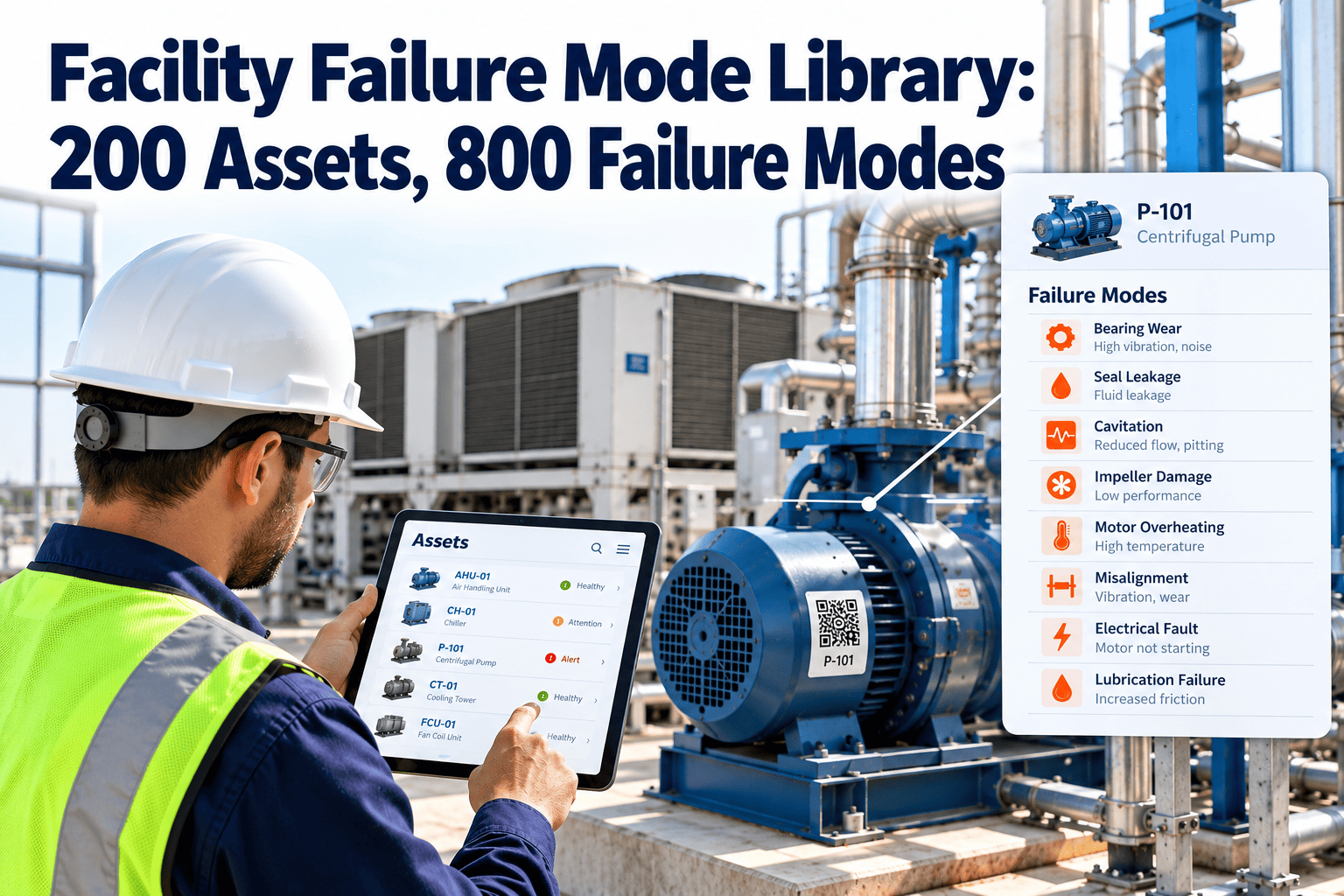
A facility failure mode library gives maintenance teams a ready catalog of how each asset can fail, what causes it, what happens next, and how to catch it early. This page walks through a structured library of 200 facility assets and 800 failure modes, built on the logic of SAE JA1011 and JA1012. You will see how entries are organized, how detection strategy is matched to every mode, and how the results move into daily work. Teams that want to put the library to use can do so inside maintenance management software from the first week.
Predictive maintenance for facilities
Facility Failure Mode Library: 200 Assets, 800 Failure Modes
Every facility asset fails in patterns that can be named, ranked, and detected. A structured library turns those patterns into inspection points, condition checks, and spare parts decisions before a breakdown reaches tenants.
200assets grouped into 10 building systems
800failure modes, about four per asset
5detection layers matched to each mode
Why a failure mode library beats a blank FMEA sheet
Most facility FMEA efforts stall because the team starts from nothing. A library flips the work from inventing to editing, which is far faster and far more consistent across sites.
Blank-sheet FMEA
- Long workshops for every asset class
- Results depend on who is in the room
- Vague entries such as "motor problem"
- Different sites use different words for the same failure
- Work stops after the pilot building
Library-first FMEA
- Standard entries ready before the workshop
- Technicians review and correct, not invent
- Specific modes such as "bearing wear from lubrication loss"
- One vocabulary across the whole portfolio
- New buildings inherit the library on day one
The real value is not the spreadsheet. It is the shared language that lets a work order written in one building teach the team in another.
Anatomy of one library entry: the seven questions
SAE JA1011 sets the minimum criteria a process must meet to be called reliability-centered maintenance, and SAE JA1012 is the companion guide for carrying it out. Every library entry answers the same seven questions in order.
1
Function and performance standard
What the asset must do, and to what level. Example: deliver rated airflow to a zone.
2
Functional failure
The ways it can fall short: no airflow, low airflow, or excessive noise.
3
Failure mode
What causes each functional failure, such as bearing wear, belt slip, or a stuck damper.
4
Failure effect
What happens if nobody intervenes: comfort complaints, energy loss, secondary damage.
5
Failure consequence
Why it matters: safety, environmental, operational, or non-operational, and whether the failure is hidden.
6
Proactive task
A technically feasible and worthwhile inspection, condition check, or restoration task.
7
Default action
If no proactive task pays off: a failure-finding test, a redesign, or run to failure with spares.
JA1011 asks for failure modes that are reasonably likely to cause each functional failure. That qualifier is why a practical library averages about four modes per asset instead of forty.
How the 200 assets are organized
The library groups assets by building system so a reliability planner can open one section and cover a whole discipline. The bars below show how many assets sit in each group.
HVAC and air handling42
Electrical distribution30
Plumbing and water24
Fire and life safety22
Central plant and boilers20
Controls and BMS16
Building envelope14
Kitchen and specialty12
Vertical transport10
Site and exterior10
Adjust the grouping to your own portfolio. A hospital will weight life safety and medical gas heavily, while an office tower leans toward HVAC and vertical transport.
Failure mechanisms behind most facility modes
Behind hundreds of named modes sit a small number of physical mechanisms. Grouping by mechanism helps technicians recognize patterns across unrelated equipment.
| Mechanism | Typical facility examples | Early signal to look for |
|---|---|---|
| Wear | Fan and pump bearings, belts, door operators | Rising vibration, noise, slower cycle times |
| Corrosion | Boiler tubes, pipe fittings, roof fasteners | Staining, water chemistry drift, pitting |
| Fouling | Condenser tubes, coils, filters, drains | Rising approach temperature, pressure drop |
| Electrical degradation | Loose lugs, motor windings, contactors | Hot spots, current imbalance, tripping |
| Fatigue | Vibrating supports, flexible connectors, springs | Cracks, looseness, repeated fastener loss |
| Control drift | Sensors, actuators, setpoints, schedules | Command versus feedback variance |
| Hidden failure | Emergency lighting, fire pumps, standby power | Only a functional test reveals it |
The detection ladder: earlier signals give planners more time
Every failure mode develops over time. The earlier a technique can see the problem, the more room the team has to order parts, schedule access, and fix it during planned hours.
Stage 1
Defect begins inside the component
Stage 2
Instruments detect it: ultrasound, vibration, oil or water analysis
Stage 3
Trends move: temperature, current, pressure, approach
Stage 4
People notice noise, heat, leaks, or odor
Stage 5
Functional failure and tenant impact
Lead time varies by asset and operating context, so the library records the detection layer for each mode rather than promising a fixed warning period.
The five detection layers used in the library
- Sensory round: look, listen, smell, and touch on a routine walk
- Measured inspection: readings taken with a gauge, meter, or handheld tool
- Condition monitoring: trends from sensors, the BMS, or periodic analysis
- Functional test: proving a hidden or standby function still works
- Planned replacement: restoring or replacing on a fixed interval when nothing else pays off
Detection strategy by asset class
Not every layer suits every asset. The matrix shows which layer usually carries the load for each family of equipment.
| Asset family | Sensory round | Measured inspection | Condition monitoring | Functional test |
|---|---|---|---|---|
| Rotating HVAC equipment | Support | Primary | Primary | Limited |
| Chillers and heat rejection | Support | Primary | Primary | Limited |
| Electrical distribution | Limited | Primary | Support | Support |
| Standby power and life safety | Support | Support | Limited | Primary |
| Pumps and plumbing | Primary | Support | Support | Limited |
| Vertical transport | Support | Limited | Primary | Support |
| Building envelope | Primary | Support | Limited | Limited |
| Controls and sensors | Limited | Support | Primary | Support |
Sample entries from the library
The excerpt below shows the level of detail each entry carries. Specific enough to drive a task, short enough to review in a workshop.
| Asset | Failure mode | Typical cause | Effect | Detection | Task |
|---|---|---|---|---|---|
| AHU supply fan | Bearing wear | Lubrication loss, misalignment | Low airflow, fan seizure | Vibration or ultrasound reading | Condition-based lubrication, replace on trend |
| AHU belt drive | Belt slippage | Loose tension, worn sheaves | Comfort complaints | Tension and speed check | Inspect and retension |
| Chiller | Condenser tube fouling | Poor water treatment | Higher energy use, trips | Approach temperature trend | Clean when trend crosses limit |
| Cooling tower | Chemical feed pump failure | Diaphragm wear, air lock | Scale or biological growth | Water quality log | Weekly check, stock spare diaphragm |
| Low-voltage switchgear | Loose connection | Thermal cycling | Hot spot, trip | Infrared scan under load | Annual scan, torque at outage |
| Standby generator | Fails to start | Battery or charger fault | No backup power | Battery test, load test | Scheduled start and load test |
| Fire pump | Fails to start on demand | Controller fault, closed valve | Loss of sprinkler supply | Functional start test | Test per applicable code |
| Passenger elevator | Door operator fault | Roller wear, sensor misalignment | Entrapment calls | Door fault log review | Adjust and replace parts |
| Booster pump | Mechanical seal leak | Dry running, wear | Leak, pressure loss | Round check, leak sensor | Replace seal on condition |
| Roof membrane | Seam separation | UV, ponding, movement | Water ingress | Post-storm inspection | Seasonal inspection and repair |
Put the failure mode library to work in your buildings
Load your assets, attach the failure modes that matter, and turn each one into a scheduled inspection or condition check your technicians can complete on a phone.
Ranking modes by consequence, not by habit
Eight hundred modes do not all deserve the same attention. Pair likelihood with consequence to decide how much effort each one earns.
Minor consequence
Major consequence
Critical consequence
High likelihood
Routine inspection and spares
Condition monitoring and planned restoration
Redesign, redundancy, and monitoring
Medium likelihood
Run to failure with spares
Scheduled inspection
Condition monitoring and functional test
Low likelihood
Run to failure
Corrective on finding
Failure-finding test
Hidden failures sit in the critical column by default. A fire pump that fails silently is more dangerous than one that fails loudly.
From library entry to work order: the six-step flow
A library only pays off when each mode ends up as a task someone actually performs. This is the path from catalog to completed work.
01
Register the asset
Create the asset record with location, system, and criticality in the asset management module.
02
Attach relevant modes
Keep only the modes that are reasonably likely in your operating context.
03
Build the task
Convert each detection layer into a preventive maintenance or inspection checklist.
04
Schedule and assign
Set time-based or meter-based intervals and push work orders to technicians on mobile.
05
Record what was found
Capture readings, photos, and the failure mode observed on every corrective work order.
06
Review and refine
Use dashboards and reports to retire tasks that find nothing and add tasks where failures slipped through.
Measuring library health
Track a handful of indicators so the library stays a working tool instead of a one-time project.
Mode coverageShare of critical assets with reviewed failure modes and a mapped task.
Repeat failure rateFailures of the same mode on the same asset class within a set period.
Planned work ratioPlanned and condition-triggered hours compared with reactive hours.
Detection hit rateFailures found by a proactive task before they became functional failures.
Task yieldShare of inspections that produced a finding, used to prune low-value tasks.
One failure mode followed end to end
Take a chilled water booster pump with a mechanical seal that slowly leaks. The path below shows how a single library entry becomes a prevented breakdown.
Without the library
- A small drip is noticed but nobody logs it
- The seal fails on a hot afternoon and the pump trips
- Staff search for a seal kit that is not in stock
- The work order says only "pump repaired"
- The same failure repeats at another building
With the library
- The seal leak mode is attached to the pump record
- A weekly round checks for drips and records the finding
- A repeat finding raises a corrective work order
- The seal kit is held as a critical spare
- The closed work order names the failure mode and cause
The difference is not smarter technicians. It is that the knowledge about the mode lives in the system instead of in one person's memory.
Where Oxmaint fits in the library workflow
A library is a data set, and data needs a home that technicians use every day. These are the Oxmaint capabilities that map to each stage.
| Library stage | Oxmaint capability | What the team gains |
|---|---|---|
| Asset register | Asset management with hierarchy and criticality | One record per asset that failure modes attach to |
| Detection tasks | Preventive maintenance and inspection checklists | Consistent rounds and measured readings |
| Condition triggers | Condition-based and meter-based scheduling | Work raised when a trend crosses a limit |
| Field execution | Mobile work orders with photos and notes | Findings captured at the asset |
| Spares | Inventory with reorder points | Critical parts on the shelf for dominant modes |
| Hidden failures | Recurring test schedules and compliance records | Proof that standby systems were tested |
| Review | Reports and dashboards | Evidence to retire or add tasks |
Keeping the library current
A library that never changes is a library that is wrong. Build a light governance rhythm so it improves with every failure.
- Tag every corrective work order with the failure mode observed, using the library vocabulary
- Review new or unexpected modes quarterly and add them with cause and effect
- Check each year whether tasks still find defects, and prune those that never do
- Revisit the entries after equipment replacement, since new designs fail differently
- Record who approved each change so audits can trace the reasoning
Treat the library as living documentation owned by reliability, reviewed by technicians, and enforced through the work order system.
Common mistakes when adopting a failure mode library
- Importing every mode for every asset instead of keeping those reasonably likely at your sites
- Writing modes so broadly that no specific task can follow
- Skipping hidden failures because they never show up in the work order history
- Treating the library as finished rather than updating it from real corrective work
- Assigning detection tasks without the tools, access, or training to perform them
- Ranking assets by age or cost alone instead of by failure consequence
Facility failure mode library: frequently asked questions
What is a facility failure mode library?
It is a structured catalog of how each facility asset can fail, with causes, effects, consequences, and detection or maintenance tasks. It replaces blank-sheet FMEA workshops.
How do SAE JA1011 and JA1012 relate to it?
JA1011 defines the minimum criteria for a process to count as RCM, and JA1012 guides how to apply it. Library entries follow the same seven questions.
Why about four failure modes per asset?
JA1011 asks for modes that are reasonably likely, not every conceivable one. That keeps the library reviewable and the task list realistic.
How are hidden failures handled?
They get a functional or failure-finding test, since no inspection will reveal them. Schedule these in your preventive maintenance software with sign-off records.
Can I tailor the library to my buildings?
Yes. Keep the modes that fit your operating context and add site-specific ones. A short demo shows how teams structure this.
Turn 800 failure modes into work your team can finish
Start with your most critical assets, link each failure mode to a task, and let real work orders sharpen the library over time.