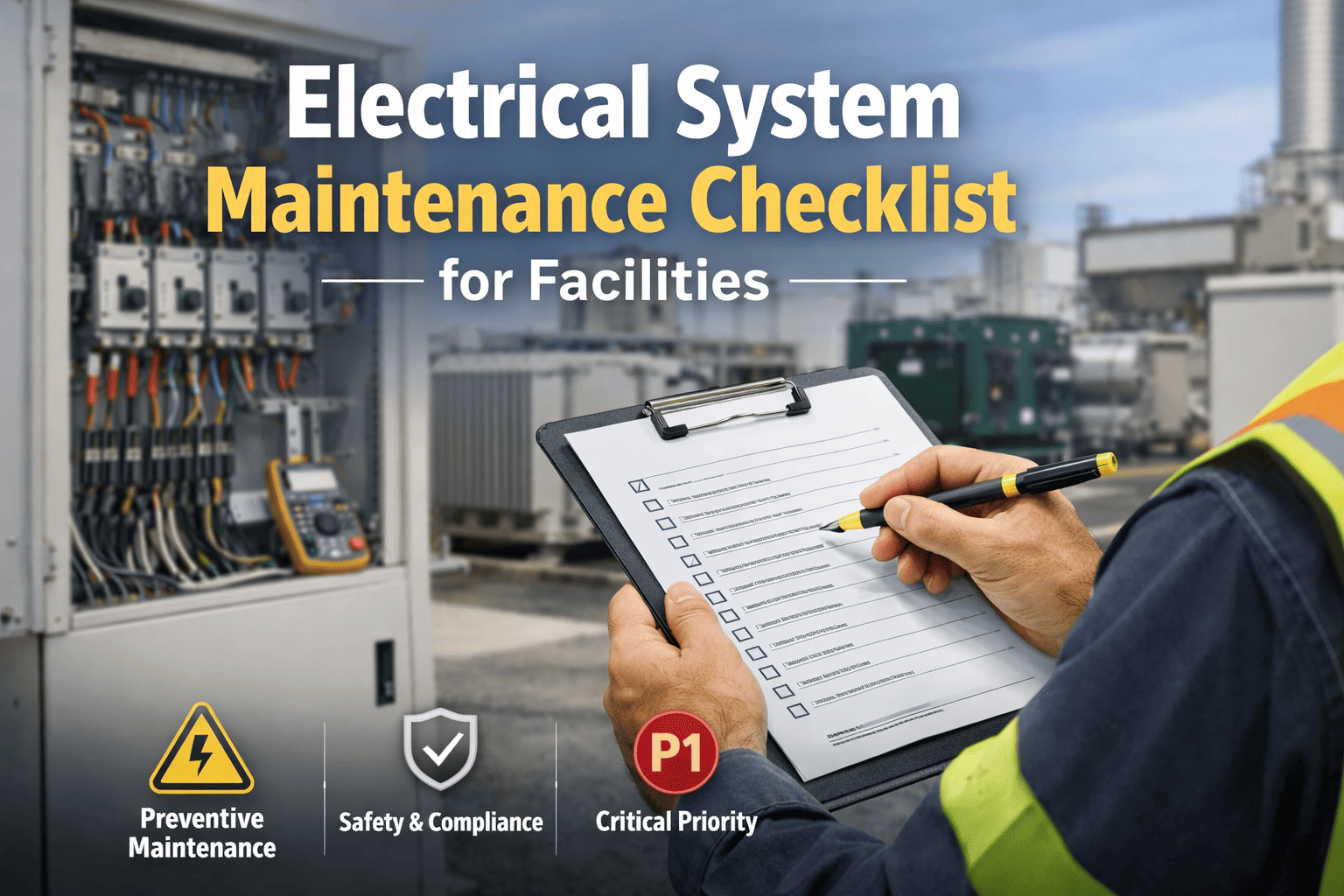
Electrical failures are responsible for over $150 billion in annual global power outage costs — and most are preventable. Facility managers who rely on reactive repairs pay 3–5× more than those running structured preventive maintenance programs. This checklist gives you every inspection point your team needs to keep panels, transformers, switchgear, generators, and grounding systems operating safely and within compliance. Start a free Oxmaint trial to digitize this checklist and auto-assign work orders to your technicians — no spreadsheets, no missed tasks.
Safety & Compliance
Preventive Maintenance
P1 — Critical
$697B
Global Electrical MRO Market 2024
40%
of electrical failures are maintenance-preventable
3–5×
Higher cost of reactive vs preventive repair
9.7%
CAGR — Industrial electrical services growth to 2030
Why This Checklist Matters
The Real Cost of Skipping Electrical PM
Arc Flash & Fire Hazard
Loose connections and degraded insulation are the leading causes of electrical fires in commercial facilities. NFPA 70E mandates arc flash analysis and regular IR thermography on energized equipment.
Unplanned Downtime
A single transformer failure in a manufacturing facility averages $250,000 in lost production per incident. Transformer insulation testing every 12 months reduces failure risk by over 60%.
Compliance Penalties
OSHA 1910.303 and local electrical codes require documented inspection records. Facilities without audit trails face fines starting at $15,625 per violation — with repeat violations reaching $156,259.
Full Inspection Checklist
Electrical System Maintenance Checklist — 6 Critical Areas
Panels
Transformers
Switchgear
Generators
Grounding
Arc Flash
01 — Electrical Panel Inspection Checklist
| Inspection Item | Frequency | Standard/Reference | Pass Criteria |
|---|---|---|---|
| Visual inspection for corrosion, moisture, physical damage | Monthly | NFPA 70B | No visible corrosion, dry interior, no mechanical damage |
| Thermal (IR) scan of all breakers and bus bars | Quarterly | NFPA 70E / NETA MTS | Temperature delta < 10°C from ambient; no hot spots > 40°C rise |
| Tighten all lugs and terminal connections to torque spec | Annually | NEC 110.14 | All terminals at manufacturer-specified torque values |
| Verify circuit breaker operation (manual trip test) | Annually | NETA MTS 7.5 | All breakers trip and reset without binding or arcing |
| Check panel labeling — all circuits clearly identified | Annually | NEC 408.4 | Every circuit labeled with load description and amperage |
| Verify panel cover seals and gaskets are intact | Semi-annually | NEMA 3R / 4X | No gaps, weatherstripping intact, IP rating maintained |
| Insulation resistance test (Megger) on feeders | Annually | IEEE 43-2013 | Minimum 1 MΩ per kV of operating voltage |
| Verify AFCI/GFCI breaker functionality where required | Monthly | NEC 210.12 | Test button trips within 25ms; resets cleanly |
02 — Transformer Maintenance Checklist
| Inspection Item | Frequency | Standard/Reference | Pass Criteria |
|---|---|---|---|
| Visual inspection — tank, bushings, cooling fins | Monthly | IEEE C57.106 | No oil leaks, no cracks, fins clear of obstruction |
| Oil sample analysis (DGA — dissolved gas) | Annually | IEEE C57.104 | Hydrogen < 100 ppm; no acetylene detected; CO < 350 ppm |
| Winding resistance measurement | Annually | NETA MTS 7.2 | Variance between phases < 1%; within 2% of nameplate |
| Core insulation resistance (Megger) | Annually | IEEE 43-2013 | PI ratio > 2.0; IR > 100 MΩ at rated voltage |
| Tap changer inspection and lubrication | Annually | Manufacturer spec | All tap positions operate; contacts clean, no burning marks |
| Cooling system check — fans, pumps, radiators | Quarterly | NFPA 70B 11.16 | Fans run at rated speed; oil temperature within limits |
| Grounding connection integrity check | Semi-annually | NEC 250.30 | Ground resistance < 5Ω; connections torqued and corrosion-free |
03 — Switchgear Inspection Checklist
| Inspection Item | Frequency | Standard/Reference | Pass Criteria |
|---|---|---|---|
| Contact resistance test — all primary contacts | Annually | NETA MTS 7.6 | Resistance within 10% of factory baseline; no burning |
| Mechanism lubrication — operating mechanisms, hinges | Annually | Manufacturer spec | Smooth operation at rated speed; no binding or stiction |
| Control wiring and secondary terminal check | Annually | NEMA SG4 | All terminals tight; no damaged insulation; labels intact |
| Dielectric withstand (hi-pot) test | Every 3 years | ANSI/IEEE C37.20 | No flashover at rated test voltage; leakage < 1mA |
| Trip and close timing test | Annually | NETA MTS 7.6.1 | Trip time within ±10% of manufacturer spec |
| Protective relay calibration verification | Annually | NERC PRC-005 | All relay setpoints within ±2% of protection coordination study |
04 — Emergency Generator Maintenance Checklist
| Inspection Item | Frequency | Standard/Reference | Pass Criteria |
|---|---|---|---|
| Monthly load test — minimum 30% rated load | Monthly | NFPA 110 8.4.2 | Engine starts within 10 seconds; voltage and frequency stable |
| Annual full-load test — 2-hour minimum | Annually | NFPA 110 8.4.2 | Rated output sustained; no alarms; coolant and oil temp within limits |
| Automatic Transfer Switch (ATS) operation test | Monthly | NFPA 110 8.3 | Transfer to generator within rated transfer time; retransfer clean |
| Fuel tank level and quality check | Monthly | NFPA 110 7.9 | Minimum 90% tank level; fuel sample clear; no microbial growth |
| Battery load test and electrolyte level check | Quarterly | IEEE 450 | Starting voltage > 1.75V/cell under load; no sulfation |
| Cooling system check — coolant level, hose condition, fan belt | Quarterly | Engine manufacturer spec | Coolant at full mark; no cracks in hoses; belt tension within spec |
| Exhaust system inspection — leaks, backpressure | Semi-annually | EPA 40 CFR Part 63 | No exhaust leaks; backpressure within engine tolerance |
05 — Grounding System Inspection Checklist
| Inspection Item | Frequency | Standard/Reference | Pass Criteria |
|---|---|---|---|
| Ground resistance test at all main electrodes | Annually | IEEE 81 / NEC 250 | < 5Ω for commercial; < 1Ω for data centers and hospitals |
| Visual inspection of all bonding conductors and connections | Semi-annually | NEC 250.64 | No corrosion, no mechanical damage, all clamps tight |
| Continuity test — equipment grounding conductors | Annually | NETA MTS 7.14 | Resistance < 0.1Ω between equipment and grounding electrode |
| Ground rod inspection — depth and condition | Every 3 years | NEC 250.52 | Minimum 8 ft depth; no significant corrosion; listed material |
| Neutral-to-ground bond verification at service entrance | Annually | NEC 250.28 | Single main bonding jumper present; no downstream neutral-ground bonds |
06 — Arc Flash & Safety Inspection Checklist
| Inspection Item | Frequency | Standard/Reference | Pass Criteria |
|---|---|---|---|
| Arc flash hazard analysis review and update | Every 5 years or after system changes | NFPA 70E 130.5 | Incident energy levels calculated; PPE categories labeled |
| Arc flash boundary and PPE label verification on all equipment | Annually | NFPA 70E 130.5(H) | All labels present, legible, and match current study data |
| PPE inventory inspection — FR clothing, face shields, gloves | Quarterly | NFPA 70E 130.7 | No damage, no contamination; within rated arc flash cal/cm² |
| Energized work permit system audit | Annually | NFPA 70E 130.2 | Permit log complete; all live work documented with justification |
| LOTO (Lockout/Tagout) procedure verification | Annually | OSHA 1910.147 | Procedures for each piece of equipment; hardware adequate; training current |
5 min
Turn This Checklist Into Live Work Orders
Oxmaint converts every checklist item into assigned, trackable work orders — with automated scheduling, mobile sign-off, and a full compliance audit trail. No spreadsheets. No missed inspections.
Inspection Frequency Reference
PM Schedule at a Glance
Monthly
- Panel visual inspection
- AFCI/GFCI test
- Generator load test
- ATS operation test
- Fuel tank level check
Quarterly
- IR thermography scan
- Transformer cooling system
- Battery load test
- PPE inventory inspection
- Generator cooling check
Semi-Annual
- Panel cover seals
- Transformer ground check
- Bonding conductor visual
- Generator exhaust inspection
Annual
- Lug torque verification
- Breaker trip test
- Oil sample analysis (DGA)
- Switchgear timing test
- Ground resistance test
- Arc flash label audit
Printable Checklist
Complete Electrical PM Checklist — Mark Tasks as Completed
Monthly Tasks
Quarterly Tasks
Semi-Annual Tasks
Annual Tasks
Industry Data
Electrical Maintenance by the Numbers
Cost of Electrical Downtime by Facility Type
Manufacturing plant
$250,000/hr
Data center
$9,000/min
Hospital
$100,000+/event
Retail / commercial
$30,000/hr
OSHA fine (single violation)
$15,625+
Expert Review
What Facility Electrical Professionals Say
"The single most overlooked item in any facility electrical PM program is connection torque verification. We see IR scans flag hot spots that turn out to be loose lugs — every time. Annual torque checks on main feeders would eliminate 60% of those findings before they ever show up on a thermal camera. Document it. Assign it. Close it. That is what a CMMS is for."
Fortune 500 Facility Operations — 12 Sites, North America
"Facilities that treat generator testing as a checkbox exercise — run it for 30 seconds, call it done — are the ones that discover their ATS hasn't transferred cleanly in three years when the power actually goes out. Load testing under real conditions, with documented runtime and output measurements, is non-negotiable for healthcare and data centers. A CMMS that closes work orders with actual readings, not just 'completed,' changes everything."
Regional Healthcare System — 6 Hospitals, 1,200+ Beds
Frequently Asked Questions
Electrical Maintenance Checklist — Common Questions
How often should a facility conduct a full electrical system inspection?
A tiered inspection schedule is the industry standard. Visual checks on panels and generators happen monthly, thermal (IR) scans and mechanical tests quarterly, and comprehensive testing including insulation resistance, contact resistance, and oil analysis annually. High-criticality facilities — hospitals, data centers, and manufacturing plants — often run semi-annual comprehensive inspections. Oxmaint lets you schedule all tiers automatically and sends reminders before each inspection window, so no frequency level is ever missed.
What is the difference between NFPA 70B and NFPA 70E and which applies to my facility?
NFPA 70B is the recommended practice for electrical equipment maintenance — it covers inspection intervals, testing methods, and maintenance procedures for all electrical equipment. NFPA 70E governs electrical safety in the workplace, specifically arc flash hazard analysis, PPE requirements, and energized work permits. Most facilities need both: 70B to structure your PM program and 70E to protect your workers during any live electrical work. Both are referenced throughout this checklist. Book a demo to see how Oxmaint maps checklist items to the correct standard and flags compliance gaps automatically.
Do I need to hire a third-party testing firm or can in-house technicians complete this checklist?
Most visual, operational, and monthly checks can be completed by trained in-house technicians. Annual high-voltage tests — dielectric withstand, Megger insulation resistance on large transformers, DGA oil sampling, and protective relay calibration — typically require NETA-certified or manufacturer-trained technicians with specialized equipment. For OSHA compliance, any energized work above 50V requires documented arc flash analysis and proper PPE regardless of who performs it. Oxmaint work orders track technician certifications against task requirements, so no unqualified person is assigned to a high-voltage task.
How does Oxmaint help with electrical PM compliance documentation?
Oxmaint creates a timestamped, technician-signed digital record for every inspection item completed. Each work order captures the date, technician, readings taken, pass/fail status, and any corrective actions initiated. For OSHA audits, insurance inspections, or NETA certification reviews, the complete documentation trail is exportable in minutes. Start a free trial to walk through the compliance reporting dashboard and see how your current paper-based records can be migrated and structured for audit readiness.
What happens when a checklist item fails — how does Oxmaint handle corrective actions?
When a technician marks an inspection item as failed in Oxmaint, the system automatically generates a corrective maintenance work order linked to the original PM record. The corrective order includes the failure description, the affected asset, recommended action, and priority level based on the criticality of the equipment. Managers see both the original inspection and the corrective action in a single asset history, giving a complete picture of equipment health without any manual follow-up. Book a demo to see the full PM-to-corrective-action workflow live.
Ready to Automate Your Electrical PM Program?
Stop managing electrical checklists on paper and spreadsheets. Oxmaint digitizes every item in this checklist, auto-schedules inspections, assigns work orders to the right technicians, and builds your compliance audit trail automatically.