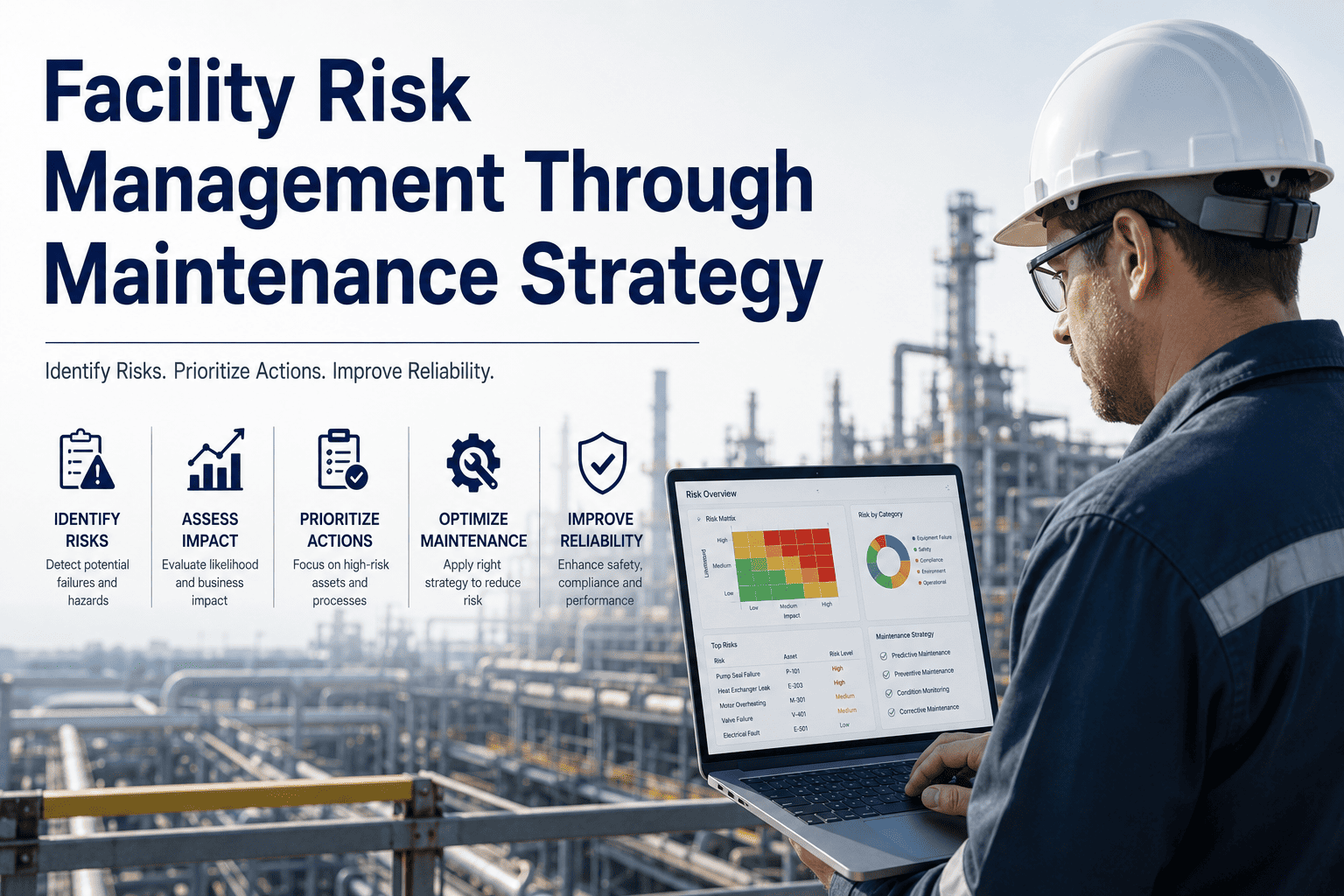
Facility risk is not a single event — it is a compounding condition. Every uninspected asset, every overdue PM, every undocumented corrective action, and every missing compliance record is a risk accumulating silently across your building portfolio. When that risk materialises — a chiller fails during peak occupancy, an elevator inspection lapses before an audit, a fire damper malfunction goes unreported — the financial and operational impact is immediate and disproportionate to what structured preventive maintenance would have cost. OxMaint's Compliance Tracking gives facility managers a real-time risk dashboard across every asset, inspection schedule, and documentation requirement — converting maintenance data into operational risk intelligence before something fails.
Facility Risk Management Through Maintenance Strategy
How preventive maintenance, structured inspections, compliance documentation, and CMMS analytics reduce the four categories of facility operational risk — before they become incidents.
Asset Failure Risk — The Cost of No Early Warning
Unplanned asset failure in a commercial facility produces costs that extend well beyond repair parts and labour. The cascade — emergency contractor rates, tenant disruption, temporary equipment hire, and potential insurance claims — typically runs 4–8x the cost of the maintenance that would have prevented it. The assets below represent the highest-consequence failure categories in a commercial facility portfolio.
| Asset | Primary Failure Mode | Warning Signal | Unplanned Failure Cost | PM Prevention Cost |
|---|---|---|---|---|
| Chiller / AHU | Compressor seizure, bearing failure | Current draw rise, vibration trend | $18,000–$65,000 | $400–$1,200 |
| Elevator | Drive failure, door system fault | Cycle count deviation, motor temp | $8,000–$35,000 + shutdown | $600–$1,800 |
| DG Set / Standby Generator | Battery failure, fuel system blockage | Test run current, battery voltage | $12,000–$50,000 + outage | $300–$900 |
| Fire Suppression System | Pump failure, valve corrosion | Pressure test deviation, flow test | $25,000–$200,000 liability | $500–$1,500 |
| Cooling Tower | Legionella colonisation, fill fouling | Water treatment logs, blowdown rate | $40,000–$500,000 liability | $800–$2,400 |
How CMMS Reduces Each Risk Category
Risk reduction in facility management is not about eliminating all failures — it is about converting unmanaged risk into managed, documented, and mitigated conditions. A CMMS achieves this by creating a structured workflow between detection, action, and verification for every asset in the portfolio.
OxMaint auto-schedules preventive maintenance based on run hours, calendar intervals, and condition triggers from connected sensors. Each PM work order captures parameter readings — bearing temperature, vibration amplitude, filter pressure drop — that build an asset baseline. Deviation from that baseline triggers an inspection before failure occurs.
Every regulatory inspection — elevator certifications, fire system tests, cooling tower Legionella assessments, electrical thermography, pressure vessel inspections — is tracked as a recurring work order in OxMaint with expiry dates, responsible parties, and document attachment fields. Upcoming expirations are surfaced 30 and 60 days in advance.
OxMaint's asset registry supports risk classification by criticality tier. Life-safety assets — fire suppression, emergency egress lighting, sprinkler systems, stairwell pressurisation — are flagged as Tier 1 critical with elevated inspection frequencies, mandatory QA sign-off, and automatic escalation if any inspection is overdue by more than 24 hours.
OxMaint's reporting dashboard tracks maintenance cost per asset, work order backlog age, repeat failure rate, and PM compliance percentage across every building in the portfolio. Operational risk concentrations — assets with high reactive-to-planned ratios, buildings with low PM compliance, or systems with escalating repair frequency — are surfaced automatically for proactive management decisions.
Risk Reduction — Before vs. After Structured Maintenance
12-month data from a 6-building commercial portfolio (850,000 sq ft) following implementation of structured PM scheduling, compliance tracking, and asset risk classification in OxMaint.
See Your Facility Risk Profile — Live
OxMaint's risk dashboard shows every overdue inspection, every compliance gap, and every asset trending toward failure — across your entire portfolio in a single view.
Compliance Documentation — What Facility Risk Audits Require
| Compliance Area | Required Documentation | Typical Retention | OxMaint Module |
|---|---|---|---|
| Elevator Safety Certification | Annual inspection cert, load test record, technician sign-off | Duration + 5 years | Asset record + expiry alert |
| Fire System Inspection | NFPA 25 quarterly/annual test records, deficiency reports, corrective actions | Minimum 3 years | Compliance WO with document attach |
| Cooling Tower (Legionella) | ASHRAE 188 water management plan, monthly treatment logs, annual risk assessment | 3 years minimum | Recurring PM WO + log capture |
| Electrical Thermography | Annual thermographic scan report, hotspot identification, corrective actions | Until next survey + 2 years | Inspection WO + report attachment |
| Emergency Lighting | Monthly function test, annual 90-minute discharge test, battery replacement record | 3 years | Monthly + annual recurring PM WO |
| Pressure Vessel / Boiler | Annual certificate of inspection, safety valve test, pressure test record | Life of vessel + 5 years | Asset cert record + 60-day advance alert |
Expert Review
The most preventable category of facility risk is not the dramatic failure — it is the documentation failure. In 22 years of facilities risk management across commercial portfolios in India and the UK, the majority of regulatory enforcement actions I have seen were triggered not by actual safety incidents, but by the inability to produce inspection records that proved the safety work was done. Elevator certifications that existed in a binder but were not retrievable during an audit. Fire system test records that were completed by the contractor but never filed against the asset. Cooling tower water treatment logs that were kept by the service provider but not transferred to the facility. A CMMS like OxMaint that attaches every compliance document directly to the asset work order eliminates this documentation risk entirely — the record is created at the point of work, signed off digitally, and retrievable in seconds from any device. That capability alone pays for the platform several times over when a regulatory inspection occurs.
Frequently Asked Questions
Every Uninspected Asset Is an Unmanaged Risk. Start Tracking Both.
OxMaint's Compliance Tracking links inspection schedules, certification records, and corrective actions into a single audit-ready system — so your facility risk profile is visible before an incident, not reconstructed after one.