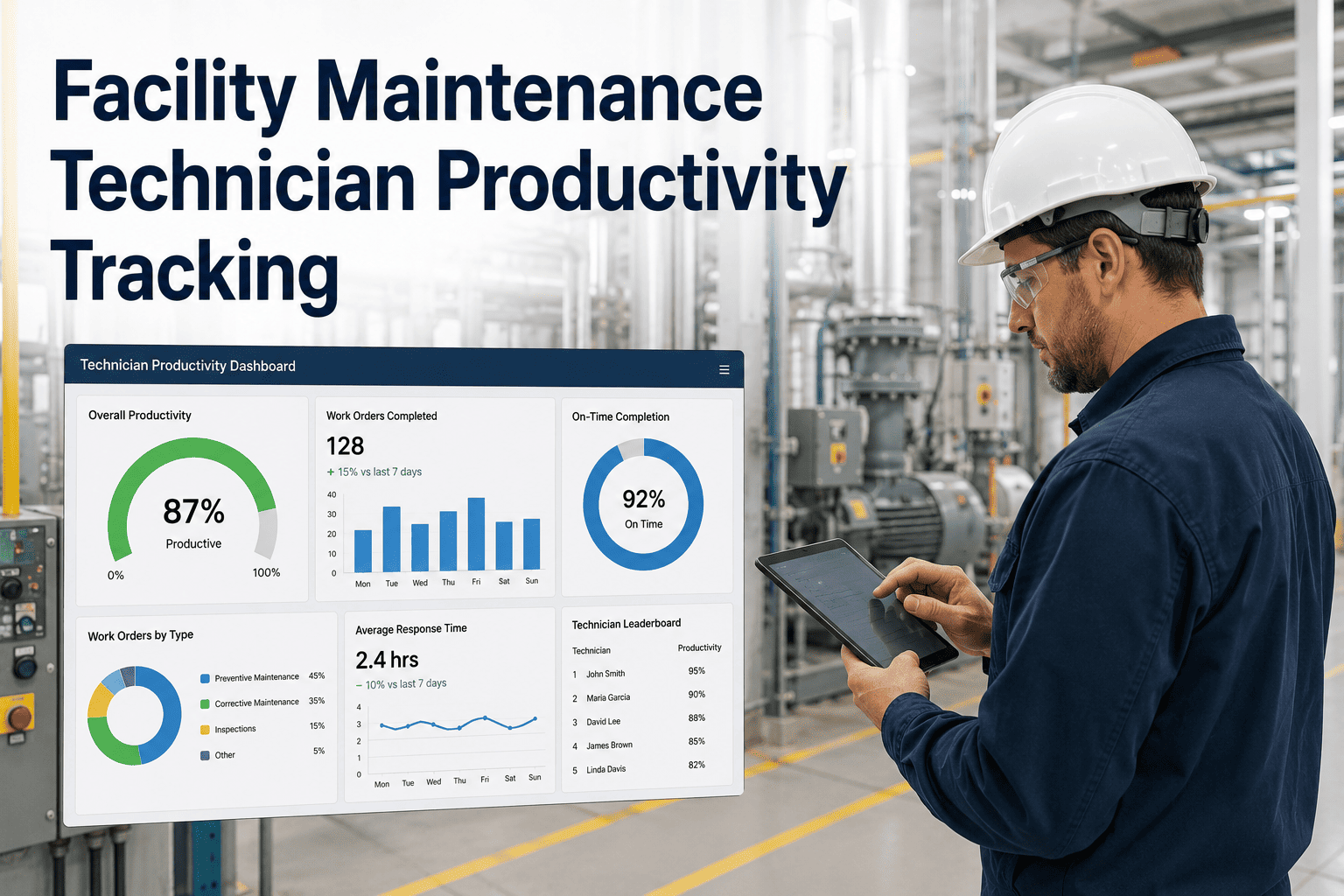
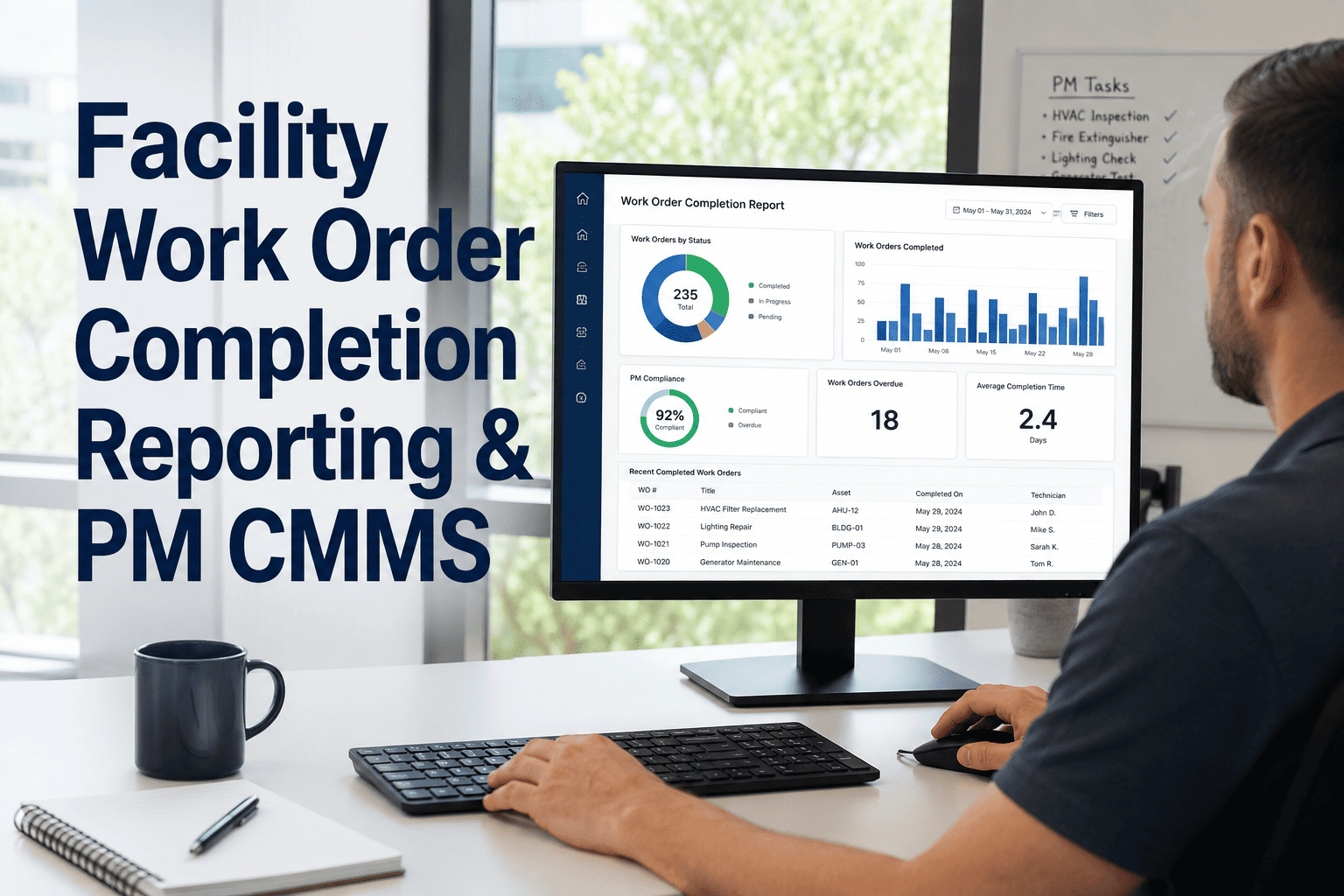
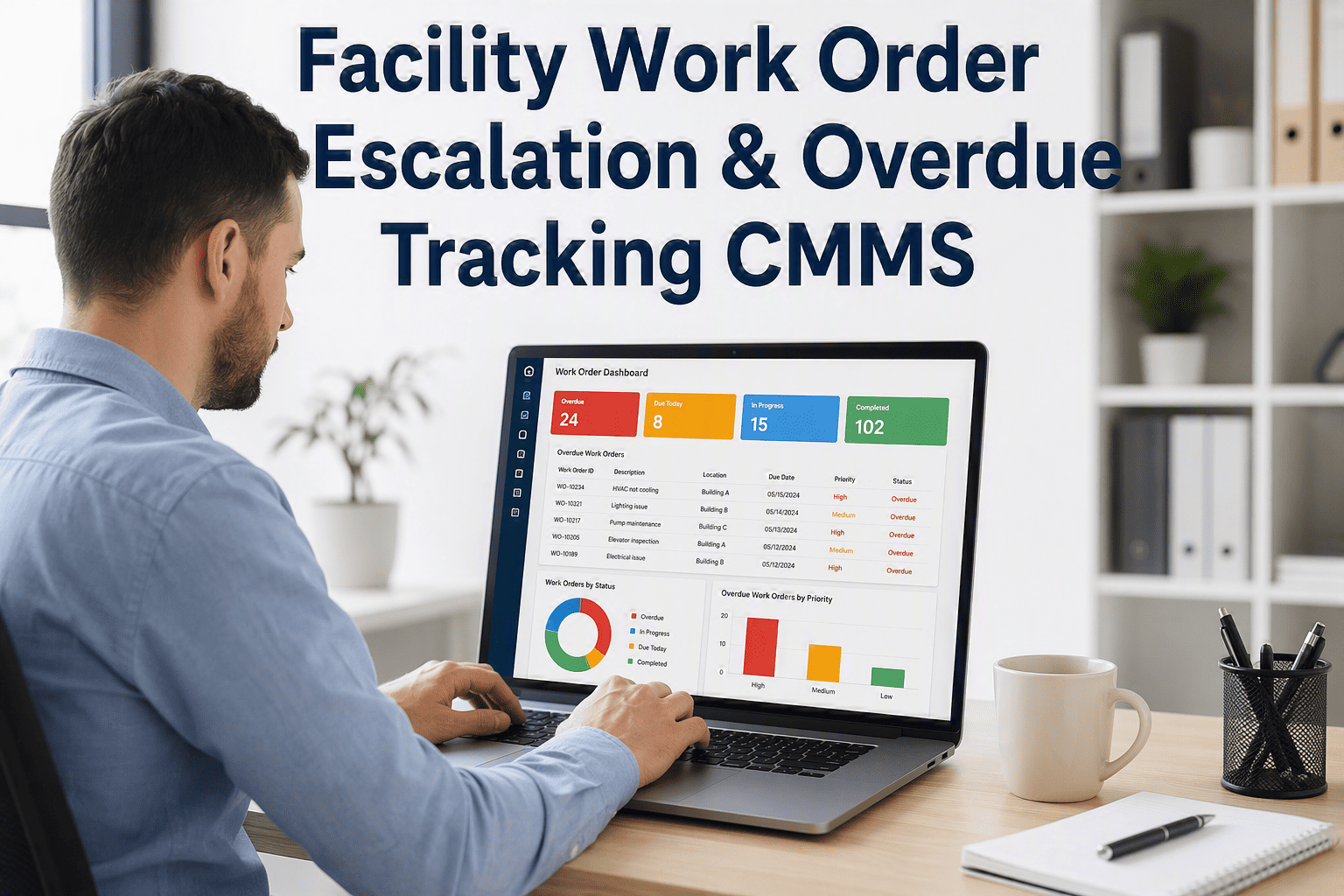
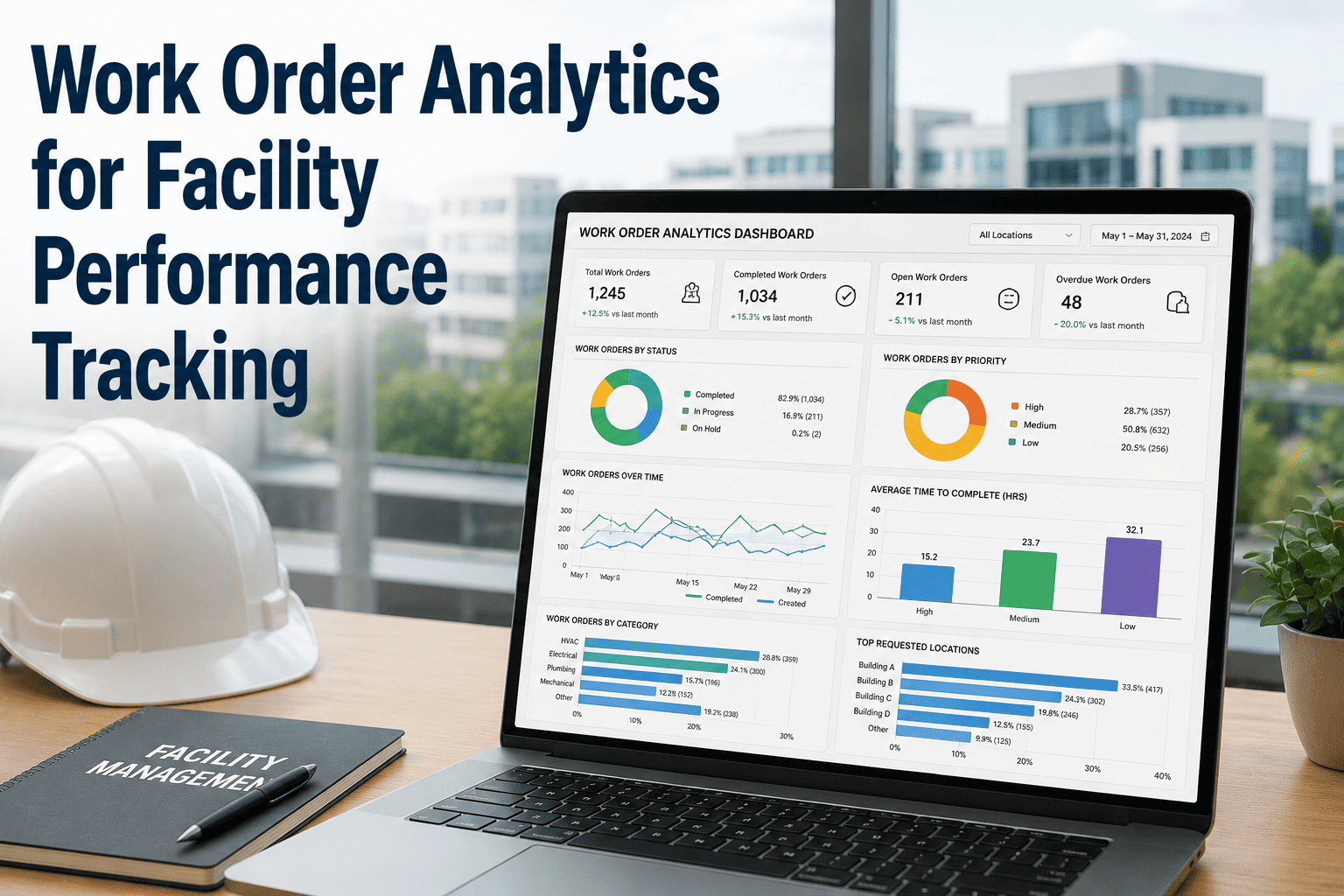
Most facility maintenance managers know their technicians are busy — but busy is not the same as productive. When work orders are dispatched on paper or by phone, wrench time goes unmeasured, travel time between assets is invisible, and the only signal that a technician's day went wrong is a complaint from a floor manager at 5 PM. OxMaint's Workforce Management module captures every measurable dimension of technician productivity — task completion rates, wrench time ratio, response times, repeat visit frequency, and work quality indicators — in real time, from the mobile devices your team already carries. This guide covers what to measure, what benchmarks to target, and how CMMS analytics convert raw activity data into workforce decisions that reduce cost and improve response.
Blog · Facility Management · Workforce Analytics
Facility Maintenance Technician Productivity Tracking
Wrench time benchmarks, completion rate targets, travel time analysis, repeat visit metrics, and work quality indicators — the complete analytics framework for facility maintenance workforce performance.
What This Guide Covers
01 · Wrench Time Benchmarks
02 · Completion Rate Targets
03 · Travel Time Analysis
04 · Repeat Visit Metrics
05 · Work Quality Indicators
06 · Live KPI Dashboard
07 · Expert Review
08 · FAQs
25–35%
Industry average wrench time — most technicians spend less than a third of their shift actually working on assets
55–65%
Target wrench time achievable with mobile work orders, route optimisation, and pre-staged parts
18%
Avg. work orders require a repeat visit due to missing parts, incomplete diagnosis, or inadequate instructions
42 min
Average time lost per technician per day to paper work orders, manual reporting, and administrative tasks
The 6 Productivity Metrics That Actually Matter
Tracking "tasks completed" is not productivity management — it is activity counting. Genuine workforce productivity analytics measure the ratio between available labour time and value-producing wrench time, identify the system-level causes of lost time, and create actionable signals for scheduling and resource decisions.
01
Wrench Time Ratio
Time spent physically working on assets ÷ total available shift time. Industry baseline: 25–35%. High-performance teams with mobile CMMS: 55–65%.
Measured via work order start/stop timestamps in OxMaint mobile app. The gap between arrival and work-start captures administrative overhead; the gap between completion and close captures documentation time.
Target: >50% wrench time ratio
02
Work Order Completion Rate
Work orders completed on time ÷ total work orders assigned in the period. Measures scheduling accuracy and technician capacity utilisation.
OxMaint tracks completion rate by technician, by asset type, by building, and by work order priority — segmenting PM completion rate from reactive completion rate to distinguish planning problems from execution problems.
Target: >90% PM completion rate · >85% reactive on-time close
03
Travel Time Percentage
Time spent travelling between assets and buildings ÷ total shift time. In multi-building facilities, travel time typically accounts for 20–35% of a technician's day.
Captured by work order location data and check-in timestamps. OxMaint's route analytics identify buildings or floors where work orders cluster — enabling scheduling that groups adjacent tasks and reduces total travel distance per shift.
Target: <20% travel time ratio in single-campus facilities
04
First-Time Fix Rate
Work orders closed without a repeat visit for the same fault within 30 days ÷ total work orders closed. Repeat visits indicate incomplete diagnosis, missing parts, or inadequate work instructions.
OxMaint automatically flags work orders that reopen on the same asset for the same fault type within 30 days. A technician with a first-time fix rate below 80% consistently signals a training gap, parts availability issue, or inadequate work instructions — not an effort problem.
Target: >85% first-time fix rate
05
Response Time to P1 Work Orders
Time from P1 work order creation to technician on-site. In commercial facilities, P1 assets include life-safety systems, chiller plant, and primary air handling equipment.
OxMaint timestamps every stage — creation, assignment, acknowledgement, arrival, and resolution. For P1 work orders, automated escalation triggers if acknowledgement exceeds 15 minutes or arrival exceeds the SLA threshold without confirmation.
Target: <30 min on-site for P1 in single-campus facilities
06
PM vs. Reactive Work Order Ratio
Percentage of total work order volume that is planned PM vs. reactive emergency. A high reactive ratio indicates a PM programme that is not preventing failures — not a workforce productivity problem.
Industry benchmark for well-managed facilities: 70–80% planned, 20–30% reactive. A facility running 60%+ reactive is systemically understaffed for prevention — adding technicians without fixing the PM programme adds cost without reducing failures.
Target: >70% planned work order ratio
OxMaint captures all six metrics automatically from mobile work order activity — no manual timesheets, no supervisor observation. Start free or book a demo to see the workforce analytics dashboard.
Productivity Benchmarks by Facility Type
Wrench time and completion rate benchmarks vary by facility type and technician role. The table below provides industry reference ranges for commercial facility maintenance operations.
| Facility Type |
Avg. Wrench Time |
PM Completion Target |
First-Time Fix Target |
P1 Response Target |
| Corporate Campus (multi-building) |
28–38% |
>88% |
>82% |
<45 min |
| Commercial Office Tower |
35–45% |
>92% |
>85% |
<20 min |
| Healthcare / Hospital |
40–52% |
>96% |
>90% |
<15 min |
| Retail / Shopping Centre |
30–42% |
>85% |
>80% |
<30 min |
| Industrial / Warehouse |
42–55% |
>90% |
>83% |
<25 min |
Before vs. After — Mobile CMMS on Technician Productivity
Measured productivity metrics from a 12-technician facility maintenance team at a 6-building corporate campus, comparing 12 months pre- and post-OxMaint mobile CMMS deployment.
Wrench Time — Before Mobile CMMS
Wrench Time — After Mobile CMMS
PM Completion Rate — Before
PM Completion Rate — After
Repeat Visit Rate — Before
Repeat Visit Rate — After
| Technician |
Active Task |
WOs Today |
Wrench Time |
Status |
| A. Sharma |
AHU-04 Filter Change · Bldg B |
6 |
62% |
On Task |
| R. Pillai |
Chiller-01 PM · Mechanical Room |
3 |
57% |
On Task |
| M. Gupta |
Travelling to Bldg D (12 min) |
4 |
38% |
In Transit |
| D. Nair |
Lift E-3 Inspection · Floor 1 |
5 |
54% |
On Task |
| S. Kumar |
Idle — 2 WOs pending assignment |
2 |
24% |
Unassigned |
See Your Team's Wrench Time, Completion Rate, and Travel Time — Live
OxMaint's Workforce Analytics dashboard gives facility managers real-time visibility into every technician's productivity metrics — without observation, timesheets, or manual reporting. Available on any device, across any number of buildings.
Expert Review
SK
Sandeep Krishnan
Director of Facilities Operations — Commercial Real Estate Portfolio, 20 years · IFMA Certified Facility Manager (CFM), IIM Bangalore
The wrench time problem in facility maintenance is systemic, not motivational. When I audit maintenance operations for underperforming portfolios, the most common finding is that technicians are spending 60–70% of their shift on everything except maintenance work — waiting for work orders, tracking down parts, filling in paper forms, travelling between assets without optimised routing, and attending briefings that could be a push notification. The shift to mobile CMMS is not about surveillance — it is about removing the friction that prevents skilled people from doing the work they were hired to do. When a technician receives a work order on their phone with the asset location, maintenance history, and required parts pre-listed, they spend zero time on coordination and 100% on resolution. In portfolios where I have overseen OxMaint deployments, wrench time typically increases from the industry average of 28–35% to 52–62% within 90 days of mobile rollout — not because technicians start working harder, but because they stop wasting time on process friction. OxMaint's Workforce Management module is the clearest path to that improvement I have seen at scale.
Frequently Asked Questions
What is considered a good wrench time ratio for facility maintenance technicians?
Industry research consistently places the average facility maintenance wrench time at 25–35% of available shift time — meaning most technicians spend less than a third of their day physically working on assets. A well-managed facility with mobile work orders, pre-staged parts, and route-optimised scheduling can achieve 50–65% wrench time. If your team is below 40%, the problem is almost never effort — it is administrative overhead, parts unavailability, and unoptimised routing.
OxMaint's Workforce Analytics measures your actual wrench time baseline within the first 30 days of deployment so you know exactly where the time is going.
How does OxMaint measure technician productivity without invasive monitoring?
OxMaint captures productivity data as a by-product of normal work order activity — not through GPS tracking or manual timesheets. When a technician opens a work order, starts a task, pauses for parts, resumes, completes, and closes — those timestamps automatically generate wrench time, travel time, and completion data. The supervisor sees aggregate metrics: average wrench time per technician, completion rate, first-time fix rate, and work order backlog age. The technician experience is simply a cleaner, faster mobile work order process.
Book a demo to see how the dashboard presents productivity data to managers vs. technicians.
What causes high repeat visit rates, and how do we reduce them?
Repeat visits — the same fault requiring a second or third work order within 30 days — are most commonly caused by three factors: incomplete initial diagnosis due to missing asset history at time of repair, parts unavailability forcing a temporary fix instead of a root cause repair, and insufficient work instructions leaving resolution to individual technician judgment. OxMaint addresses all three by pre-attaching 24-month maintenance history and OEM guides to every work order, integrating with parts inventory to flag stocking issues before dispatch, and allowing managers to add mandatory resolution fields to work order templates that enforce complete fault documentation. Typical repeat visit rate reduction after implementation: 60–75%.
How do we use productivity data to justify additional headcount or tools?
Workforce analytics from OxMaint provide the quantitative basis for headcount decisions that subjective reporting cannot. If wrench time is already at 58% and PM completion rate is consistently below 88%, the data shows a capacity problem — the team is working efficiently but does not have enough hours to cover the asset volume. If wrench time is 30% and PM completion is 65%, the problem is process friction, not headcount — and adding staff without fixing the process will not improve either metric. OxMaint's analytics module generates workforce capacity reports that separate these two conditions clearly, giving facilities managers the evidence to justify the right investment to building owners or senior management.
Your Technicians Are Already Working. OxMaint Measures How Effectively.
OxMaint captures wrench time, completion rates, travel time, first-time fix rates, and P1 response times automatically — from mobile work order activity, with zero manual reporting. See your team's actual productivity baseline in the first 30 days.