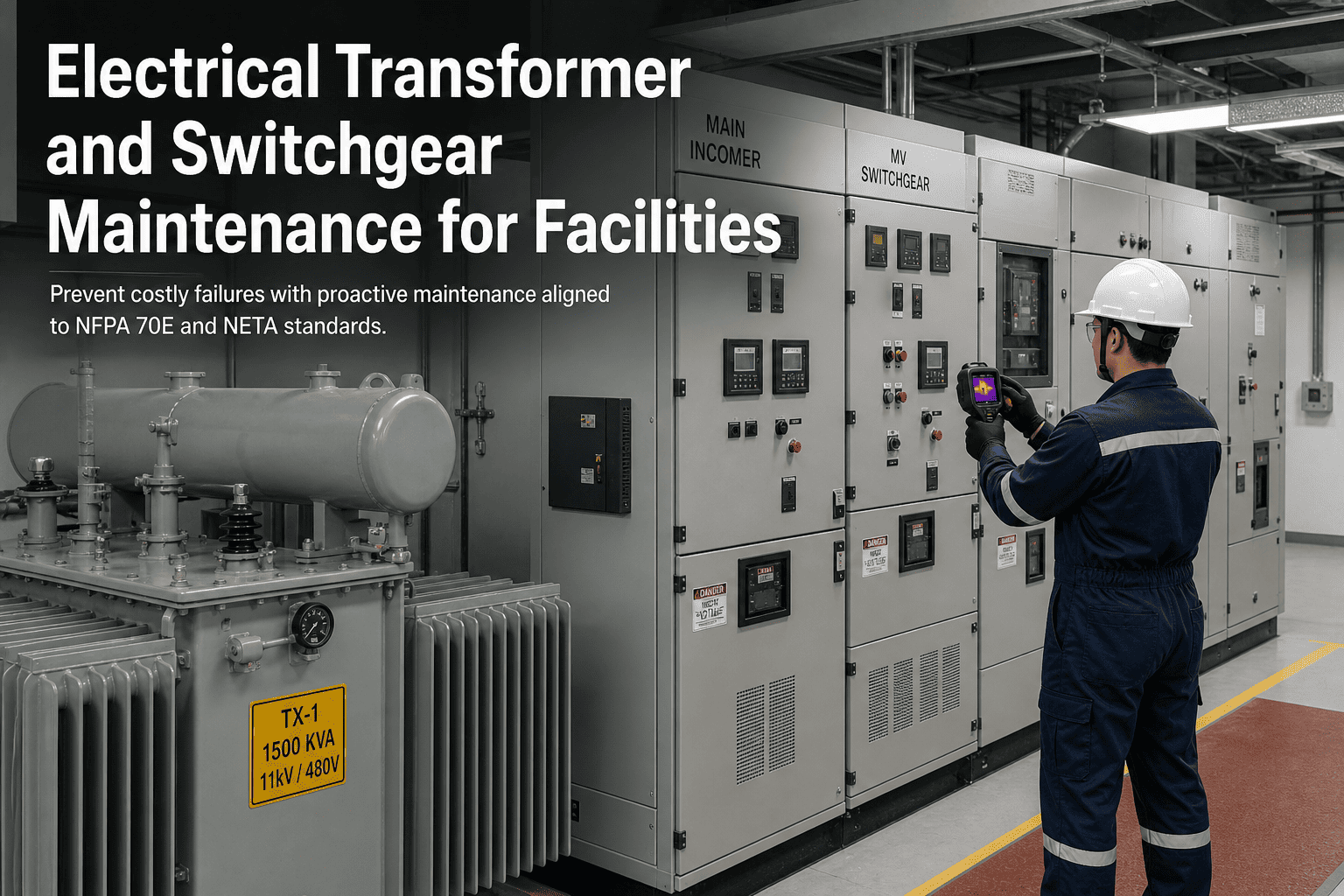
An unplanned transformer failure in a commercial facility does not just trip a breaker — it shuts down operations, voids equipment warranties, triggers insurance investigations, and in serious cases causes arc flash events that injure personnel and destroy switchgear worth hundreds of thousands of dollars. Yet the majority of medium-voltage transformer and switchgear failures in facilities are preventable. Transformer oil analysis, annual thermographic surveys, and a structured NETA-compliant maintenance schedule eliminate the failure modes that account for over 80% of unplanned electrical outages in commercial buildings. Facilities that implement a documented transformer and switchgear maintenance program under NFPA 70E requirements reduce electrical downtime by an average of 71% and cut emergency repair costs by more than half within two years. Start a free OxMaint trial to build your electrical PM program today, or book a 30-minute demo with our preventive maintenance specialists.
Root Causes of Transformer and Switchgear Failure in Facilities
Understanding the failure hierarchy is the foundation of any maintenance program. The data below is drawn from IEEE and EPRI failure analysis studies covering commercial and institutional facility electrical systems.
Build Your Electrical PM Program in OxMaint
OxMaint's Preventive Maintenance module includes pre-built electrical inspection templates aligned to NFPA 70E and NETA standards — transformer oil sampling workflows, switchgear inspection checklists, thermography record forms, and arc flash documentation — all mobile-ready for field technicians and auto-scheduled by equipment criticality.
NFPA 70E and NETA: What Facilities Must Actually Do
Two standards govern electrical maintenance in commercial facilities — and understanding how they work together is essential for building a compliant, defensible maintenance program.
Transformer Maintenance Program — Frequency and Tests
A complete transformer maintenance program combines visual inspection, oil sampling, electrical testing, and thermographic survey on a structured schedule. The table below covers the minimum required scope for liquid-filled and dry-type transformers in commercial facilities.
| Maintenance Task | Transformer Type | Frequency | Standard Reference | Key Parameter |
|---|---|---|---|---|
| Visual inspection — enclosure, gaskets, bushings, connections | Both | Monthly | NETA MTS 7.1 | No leaks, corrosion, or physical damage |
| Thermographic infrared survey — all connections and bushings | Both | Annual | NFPA 70E / NETA | Delta T <15°C vs ambient at rated load |
| Transformer oil sampling — DGA, moisture, acidity, dielectric | Liquid-filled only | Annual | NETA MTS 7.1.3 | CO2/CO ratio, moisture <25 ppm, dielectric >26 kV |
| Insulation resistance (Megger) — windings to ground | Both | Annual | NETA MTS 7.1.1 | PI ratio >2.0; IR >1000 MΩ at 1 min |
| Turns ratio test (TTR) — verify winding integrity | Both | Every 3 years | NETA MTS 7.1.2 | Within 0.5% of nameplate ratio |
| Oil filtration or reclamation | Liquid-filled only | As indicated by DGA | IEEE C57.106 | Acidity <0.5 mg KOH/g; moisture <20 ppm |
| Tap changer inspection and contact resistance test | Both | Every 3 years | NETA MTS 7.1.4 | Contact resistance within 10% of manufacturer spec |
| Grounding and bonding verification | Both | Annual | NFPA 70 / NETA | Ground resistance <5 Ω; continuity confirmed |
MV and LV Switchgear Inspection Checklist
Switchgear maintenance is the highest-risk activity in facility electrical maintenance and the most commonly deferred. Deferred switchgear maintenance is the leading contributing factor in arc flash incidents at commercial facilities. The checklist below covers both medium-voltage and low-voltage equipment.
Infrared Thermography — What to Look For and When to Act
Thermographic inspection is the single highest-value diagnostic tool in electrical PM programs. It identifies resistance heating — the precursor to every connection failure and most arc flash events — while equipment is live and under load, without interrupting operations.
| Temperature Rise (Delta T vs ambient) | NETA Severity Rating | Risk Level | Required Action | Timeline |
|---|---|---|---|---|
| 1°C — 3°C | Level 1 | Low | Note and monitor at next scheduled inspection | Next PM cycle |
| 4°C — 15°C | Level 2 | Moderate | Schedule repair at next planned outage — do not defer beyond 60 days | Within 60 days |
| 16°C — 40°C | Level 3 | Serious | Repair at earliest planned opportunity — increase monitoring frequency | Within 2 weeks |
| Above 40°C | Level 4 — Critical | Critical | De-energize and repair immediately — arc flash hazard risk elevated | Immediate |
Build Your Electrical PM Program in OxMaint
OxMaint's Preventive Maintenance module includes pre-built electrical inspection templates aligned to NFPA 70E and NETA standards — transformer oil sampling workflows, switchgear inspection checklists, thermography record forms, and arc flash documentation — all mobile-ready for field technicians and auto-scheduled by equipment criticality.
What Electrical Safety Specialists Say
Transformer and Switchgear Maintenance — Common Questions
Build Your Electrical PM Program in OxMaint
OxMaint's Preventive Maintenance module includes pre-built electrical inspection templates aligned to NFPA 70E and NETA standards — transformer oil sampling workflows, switchgear inspection checklists, thermography record forms, and arc flash documentation — all mobile-ready for field technicians and auto-scheduled by equipment criticality.




.jpeg)
