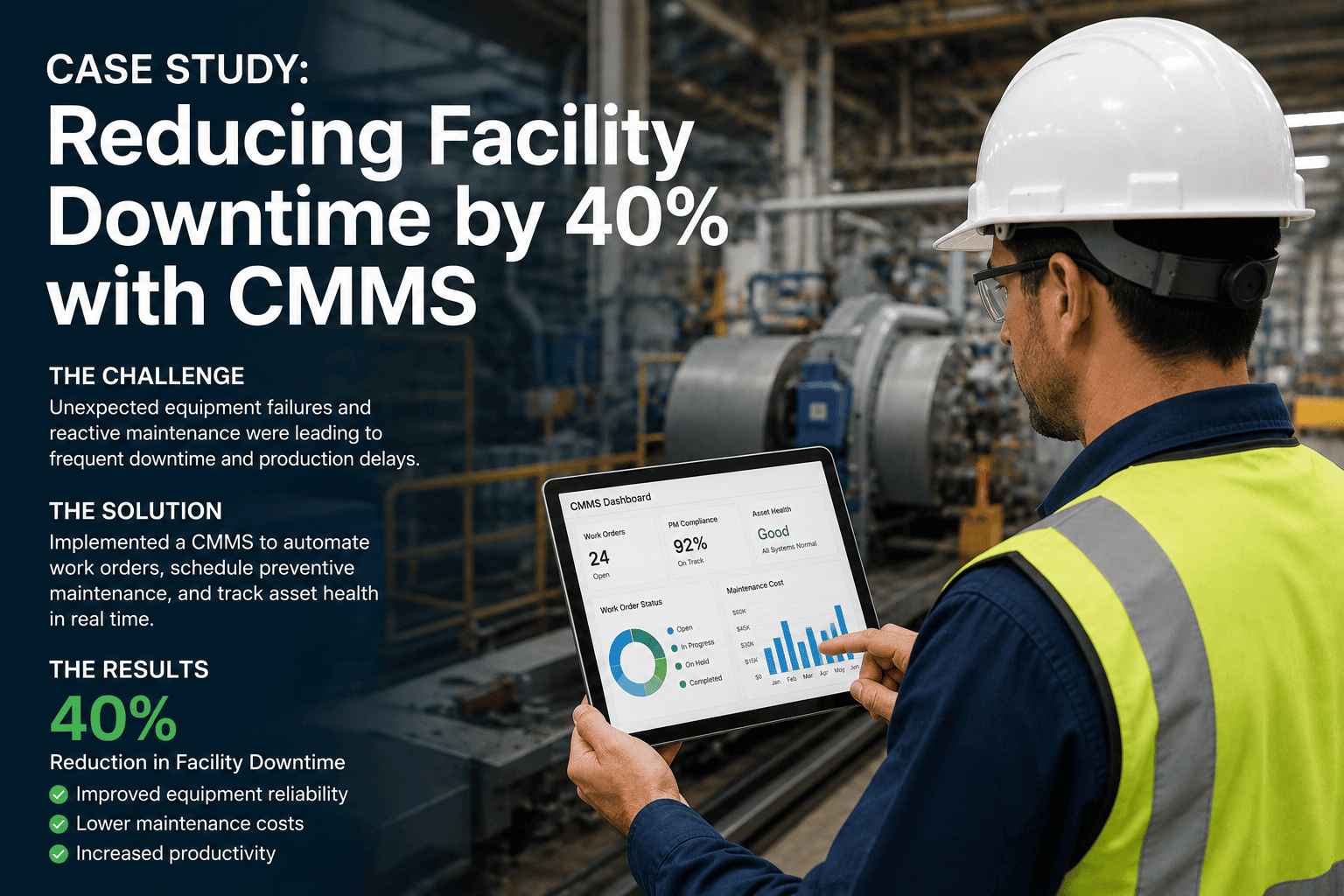
A 1.2-million-square-foot commercial property portfolio was averaging 6.4 hours of equipment downtime per incident — twice the industry benchmark — while spending 41% of its total maintenance budget on reactive repairs. The facility director had dashboards, a legacy CMMS, and a 22-person maintenance team. What was missing was the ability to see a problem before it became a failure. After deploying OxMaint's Predictive Maintenance AI, the same team — same headcount, same buildings — reduced unplanned downtime by 40% in 11 months and shifted reactive work from 41% to 19% of all work orders.
The Situation Before OxMaint
The property management company operated six Class-A commercial buildings across two metro markets. Maintenance operations ran on a combination of a decade-old work order system, spreadsheet PM schedules, and verbal technician dispatch. Equipment alarms from each building's BMS arrived in separate email inboxes — no central triage, no SLA tracking, no automatic work order creation.
What Changed: The 3 OxMaint Capabilities That Drove Results
See Predictive Maintenance in Action for Your Facility
OxMaint connects your sensor data, work order history, and PM records to flag degradation before it becomes downtime. Book a live demo and see it applied to your asset types.
Month-by-Month: How the Numbers Moved
| Milestone | Month 1–3 | Month 4–6 | Month 7–9 | Month 10–11 |
|---|---|---|---|---|
| PM Compliance | 61% | 74% | 84% | 91% |
| Reactive Work Ratio | 39% | 31% | 24% | 19% |
| Avg MTTR | 5.8 hrs | 4.1 hrs | 2.6 hrs | 88 min |
| Predictive Alerts Acted On | 4 of 6 | 9 of 11 | 13 of 14 | 16 of 17 |
| Cost per Sq Ft (annualized) | $4.85 | $4.42 | $4.01 | $3.54 |
Expert Review
The 40% downtime reduction this facility achieved is consistent with what we see across commercial portfolios that make the transition from reactive to condition-based maintenance — but the timeline is faster than average. What accelerated the result here was the combination of automated alarm-to-work-order conversion and mobile inspection data feeding the predictive model simultaneously. Most organizations implement one or the other. Running both together compounds the improvement because the AI model improves faster when it receives structured inspection readings in addition to sensor data. By month 9, this team had essentially rebuilt their maintenance program around data instead of instinct — and the KPI trajectory reflects exactly that structural shift.
Frequently Asked Questions
How long does it take to see measurable downtime reduction with OxMaint?
Most facilities see their first measurable impact within 60 to 90 days — primarily from automated alarm-to-work-order conversion reducing response lag and from PM compliance improvements catching deferred maintenance. Predictive maintenance results typically become statistically significant between months 4 and 7, as the AI model accumulates sufficient inspection and sensor data to generate reliable failure predictions. Full downtime reduction of 35 to 45% is typically achieved between months 9 and 14 for facilities starting from a reactive baseline. The case study above reached 40% reduction in 11 months with a starting reactive ratio of 41%.
What sensor infrastructure does OxMaint's predictive AI require?
OxMaint's predictive maintenance AI works across three data tiers. At the highest tier, IoT sensors (vibration, temperature, current, pressure) feed continuous data for real-time anomaly detection. At the middle tier, BMS and SCADA integration provides equipment operating parameters without additional sensor hardware. At the baseline tier, structured mobile inspection readings from technicians provide the training data for failure pattern recognition even without IoT hardware. Facilities without existing IoT infrastructure can begin with inspection-based prediction and add sensor integration incrementally as budget allows — the OxMaint platform supports all three tiers simultaneously.
What is the typical ROI calculation for predictive maintenance CMMS implementation?
The ROI calculation for CMMS-driven predictive maintenance includes four primary value streams: reactive repair cost reduction (reactive repairs cost 3 to 5 times more than planned maintenance for the same fault), equipment life extension (well-maintained assets last 20 to 40% longer than reactively maintained equivalents), energy efficiency gains (degraded equipment uses 15 to 30% more energy than maintained equipment), and administrative time savings (eliminating manual report compilation and data chasing). For a 500,000 sq ft commercial portfolio, combined annual savings typically range from $180,000 to $420,000 depending on starting baseline and asset density — producing an ROI payback period of 8 to 14 months.
Does the OxMaint predictive AI work for facilities without historical maintenance data?
Yes. OxMaint's predictive model initializes using industry-standard failure curves and OEM-specified maintenance intervals rather than requiring years of historical data. As technicians complete inspections and the system accumulates work order history, the model transitions from industry-average predictions to facility-specific failure patterns — typically achieving facility-specific accuracy by month 6. For facilities migrating from a legacy CMMS, historical work order data can be imported to accelerate model initialization. Book a demo at this link to see how the AI initializes for your specific asset types.
40% Less Downtime Is a Decision, Not a Coincidence
The facilities that reduce downtime fastest are not the ones with the biggest teams — they are the ones with the best data. OxMaint gives your existing team the predictive intelligence to act before failures happen.