Facility Inspection Checklist 2026: Complete Building Walk-Through Guide for Facility Managers
By Hana Ortaga on March 19, 2026
Commercial properties face an average of 4 to 7 regulatory inspections per year — covering fire safety, structural integrity, accessibility, energy compliance, and documentation. Most compliance failures are not caused by dangerous buildings: they are caused by poor documentation, inconsistent inspection schedules, and siloed record-keeping. Sign up for Oxmaint free and turn every checklist item below into an automated, mobile-ready digital workflow with mandatory photo capture, GPS-stamped proof of presence, and instant work order creation on every finding. As of 2026, OSHA penalties reach $16,131 per serious violation and $161,323 per willful or repeat violation — the math of proactive inspection is straightforward. This checklist covers all six critical compliance domains facility managers must walk through: structural and envelope, life safety and fire, mechanical and HVAC, electrical, plumbing and water, and ADA accessibility. Book a demo to see Oxmaint's digital inspection management configured for your building.
6Domains
60+Checklist Items
4 to 7Annual Inspections per Property
62%Violations from Documentation Gaps
Priority:Critical Life safety — legal halt if failedHigh Compliance or equipment impactStandard Required for programme completeness Check each item as you complete it
Every Item Below Becomes an Automated Digital Work Order in Oxmaint — With Photo Verification and Instant Corrective Action Tracking.
Automated scheduling. Mobile checklists. GPS-stamped photo proof. Instant work order creation on findings. Audit-ready reports in 5 minutes. 99.2% completion rate versus 60 to 70% for paper systems. Free to start.
Annual + after major weather eventsCode: IBC Chapter 17Structural engineer for 30+ yr buildings
IBC Chapter 17 mandates periodic structural assessments for occupied commercial buildings with increased frequency for structures older than 30 years or in seismic zones. Foundation crack mapping requires width measurement and photo documentation for trend comparison against prior records.
1.1 Foundation and Structural Elements
#
Inspection Item
Pass Criteria
Freq
Priority
1.1.1
Foundation perimeter — inspect for cracks wider than 1/4 inch, horizontal cracking, water staining, efflorescence, and settlement signs. Photograph and measure any crack wider than 1/8 inch against prior inspection record.
No horizontal cracks. Vertical/diagonal cracks under 1/4 inch. No active water infiltration. Photo log updated and compared to prior.
Annual
Critical
1.1.2
Structural columns, beams, and connections — inspect for visible cracks, corrosion on exposed steel, spalling concrete, and missing or damaged fireproofing materials on fire-rated members.
No active spalling. Surface rust acceptable — active section loss requires engineering assessment. Fireproofing intact on all rated members.
Annual
High
1.1.3
Floor slabs — check for cracks, heaving or depression, uneven surface above 1/4 inch per foot, delamination, and evidence of sub-slab void formation at column bases.
No cracks wider than 1/4 inch. No heaving above 1/2 inch. Surface variations within ADA slope tolerances. Trip hazards work-ordered immediately.
Annual
High
1.1.4
Roof membrane and drainage — inspect for ponding water standing more than 48 hours after rain, membrane bubbling, flashing separation at penetrations, and clogged drains, scuppers, and downspouts.
No ponding 48 hrs post-rain. Flashing sealed at penetrations. All drains clear. Membrane with no open blisters above 2 inches diameter.
Semi-Annual
Critical
1.2 Exterior Envelope
#
Inspection Item
Pass Criteria
Freq
Priority
1.2.1
Exterior walls — inspect for cracked, warped, or missing cladding; moisture intrusion signs at window sills, copings, and penetrations; sealant deterioration visible from grade level.
No missing cladding. No active water staining on interior side of exterior walls. Sealant joints continuous with no open gaps above 1/4 inch.
Annual
High
1.2.2
Windows and glazing — check for cracked or broken panes, failed perimeter seals, condensation between IGU panes indicating seal failure, damaged frames, and deteriorated sill flashings.
No cracked panes. No condensation between panes. Perimeter sealant intact. Frames secure with no racking under hand pressure test.
Annual
Standard
1.2.3
Interior surfaces — walk representative spaces checking ceilings for water staining, mold indicators, displaced ceiling tiles; floors for uneven surfaces and tripping hazards; walls for cracks or separation at joints.
No active water staining. No visible mold growth. No floor transitions above 1/2 inch. All ceiling tiles in place with no sagging.
Quarterly
Standard
DOMAIN 1 COMPLETEAll structural and envelope items documented. Open findings work-ordered to responsible party. Records filed in Oxmaint asset history. Next inspection date auto-scheduled.
Oxmaint CMMS
Structural and envelope findings photo-documented on mobile, auto-filed against the building asset record, and corrective work orders routed to the right contractor automatically — no manual translation step. Book a demo to see structural inspection tracking live.
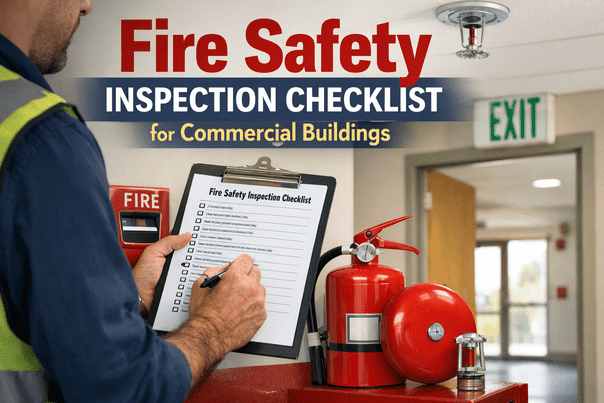
Highest-stakes domain — building closure for failuresCodes: NFPA 10, 25, 72, 101Licensed contractors required for annual certs
A fire door that passes its annual swing test still fails compliance if the adjacent fire-rated wall assembly was penetrated during a tenant improvement and never re-inspected. Digital systems catch cascading dependencies that paper cannot. Building closure orders, insurance cancellations, and criminal liability result from life safety failures.
2.1 Fire Extinguishers — NFPA 10
#
Inspection Item
Pass Criteria
Freq
Priority
2.1.1
Monthly visual inspection — confirm each extinguisher in designated location, accessible with no obstructions within 3 feet, gauge in green zone, no visible physical damage, pull pin seal intact, inspection tag current with inspector initials and date per NFPA 10 Section 7.2.1.
Tag current within 31 days. Gauge in green zone. Accessible. Seal intact. All pass criteria documented in monthly log.
Monthly
Critical
2.1.2
Annual professional maintenance — full inspection per NFPA 10 Section 7.3, including internal examination at required intervals, hydrostatic test per schedule. Service tag with licensed contractor name and date attached.
Annual service tag current. 6-year teardown and 12-year hydrostatic test intervals met per type. Certificate on file retrievable from Oxmaint.
Annual
Critical
2.1.3
Mounting heights and travel distances — Class A extinguishers within 75 feet travel, Class B within 50 feet; top of unit no more than 5 feet above floor for under-40-lb units per NFPA 10 Section 6.1.3; correct type for occupancy hazard class.
Travel distances within code. Mounting heights within code. Correct class for occupancy. NFPA 10 Section 6.1 compliance confirmed.
Annual
High
2.2 Fire Alarm — NFPA 72 and Sprinkler — NFPA 25
#
Inspection Item
Pass Criteria
Freq
Priority
2.2.1
Fire alarm panel visual check — confirm FACP shows no trouble, supervisory, or alarm conditions. Record panel status and battery backup indicator. Verify monitoring service contract current with documentation on file.
Panel in normal condition — no active faults. Battery backup within specification. Monitoring service current. Panel check log entry completed.
Monthly
Critical
2.2.2
Annual full fire alarm system test — every initiating device tested with sensitivity readings for smoke detectors, every notification appliance and supervisory signal tested per NFPA 72 Chapter 14. Certificate generated and filed.
Certificate current. All smoke detectors within listed sensitivity range. No devices in trouble or bypassed status without approved cause. Certificate stored in Oxmaint.
Annual
Critical
2.2.3
Sprinkler quarterly visual — verify all control valves fully open, no obstructed sprinkler heads (no storage within 18 inches), no painted or corroded heads, test alarm switches per NFPA 25 Table 5.1.
All valves fully open and locked. No obstructed, painted, or corroded heads. Alarm valve test documented. NFPA 25 quarterly compliance confirmed.
Quarterly
Critical
2.2.4
Sprinkler annual inspection — main drain test to confirm water supply pressure, full flow test at inspector's test connection per NFPA 25. Certificate filed with water authority where required by jurisdiction.
Annual certificate current. Main drain test documented. Flow test results on file. No findings requiring immediate correction. Certificate in Oxmaint.
Annual
Critical
2.3 Egress and Emergency Lighting — NFPA 101
#
Inspection Item
Pass Criteria
Freq
Priority
2.3.1
Daily egress path check — physically walk all exit routes to confirm clear of obstructions, exit doors operable without special knowledge or keys, no propped-open fire doors, no storage in stairwells or corridors.
All exit routes clear. Exit doors open from inside without keys. Fire doors closed and latched. Stairwells clear of all storage. Log entry completed.
Daily
Critical
2.3.2
Monthly 30-second emergency lighting test — simulate power failure and confirm all emergency luminaires illuminate and all exit signs display. Record pass/fail per unit per NFPA 101 Section 7.9.3.
All luminaires illuminate within 10 seconds. All exit signs illuminated. Monthly log with unit ID, result, and initials current within 31 days.
Monthly
Critical
2.3.3
Annual 90-minute battery discharge test — simulate power failure for 90 continuous minutes. Confirm all emergency lighting maintains minimum 1 foot-candle at floor level throughout full duration. Document results per unit.
All units maintain illumination for full 90 minutes. Minimum 1 fc at floor throughout. Failed units replaced before next business day. Certificate on file.
Annual
Critical
DOMAIN 2 COMPLETEAll life safety certificates current. Monthly log entries complete. No open critical findings without active work orders. Records retrievable from Oxmaint in under 5 minutes for any regulatory visit.
62% of Violations Are Documentation Failures
Facilities using Oxmaint digital inspection management document zero violations on consecutive audit cycles after migrating from paper. The change is documentation completeness, not building condition. See the digital inspection workflow live.
40 to 60% of FM spend — highest maintenance cost domainCodes: ASHRAE 62.1, 90.1Monthly visual + quarterly maintenance
A 25-year-old chiller operating at 40% efficiency generates $15,000+ in annual electricity overage versus a modern unit. Condition-based PM inspection is the correct approach for systems with 15 to 25 year design lives — Oxmaint tracks each unit's age, condition score, and maintenance history to generate replacement timing alerts 2 to 3 years before end-of-life.
#
Inspection Item
Pass Criteria
Freq
Priority
3.1
Air handling units — filter condition and pressure drop measurement, coil surfaces clean with no biological growth, belt condition and tension, drain pan clear with no standing water, condensate line unobstructed, filter change date logged in CMMS.
Filter pressure drop below change threshold. Coils clean. Belt within tension spec. Drain pan dry. Change-out date recorded against AHU asset record in Oxmaint.
Monthly
Critical
3.2
Chiller and boiler operating conditions — verify operating pressures, temperatures, and efficiency indicators against manufacturer baseline; confirm water treatment programme current with records; inspect for visible leaks at connections; safety relief valve sealed and within test date.
Operating parameters within 5% of design. Water treatment log current within 30 days. No active leaks. Safety relief valve within test date.
Monthly
Critical
3.3
Cooling tower — inspect basin for debris, scale, and biological growth; verify blowdown and makeup water rates; confirm chemical treatment records current and meeting Legionella risk management plan requirements for the tower type and building risk category.
Basin clean with no biological slime. Chemical treatment records current. Legionella WMP requirements met. Treatment programme documentation on file.
Monthly
Critical
3.4
BAS and controls — verify setpoints for occupied/unoccupied modes, confirm communication to all terminal units, check for overridden or permanently locked-out zones, log outside air intake operation per ASHRAE 62.1 for compliance records.
All zones communicating with BAS. No permanently overridden zones without documented reason. OA intake per ASHRAE 62.1 schedule. Energy use logged.
Quarterly
Standard
3.5
Ductwork — visual inspection for disconnections, damage, missing access panel covers, insulation condition on exposed runs in unconditioned spaces, and supply/return balance indicators in representative occupied zones.
No open duct disconnections. Insulation intact on all exposed ductwork. Access panels secured. No visible contamination in accessible sections.
Annual
High
3.6
Kitchen exhaust — grease filters in place and cleaning frequency current against NFPA 96 hood usage hour schedule; makeup air unit operational; exhaust fan speed adequate per design; no grease accumulation in ductwork beyond schedule threshold.
Grease filters clean per NFPA 96 interval for usage level. Cleaning log current. Makeup air operating. Fan running at design speed without vibration.
Quarterly
High
DOMAIN 3 COMPLETEAll HVAC items recorded. Filter changes logged against asset records in Oxmaint. Open findings work-ordered to mechanical contractor. Efficiency deviation alerts set for aging equipment.
DOMAIN 4
Electrical Systems
Electrical failures cause 18% of commercial building fires — NFPA dataCodes: NFPA 70 (NEC), NFPA 70B, NFPA 70EIR thermographic scan annually per NFPA 70B
Extension cords used as permanent wiring is one of the most cited fire code violations. Confirm 36-inch clearance in front of all electrical panels at every walkthrough. NFPA 70B recommends thermographic surveys of all switchgear annually to detect hot spots indicating loose connections or overloaded circuits before arc flash incidents occur.
#
Inspection Item
Pass Criteria
Freq
Priority
4.1
Electrical panels — confirm 36-inch clear working space in front of each panel, covers secured, all breakers labeled legibly, no warm panels or discolored breakers, no signs of water intrusion inside enclosures.
36-inch clearance confirmed. All breakers labeled. No warm panels. No discolored breakers. Covers secured. No water staining inside enclosures.
Quarterly
Critical
4.2
Infrared thermographic survey — scan all switchgear, panel boards, transformers, and bus connections using calibrated IR camera per NFPA 70B. Temperature differentials above 18°F versus similar components under same load documented and work-ordered.
No differential above 18°F (10°C) vs. similar components. Hot spots above 54°F (30°C) above ambient trigger immediate corrective work order. Survey report filed.
Annual
Critical
4.3
GFCI and AFCI protection — test and reset all GFCI receptacles in wet locations (bathrooms, kitchens, exterior, mechanical rooms). Confirm AFCI breakers operational in required locations per NEC 210.12. Failed devices replaced before occupancy.
All GFCI devices trip within NEC test parameters. AFCI breakers operational. No GFCI devices in fail position without replacement work order in progress.
Quarterly
High
4.4
Emergency generator — check fuel level (75% minimum), confirm monthly 30-minute run-under-load log current within 31 days, transfer switch operation confirmed, annual full-load test record on file per NFPA 110. Diesel fuel dated — degrades after 6 to 12 months.
Fuel above 75%. Monthly test log current. Annual full-load test on file. Transfer switch within NFPA 110 transfer time. Fuel freshness within 12-month maximum.
Monthly
Critical
4.5
Extension cord and temporary wiring audit — walk all occupied spaces to confirm no extension cords used as permanent wiring, no daisy-chained power strips in non-office locations, no overloaded circuits evidenced by warm receptacles or tripped breakers.
No extension cords as permanent wiring. No daisy-chained strips. No warm receptacles. Any violation documented, work-ordered for removal, and corrected before next walkthrough.
Semi-Annual
High
DOMAIN 4 COMPLETEElectrical inspection complete. IR thermographic survey results filed. Generator test log current. Open electrical findings routed to licensed electrician via Oxmaint work order.
26 Hours Per Week Recovered
A 500,000 sq ft office complex saved 26 hours per week previously spent compiling paper records after migrating to Oxmaint. Every compliance certificate stored digitally — retrievable in under 5 minutes, not 40 hours. Book a demo to see the compliance dashboard.
Plumbing, Water Systems, and Domestic Water Safety
Backflow: annual statutory test, filed with water authorityLegionella: mandatory in high-risk building typesCode: Local plumbing code + ASSE 1013
#
Inspection Item
Pass Criteria
Freq
Priority
5.1
Backflow preventer annual test — arranged with licensed tester, test results documented per jurisdiction requirements, test report filed with water authority within required period. Device accessible and not bypassed.
Annual test certificate on file. Filed with water authority per local requirement. Device passes test. No bypass valves open. Certificate stored in Oxmaint with next due date.
Annual
Critical
5.2
Domestic hot water — verify temperature at representative fixtures meets ASHRAE 188 requirements for Legionella risk management (120°F minimum at heater, 110°F minimum at fixtures for scalding balance). Water heater condition and anode rod inspection.
Hot water at 120°F minimum at heater. Fixtures above 110°F. Legionella Water Management Plan current for high-risk building types. Anode rod condition logged in Oxmaint.
Quarterly
Critical
5.3
Pipe and valve inspection — walk accessible mechanical spaces checking for active leaks, corrosion on copper, galvanized, or steel piping, water staining on adjacent surfaces, and proper identification labels on all shut-off valves.
No active leaks. No green patina indicating active copper corrosion. All shut-off valves labeled and operable. Insulation intact on cold water lines.
Semi-Annual
High
5.4
Floor drains, sump pumps, and storm drains — test sump pump under load, confirm float switch activates pump at correct level, verify floor drain strainers in place and clear, confirm storm drain discharge path unobstructed with no erosion at outfall.
Sump pump starts on float activation and runs until dry. Floor drains clear with strainers in place. Storm drain discharge unobstructed. Sump pump test log entry completed.
Semi-Annual
Standard
DOMAIN 5 COMPLETEBackflow certificate filed with water authority. Hot water temperatures logged. Open plumbing findings work-ordered. All records filed in Oxmaint building asset history.
DOMAIN 6
ADA Accessibility, Site Conditions, and Environmental Safety
ADA violations: average fine $250,000 — most common FM lawsuit triggerCode: ADA Standards for Accessible DesignOSHA 29 CFR 1910.147 for LOTO
ADA violations generate some of the most expensive enforcement outcomes in facility management. A strip mall recently faced a $250,000 lawsuit for lacking accessible parking and compliant restroom facilities. ADA compliance inspections require systematic coverage of path of travel, parking, restrooms, signage, and elevator controls — most of which are absent from standard building walkthroughs.
#
Inspection Item
Pass Criteria
Freq
Priority
6.1
Accessible path of travel — walk from accessible parking to primary building entrance and through to all floors. Confirm route free of barriers, slopes within 1:20 for accessible routes and 1:12 for ramps, surface transitions below 1/2 inch.
Route continuous without barriers. Slopes within ADA limits. Surface transitions below 1/2 inch. Accessible entrance door opening force under 5 lbs (interior).
Annual
Critical
6.2
Accessible parking — count spaces versus required ratio per ADA Standards Table 208.2, verify at least one van-accessible space per cluster, confirm ISA signs installed per ADA 502.6, check surface cross-slopes within 1:48.
Space count meets table requirement. Van-accessible space marked. ISA signage installed. Cross-slope within 1:48. No spaces blocked by cart corrals or landscaping.
Annual
Critical
6.3
Accessible restrooms — verify 60-inch turning radius clear, grab bar heights at 33 to 36 inches AFF per ADA Section 609, mirror bottom at or below 40 inches AFF, lavatory knee clearance 27 inches minimum, flush control on accessible side.
60-inch turning radius clear. Grab bars at 33 to 36 inches AFF. Mirror at or below 40 inches AFF. Knee clearance met. Door hardware lever type or compliant.
Annual
High
6.4
Site conditions — parking lot and sidewalks for cracks, potholes, faded striping, and broken curbs. Site drainage directs water away from foundation. All handrails 34 to 38 inches AFF and guardrails 42 inches minimum, secure without wobble under hand loading.
No cracks above 1 inch wide. Striping legible. Drainage away from foundation. Guardrails 42 inches minimum. No wobble under hand loading. Trip hazards immediately work-ordered.
Semi-Annual
High
6.5
LOTO compliance — confirm LOTO station devices present and in good condition per OSHA 29 CFR 1910.147, authorized employee training records current within training interval, energy control procedures posted at each machine that requires them.
LOTO devices complete at each station. Training records current. Energy control procedures posted per 1910.147(c)(4). No substituted or improvised lock devices in use.
Annual
Critical
6.6
Eyewash and safety shower — monthly activation per ANSI Z358.1 (10-second minimum flush), confirm within 10-second travel time from all chemical hazard areas, path of travel clear, water temperature 60 to 100°F, monthly log current.
Monthly test log current. Water flows tepid (60 to 100°F). Within 10-second travel of all chemical hazards. Path clear. Nozzle caps remove freely. Drain functional.
Monthly
Critical
ALL DOMAINS COMPLETEAll six inspection domains completed and findings documented. Open corrective work orders active in Oxmaint. Complete inspection package retrievable for any regulatory visit in under 5 minutes. Annual inspection cycle resets automatically in Oxmaint.
Frequently Asked Questions
Facility Inspection Checklists — What Facility Managers Ask First
How often should each inspection domain be checked — and what are the legal frequency minimums in 2026?
Legal minimums vary by system and jurisdiction. The critical monthly minimums are: fire extinguisher visual checks under NFPA 10 Section 7.2.1, emergency lighting 30-second tests under NFPA 101 Section 7.9.3, fire alarm panel visual checks, and eyewash station activation tests under ANSI Z358.1. Sprinkler systems require quarterly visual inspections per NFPA 25. HVAC filters require monthly checks in most occupancies. Annual statutory requirements include: fire alarm full test with certificate (NFPA 72), sprinkler annual inspection (NFPA 25), fire extinguisher professional maintenance (NFPA 10), backflow preventer test filed with water authority, elevator inspection per ASME A17.1, and the 90-minute emergency lighting battery discharge test per NFPA 101. The most common compliance failure is treating monthly-required inspections as annual — creating documentation gaps that regulators treat as evidence of non-maintenance. Oxmaint generates every inspection work order automatically at the legally required frequency, escalates overdue items before compliance gaps form, and stores all records for instant retrieval. Sign up free to configure your building's automated inspection schedule, or book a demo to see the frequency matrix in action.
Why do facilities fail compliance audits even when inspections are being conducted?
The answer is documentation failure, not inspection failure. Research across commercial properties shows 62% of building code violations stem from documentation gaps — not actual structural or safety deficiencies. Three specific documentation failures cause most compliance findings. First, records not immediately retrievable: paper forms filed in a building office are not available for review during an unannounced enforcement visit, and inspectors treat this identically to inspections never conducted. Second, no photo evidence: OSHA and fire marshal inspectors increasingly require GPS-stamped photographic documentation proving physical presence at each inspection point — a checkmark on a form without a timestamped photo does not satisfy enforcement scrutiny. Third, corrective actions not formally tracked: a deficiency noted on a paper form that was never converted to a work order, never assigned, and never closed represents an open gap that generates repeat findings with escalating penalties. As of 2026, OSHA willful and repeat violations reach $161,323 per violation. Oxmaint addresses all three simultaneously: GPS-stamped photos required for all critical items, all findings auto-generate tracked work orders, all records retrievable in under 5 minutes. Book a demo to see documentation-first inspection management, or sign up free to start today.
How long must inspection records be retained for each domain?
Retention requirements differ by system. Fire extinguisher inspection records under NFPA 10 must be retained for at least one year, with annual professional maintenance records kept for the life of the extinguisher. Fire alarm inspection and test reports under NFPA 72 require one year minimum, with the prior inspection report always on-site. Fire sprinkler records under NFPA 25 require one year for quarterly records and three years for annual inspection records. Elevator inspection certificates must be posted in the cab, with three years of prior certificates in the building file in most jurisdictions. Emergency lighting test logs under NFPA 101 require one year. OSHA inspection and corrective action records require five years under OSHA 29 CFR 1904. ADA compliance assessments should be retained indefinitely as litigation evidence. Backflow preventer test records should be kept for the life of the device plus three years after removal. Oxmaint stores all records digitally with configurable retention periods and instant retrieval. Sign up free to start your compliant record archive, or book a demo to see retention management across a multi-building portfolio.
How does Oxmaint convert this checklist into a managed compliance programme — and how quickly can my team be live?
Oxmaint converts every item in this checklist into a recurring digital work order with the correct frequency, required photo capture fields, severity rating options, and automatic corrective work order creation on any failed item. The six inspection domains are configured as standardized digital checklists in Oxmaint, each item mapped to its required inspection frequency. Recurring work orders generate automatically and route to the inspector responsible for each domain. Inspectors complete checklists on the Oxmaint mobile app with mandatory GPS-stamped photos for critical items and severity flags for any finding. Critical findings instantly create corrective work orders pre-routed to the relevant trade contractor. All completions, photos, and corrective actions are stored in a searchable dashboard with full audit trail. Certificate and permit expiry dates tracked with 90/60/30-day advance alerts. Complete compliance documentation for any regulatory visit generated in under 5 minutes. Most commercial buildings are fully live in Oxmaint within days — cloud-based, mobile-first, no IT infrastructure, no hardware, no implementation project. Book a demo to see your building's checklist domains configured live, or sign up free to start immediately.
Oxmaint · Digital Facility Inspection and Compliance Management
This Checklist Is the Starting Point. Oxmaint Is Where It Becomes Automated, Tracked, and Audit-Ready — Free to Start.
All 60+ items across 6 inspection domains become automated recurring digital work orders. GPS-stamped photo verification. Instant corrective work order creation. Certificate tracking with 90/60/30-day alerts. Portfolio compliance dashboard. Audit reports in 5 minutes. OSHA, NFPA 10/25/72/101, ADA, and IBC coverage. Free to start. No IT project. No implementation fees.




.jpeg)
