Restroom cleanliness is the single most complained-about facility issue in commercial buildings, retail centres, airports, and corporate campuses — and it is also one of the most operationally inefficient areas of facility management. Traditional restroom service schedules are time-based: clean every 2 hours regardless of whether the restroom served 400 people or 12 in that interval. The result is over-service in low-traffic periods, under-service at peak usage times, and SLA records that say "scheduled cleaning completed" while occupants post negative reviews about the actual condition. OxMaint's work order management platform changes this by linking restroom service dispatch directly to occupancy triggers, sensor data, and real-time service request signals — so cleaning happens when it is needed, not just when the clock says so. Book a demo to see smart restroom automation in action or start a free trial on OxMaint.
Blog · Janitorial Operations · Work Order Management · Smart Buildings
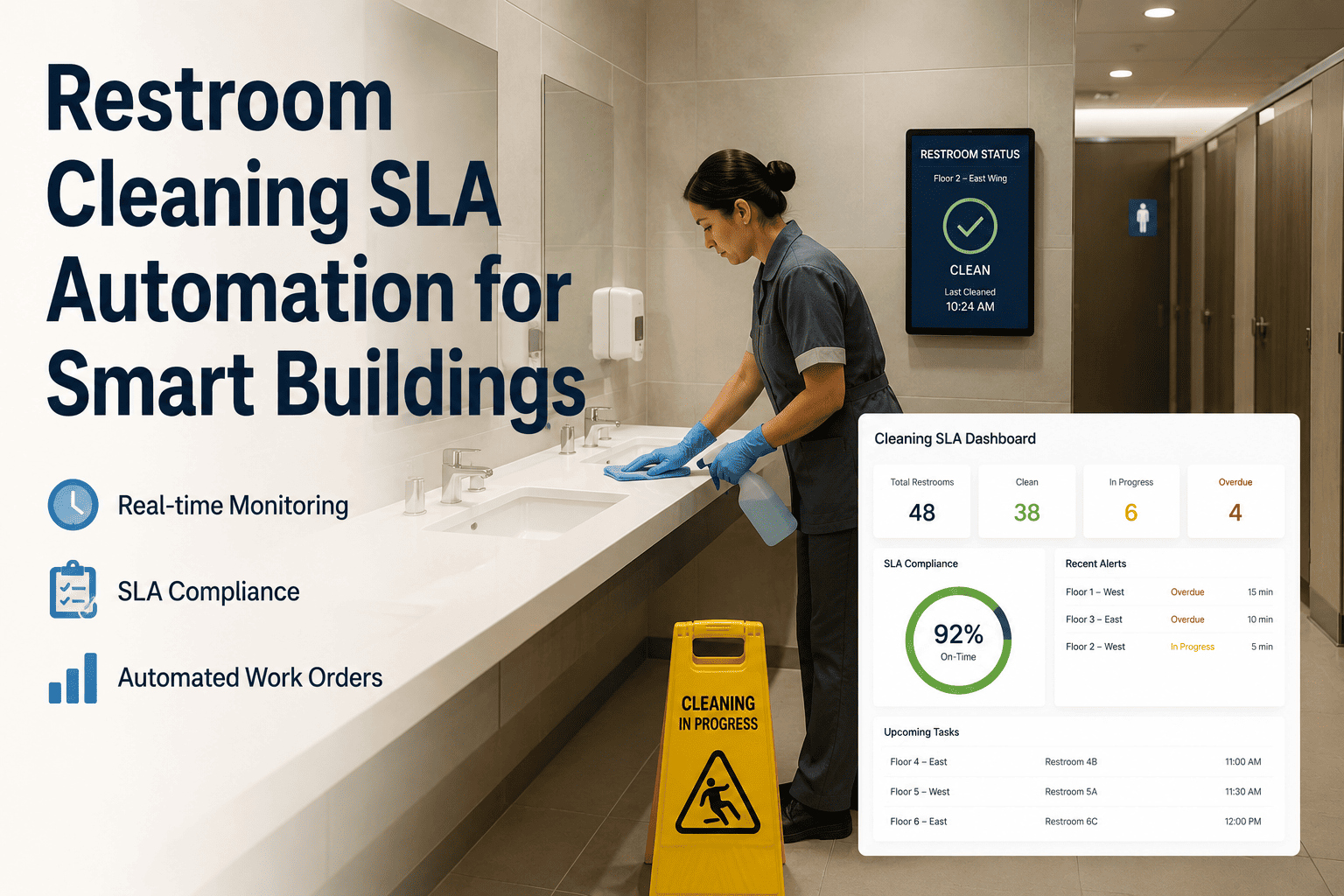
Restroom Cleaning SLA Automation for Smart Buildings
How occupancy-triggered dispatch, automated SLA tracking, and performance dashboards are replacing clipboard-and-schedule restroom management — and why tenant satisfaction scores follow immediately.
73%
Of facility complaints in commercial buildings are restroom-related
40%
Janitorial labour wasted on time-based service of low-occupancy restrooms
28%
Reduction in restroom complaints after occupancy-based dispatch deployment
Why Time-Based Restroom Scheduling Fails — and How SLA Automation Fixes It
Time-based restroom scheduling was designed for a pre-sensor world where occupancy data was not available and interval-based service was the only manageable approach. In smart buildings where people counting, IoT dispensers, and digital service request panels are already installed, continuing to schedule cleaning by the clock is leaving operational efficiency and tenant satisfaction on the table.
Time-Based Scheduling
Fixed 2-hour service intervals regardless of restroom usage
No record of actual condition at time of service — only that service occurred
SLA compliance = task completed on schedule, not restroom actually clean
Complaints arrive at facilities desk with no restroom-level history to reference
Supervisor verification requires physical rounds — unscalable across large portfolios
OxMaint SLA Automation
Service dispatched when occupancy threshold is met — regardless of clock interval
Technician records condition at service: paper level, soap, floor condition, odour
SLA measured against condition outcome and response time — not just schedule adherence
Complaint arrives with full restroom history: last service, condition recorded, technician assigned
Real-time dashboard shows service status for every restroom — no physical rounds required
How Occupancy-Triggered Dispatch Works
OxMaint's restroom automation integrates with three types of data sources to generate service dispatch signals — each applicable at a different building technology maturity level. Facilities without sensor infrastructure can start with QR-code service requests and build toward full sensor integration incrementally.
Level 1
QR Code Service Request Panel
Applicable to: Any building · No sensor infrastructure required
A QR code panel posted in each restroom allows occupants to submit a service request in 10 seconds — selecting the issue type (paper out, soap out, cleaning needed, maintenance issue). The request creates an OxMaint work order with priority level, restroom location, and issue type — routed to the nearest available janitorial team member.
SLA measured: Time from service request submission to technician check-in at restroom
Level 2
People Counter Occupancy Thresholds
Applicable to: Buildings with entrance people counters or footfall analytics
OxMaint connects to building occupancy data (people counters, badge access, HVAC occupancy sensors) to estimate restroom usage. When a restroom's estimated usage count crosses a configurable threshold — say, 75 uses since last service — OxMaint auto-generates a service work order. Threshold values are configurable by restroom type, floor, and time of day.
SLA measured: Response time after auto-trigger, plus condition outcome at next service
Level 3
IoT Dispenser and Sensor Integration
Applicable to: Buildings with smart dispensers (Tork, Kimberly-Clark, etc.)
Smart dispensers report paper level, soap level, and usage count in real time via cloud API. OxMaint receives these feeds and generates restocking work orders before dispensers reach empty — eliminating the occupant complaint that follows an empty soap dispenser. Combined with odour or air quality sensors, this delivers the highest fidelity service signal available without manual inspection.
SLA measured: Dispenser refill response time, out-of-stock duration, occupant complaint rate
OxMaint integrates with your existing building systems — people counters, smart dispensers, QR panels — to automate restroom service dispatch without replacing any hardware. Book a demo to see the integration for your building type.
SLA Definitions — What to Measure and What to Avoid
Many restroom cleaning SLAs are written to measure activity — cleaning tasks completed — rather than outcomes — restroom condition. The table below contrasts common SLA metrics that create compliance theatre with outcome-based SLAs that reflect actual service quality.
| SLA Metric | Activity-Based (Problematic) | Outcome-Based (OxMaint Standard) |
| Service frequency |
Every 2 hours, regardless of usage |
Within 45 minutes of occupancy threshold trigger |
| SLA compliance definition |
Service task marked complete in CMMS |
Service completed + condition checklist passed |
| Complaint response |
Routed to facility desk — no restroom history |
Auto-generates work order with last service record attached |
| Supervisor verification |
Physical rounds — not scalable, spotty coverage |
Real-time dashboard + photo evidence on work order closure |
| Dispenser management |
Checked during each service visit — reactive refill |
IoT level monitoring — proactive refill before empty |
| Performance reporting |
Tasks completed / total tasks scheduled = compliance % |
Response time, condition pass rate, complaint rate per restroom |
The Performance Dashboard — What Facility Managers Can See
OxMaint's restroom operations dashboard gives facility managers real-time visibility into service status, SLA performance, and complaint trends across every restroom in their portfolio — without leaving their desk or conducting physical rounds.
Restrooms currently clean47 / 52
Service work orders in progress3
Overdue service (SLA breach)2
Open occupant service requests4
Average response time to trigger22 min
SLA compliance rate (response time)94.2%
Condition checklist pass rate97.8%
Dispenser out-of-stock events0
Level 3 North — 6 complaintsInvestigate
Lobby South — 3 complaintsMonitor
Level 7 East — 2 complaintsMonitor
All other restrooms0–1 complaints
Service tasks completed today84
Tasks dispatched by sensor trigger61 (73%)
Tasks dispatched by occupant request14 (17%)
Time-based tasks (remaining)9 (10%)
Expert Review
RB
Rachel Burke, CFM, LEED BD+C
Director of Facilities · 12-Building Corporate Campus · IFMA Certified Facility Manager · Smart Building Technology Specialist
The restroom complaint is the canary in the coal mine for tenant satisfaction. When tenants in a commercial building are complaining about restrooms, it means the janitorial programme is not responsive — not that the building has too many restrooms or too few cleaning staff. In every building I have managed, the shift from time-based to occupancy-triggered service reduced restroom complaints by 25–35% within 60 days, without adding any headcount. The mechanism is simple: you stop cleaning restrooms that have had 8 visitors since the last service and start cleaning the ones that have had 150. The labour is the same; the allocation is smarter.
PO
Patrick O'Brien, MBA
VP of Operations · Integrated Facility Services Provider · 18 Years Janitorial Contract Management · BSCAI Board Member
From the service provider side, SLA automation changes the commercial relationship between building owners and janitorial contractors in a fundamental way. When SLA compliance is measured by task completion only, the contractor's incentive is to document activity. When it is measured by response time and condition outcome — with real-time dashboard visibility that the building owner shares — the incentive shifts to actual performance. I have seen this change reduce SLA disputes between clients and service providers by 80% in the first year, because both parties are looking at the same data in real time. That transparency is worth as much as the operational efficiency gains in most contracts.
Frequently Asked Questions
Does OxMaint work with our existing smart dispenser brand, or do we need to replace hardware?
OxMaint integrates with the leading smart dispenser platforms via cloud API — including Tork EasyCube (Essity), Kimberly-Clark Professional, Cascades PRO Tandem, and Georgia-Pacific enMotion. For buildings using non-connected dispensers, OxMaint's mobile inspection workflow provides a structured restroom check-in that captures dispenser levels manually — which still enables condition-based SLA tracking and service history documentation, just without the real-time low-level alerts. Most facilities find that deploying smart dispensers in the highest-traffic restrooms first (typically 30–40% of total restrooms by count but 70%+ of usage volume) delivers the majority of the efficiency benefit before a full building rollout.
Book a demo to see the dispenser integration for your specific hardware.
How do you handle after-hours and weekend restroom service when occupancy patterns are unpredictable?
OxMaint's SLA automation includes configurable service windows and after-hours staffing rules. During after-hours periods when reduced janitorial coverage is scheduled, the occupancy threshold triggers are automatically adjusted upward — requiring a higher usage count before dispatch — and minimum service interval rules (e.g., at least one service every 4 hours regardless of trigger) can be applied to ensure baseline coverage. For facilities with weekend events, OxMaint's event scheduling feature allows temporary override rules to be applied to specific restrooms during defined time windows, restoring normal occupancy-based dispatch automatically when the event window closes.
Start a free trial to configure your after-hours rules.
How does OxMaint's restroom SLA reporting work for janitorial contract compliance documentation?
OxMaint's SLA reporting module generates a contractual compliance report for any date range — showing response time per work order, condition checklist results per service, dispenser out-of-stock events, complaint rate per restroom, and overall SLA compliance percentage by building, floor, or restroom type. Reports are exportable to PDF or Excel for inclusion in monthly contract review packages. For performance-based janitorial contracts where service fees are tied to SLA compliance scores, OxMaint's dashboard serves as the shared measurement system that both parties review — eliminating the separate tracking and reconciliation process that manual documentation requires.
See the SLA reporting module in a live demo.
SMART BUILDINGS · RESTROOM AUTOMATION · OXMAINT
Stop Scheduling Restroom Cleaning by the Clock — Start Triggering It by Occupancy
OxMaint connects to your building's occupancy data, smart dispensers, and service request panels — dispatching cleaning when it is needed, tracking SLA compliance by outcome, and surfacing the top-complaint restrooms before tenants escalate to management. Most buildings see complaint reduction within 60 days of deployment.