Fire Safety Maintenance Checklist: NFPA 25, NFPA 72 Sprinkler and Alarm Inspection Schedules for FM Teams

By Jhon Polus on March 23, 2026

fire-safety-maintenance-commercial-buildings-nfpa

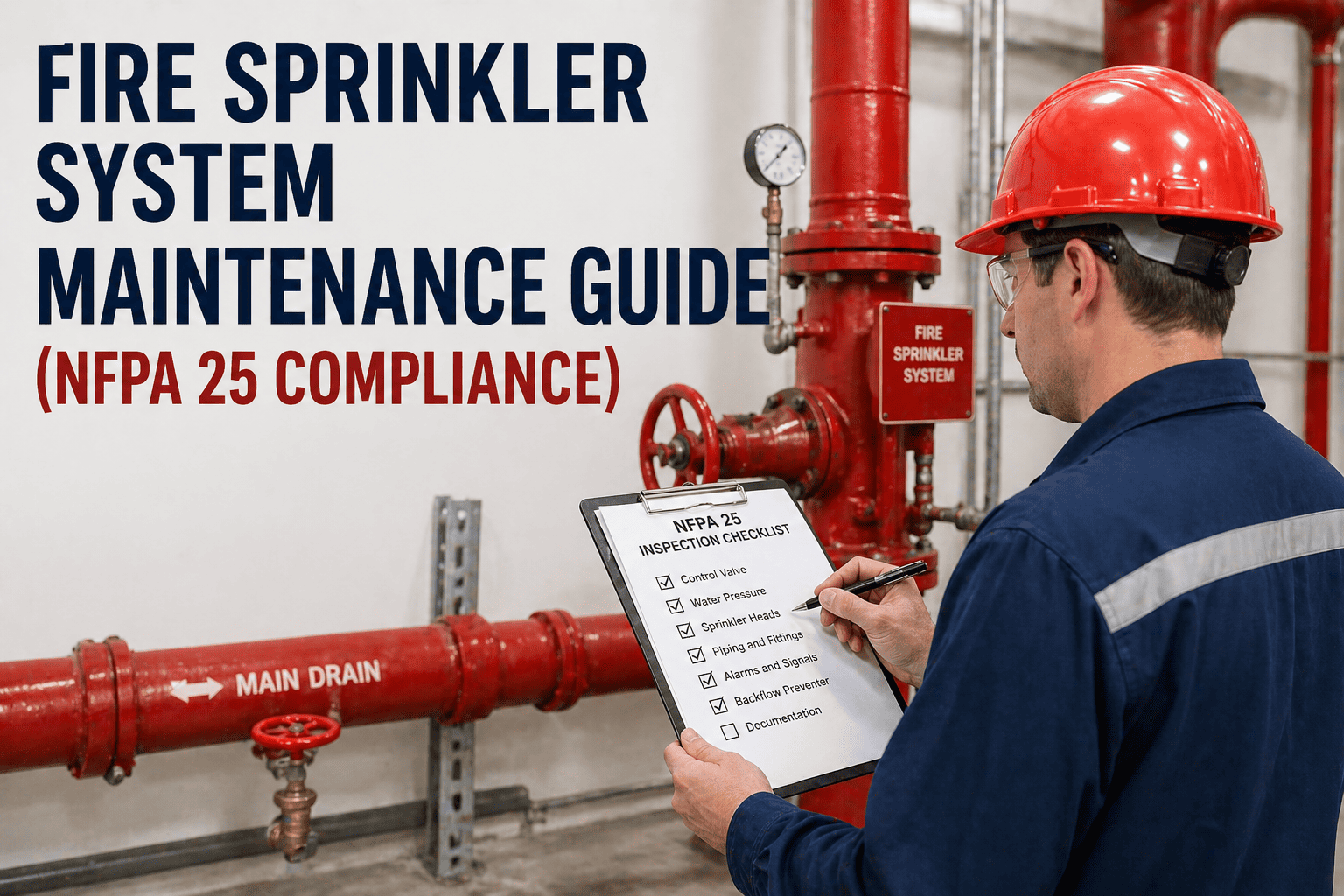
NFPA 25 requires quarterly inspections of wet pipe sprinkler control valves and annual main drain flow tests. NFPA 72 mandates semi-annual fire alarm panel inspections and annual functional testing of every detection device and notification appliance in the building. NFPA 10 requires monthly visual checks and annual licensed inspections of every fire extinguisher. NFPA 101 Life Safety Code demands monthly 30-second and annual 90-minute emergency lighting tests. These are not guidelines. They are enforceable compliance obligations backed by AHJ citation authority, fire marshal enforcement, and insurance policy voidance risk when documentation cannot be produced on demand. For FM teams managing commercial buildings, healthcare facilities, educational campuses, and multi-tenant office properties, fire safety maintenance is a structured, interval-driven programme that generates a paper trail an inspector can review at any time without advance notice. This checklist defines every fire protection inspection obligation across NFPA 25, NFPA 72, NFPA 10, NFPA 101, and building code requirements, organized by system type and inspection interval, with acceptance criteria for each item and the documentation format inspectors require. Sign up free to schedule every fire safety inspection as a recurring PM task in Oxmaint, or book a demo to see CMMS-tracked fire protection compliance documentation configured for your building portfolio.

Compliance Checklist Fire Safety Maintenance Checklist: NFPA 25, NFPA 72 Sprinkler and Alarm Inspection Schedules for FM Teams 10 to 12 min read
Quarterly
NFPA 25 minimum inspection interval for wet pipe sprinkler control valves, gauges, and alarm devices in commercial buildings
Semi-Annual
NFPA 72 minimum inspection interval for fire alarm control panels and accessible smoke detectors in occupied buildings
Monthly
NFPA 101 minimum testing interval for emergency lighting (30-second test) and exit signage visual condition check
84%
Compliance audit preparation time saved by FM teams using CMMS fire safety documentation vs manual paper registers

Schedule Every NFPA 25, NFPA 72, and NFPA 10 Inspection as a Recurring PM Task in Oxmaint

Oxmaint pre-loads fire protection inspection intervals as recurring PM tasks linked to each fire system asset. Completion logs automatically with technician attribution, test result, and timestamp. Every deficiency generates a linked corrective work order. AHJ inspectors get an on-demand compliance export in under 60 seconds.

How to Use This Fire Safety Maintenance Checklist

This checklist organizes fire protection inspection obligations by system type and inspection interval. Each section defines what must be inspected, the acceptance criterion that determines pass or fail, and the documentation format the AHJ or fire marshal will expect to see. Complete each section at the stated interval and log results with technician name, date, and test outcome before signing off. Deficiencies must be linked to corrective work orders with target completion dates before the inspection record is closed.

1
Complete each system section at its stated minimum interval. Do not defer quarterly tasks to annual cycles even when the building appears fully compliant during visual review.
2
Record the actual observed or measured condition against each acceptance criterion. Pass and Fail entries both require documentation. A pass with no recorded evidence is not a compliant record.
3
Photograph any deficiency with a location reference before marking it for corrective action. Photos stored in Oxmaint link directly to the asset record and deficiency work order.
4
Log inspector name, license number where required, inspection date, and building address as header data. AHJ citation risk increases significantly when inspection headers are incomplete or missing.
Severity Classification
Critical Immediate corrective action required. Notify AHJ if system is impaired. Do not defer.
Action Corrective work order required before next inspection cycle. Document and assign.
Monitor Log condition and increase inspection frequency. Escalate if condition worsens.
Pass Condition meets acceptance criterion. Document result and inspector sign-off.

NFPA 25: Sprinkler System Inspection, Testing and Maintenance Checklist

NFPA 25 (Standard for the Inspection, Testing and Maintenance of Water-Based Fire Protection Systems) defines the minimum inspection, testing, and maintenance intervals for wet pipe, dry pipe, deluge, and pre-action sprinkler systems. All tests must be performed by a licensed contractor and documented in a format acceptable to the AHJ. Deficiencies must be corrected within a timeframe acceptable to the AHJ and a re-inspection record generated.

Monthly NFPA 25 Monthly Inspections
Inspect all sprinkler heads in the building for physical damage, corrosion, paint overspray, or obstruction within 18 inches below the deflector. Acceptance: no damaged, corroded, or painted heads. No obstructions within the 18-inch clearance zone below any deflector.Action
Verify all sprinkler system control valves are in the fully open position and locked or supervised with a tamper switch connected to the fire alarm system. Acceptance: all valves fully open, tamper switch supervision active, no valves in a partially or fully closed condition.Critical
Check sprinkler gauges on wet pipe systems for correct pressure reading. Acceptance: supply pressure within the design range shown on the hydraulic nameplate. No gauges reading zero or below minimum design working pressure.Action
Quarterly NFPA 25 Quarterly Inspections
Inspect all wet pipe sprinkler control valves, alarm valves, and check valves for position, condition, and accessibility. Record valve number, location, position (open/closed), and supervising condition. Acceptance: all control valves fully open, no leaks at valve body or packing gland.Critical
Inspect alarm valve trim, accelerator, and water motor gong for condition and proper function indication. Check trim valve positions match as-installed configuration. Acceptance: all trim valves in correct position, no leaks, water motor gong drain clear and unobstructed.Action
Inspect gauge readings on both sides of all alarm valves, dry pipe valves, and pre-action valves. Record actual pressure readings against design values. Acceptance: supply pressure within 10 psi of hydraulic nameplate design pressure.Action
Inspect fire department connection (FDC) caps, clappers, and accessibility. Verify FDC is visible, accessible, and free of obstructions within 3 feet. Acceptance: caps in place, clappers operational, no debris in FDC inlets, signage legible and visible from street.Monitor
Inspect sprinkler system piping for corrosion, mechanical damage, missing hangers, and pipe support conditions. Verify sprinkler pipe clearance from structural elements is maintained per original design. Acceptance: no corrosion beyond surface oxidation, all hangers intact, minimum 1-inch clearance maintained.Monitor
Annual NFPA 25 Annual Tests and Inspections
Conduct main drain flow test to verify unobstructed water supply to the sprinkler system. Record static pressure, residual pressure during full flow, and flow rate. Compare to previous year's test data. Acceptance: residual pressure within 10% of prior year reading. Significant drop indicates supply degradation requiring investigation.Critical
Test waterflow alarm device (water motor gong or electronic flow switch) by opening inspector's test valve. Time from valve opening to alarm activation. Acceptance: alarm activates within 60 seconds of water flow initiation at the inspector's test valve.Critical
Test all alarm valve and alarm check valve trim by flowing water through inspector test connection. Verify alarm initiates at fire alarm control panel and in monitoring center within acceptable time. Acceptance: FACP alarm activation within 90 seconds of inspector test valve opening.Critical
Exercise and exercise-test all OS and Y gate valves, butterfly valves, and indicating valves through full open and full close travel. Verify valve operates freely without tools and returns to full open position. Acceptance: smooth operation through full travel, valve position indicator matches actual valve position, no valve requires tools or excessive force.Action
Test anti-freeze loop concentration where anti-freeze systems are installed to protect sprinklers in unheated spaces. Record specific gravity and corresponding freeze protection temperature. Acceptance: solution freeze point at least 10 degrees below the lowest recorded ambient temperature in the protected space.Action
Inspect fire pump (where installed) for correct pump rotation, unusual noise or vibration, packing gland condition, and bearing lubrication. Conduct no-flow churn test for minimum 10 minutes. Acceptance: churn pressure within 5% of name plate shutoff pressure, no unusual noise or vibration, all gauges operational.Critical
5-Year NFPA 25 Five-Year Tests
Conduct internal pipe inspection of sprinkler system to check for MIC (microbiologically influenced corrosion), debris, scale, or tuberculation that could obstruct sprinkler heads or reduce flow capacity. Acceptance: no MIC confirmed, debris loading below NFPA 25 Table 14.2.1 thresholds, no obstructions at sprinkler head drops.Action
Conduct obstruction investigation on all sprinkler systems where internal pipe inspection reveals debris or where water supply tests indicate flow degradation from the previous year test. Includes flushing of system and confirmation of clear flow path to the hydraulically most remote sprinkler head.Action
Replace sprinkler heads that have been in service for 50 years (standard response) or at intervals specified by the manufacturer for fast response heads. Conduct sample testing of sprinkler heads per NFPA 25 Table 5.4.1.1 at 50-year intervals or 25 years for fast response heads.Action

NFPA 72: Fire Alarm System Inspection and Testing Checklist

NFPA 72 (National Fire Alarm and Signalling Code) defines inspection, testing, and maintenance requirements for fire alarm control panels, detection devices, notification appliances, and monitoring connections. All testing must be documented on NFPA 72 Form 72A or an AHJ-equivalent format. Deficient devices must be cleaned or replaced and re-tested before the inspection record is closed as compliant.

Semi-Annual NFPA 72 Semi-Annual Inspections
Inspect fire alarm control panel (FACP) for visible damage, cleanliness, indicator lamps, and absence of trouble or supervisory signals. Verify access to FACP is unobstructed and panel door closes and locks. Acceptance: no trouble or supervisory signals present, all indicator lamps functional, no physical damage to panel enclosure.Critical
Visually inspect all accessible smoke detectors for physical damage, dust accumulation exceeding manufacturer guidance, and proper mounting. Acceptance: no damaged or improperly mounted detectors, no visible contamination that could affect sensitivity, no detectors missing cover plates or base tamper springs.Action
Inspect all manual pull stations for physical damage, proper mounting height, and absence of obstructions within 3 feet. Verify pull station reset key is accessible and identified at the panel. Acceptance: all pull stations intact, mounted 42 to 48 inches from floor to activating handle, no obstructions, reset keys identified.Monitor
Inspect all notification appliances (horns, strobes, speakers) for physical damage, obstruction, and correct coverage position. Verify no notification appliances have been painted, covered, or repositioned since previous inspection. Acceptance: all notification appliances intact, unobstructed, at original installed position, no signs of paint overspray.Monitor
Annual NFPA 72 Annual Functional Tests
Test all smoke detectors for sensitivity and functional response using listed aerosol or heat source per manufacturer's instructions. Record detector address, zone, pre-test condition, and test result for each device. Acceptance: all detectors activate within manufacturer's sensitivity band. Detectors outside sensitivity limits must be cleaned or replaced and re-tested.Critical
Test all heat detectors for functional response per NFPA 72 Table 14.4.2.2 testing intervals (fixed temperature: confirm device activates within rated temperature tolerance; rate-of-rise: confirm device activates with approved heat source). Record device address and test result. Acceptance: all devices activate within rated parameters.Critical
Activate each manual pull station individually and verify alarm transmission to FACP and to monitoring center. Record pull station address, zone, and response time. Acceptance: FACP alarm within 10 seconds of pull station activation, monitoring center alarm receipt within 90 seconds including transmission delay.Critical
Test all horn and strobe notification appliances for audibility and visual intensity compliance with NFPA 72 sound pressure level requirements. Conduct sound level measurement at the point of maximum attenuation. Acceptance: minimum 15 dBA above ambient or 70 dBA minimum, whichever is greater, at all required coverage points.Critical
Test emergency voice communication system where installed: conduct full zone-by-zone announcement test, verify intelligibility at all speaker locations, and confirm microphone and amplifier backup power operation. Record zone, speaker location, and intelligibility result per location. Acceptance: intelligibility above 0.7 CIS at all speaker positions.Action
Test FACP primary and secondary (battery) power supply. Simulate primary power failure and verify transfer to secondary power within 60 seconds. Verify battery capacity supports 24 hours standby plus 5 minutes alarm. Record battery voltage, load current, and calculated capacity. Acceptance: battery capacity per NFPA 72 Section 10.6.Action
5-Year NFPA 72 Five-Year Tests
Replace FACP batteries where battery replacement is not documented within 5-year service life. Conduct load test on replacement batteries to confirm rated capacity. Acceptance: new batteries installed and load test confirms rated AH capacity per manufacturer specification and NFPA 72 Annex B calculations.Action
Conduct sensitivity testing certification for all addressable smoke detectors. Manufacturer sensitivity data submitted to AHJ confirms each detector's drift history and projected remaining sensitivity service life. Detectors outside manufacturer's allowed drift band must be replaced. Acceptance: all detectors within sensitivity band, certification documentation submitted to AHJ.Action

NFPA 10 and NFPA 101: Fire Extinguisher and Life Safety Checklist

Monthly NFPA 10 Monthly Visual Inspection and NFPA 101 Emergency Lighting
Visually inspect every portable fire extinguisher for: location (mounted in designated location, unobstructed), physical condition (no damage, corrosion, or nozzle obstruction), pressure gauge reading (needle in green zone), and pull pin and tamper seal intact. Record extinguisher ID and result. Acceptance: all items pass visual check. Any failed item requires corrective action before next business day.Action
Conduct 30-second emergency lighting duration test on all emergency lighting units per NFPA 101 Section 7.9. Press test button or interrupt power at circuit breaker. Verify all lamps illuminate within 10 seconds of power loss. Acceptance: all emergency lamps illuminate within 10 seconds, remain on for full 30-second test duration, minimum 1 footcandle illumination at floor level.Action
Visually inspect all exit signs for illumination, legibility, and condition. Verify internally and externally illuminated signs are lit and legible. Verify no exit signs are obstructed by stored material, furniture, or signage. Acceptance: all exit signs illuminated and legible from the required viewing distance, no obstructions.Action
Annual NFPA 10 Annual Licensed Inspection and NFPA 101 Annual Testing
Annual inspection of all portable fire extinguishers by a licensed fire extinguisher technician per NFPA 10. Includes: physical inspection, weight check or test for CO2 extinguishers, pressure testing where required, hose and nozzle condition, label compliance, and annual inspection tag placement. Record technician license number, extinguisher ID, and inspection result for every unit.Critical
Conduct 90-minute emergency lighting full discharge test on all emergency lighting units per NFPA 101 Section 7.9. Interrupt power at circuit breaker or battery disconnect and operate for full 90-minute duration. Measure illumination at floor level at 60 and 90 minutes. Acceptance: minimum 1 footcandle illumination maintained for full 90-minute test duration at all locations.Critical
Inspect all means of egress: exit doors for operation without special knowledge or keys, door hardware for correct function, door closers and hold-open devices for operation, and egress corridors for width compliance and absence of storage. Acceptance: all exit doors open with single motion without special knowledge, no obstructions in egress corridors wider than 1 inch, door hardware in correct working condition.Critical
Verify illumination level verification for all exit signs. Measure luminance at each sign face using calibrated photometer. Acceptance: self-luminous exit signs above minimum luminance per manufacturer certification; internally illuminated signs achieve minimum 50 footcandles at face reading from 10 feet in darkness per NFPA 101.Action
6-Year / 12-Year NFPA 10 Extended Service Tests
Six-year internal examination of all stored pressure dry chemical, wet chemical, clean agent, and halon extinguishers. Requires emptying, internal inspection, replacement of O-rings and gaskets where required, refill, and recharge. Record extinguisher ID, internal condition findings, maintenance performed, and recharge date. Licensed technician signature required.Action
Twelve-year hydrostatic test of all extinguisher cylinders where hydrostatic testing is required. Conduct at licensed hydrostatic testing facility. Extinguishers failing hydrostatic test must be condemned and replaced. Record test date, facility license number, test pressure, and pass or fail result for each cylinder submitted for testing.Action

Convert This Fire Safety Checklist Into CMMS-Tracked PM Tasks With Automatic Deficiency Work Orders

Every inspection item in this checklist can be pre-loaded in Oxmaint as a recurring PM task. When a deficiency is found, a corrective work order is generated automatically and linked to the inspection record. AHJ inspectors get a complete compliance documentation export covering all fire protection systems simultaneously. Book a demo to see fire safety PM scheduling for your building.

Fire Safety Compliance Performance Benchmarks

Compliance audit preparation time saved using CMMS fire safety documentation vs manual paper register compilation84%
Reduction in missed fire inspection deadlines after implementing CMMS compliance PM scheduling with overdue escalation78%
Reduction in deficiency recurrence when corrective work orders are linked to the triggering fire system test record65%
Fire protection system failures that could have been prevented by documented inspection and corrective action programmes96%

Frequently Asked Questions: Fire Safety Maintenance for FM Teams

QWhat is the minimum NFPA 25 inspection interval for wet pipe sprinkler systems?
NFPA 25 requires quarterly inspection of control valves, gauges, and alarm devices. Annual tests include main drain flow test and waterflow alarm test. Five-year tests include internal pipe inspection and obstruction investigation. All tests must be documented with inspector attribution and AHJ-acceptable report format. Sign up free to schedule these tasks, or book a demo to see NFPA 25 PM scheduling in Oxmaint.
QHow often must smoke detectors be tested under NFPA 72?
NFPA 72 requires semi-annual visual inspection of accessible smoke detectors and annual functional sensitivity testing of all smoke detection devices. Detectors failing sensitivity testing must be cleaned or replaced and re-tested. Five-year sensitivity certification is required for all addressable detectors. Book a demo to see NFPA 72 scheduling in Oxmaint, or sign up free to begin building your fire alarm inspection record.
QWhat documentation does an AHJ inspector require for fire safety compliance?
An AHJ will request: NFPA 25 quarterly inspection records with valve positions, NFPA 72 Form 72A or equivalent with all device test results, NFPA 10 annual inspection tags and technician-signed records, and NFPA 101 monthly and annual emergency lighting test logs. Oxmaint generates all documentation in a single on-demand export. Sign up free to start, or book a demo to see the compliance export live.
QHow does Oxmaint handle fire protection deficiencies found during inspection?
When a deficiency is logged during a fire safety inspection in Oxmaint, a corrective work order is automatically generated and linked to the inspection record. The deficiency status tracks as open until the corrective work order is completed. The inspection record does not close as compliant until all deficiencies are resolved and documented. Book a demo to see deficiency tracking, or sign up free to configure fire compliance workflows today.

Run This Fire Safety Checklist Digitally and Never Miss an NFPA Inspection Deadline

Oxmaint pre-loads NFPA 25, NFPA 72, NFPA 10, and NFPA 101 inspection intervals as recurring PM tasks with automatic overdue escalation. Every completion generates a timestamped record. Every deficiency links to a corrective work order. Every AHJ audit produces a complete documentation export in under 60 seconds. No paper registers. No missed compliance deadlines. Book a 30-minute demo to see fire safety compliance management configured for your building portfolio.

Share This Story, Choose Your Platform!