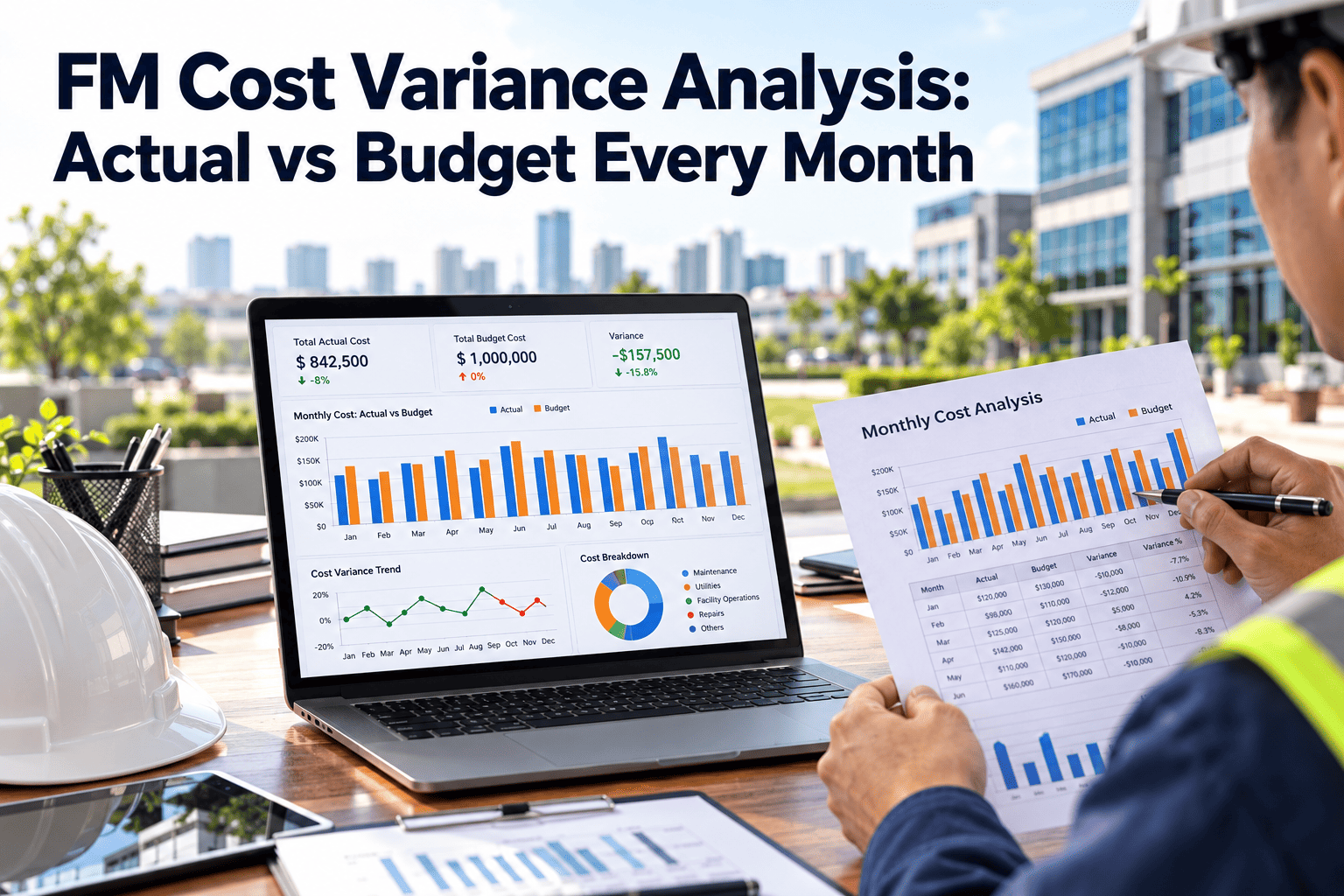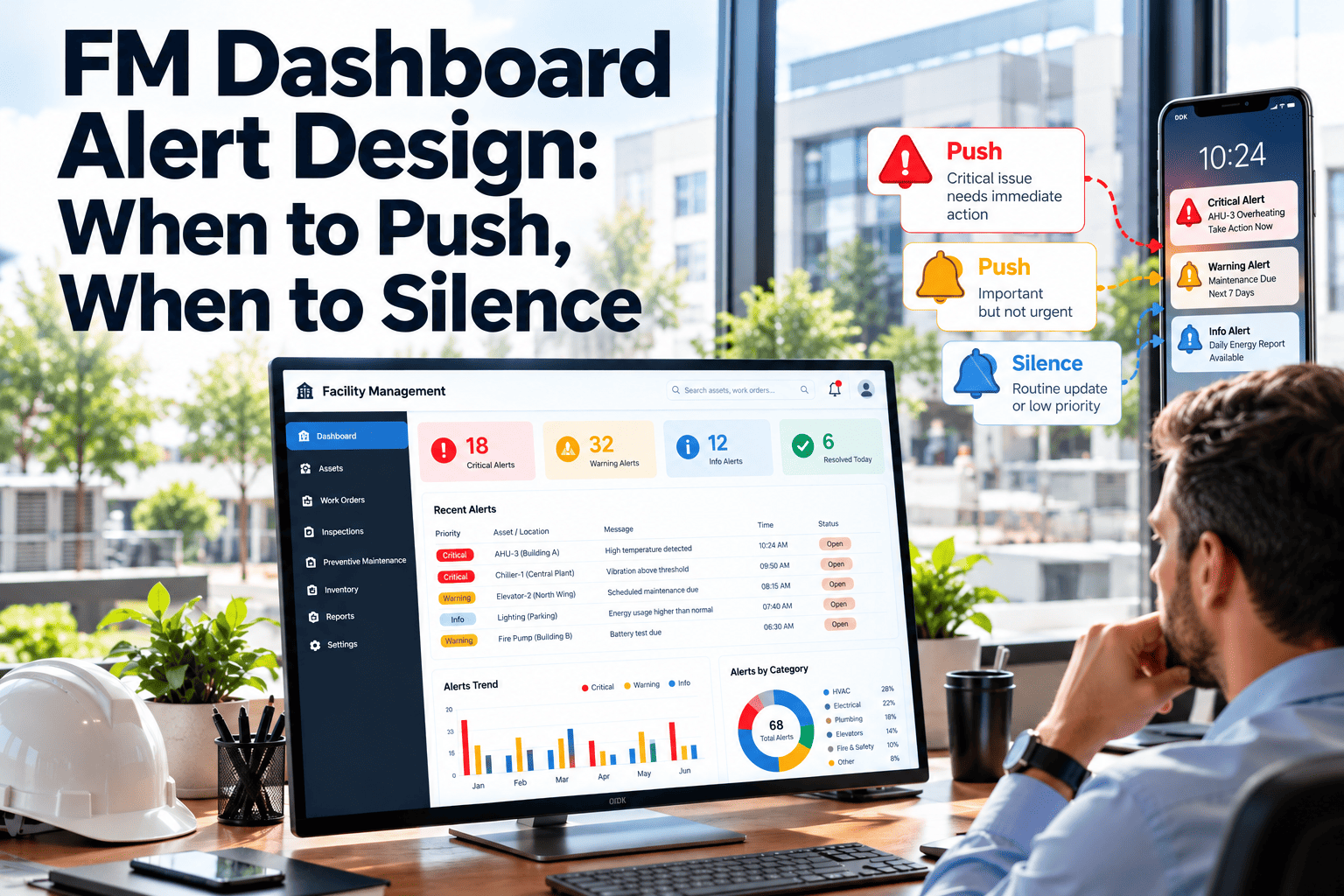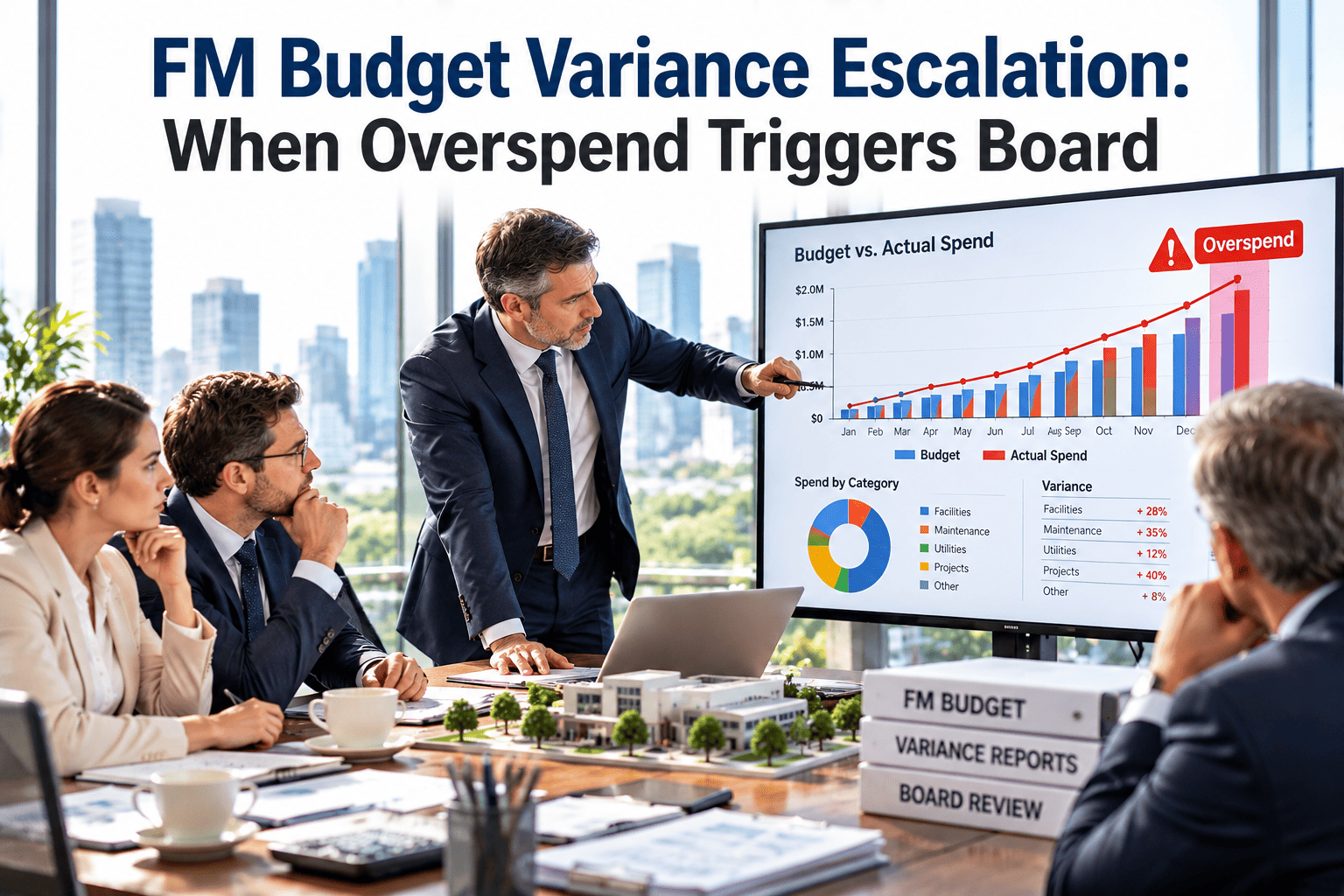
Few things damage trust in a facilities team faster than an overspend that reaches the board in the last quarter. Most of those surprises were visible months earlier, but nobody had agreed who needed to know at what size. A variance escalation protocol fixes that by tying specific thresholds to specific audiences and required actions. This guide uses 5%, 10% and 15% as working triggers, explains how to adapt them, and shows how work order cost data keeps the numbers current.
FM Budget Variance Escalation: When Overspend Triggers the Board
Agree thresholds, audiences and responses before the overspend happens, so escalation is a routine step and not a crisis.
Why a fixed protocol beats case-by-case judgment
The usual failure pattern
Variance is first treated as timing, then as a one-off, then as something that will be absorbed later. By the time it is labeled a problem, the remaining months cannot recover it, and leadership hears the news with no options attached.
What a protocol changes
Thresholds remove the debate about whether a number is "bad enough" to mention. Each level states who is told, what they receive and how soon a plan is due.
Treat these figures as defaults
The 5%, 10% and 15% levels are a common starting structure, not a standard. Set your own to reflect budget size, contract commitments and what your board needs to see.
The escalation matrix
| Level | Trigger | Who is told | Response required | Timing |
|---|---|---|---|---|
| Watch | Forecast variance reaches 5% over budget on a cost line or building | FM manager and finance partner | Explain the driver and confirm whether it is timing, volume or price | Within one reporting cycle |
| Action | Forecast variance reaches 10% | FM director, CFO or asset management lead | Written recovery plan with options and cost of each | Within two weeks |
| Board | Forecast variance reaches 15%, or any single unbudgeted item above an agreed dollar limit | Executive team and board or investment committee | Decision on funding, scope reduction or reserve use | Next scheduled meeting or earlier if urgent |
Trigger on the forecast to year end, not only on spend to date. By the time actuals cross a threshold, options have usually narrowed.
Percentages alone are not enough
Add a dollar floor
A 15% variance on a small line may not merit board attention. Set a minimum amount for each level.
Add a dollar ceiling
A 3% variance on a very large budget can still be a serious sum. Let large absolute overruns escalate early.
Separate controllable lines
Utilities, taxes and insurance pass-throughs behave differently from labor, repairs and contracts.
Escalate repeat variance
Three consecutive months at 4% may deserve the same attention as one month at 8%.
Give variance conversations current maintenance cost data
Oxmaint records labor, parts and contractor cost on work orders by asset and location, so budget owners can see what is driving spend while there is still time to respond.
Diagnose the variance before escalating it
Timing
Invoices posted early, projects pulled forward or seasonal work. Document the reversal month and monitor.
Volume
More reactive work than planned. Check PM compliance, backlog age and equipment condition for the cause.
Price
Rates, materials or contract escalations. Review contract terms, bulk purchasing and alternative suppliers.
Scope
New requirements, tenant requests or code work. Seek approval and funding rather than absorbing silently.
What each audience needs to receive
FM manager and finance partner
- Variance by cost line and building
- Top five work orders or contracts driving it
- Initial classification: timing, volume, price or scope
FM director and CFO
- Revised forecast to year end
- Recovery options with cost and risk of each
- Impact on service levels and compliance
Executives and board
- Plain-language cause and size of the gap
- Decision requested, with consequences of each choice
- Controls added to prevent a repeat
Recovery options to prepare in advance
| Option | Benefit | Risk to evaluate |
|---|---|---|
| Defer low-risk discretionary work | Immediate relief with little service impact | Deferred items may become next year's backlog |
| Re-sequence capital or repair projects | Moves cost between periods | Can raise failure risk on aging assets |
| Renegotiate or rebid contracts | Addresses structural price variance | Transition cost and service disruption |
| Reduce overtime through planning | Targets avoidable premium labor | Needs better backlog and schedule discipline |
| Request supplemental funding | Protects service and asset condition | Requires clear evidence and a credible plan |
Leading signals that warn before variance appears
Making escalation routine instead of political
Without a protocol
- Thresholds are negotiated each time
- Bad news is delayed until options are gone
- Board hears a number without a plan
- Variance is blamed on the FM team in general
With a protocol
- Triggers and audiences are agreed in writing
- Early flags lead to early, smaller corrections
- Each escalation carries options and costs
- Drivers are traced to specific work and contracts
Where maintenance software helps
Oxmaint captures labor, parts and contractor cost on work orders, tags them to assets and locations, and reports backlog, PM compliance and reactive work. It supports variance analysis with operational detail, while budgets and approvals remain in your finance process.
A worked example: one budget crossing each threshold
The figures below are invented to show how the protocol behaves over a year. They are not benchmarks and not a forecast for any real portfolio.
| Month | What happened | Forecast variance | Protocol response |
|---|---|---|---|
| April | Cooling plant repairs run ahead of plan after an early warm spell | Around 5% over | Watch level. Manager confirms the cause is volume, not timing, and notes the plant's repair history. |
| July | Two further failures and rising overtime | Around 10% over | Action level. Director presents a recovery plan with deferral and re-sequencing options. |
| September | A chiller fails and cannot be repaired economically | Above 15% over | Board level. Committee is asked to fund replacement or draw on a reserve, with the cost of waiting stated. |
What this shows
Each step happened months before year end, so each level had real options. Without thresholds, the same story typically reaches leadership once, in the fourth quarter, as a single large number.
Frequent causes of FM overspend
Work mix drifts to reactive
- Skipped PM leads to more breakdowns
- Emergency call-outs cost more per task
- Overtime fills the gap left by planning
Contract and price pressure
- Annual rate increases above the budget assumption
- Scope creep inside service contracts
- Out-of-scope charges approved informally
Aging equipment
- Repeat repairs on the same units
- Parts becoming scarce or costly
- Deferred renewal returning as repair spend
What a good escalation note contains
Reforecasting rhythm that supports the triggers
Monthly
Compare actuals and open commitments with the budget, and update the year-end forecast for every controllable line.
Quarterly
Review the forecast with finance, test the assumptions behind it and confirm which variances are timing.
Before peak season
Check cooling and heating plant readiness, stock levels and contractor availability for the busiest months.
At year end
Record which variances were predicted early and which were not, and adjust next year's budget assumptions.
Forecast the commitments, not just the spend
Open purchase orders, signed contracts and approved projects that have not yet been invoiced are future cost. A forecast that ignores them will understate the year-end position and delay the first escalation.
Mistakes that make escalation protocols fail
| Mistake | Effect | Fix |
|---|---|---|
| Thresholds never written down | Each escalation becomes a negotiation | Publish the levels, audiences and deadlines in one page |
| Only reporting actuals | Problems surface after options narrow | Trigger on the year-end forecast |
| Escalating without options | Leadership receives a problem, not a decision | Require at least two costed choices |
| Ignoring small but repeated overruns | Slow leaks never reach a trigger | Add a rule for consecutive months over budget |
| Using stale work order cost data | Forecasts lag real spend | Close work orders and enter cost the day work finishes |
Review the protocol once a year
Check whether thresholds fired too often, too rarely or too late. Adjust them with finance and the governing body, and record the change so past reports remain comparable.
Setting thresholds that fit your organization
Look at history
- Review variance by line for the last three years
- Note which overruns were predictable
- Set the first trigger just above normal volatility
Agree with finance and governance
- Confirm what the board expects to see and when
- Align with existing delegated authority limits
- Decide how reserves and contingencies may be used
Test and publish
- Replay last year's numbers against the thresholds
- Adjust where alerts would have been too late or too noisy
- Publish the final version to all budget holders
Contents of a board-level variance pack
- A one-page summary with the amount, percent and cause of the variance
- The decision requested and the consequence of each option
- A short list of controls being added to prevent a repeat
- An appendix with work order, contract and asset detail for anyone who wants to check the numbers
Keep the board pack short
Boards respond to clarity. One page that states the problem, the options and the decision needed will be read; a thirty-page appendix without a summary usually will not. Put the detail behind the summary and make it easy to trace every figure to a record.
Escalation is not an admission of failure. It is the mechanism that lets a facility team ask for a decision while there is still time for the decision to matter. Teams that escalate early, with options and evidence, tend to keep more control over the outcome than teams that wait for certainty. Record each escalation, its outcome and the lesson learned so the protocol improves every year and new budget holders can see how it works in practice.
Frequently asked questions
What variance level should reach the board?
Many teams start at 15% of forecast or a set dollar amount, whichever comes first. Set the figure with finance and your governing body, and document it.
Should escalation use actuals or forecast?
Use the forecast to year end. Actuals to date lag, and waiting for them removes options for correcting course.
How do I tell timing variance from real overspend?
Check when invoices and projects were expected versus posted, then compare with work order volume. A CMMS like Oxmaint shows reactive and planned work by period.
Do utilities and taxes follow the same triggers?
Usually they are tracked separately because FM has less control over them. Many protocols apply the thresholds to controllable lines only.
How can I get current cost data for these reviews?
Record labor, parts and contractor cost on each work order as work happens. You can book a demo to see cost reporting by asset.
Escalate early, with options, and keep the board informed
Clear thresholds and current cost data turn variance from a year-end surprise into a managed decision. Oxmaint helps FM teams see the maintenance spend behind their numbers.