How to Reduce Maintenance Backlog in Large Commercial Buildings
By shreen on March 9, 2026
A 2.4-million-square-foot Class A office complex in Chicago discovered during its annual capital planning cycle that 1,847 deferred work orders had accumulated across HVAC, plumbing, electrical, and envelope systems — representing $3.1 million in unaddressed maintenance. Tenant complaints had increased 62% year-over-year, two elevator banks were operating on emergency-only protocols, and the rooftop air handling units were running 19% beyond their scheduled filter replacement intervals. Within 14 months of deploying Oxmaint CMMS — Sign Up Free to start clearing your backlog, the facility reduced its open work order count by 74%, brought all critical systems back into compliance, and cut emergency repair spending by $480,000 annually. This guide delivers the exact framework commercial building teams use to systematically eliminate maintenance backlogs and prevent them from returning.
74%
Average backlog reduction within 14 months when commercial facilities implement structured CMMS-driven prioritization workflows
$3.2M
Mean deferred maintenance liability accumulated in large commercial buildings before intervention — growing 18% annually if unaddressed
62%
Increase in tenant complaints correlated with maintenance backlogs exceeding 500 open work orders in multi-tenant commercial properties
Why Maintenance Backlogs Spiral Out of Control in Commercial Buildings
Backlogs do not accumulate because maintenance teams are underperforming — they accumulate because reactive workflows consume the labor hours that should be allocated to scheduled preventive tasks. Every emergency call-out that pulls a technician off a planned PM route adds two deferred items to the queue: the PM that was skipped and the corrective action that caused the interruption. Without a centralized CMMS platform like Oxmaint enforcing priority-based scheduling, this cycle compounds until the backlog becomes structurally unrecoverable through normal staffing levels.
Reactive Work Dominance
When emergency and urgent repairs consume more than 40% of available labor hours, preventive maintenance schedules collapse — each skipped PM generates 2.3 additional corrective work orders within 90 days.
No Criticality-Based Triage
Paper-based and spreadsheet systems treat all work orders equally. A failed AHU bearing and a stained ceiling tile sit in the same queue — critical infrastructure degrades while cosmetic items consume technician time.
Invisible Aging Infrastructure
Without runtime tracking and condition monitoring, equipment deteriorates silently. By the time a failure is reported, the repair cost is 4–8x what a preventive intervention would have been.
Staffing-Budget Disconnect
Maintenance budgets are set annually against building square footage — not against actual asset condition. A 15-year-old building with original equipment needs 2.4x the maintenance labor of a 5-year-old building, but budgets rarely reflect this reality.
Key Insight
83%
of commercial building maintenance backlogs exceeding 1,000 work orders share a single root cause: the absence of automated work order prioritization. Facilities that implement criticality-based scoring through a CMMS reduce backlog growth rate by 83% within the first quarter — not by adding staff, but by ensuring technicians work on the right tasks in the right sequence.
Eliminating a maintenance backlog requires more than hiring temporary contractors to burn through open work orders. That approach clears the queue temporarily but does nothing to prevent re-accumulation. The framework below attacks both the existing backlog and the systemic conditions that created it — all orchestrated through Oxmaint's work order management platform — Sign Up Free.
01
AUD
Complete Backlog Audit and Classification
Before prioritizing, you need an accurate inventory. Export every open work order, deferred PM, and tenant request into a single system. Classify each item by asset criticality, safety impact, tenant visibility, and estimated repair cost. This audit typically reveals that 15–25% of backlog items are duplicates, already completed but never closed, or no longer relevant.
Full work order extraction — consolidate every open item from spreadsheets, email threads, sticky notes, and verbal requests into a single CMMS queue
Duplicate and obsolete purge — eliminate redundant entries and items tied to decommissioned or replaced equipment to establish a true backlog count
Five-tier criticality scoring — assign every work order a priority score based on life safety, code compliance, tenant impact, asset degradation, and cost escalation risk
Reveals hidden duplicate work orders inflating backlog counts by 15–25%
Identifies life-safety items buried under low-priority cosmetic requests
02
PRI
Criticality-Based Prioritization Engine
Once classified, work orders need a scoring engine that automatically sequences them for execution. The highest-impact items — fire life safety deficiencies, code violations, and equipment at imminent failure risk — must surface to the top regardless of when they were submitted. Book a demo to see Oxmaint's priority scoring in action.
Weighted scoring matrix — assign multipliers to safety (3x), compliance (2.5x), tenant impact (2x), asset value (1.5x), and cost escalation (1x) to generate composite priority scores
Automated queue resequencing — CMMS reorders the technician work queue daily based on updated priority scores and resource availability
Escalation triggers — work orders aging beyond threshold days automatically escalate in priority to prevent chronic deferral of medium-criticality items
Prevents low-priority items from consuming technician hours ahead of critical repairs
Catches aging work orders before deferred maintenance becomes capital replacement
03
LBR
Labor Allocation and Capacity Planning
Backlogs persist when available labor hours are less than the hours required to complete incoming plus deferred work. Map your current labor capacity against actual demand — most commercial buildings discover they are running at 120–140% utilization, meaning technicians cannot complete scheduled work even without emergencies.
Labor hours vs. demand audit — calculate total available wrench-time hours per week against estimated hours to clear the backlog and maintain PM schedules
Reactive vs. planned ratio tracking — target 80% planned / 20% reactive split using CMMS scheduling to protect PM time blocks from emergency interruptions
Contractor surge strategy — identify backlog categories suitable for outsourcing (painting, filter replacements, lighting retrofits) to free in-house staff for critical systems
Quantifies the exact labor gap preventing backlog reduction
Identifies tasks best suited for contractor delegation
04
PMO
Preventive Maintenance Optimization
A bloated PM program contributes to backlogs just as much as reactive work. Many commercial buildings run PM schedules inherited from original equipment manufacturers — designed for worst-case conditions that may not apply to your facility. Optimizing PM intervals based on actual runtime data through Oxmaint's runtime-based scheduling — Sign Up Free can reduce total PM volume by 20–30% without increasing failure risk.
PM task rationalization — review every PM procedure for value: eliminate inspections that have never found a defect and consolidate overlapping tasks
Runtime-based scheduling — transition high-value assets from calendar-based to runtime-based PM triggers using meter readings tracked in your CMMS
Route optimization — group PM tasks by building zone and equipment proximity to minimize technician travel time between tasks
Eliminates low-value PM tasks consuming labor without reducing failure rates
Identifies assets running well below PM-triggering thresholds
05
TRK
Real-Time Backlog Tracking and Reporting
You cannot manage what you cannot measure. A backlog dashboard visible to maintenance leadership, property management, and ownership creates accountability and tracks progress against reduction targets. Book a demo to see Oxmaint's backlog analytics dashboard.
Weekly backlog velocity metrics — track work orders created vs. completed each week to confirm the backlog is shrinking, not growing
Aging distribution analysis — categorize open work orders by age (0–30, 31–90, 91–180, 180+ days) to identify chronic deferral patterns
Cost-of-delay projections — calculate how deferred maintenance compounds repair costs monthly to build the business case for backlog funding
Exposes backlog growth trends before they reach crisis levels
Provides ownership with data to justify additional maintenance funding
06
SYS
Systemic Prevention and Continuous Improvement
Clearing a backlog is a one-time effort. Preventing re-accumulation requires systemic changes to how work enters, flows through, and exits your maintenance operation. This workstream builds the guardrails that keep your backlog permanently below threshold.
Tenant request portal — replace phone and email requests with a structured submission form that auto-classifies and routes work orders into the CMMS
Monthly backlog review cadence — establish a recurring leadership review of backlog metrics with escalation protocols for threshold breaches
Root cause analysis on repeat failures — flag assets generating recurring work orders for capital replacement evaluation instead of perpetual repair
Prevents unstructured work requests from bypassing prioritization
Identifies repair-vs-replace decision points for chronic failure assets
Stop managing spreadsheets. Start eliminating your backlog. Oxmaint gives your maintenance team the prioritization engine, scheduling tools, and analytics dashboard to systematically reduce open work orders and keep them down.
Paper Processes vs. CMMS-Driven Backlog Management
The difference between facilities that permanently reduce backlogs and those that cycle between crisis and cleanup comes down to one factor: whether their maintenance workflow is managed through a structured digital system or through disconnected manual processes.
Spreadsheet / Paper Tracking
−
Static priority assignments — work orders keep their original priority indefinitely regardless of aging or changing conditions
−
Manual scheduling — supervisors spend 6–10 hours weekly building and adjusting technician assignments from a master spreadsheet
−
No completion verification — work orders marked "done" without photographic evidence, parts confirmation, or time tracking
−
Invisible backlog growth — no automated alerts when open work orders exceed threshold counts or aging limits
Oxmaint CMMS Platform
+
Dynamic priority scoring — work order priority recalculates daily based on age, asset criticality, and cost-of-delay factors
+
Auto-scheduled assignments — technician queues built automatically based on skill match, location proximity, and priority ranking
+
Verified task closure — work orders require photo documentation, parts usage logging, and time capture before they can be closed
+
Real-time backlog dashboards — automated alerts trigger when open work order counts or aging thresholds breach configurable limits
CMMS Features That Drive Backlog Reduction
The right platform does not just track work orders — it actively prevents backlog accumulation through automation, analytics, and intelligent scheduling. Here is how Oxmaint — Sign Up Free closes the gaps that create backlogs.
Automated PM Scheduling
Calendar-based and runtime-based PM triggers generated automatically — no manual scheduling required. Missed PMs escalate instantly.
Auto-TriggerRuntime-Based
Tenant Request Portal
Structured digital submission forms replace phone calls and emails. Requests auto-classify, route, and enter the priority queue without manual data entry.
Self-ServiceAuto-Route
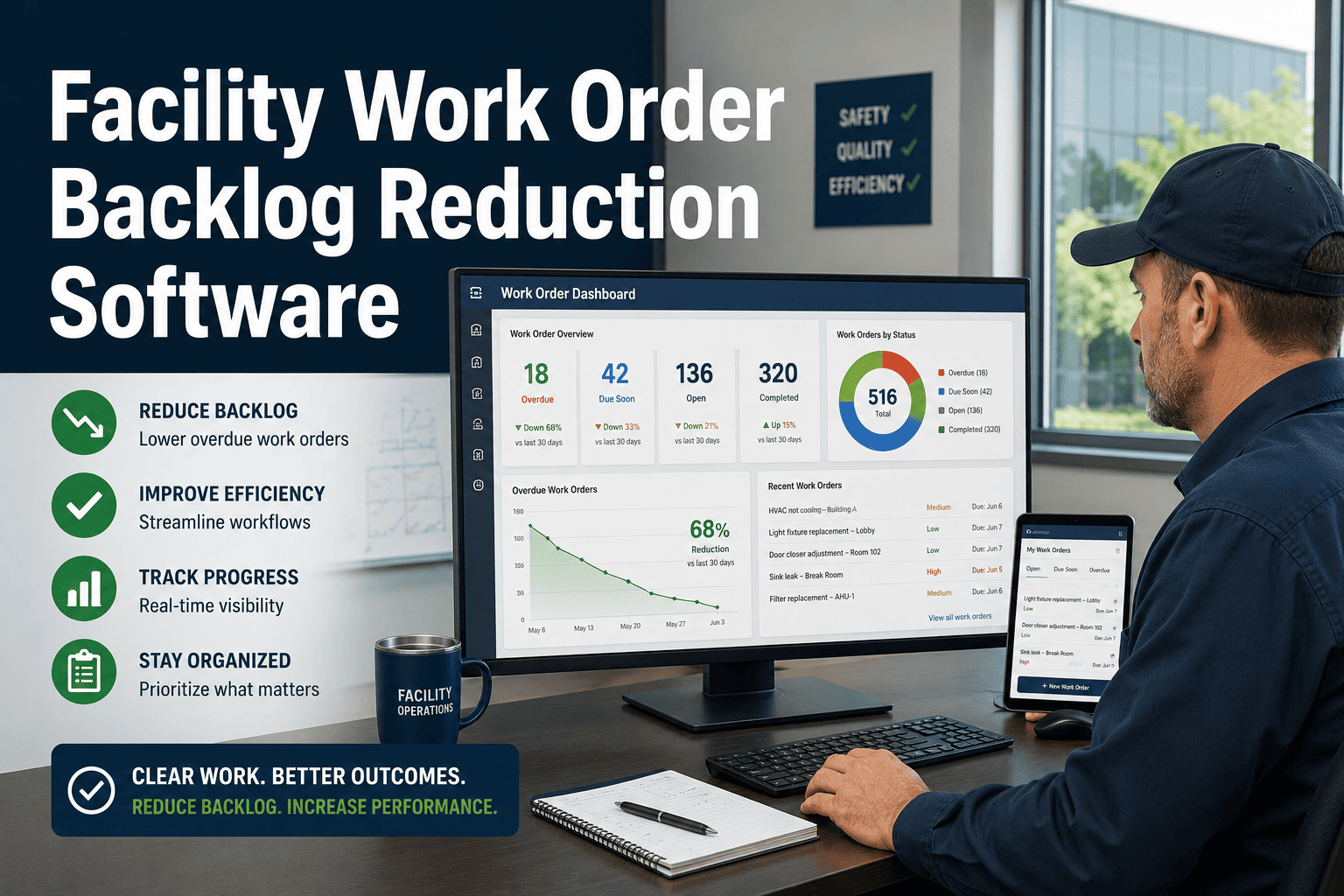
Backlog Analytics Dashboard
Live visibility into open work order counts, aging distributions, completion velocity, and cost-of-delay projections — updated in real time.
Real-TimeExecutive View
Criticality-Based Prioritization
Weighted scoring engine ranks every work order by safety impact, compliance risk, tenant visibility, and cost escalation — ensuring the right work gets done first.
Auto-ScoreDynamic Queue
We had 2,100 open work orders when we started. Everyone assumed we needed more headcount. After implementing CMMS-based prioritization, we discovered 340 were duplicates, 280 were already resolved but never closed, and 400 low-value items could be batched into quarterly contractor runs. We cleared the backlog in 11 months with the same team.
— Director of Engineering, 1.8M sq ft Mixed-Use Portfolio
Monthly backlog reviews. Root cause analysis on repeat failures. Continuous PM optimization with runtime data.
Frequently Asked Questions
How long does it take to clear a maintenance backlog of 1,000+ work orders?
Most commercial facilities clear a 1,000–2,000 work order backlog within 10–14 months using a structured CMMS-driven approach — without adding permanent headcount. The first 25% reduction typically occurs in weeks 3–6 through duplicate purging and batch contractor execution.
Do we need to hire more technicians to reduce our backlog?
In most cases, no. Facilities that implement criticality-based prioritization and PM optimization through Oxmaint — Sign Up Free recover 15–25% of existing labor capacity by eliminating low-value tasks, reducing travel time, and automating scheduling. Temporary contractor surges for batch work supplement this without permanent cost increases.
What is the ideal maintenance backlog size for a commercial building?
Industry benchmarks target 2–4 weeks of work in the backlog — enough to maintain scheduling flexibility without accumulating deferred risk. For a 10-technician team, this typically means 80–160 open work orders. Anything above 6 weeks indicates systemic capacity or prioritization problems.
How does Oxmaint prevent backlogs from re-accumulating after we clear them?
Oxmaint provides automated backlog threshold alerts, dynamic priority resequencing, PM schedule optimization based on runtime data, and real-time velocity tracking that flags when incoming work orders consistently exceed completion rates. Book a demo to see the prevention dashboard.
Can Oxmaint integrate with our existing building management system?
Oxmaint integrates with major BMS platforms to pull equipment runtime data, fault codes, and alarm histories directly into the CMMS. This enables runtime-based PM scheduling and automatic work order generation from BMS alerts — eliminating manual monitoring that contributes to backlogs. Sign Up Free to explore integration options.
Clear Your Backlog. Keep It Clear.
Join the commercial building teams using Oxmaint to eliminate maintenance backlogs, protect asset value, and deliver the building performance tenants expect.