Every work order your team closes is a data point. Every failure event, every parts request, every PM completion or deferral is a signal. Most FM organisations generate thousands of these signals per year and analyse almost none of them. The work order history sitting in a CMMS is the most underutilised strategic asset in facility management. It contains the answer to questions that FM directors currently answer by instinct: which assets cost the most to maintain, which technicians are most productive, where emergency spend is concentrated, which failure modes are recurring, and which assets will require CapEx replacement within 24 months. The global predictive maintenance market reached $12.3 billion in 2024 and is forecast to hit $28.2 billion by 2029, driven by organisations realising that maintenance data already exists and is not being used. Start a free trial or book a demo to see how Oxmaint's analytics dashboard transforms your work order history into strategic FM intelligence.
FM Data, Analytics and ROI
Maintenance Data Analytics: How to Turn Work Order History into Strategic FM Insights
Core · P1 · 9 min read
$28.2B
Predictive maintenance market forecast for 2029, up from $12.3B in 2024 as organisations mine existing CMMS data for insight
68%
Of FM organisations that analyse work order failure patterns reduce emergency repair frequency within 12 months of structured analytics deployment
22%
Average labour productivity gain when technician performance data is tracked and feeding back into scheduling and skills development
4.8x
Higher cost of emergency repairs vs planned maintenance events at the same asset, measurable directly from CMMS work order cost records
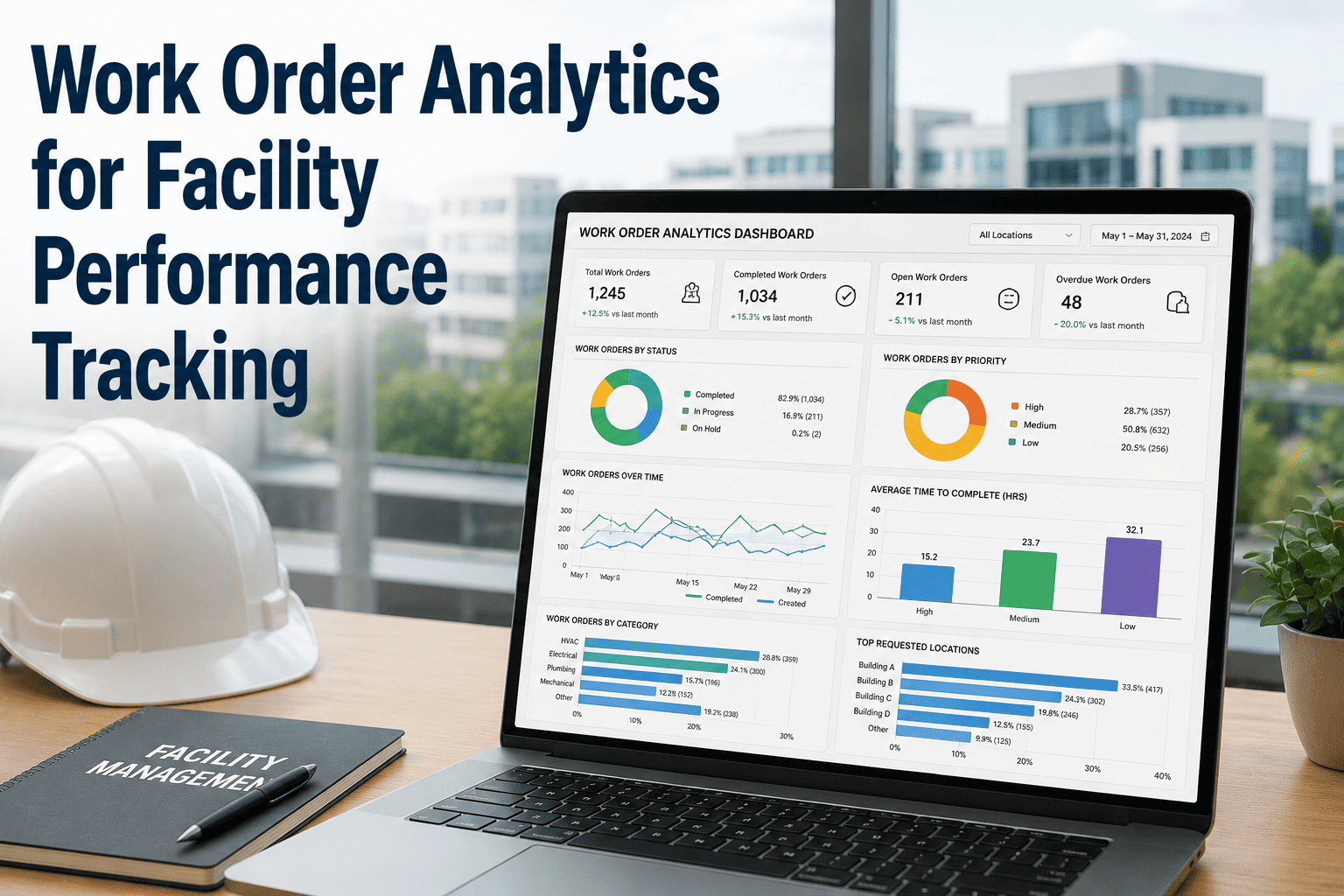
Oxmaint Analytics Dashboard: Your Work Order Data Turned Into Actionable FM Intelligence
Oxmaint's analytics module analyses every work order your team closes and surfaces failure patterns, technician performance data, cost concentration, and asset-level MTBF trends automatically. No data science team. No manual export. Book a demo to see maintenance data analytics configured for your FM operation.
The Four Maintenance Analytics Domains Every FM Director Must Track
Work order data contains four distinct intelligence streams. Each answers a different strategic question and drives a different operational decision. Most FM operations extract only the first and ignore the other three entirely.
Failure Pattern Analytics
Strategic question answered
Which assets fail most often?
What failure modes recur?
What triggers each failure?
Data sourced from
Work order fault description fields · Asset ID on each work order · Failure mode classification · Time between failures per asset · Previous repair history linked to same fault
Key output: MTBF
Mean time between failures calculated per asset class from closed work order history
Strategic question answered
Where is spend concentrated?
Which assets cost most to maintain?
Is the planned/reactive split improving?
Data sourced from
Labour hours per work order · Parts cost per work order · Contractor invoice per work order · Emergency vs planned cost split per asset · Rolling 12-month cost-per-asset ranking
Key output: Cost/WO
Average cost per planned work order vs per emergency event, calculated from closed WO cost records
Technician Performance Analytics
Strategic question answered
Who closes the most work orders?
Which tasks take longest?
Who has the highest callback rate?
Data sourced from
Work orders assigned and closed per technician · Average time to close by technician and task type · Callback rate within 30 days per technician · PM completion rate per assigned technician
Key output: Utilisation Rate
Technician time on planned vs reactive work, tracked per individual from work order attribution data
Predictive Maintenance Analytics
Strategic question answered
Which assets will fail next?
When should we intervene?
Which assets need CapEx replacement?
Data sourced from
MTBF trend by asset over 24 months · Fault frequency acceleration per asset · Repair cost escalation trend · Cumulative repair cost vs replacement value ratio
Key output: P-F Interval
Potential-to-failure interval estimated from historical fault frequency and cost escalation patterns per asset
From Raw Work Order Data to Strategic Insight: The Five-Step Analysis Framework
Work order data does not become insight automatically. The five steps below define the transformation from raw CMMS records to the strategic intelligence that changes maintenance investment decisions.
1
Standardise Work Order Classification
Analytics are only as good as the classification quality of the underlying work orders. Every closed work order must have: asset ID, fault mode category, planned vs reactive flag, labour hours, and parts cost. Oxmaint enforces these fields at work order closure, preventing the incomplete data that invalidates pattern analysis.
Book a demo to see Oxmaint work order classification configuration.
↓
2
Build Asset-Level MTBF and Cost-Per-Asset Rankings
After 90 days of structured work order closure, Oxmaint automatically calculates MTBF by asset and total maintenance cost by asset for the trailing 12-month period. The cost-per-asset ranking identifies the 20% of assets consuming 80% of maintenance spend. This is the first output that changes CapEx decisions and maintenance strategy focus.
Start free trial to begin building asset-level analytics in Oxmaint.
↓
3
Identify Recurring Failure Modes by Asset Class
Grouping work orders by fault mode category across an asset class reveals whether failures are random or systematic. Systematic failures follow a pattern: same fault mode, same asset type, recurring at similar intervals. This pattern indicates a PM programme gap, a parts quality issue, or an installation/operating condition problem. Oxmaint surfaces these patterns automatically from fault mode data.
↓
4
Calculate Planned vs Emergency Cost Split Trend
The planned-to-emergency cost ratio is the single most important maintenance analytics metric for FM ROI tracking. It should be improving quarter over quarter as PM compliance rises. If it is not, the PM programme is not preventing failures at the rate investment would predict. Oxmaint plots this ratio monthly from work order cost data and flags when the trend reverses.
Book a demo to see the planned vs emergency cost trend in Oxmaint.
↓
5
Generate CapEx Replacement Recommendations From Cost Escalation Data
When cumulative repair cost on an asset exceeds 50 to 60% of replacement value, and MTBF is declining, the economic case for repair is exhausted. Oxmaint calculates this ratio for every registered asset and flags assets crossing the replacement threshold. The output is a data-backed CapEx recommendation that finance teams can approve without condition survey cost.
Start free trial to access Oxmaint's CapEx recommendation module from work order data.
90 Days of Work Orders in Oxmaint Generates Your First Asset MTBF and Cost Ranking
Oxmaint begins building asset-level analytics from the first work order closed. After 90 days of structured data, your first failure pattern report, cost-per-asset ranking, and planned vs emergency split trend are available with no manual analysis required.
Maintenance Analytics KPIs: Without CMMS vs With Oxmaint
| Analytics KPI |
Without Structured CMMS Analytics |
With Oxmaint Analytics Dashboard |
| Asset MTBF | Calculated manually from maintenance logs if calculated at all. Most FM operations do not calculate MTBF per asset. Failure frequency is assessed by memory, not data. | Oxmaint calculates MTBF per asset automatically from work order closure dates. Displayed as a 12-month trend line per asset class. Declining MTBF triggers a review alert. |
| Cost per asset | Total maintenance spend known but not attributed to individual assets. The 20% of assets consuming 80% of spend is unknown without manual invoice reconciliation across spreadsheets. | Every work order carries parts and labour cost to the asset record. Rolling 12-month cost per asset auto-ranked. The highest-cost assets are visible without any manual calculation. |
| Planned vs emergency ratio | Estimated from invoice categories or not tracked at all. No monthly trend data. FM directors cannot determine whether the ratio is improving or declining quarter over quarter. | Every work order is classified planned or reactive at creation. The ratio is tracked monthly and displayed as a trend. Trend reversal triggers an automatic alert before the pattern compounds. |
| Technician performance | Assessed subjectively by line manager observation. No data on closure rates, callback rates, or task-type productivity by individual technician. Skills gaps invisible until a failure event exposes them. | Work order attribution links every closed task to the assigned technician. Closure rate, average time to close, and callback rate per technician calculated automatically from work order data. |
| CapEx timing recommendation | Asset replacement recommended based on age and condition survey opinion. Survey costs $2,000 to $8,000 per property. Timing decisions made without cumulative repair cost vs replacement value data. | Cumulative repair cost vs replacement value ratio calculated per asset from work order cost records. Assets crossing the 50 to 60% replacement threshold are flagged automatically for CapEx review. |
What 12 Months of Maintenance Analytics Delivers: Benchmark Results
Reduction in emergency repair frequency for FM operations that act on failure pattern analytics within 12 months of CMMS deployment68%
Average technician productivity gain when performance data feeds back into task assignment, scheduling, and skills development decisions22%
Reduction in CapEx submission preparation time when asset cost and MTBF data replaces manual condition surveys for replacement recommendations84%
Reduction in emergency callouts when recurring failure mode analytics drives PM programme adjustment targeting systematic fault patterns47%
Continue Reading: FM Data, Analytics and ROI
CMMS ROI for Facility Management: Calculate, Justify and Measure Your InvestmentProve CMMS value with data. Calculate payback period, quantify emergency repair savings and compliance cost avoidance.
Read More
Facility Management Dashboard Design: KPIs, Widgets and Executive Reporting 2026KPI visualisation, real-time alerts, portfolio views, and executive-ready reporting for facility leadership teams.
Read More
AI-Powered Facility Performance Reports: Automated Executive Briefings for FM LeadersNatural language summaries, automated trend analysis, and board-ready facility performance reports.
Read More
Benchmarking Facility Performance: IFMA Standards, BOMA Data and Industry Comparisons 2026Cost per sqft, maintenance ratios, and energy intensity against IFMA and BOMA benchmarks for FM decisions.
Read More
Frequently Asked Questions
QHow much work order history do I need before maintenance analytics becomes meaningful?
90 days of structured work order data produces the first meaningful failure frequency and cost-per-asset outputs. 12 months produces reliable MTBF calculations and CapEx replacement recommendations. Start now.
Start free trial or
book a demo to configure Oxmaint analytics from day one.
QWhat is the most valuable maintenance analytics output for an FM director?
The planned vs emergency cost ratio trend is the most strategically valuable single output because it directly measures whether the maintenance investment is working. A declining emergency ratio with rising PM compliance demonstrates ROI in one number.
Book a demo to see this metric live in Oxmaint.
QCan Oxmaint identify which assets should be recommended for CapEx replacement from work order data?
Yes. Oxmaint calculates cumulative repair cost vs replacement value per asset from work order cost records. Assets crossing the 50 to 60% threshold are automatically flagged for CapEx review without a condition survey.
Sign up free to activate CapEx flagging in Oxmaint.
QHow does Oxmaint handle technician performance analytics without creating a surveillance culture?
Oxmaint tracks aggregate performance metrics at the work order level: closure rate, average time to close by task type, and callback rate. Data is used for scheduling optimisation and skills development, not individual surveillance.
Book a demo to see technician analytics configured for your team.
Your Work Order History Is the Most Underutilised Asset in Your FM Operation. Start Mining It.
Oxmaint transforms every closed work order into failure pattern data, cost intelligence, technician performance insight, and CapEx recommendation evidence. 90 days to your first asset MTBF report. 14 days to go live.