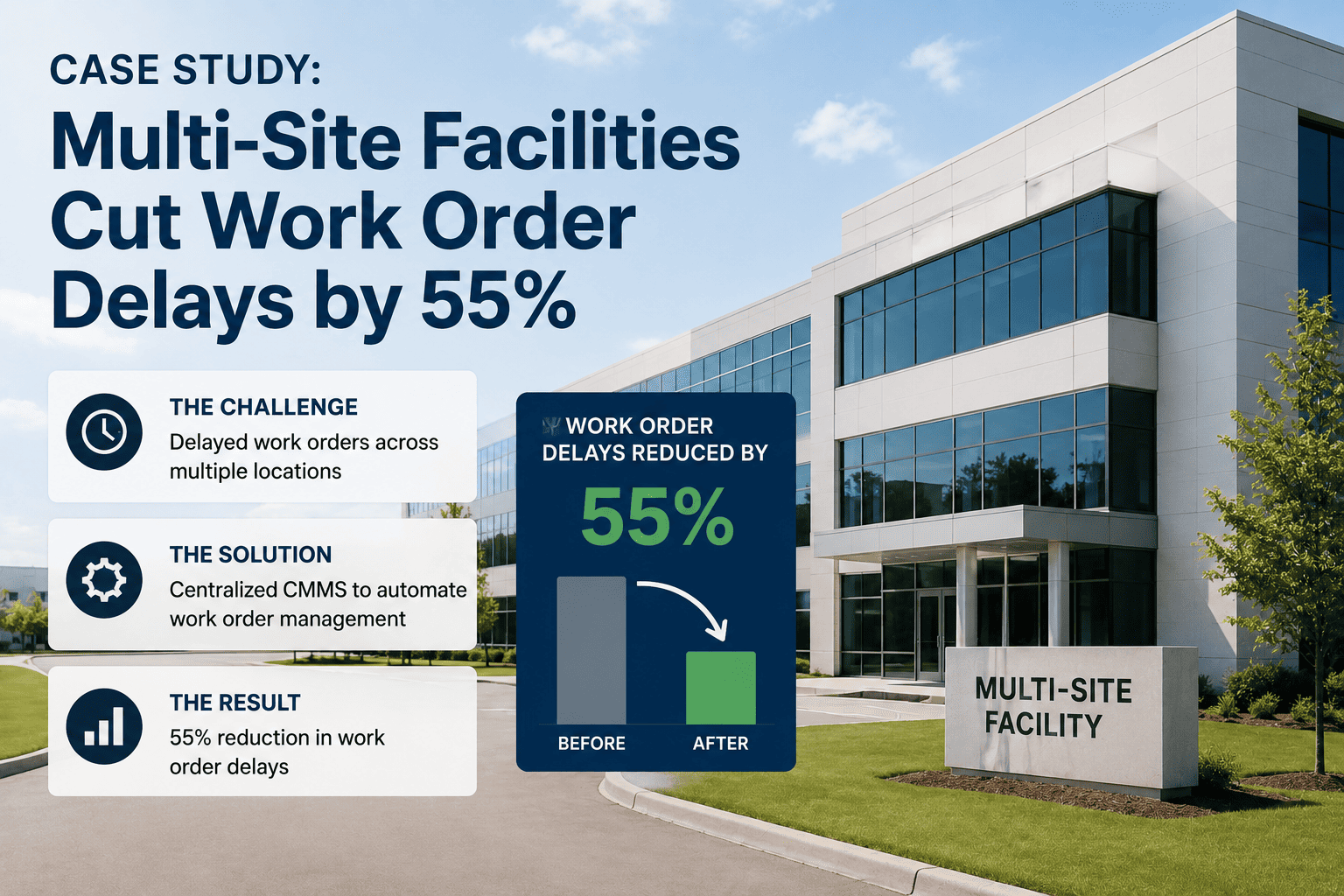
A regional property management firm overseeing 18 commercial and mixed-use buildings across four cities was losing control of its maintenance operations — not because its technicians were underperforming, but because its work order system made coordination across sites nearly impossible. Managers in different cities used different spreadsheets, different priority definitions, and different communication channels. The result: an average work order delay of 9.3 days from creation to closure and an SLA breach rate of 38% across the portfolio. Deploying OxMaint's Work Order Management platform across all 18 sites reduced work order delays by 55% and SLA breaches by 71% within 9 months.
The Multi-Site Coordination Problem
Managing work orders across 18 facilities without a centralized system creates three compounding failures that each make the others worse. Without understanding the root cause of each, adding more staff simply adds more people to a broken process.
How OxMaint Resolved Each Failure Point
| Problem | OxMaint Solution | Result Achieved |
|---|---|---|
| Inconsistent priority classification | Standardized 5-tier priority matrix applied across all 18 sites with auto-escalation rules | Priority disagreements eliminated — same criteria, all sites |
| Manual dispatch via phone/text | AI routing assigns nearest available qualified technician within 90 seconds of WO creation | Dispatch lag: 4.2 hrs → 6 minutes average |
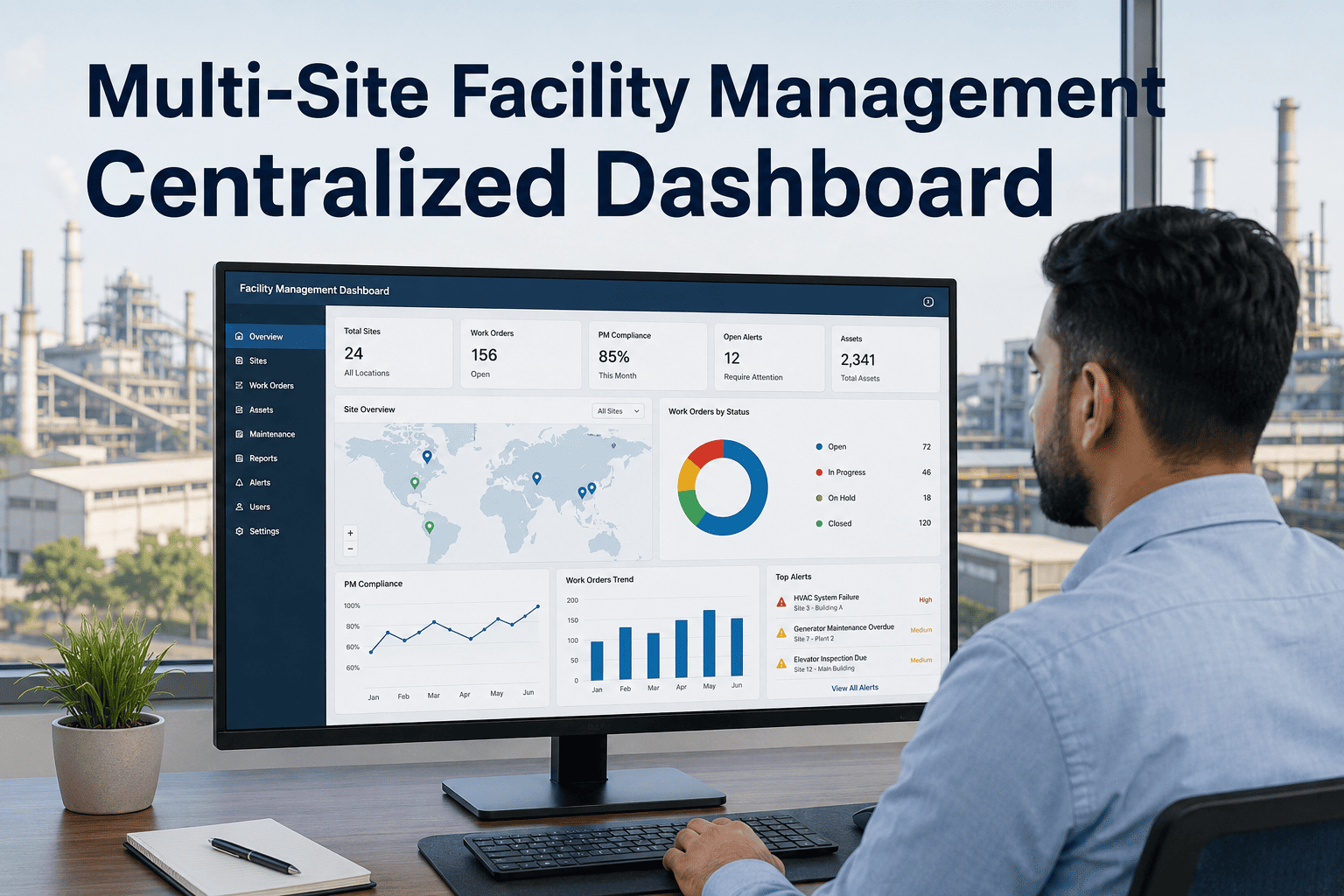
| No real-time visibility | Portfolio dashboard: all 18 sites on one screen, updated live as technicians close tasks on mobile | Director identified 3 underperforming sites in week 1 |
| SLA not tracked per WO | Every work order has a live SLA countdown — yellow at 75%, red at 90% of window | SLA breach rate: 38% → 11% in 9 months |
| Technician skill mismatch on assignments | Skill profile per technician — routing only assigns certified/qualified techs to each asset type | First-time fix rate: 61% → 84% across portfolio |
| No cross-site resource sharing | Technician availability visible across all sites — surge capacity reallocated without calls | 3 high-demand sites received cross-site support 14 times in Year 1 |
Your Multi-Site Team Deserves a Single Source of Truth
OxMaint connects all your sites into one live work order dashboard — same priority rules, same SLA tracking, same technician visibility. Book a demo and see the portfolio view in action.
Portfolio Performance: Before vs. After (All 18 Sites)
Expert Review
Work order delays in multi-site operations almost always trace back to two failure points: inconsistent priority classification and invisible dispatch. When every site defines urgency differently and every assignment happens through informal channels, there is no way to manage performance at scale — you are just managing 18 separate problems rather than one system. The 55% delay reduction this portfolio achieved required fixing both simultaneously. Centralized priority standards meant everyone knew what needed attention first. Automated routing meant the right person was assigned before a supervisor even noticed the work order existed. Together, those two changes are what moved the SLA compliance rate from 62% to 89% — not additional headcount or additional spending.
Frequently Asked Questions
How does OxMaint handle work order management across sites with different team structures?
OxMaint supports fully independent site configurations within a shared portfolio instance. Each site can have its own technician team, asset registry, PM schedule, SLA thresholds, and escalation rules — while sharing the same underlying platform so portfolio-level reporting and cross-site visibility work automatically. Sites with in-house technicians, contracted vendors, and hybrid teams all operate within the same work order system. Vendor work orders have the same tracking and SLA enforcement as internal technician assignments, which is critical for multi-site operations where contractor accountability often falls through the gaps of informal management.
What does AI-powered technician routing actually do in practice?
When a work order is created in OxMaint — whether by an alarm, a PM schedule, or a manual request — the routing engine evaluates three factors simultaneously: technician proximity to the asset location, technician skill certification for the asset type, and current workload (open WO count and estimated completion time). The system assigns the optimal technician within 90 seconds without a supervisor making a phone call. For emergency-priority work orders, on-call technicians receive an immediate push notification to their mobile device. Managers can override any auto-assignment with one tap and set site-specific routing preferences that reflect local team structures. Learn more at oxmaint.ai.
How long does OxMaint take to implement across a multi-site portfolio?
For a portfolio of 10 to 20 sites, OxMaint's phased implementation typically follows this timeline: pilot site goes live within 3 to 5 days using existing asset data imported from spreadsheets or legacy CMMS; second wave of 5 to 8 sites deploys in weeks 2 to 4 as the configuration template from the pilot is replicated; full portfolio deployment completes within 6 to 8 weeks. Technician mobile app onboarding averages 2 hours per person. Most multi-site teams report that their technicians adopt mobile work order completion faster than any previous system change because it replaces paper and text-message workflows rather than adding to them.
Can the portfolio dashboard show vendor work orders alongside internal technician work orders?
Yes. OxMaint's work order management includes a vendor portal where external contractors can receive, update, and close work orders assigned to them — with the same SLA tracking and completion documentation as internal technicians. Portfolio managers see all open work orders in one view regardless of whether the assigned party is an employee or contractor. Vendor performance metrics (response time, first-time fix rate, cost per work order) appear in the same reporting framework as internal team metrics, enabling accurate cost and performance comparisons when contract renewal decisions are being made.
18 Sites. One Dashboard. Zero Missed SLAs.
OxMaint standardizes priority, routing, and SLA tracking across every site in your portfolio — so your regional director sees the full picture in real time, not 18 weekly PDF reports.