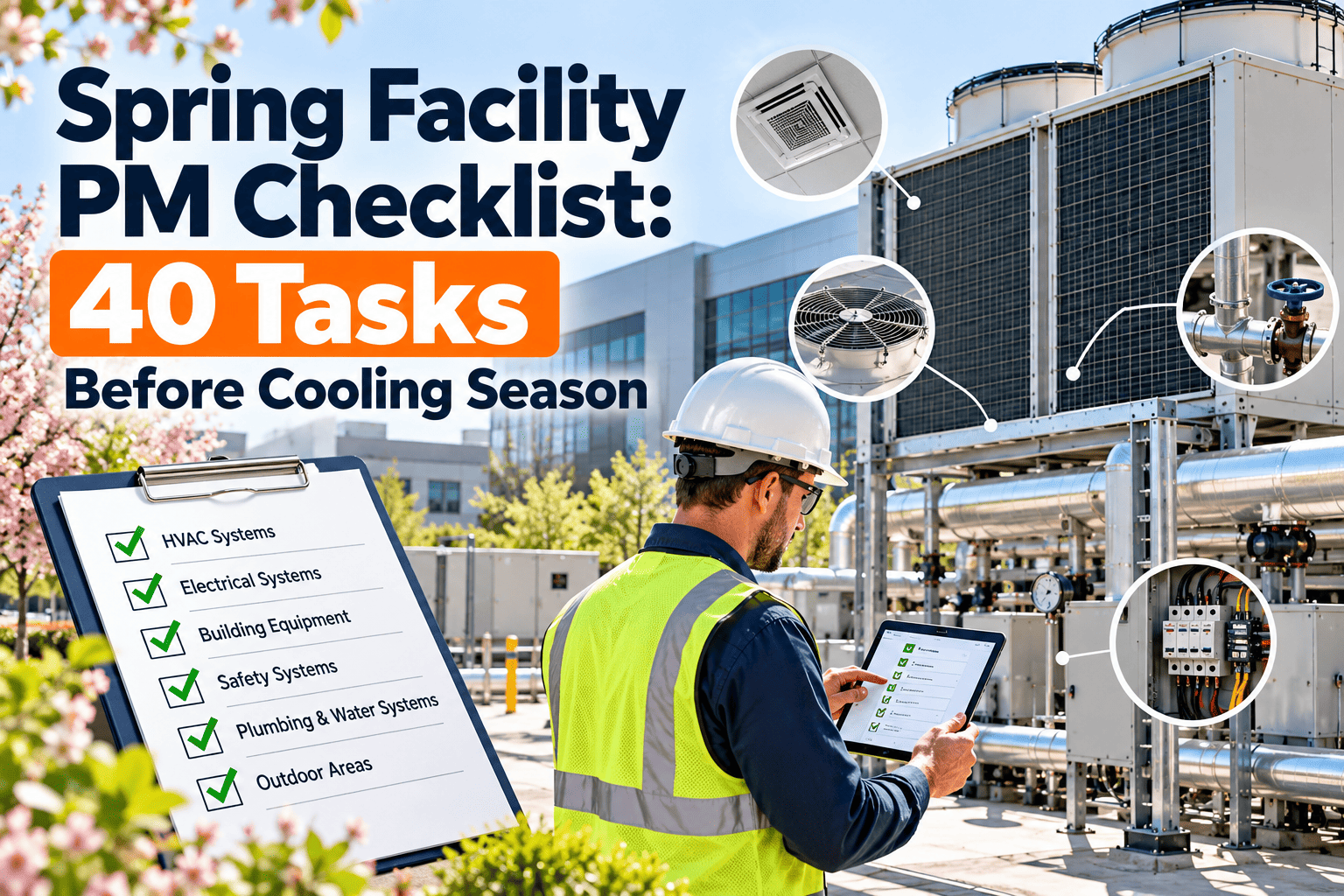
A spring facility PM program is your last chance to find a worn chiller contactor, fouled cooling tower fill, or clogged roof drain before the first hot afternoon turns each one into an emergency call. This checklist lists 40 tasks in the order most facility teams actually work them: heating wind-down, air-side startup, chiller and tower plant, roof and exterior, then controls changeover. Print it for the mechanical room, or load it into a maintenance management system so every task becomes a timestamped work order.
Spring Facility PM Checklist: 40 Tasks Before Cooling Season
Heating plant, air handlers, chillers, cooling towers, roof drainage, and exterior systems all need attention before cooling demand arrives. Work the five phases below in order and close every finding while the weather is still mild.
Why Spring Is the Highest-Leverage PM Window of the Year
- Cooling equipment sits idle for months. Seals dry out, oil migrates, condensate lines grow slime, and rodents or birds nest in rooftop units. None of this shows until the unit is called to run.
- Demand arrives faster than repair lead times. A compressor, VFD, or fan motor ordered in the first heat wave competes with every other building in your region for parts and technicians.
- Cooling towers carry a water-safety obligation. Warm, stagnant condenser water is the condition in which Legionella can grow, so tower startup is a water management task as much as a mechanical one.
- Winter damage hides on the roof and envelope. Freeze-thaw cycles open sealant joints, lift flashings, and push debris into drains that will be needed during spring storms.
- Heating and cooling can fight each other. Leaking reheat valves and stale control schedules waste energy and stress compressors during the first warm weeks.
Symptoms That Trace Back to Skipped Spring Tasks
| First-heat symptom | Typical spring root cause | Related tasks |
|---|---|---|
| Rooftop unit trips on high pressure | Dirty condenser coil or failed condenser fan | 11, 12 |
| Water stain below air handler | Blocked condensate drain or overflowing drain pan | 14 |
| Chiller low-flow or high-approach alarms | Fouled condenser tubes or tower strainers | 21, 22 |
| Tower water cloudy with high conductivity | Basin not cleaned, treatment not restarted | 24, 25 |
| Ceiling leak after first storm | Debris-blocked roof drain or open flashing | 27, 28, 29 |
| Zones overcooled while others run warm | Stuck economizer damper or stale schedule | 13, 35, 36 |
The Eight-Week Spring Runway
- Week -8Review last season's deficiency list, confirm which repairs were deferred, and book chemical treatment, refrigerant, and electrical contractors before their calendars fill.
- Week -6Decide boiler lay-up method, set a heating-off date with occupants, and pull the filters, belts, and drain-pan treatment you will need into inventory.
- Week -4Start air-side work on rooftop units and air handlers, beginning with units serving critical or high-load spaces.
- Week -2Clean the tower basin, restart water treatment, and run chiller pre-start checks with the service contractor present.
- Week 0Start the plant, record baseline readings, and verify controls changeover against actual space temperatures.
- Week +2Review trends, close remaining findings, and compare performance with last season's startup baseline.
Phase A: Heating Wind-Down (Tasks 1-6)
- 1. Confirm heating-off date. Agree on the date with tenants and operations, and note areas such as data rooms or labs that may need heat or reheat all year.
- 2. Record final boiler combustion data. Capture flue gas readings and firing rates before shutdown so summer repair scopes are based on measured condition.
- 3. Test boiler safeties. Verify low-water cutoff, flame safeguard, and high-limit controls operate correctly before the boiler is laid up or reduced to domestic hot water duty.
- 4. Choose and document lay-up method. Follow the manufacturer and water treatment provider on wet or dry lay-up, and record chemical levels and drained or isolated sections.
- 5. Stroke-test heating and reheat valves. Confirm valves close fully so hot water does not leak into coils during cooling and waste energy.
- 6. Survey steam traps and unit heaters. Log failed traps and non-working heaters as summer work orders while the system can still be pressurised for testing.
Phase B: Air-Side Startup (Tasks 7-16)
- 7. Replace filters. Change filters to the specified MERV rating and record the pressure drop across new filters as a clean baseline.
- 8. Inspect and clean evaporator coils. Look for matted debris, bent fins, and corrosion, and clean using methods approved for the coil material.
- 9. Inspect belts, sheaves, and bearings. Check tension and alignment, replace cracked belts, and listen or measure for bearing noise.
- 10. Check fan motors and VFDs. Compare amp draw with nameplate values, inspect drive cooling, and confirm no active faults in drive history.
- 11. Clean condenser coils on rooftop units. Remove cottonwood, leaves, and dirt from the outdoor coil, which directly affects head pressure and compressor life.
- 12. Verify condenser fans and compressors. Check contactors for pitting, capacitors for bulging, and compressor amp draw against rated load.
- 13. Stroke economizer dampers. Confirm actuators drive full open and full closed, linkages are tight, and blade seals are intact.
- 14. Clear condensate drains and pans. Flush lines, inspect traps, treat pans, and confirm overflow switches work before the first humid day.
- 15. Check refrigerant circuits. Review sight glasses, pressures, and leak records, and use a certified technician for any leak repair or refrigerant handling.
- 16. Verify sensors. Check mixed-air, discharge-air, return-air, and space sensors against a reference instrument and replace any that drift.
Phase C: Chiller and Cooling Tower Plant (Tasks 17-26)
- 17. Complete chiller pre-start inspection. Review oil level, electrical terminations, starter condition, and safeties following the manufacturer's startup procedure.
- 18. Review oil and refrigerant analysis. Compare lab results with prior seasons and schedule corrective work for acid, moisture, or metal indicators.
- 19. Inspect chiller controls and alarms. Clear stale alarms, confirm setpoints, and test flow switches and temperature cutouts.
- 20. Verify chilled water loop. Check pump seals, strainers, expansion tank pressure, glycol concentration where used, and air in the loop.
- 21. Inspect condenser tubes. Plan tube cleaning when approach temperature has risen, and record the result for comparison next year.
- 22. Clean tower strainers and screens. Remove debris from the basin, intake screens, and strainers that protect condenser pumps and heat exchangers.
- 23. Inspect fill, louvers, and drift eliminators. Replace damaged or scaled sections that reduce heat transfer or allow excess drift.
- 24. Drain, clean, and refill the tower basin. Disinfect according to your water management plan and applicable guidance before returning to service.
- 25. Restart water treatment. Calibrate conductivity and biocide controls, test chemical feed pumps, and record initial water chemistry.
- 26. Service tower fans and drives. Check gearbox oil, shaft alignment, vibration, blade pitch, and any heater or sump freeze protection that must be disabled.
Phase D: Roof and Exterior (Tasks 27-34)
- 27. Clean roof drains, scuppers, and gutters. Remove debris and verify water flows freely, including overflow drains.
- 28. Walk the roof membrane. Look for splits, blisters, ponding, punctures, and damage around equipment pads, then photograph each finding.
- 29. Inspect flashings and penetrations. Check edges, curbs, pipe boots, and sealant joints that winter movement may have opened.
- 30. Inspect rooftop equipment curbs and supports. Look for loose fasteners, corrosion, and damaged weather seals around mechanical units.
- 31. Survey paving and walkways. Log potholes, cracked slabs, and drainage problems, and fill urgent trip hazards quickly.
- 32. Inspect sealants, windows, and doors. Replace failed caulk and weatherstripping that allows humid air and water into conditioned space.
- 33. Start irrigation and test backflow preventers. Check for broken heads or lines, and schedule certified backflow testing where required locally.
- 34. Inspect dock seals and exterior lighting. Repair torn seals and failed fixtures that affect energy loss, safety, and security.
Phase E: Controls, Electrical and Safety (Tasks 35-40)
- 35. Switch BAS to cooling mode. Update schedules, setpoints, lockouts, and economizer logic, then trend space temperatures for several days.
- 36. Verify occupancy and holiday schedules. Remove outdated overrides left over from winter so equipment does not run unnecessarily.
- 37. Thermographic check of HVAC electrical gear. Scan disconnects, starters, and drives under load and log any hot connections for repair.
- 38. Test generator and transfer switch. Cooling load makes summer outages more costly, so confirm fuel quality, battery condition, and transfer operation.
- 39. Check refrigerant leak detection and machinery room ventilation. Test alarms and ventilation fans where mechanical refrigeration codes require them.
- 40. Stock critical spares and sign off startup. Verify belts, filters, contactors, and sensors on hand, then record sign-off for each phase.
Reactive Summer vs. Planned Spring
Without a spring program
- Failures found during the first heat wave
- Parts ordered at rush prices with long waits
- Tower water chemistry corrected after problems appear
- Leaks discovered by tenants during storms
- No baseline to judge equipment performance
With a documented spring program
- Defects found and repaired in mild weather
- Parts and contractors scheduled in advance
- Water treatment running before load arrives
- Drains and flashings checked before storms
- Startup readings stored for year-over-year comparison
Turn This List Into Scheduled Work Orders
Create the 40 tasks once, assign them by phase, and let your team close them from a phone with notes and photos.
Cooling Tower Startup and Water Safety
Tower startup deserves its own review because it joins mechanical work to public-health risk management. Facilities that follow ASHRAE Standard 188 or a similar water management plan should confirm that startup, disinfection, and monitoring steps are documented in the same record as the mechanical tasks.
- 1Inspect before filling. Look for biofilm, scale, debris, and damaged fill while the basin is empty.
- 2Clean and disinfect. Use the method and chemicals approved by your treatment provider and local requirements.
- 3Restart treatment immediately. Do not let the system circulate untreated water while waiting for load.
- 4Monitor and record. Log conductivity, biocide residual, and any sample results on the same schedule your plan requires.
Common Spring Startup Mistakes to Avoid
Starting equipment before cleaning it
Running a unit with dirty coils or a fouled basin pushes debris into heat exchangers and pumps. Clean first, then start.Skipping baseline readings
Without recorded amps, pressures, approach temperatures, and vibration, nobody can tell next spring whether a reading is normal or drifting.Treating the roof as separate from HVAC
Drains, curbs, and flashings protect the same equipment you just serviced. A leaking curb can damage a unit faster than a worn belt.Leaving winter overrides in the BAS
Manual overrides, disabled lockouts, and old schedules are easy to forget and can cause simultaneous heating and cooling for weeks.Closing the checklist with findings still open
A task marked complete with a note such as "belt worn" is not finished. Every finding needs its own work order, owner, and due date.Doing the work without lockout discipline
Coil cleaning, belt changes, and starter inspections all involve stored energy. Apply lockout and tagout procedures and confirm zero energy before opening panels or guards.KPIs That Show the Spring Program Worked
| Metric | How to measure | Target |
|---|---|---|
| Spring PM completion | Tasks closed before startup date divided by 40 | 100% |
| Findings closed before startup | Defects repaired divided by defects found | As high as possible, critical items 100% |
| Cooling emergency calls | Unplanned HVAC calls in the first month of cooling | Trending down each year |
| Startup baseline captured | Chillers, towers, and major RTUs with recorded readings | Every major unit |
| Deferred repair backlog | Open spring findings carried into summer | Reducing each season |
Baseline Readings Worth Recording at Startup
- Chillers: chilled water supply and return temperatures, condenser water temperatures, evaporator and condenser approach, compressor amps, and oil pressure.
- Cooling towers: basin level, conductivity, biocide residual, fan motor amps, and visible drift or fill condition.
- Rooftop units and air handlers: supply air temperature, static pressure, filter pressure drop, motor amps, and economizer position.
- Pumps: discharge pressure, differential pressure, motor amps, and any seal leakage or unusual vibration.
How Oxmaint Supports the Workflow
- Preventive maintenance schedules generate the spring task set automatically every year, tied to each asset.
- Work orders and mobile checklists let technicians record readings, photos, and sign-off at the unit.
- Asset history keeps last year's baselines beside this year's, so changes are easy to spot.
- Inventory tracking shows whether filters, belts, and contactors are on hand before startup week.
- Corrective work orders are created from findings so deferred items do not disappear.
- Reports and dashboards show phase completion and open deficiencies for managers and auditors.
Frequently Asked Questions
When should spring PM start?
Begin six to eight weeks before your expected cooling start so parts, treatment, and contractors are ready.
Do all 40 tasks apply to every building?
No. Remove tasks for equipment you do not have and add site-specific items, then save the list as a template in Oxmaint.
Who should perform the chiller startup?
Use qualified technicians or the manufacturer's service team, especially for refrigerant, electrical, and control work.
How do we track deferred repairs?
Convert every finding into a corrective work order with priority and due date so it stays visible after startup.
Can we see this workflow before committing?
Yes, you can book a short demo and walk through seasonal PM scheduling.
Start Cooling Season With Nothing Left Open
Schedule the checklist, capture startup baselines, and keep every finding on a work order until it is closed.


.jpeg)

