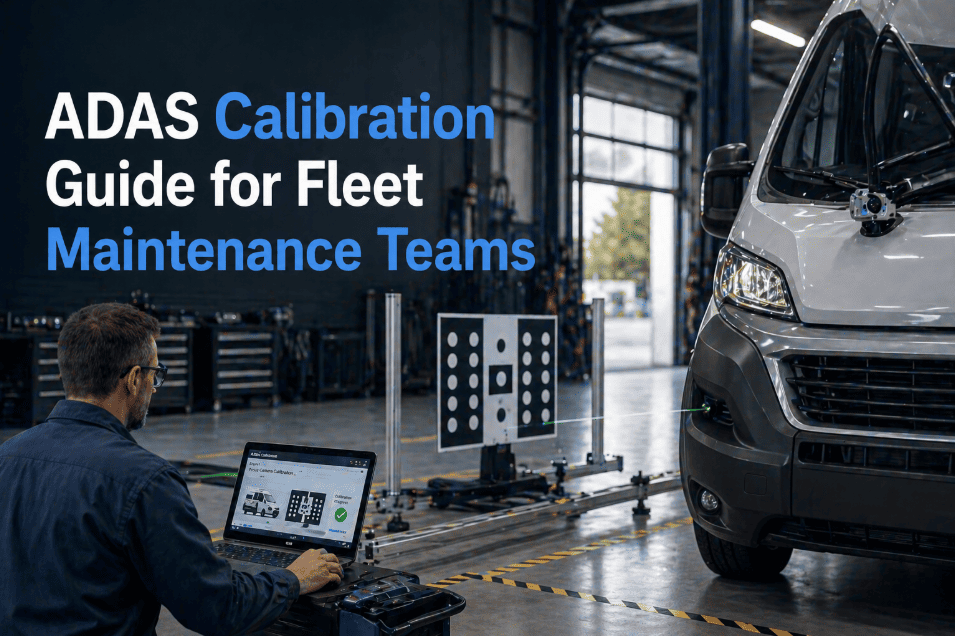
A regional last-mile delivery fleet replaced 31 windshields across its 240-vehicle portfolio in a single year — and discovered, during a quarterly safety audit, that 19 of those vehicles had never had their ADAS systems recalibrated after the windshield work. The vehicles had been operating for an average of 47 days each with potentially miscalibrated forward-collision cameras, lane-departure sensors, and adaptive cruise control. No accidents had occurred. But the audit findings showed every one of those 19 vehicles was carrying liability exposure that the fleet's insurance underwriter would view as gross negligence in any subsequent collision investigation. Nine out of ten 2023+ model year vehicles require ADAS recalibration after windshield replacement — a number that climbed from 1 in 4 vehicles in 2016. ADAS calibration is not optional. It is not a dealer upsell. It is a safety-system requirement that fleet maintenance has to track as rigorously as DOT inspection deadlines. If your fleet replaces windshields without tracking ADAS recalibration, sign up to try Oxmaint free for 30 days or book a demo.
Fleet ADAS Calibration — 2026
Nine Out of Ten 2023+ Vehicles Require ADAS Recalibration After Windshield Work — Up From 1 in 4 in 2016
90%
Of new vehicles need recalibration
Model year 2023+ vehicles requiring ADAS calibration after windshield replacement
$300–$1K
Per-vehicle calibration cost
Standard 2025 pricing range — luxury and complex multi-system vehicles can exceed $1,000
50%
Crash prevention by AEB
Documented rear-end crash prevention by properly calibrated automatic emergency braking
1° = 50ft
Camera misalignment impact
A sensor off by one degree is aimed significantly off-axis at 50+ feet down the road
The Six ADAS Subsystems Your Fleet Maintenance Has to Track
ADAS is not one system — it is a constellation of six interacting subsystems, each with its own sensors, calibration requirements, and trigger events. A windshield replacement doesn't recalibrate "the ADAS system" generically; it recalibrates the specific subsystems whose sensors are mounted on or near the glass. Book a demo to see all six tracked across your vehicle portfolio.
01
Forward Collision Warning & AEB
Forward-facing camera + radar (typically grille & windshield)
Automatic Emergency Braking can prevent up to 50% of rear-end crashes when properly calibrated. Triggers recalibration: windshield replacement, front bumper repair, suspension work, alignment changes.
02
Lane Departure / Lane Keep Assist
Forward-facing windshield camera
Reads lane markings and steers vehicle back into lane. Sensitive to even fractional misalignment because aim error compounds over distance. Triggers: windshield replacement, camera bracket disturbance.
03
Adaptive Cruise Control (ACC)
Forward radar + camera fusion
Maintains following distance from preceding vehicle. Requires precise sensor aim. Triggers: windshield replacement, radar bracket adjustment, alignment changes affecting forward axis.
04
Blind Spot Monitoring (BSM)
Side-rear radar (typically bumper-mounted)
Detects vehicles in adjacent lane blind spots. Less affected by windshield replacement but critical after rear-end collision repair, suspension work, or rear bumper replacement.
05
360-Degree / Surround View
Multiple cameras: front, rear, mirrors
Stitched bird's-eye view from camera array. Each camera requires individual calibration. Triggers: any camera replacement, mirror replacement, body panel repair near camera locations.
06
Park Assist / Cross-Traffic Alert
Ultrasonic sensors + rear camera
Lower-frequency calibration needs than forward-facing systems but still requires verification after bumper repair, sensor replacement, or rear-end collision work.
The Six Trigger Events That Require ADAS Recalibration
A
Windshield Replacement
The most common trigger across fleet operations. 90% of 2023+ vehicles require recalibration after glass replacement — even when OEM glass is used. Camera bracket position cannot be assumed unchanged.
B
Suspension & Alignment Work
Any change in vehicle ride height or wheel alignment affects forward camera aim relative to the road. Even a 1° change in vehicle geometry shifts ADAS aim point by feet at safety-critical distances.
C
Collision Repair (Front, Rear, Side)
Bumper repair, frame work, panel replacement, or any structural intervention that involves removing or moving sensor mounting points. Insurance and OEM documentation typically mandate post-repair calibration.
D
ADAS Component Replacement
Direct replacement of any ADAS component — forward camera, radar unit, side mirror with camera, ultrasonic sensor — requires post-installation calibration before the vehicle is returned to service.
E
Tire Size or Type Change
Changing wheel/tire diameter affects vehicle ride height and speedometer calibration. ADAS systems that depend on accurate speed input or vehicle height reference may require recalibration. Often missed on fleet maintenance.
F
DTC / Diagnostic Trouble Code
When the vehicle's onboard diagnostics report ADAS faults — whether dashboard warning lights or scan-tool DTCs — recalibration may be required regardless of whether other trigger events have occurred. Auto-flagged in modern fleet CMMS.
Built for Fleet ADAS Compliance Reality
Every Trigger Event Tracked. Every Calibration Documented. Every Vehicle Audit-Ready.
Oxmaint integrates ADAS calibration tracking into the standard fleet maintenance workflow — windshield replacements automatically flag recalibration requirements, every calibration completion is documented, and every vehicle's ADAS state is auditable on demand.
Static vs Dynamic Calibration — What Fleet Managers Need to Know
Not every ADAS calibration is the same procedure. Two distinct methods exist, with different cost profiles, time requirements, and infrastructure needs. Fleets that don't understand the difference end up in the wrong queue at the wrong shop and pay for it twice.
| Calibration dimension | Static calibration | Dynamic calibration |
|---|
| Method | Targets & charts in controlled facility | On-road driving against lane markings |
| Required infrastructure | Calibration bay with target frames | Well-marked roads in good weather |
| Typical duration | 30 minutes – 2 hours | 30 minutes – 1 hour driving |
| Mobile service feasible | No — requires shop infrastructure | Yes — many vehicles qualify |
| Vehicle types | Most luxury & complex multi-system | Many domestic and import models |
| Weather dependency | None — controlled environment | Heavy — clear weather + dry roads |
| Documentation produced | OEM target-based scan reports | Drive log + post-calibration scan |
How Oxmaint Manages Fleet ADAS Calibration
01
Per-Vehicle ADAS Configuration Registry
Every fleet vehicle catalogued with its specific ADAS configuration — forward camera, radar units, side cameras, ultrasonic arrays, blind spot sensors. The vehicle record knows what subsystems exist and what calibration each requires.
No more "does this truck even have ADAS" guessing
02
Trigger Event Auto-Detection
When a windshield replacement, suspension work, alignment, collision repair, or sensor swap closes in the work order system, the platform automatically flags the vehicle for ADAS calibration before return-to-service. Vehicles cannot be marked operational without the calibration sign-off.
Zero vehicles operating uncalibrated post-repair
03
Static vs Dynamic Workflow Routing
Each calibration requirement automatically routed by vehicle type — static-only vehicles dispatched to equipped shops, dynamic-eligible vehicles routed to mobile service or shorter-cycle providers. Right work to right shop, no scheduling waste.
Calibration scheduling cycle time reduced 30–50%
04
OEM Documentation & Insurance Records
Every calibration event captured with OEM scan tool report, calibration target verification, technician credentials, before/after DTCs, and digital signature. The package the insurance underwriter and the OEM warranty office both want to see, exportable instantly.
Insurance & warranty claims supported with full evidence
05
DTC Monitoring & Recalibration Alerts
Telematics-integrated fleets receive alerts when ADAS-related diagnostic trouble codes appear on a vehicle. Calibration may be required even without a triggering repair event — the platform flags it, generates a work order, and prevents the vehicle from accepting routes that depend on impaired safety systems.
Latent ADAS issues caught before incident
06
Calibration Cost & Provider Management
Per-vendor calibration cost tracking. Provider performance metrics — turnaround time, recalibration rate, dispute frequency. Fleet calibration spend optimized across glass shops, dealers, and mobile providers based on actual outcomes, not just quoted rates.
Calibration spend reduced 15–25% with vendor benchmarking
Frequently Asked Questions
Does our fleet maintenance team perform ADAS calibration directly, or do we contract it out?+
Most fleets contract ADAS calibration to specialized providers — glass shops with calibration capability, dealer service departments, or mobile calibration services. The infrastructure (target boards, OEM scan tools, calibration bays) is significant and not justified internally for most fleet sizes. Oxmaint manages the workflow regardless of whether calibration happens in-house or with contracted providers — vendor portal access, calibration record capture, and warranty documentation are configured the same way.
Book a demo to see vendor management in action.
What's the actual cost impact of skipping ADAS recalibration?+
Three categories of cost: (1) immediate insurance liability — a collision involving a vehicle with documented missed calibration creates coverage disputes and potential claim denial, (2) regulatory and warranty exposure — manufacturer warranties may be voided, (3) operational cost — when the issue is finally caught, the recalibration is the same $300–$1,000 it would have been earlier, but combined with vehicle downtime and rework. The cost of doing it on time is dramatically lower than the cost of catching it later.
How often should non-event-driven recalibration occur?+
Most OEMs do not specify routine recalibration intervals — calibration is event-driven by the trigger events listed earlier. However, fleet best practice includes a verification scan during annual DOT inspection or major service intervals to detect drift or undocumented earlier disturbances. The platform automates this scheduled verification alongside DOT compliance.
What about heavy-duty Class 7–8 trucks — do they have ADAS too?+
Yes — increasingly. New Class 7 and 8 trucks ship with collision mitigation systems, lane departure warning, adaptive cruise control, and side-collision avoidance from major OEMs (Volvo, Freightliner, Peterbilt, Kenworth). Federal mandates expanding ADAS in commercial trucks are advancing. Calibration requirements and trigger events are similar to passenger vehicles, with the additional consideration that many heavy trucks require dedicated commercial-vehicle calibration providers.
How does the platform integrate with our existing glass replacement and body shop vendors?+
Vendor portal access lets glass shops and body shops log windshield replacements, calibration completions, and supporting documentation directly into Oxmaint. The fleet maintenance team retains oversight without becoming the data entry layer. Vendor performance metrics (turnaround, calibration recheck rate, documentation completeness) drive provider selection across the fleet — and the calibration audit trail remains intact regardless of which vendor performed the work.
Fleet ADAS Calibration — Oxmaint
Every Windshield. Every Calibration. Every Vehicle Audit-Ready.
Trigger event detection, static-vs-dynamic workflow routing, OEM documentation capture, vendor performance tracking, and DTC-driven recalibration alerts — the complete ADAS compliance workflow integrated into your fleet maintenance system.
90%
Of new vehicles need post-windshield recalibration
6 systems
FCW/AEB, LDW, ACC, BSM, 360°, Park Assist
6 triggers
Repair events that mandate recalibration
15–25%
Calibration spend reduction with vendor benchmarking